
Agentic AI Platform for Intelligent Customer Self-Service
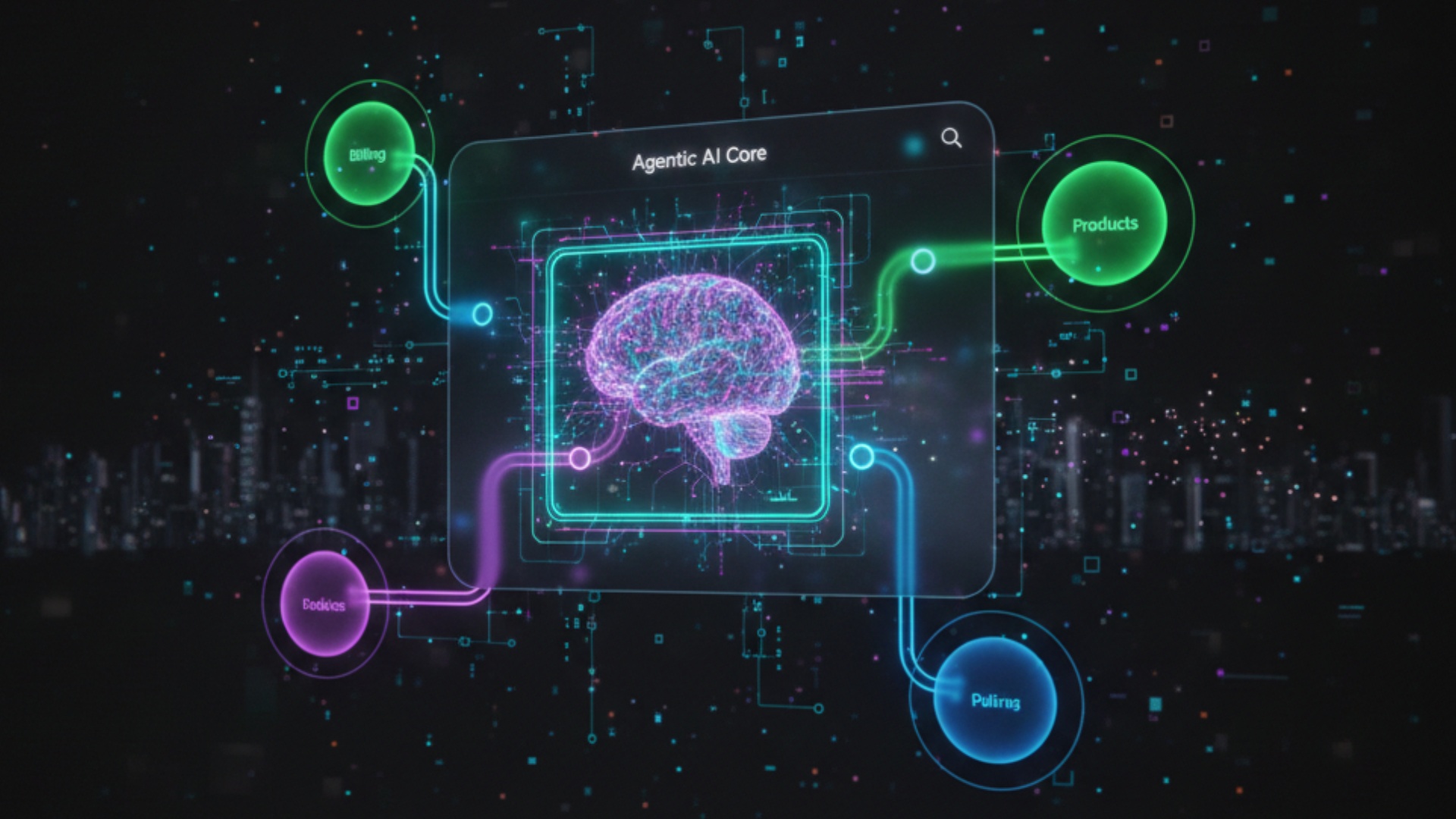
We developed a multi-agent AI platform for a large financial enterprise to deliver intelligent, context-aware customer support. Each agent specializes in domains like billing, products, and policies, reasoning across systems to provide accurate answers and actionable guidance. Built with Python, LLMs, RAG, and vector databases, the solution reduces support load while enabling scalable AI-driven customer journeys.
The Challenge
A large enterprise wanted to move beyond traditional chatbots on its B2C customer portal. The goal was not just FAQ-style automation, but a system that:
- understands customer context,
- reasons across multiple business domains (billing, products, processes, policies),
- can explain complex situations in plain language, and
- supports customers in completing real tasks, not just answering generic questions.
The existing landscape consisted of:
- fragmented backend systems,
- complex product and pricing logic,
- policy and contract documents,
- customer data in operational databases.
The challenge was to build an AI layer that could coordinate knowledge from multiple domains and expose it in a safe, scalable, customer-facing way.
Our Solution
We designed and implemented an Agentic AI platform based on a multi-agent architecture using modern AI and data engineering components.
Core Architecture
- Agentic framework: Google ADK (Agentic Development Kit)
- Backend services & orchestration: Python-based microservices
- AI stack: LLMs, RAG, embeddings, vector databases
- Data integration: enterprise databases, documents, product and policy sources
Each AI agent was specialised for a business domain (e.g. billing, products, policies, processes). Agents were trained and grounded using:
- internal documents,
- structured database metadata,
- domain-specific knowledge extracted via Python-based data pipelines.
Agents could collaborate, delegate tasks, and combine results before generating a final response.
Key B2C Use Cases Implemented
1. Smart Self-Service Assistant
Customers can ask free-form questions such as:
- “Why is my bill higher this month?”
- “What is the status of my request?”
Multiple domain agents (billing, product, support) analyse the context, retrieve relevant data via RAG, and produce a unified, customer-friendly explanation.
2. Personalised Product & Offer Advisor
Agents analyse:
- customer profile and usage patterns,
- product rules and eligibility constraints,
- current portfolio.
They generate context-aware recommendations instead of static rule-based suggestions.
3. End-to-End Case Explanation
For ongoing requests (e.g. applications, changes), the system explains:
- current process step,
- which systems are involved,
- expected next steps and timelines.
Backend workflow states are translated into human-readable narratives using LLM agents.
4. Billing & Transaction Breakdown
Customers can ask for explanations of specific charges or transactions. The system connects:
- transaction data,
- tariff logic,
- product configuration,
- policy rules,
and generates a clear breakdown using coordinated domain agents.
Technical Implementation Highlights
- Python-based AI services orchestrating agent workflows and tool usage
- Multi-agent coordination using Google ADK
- RAG pipelines built with embeddings and vector search
- Integration with structured data via secure data access layers
- Prompt engineering, schema-constrained outputs and guardrails for safe customer-facing responses
- Evaluation of agent performance (accuracy, grounding, hallucination control)
The Result
The organisation moved from a simple chatbot model to an agentic, domain-aware AI layer that:
- provides more accurate and contextual customer answers,
- reduces load on human support,
- increases transparency of complex processes,
- and creates a scalable foundation for future AI-powered customer journeys.
< Technologies Used >


< Screenshots >