
AI-Supported Impact Analysis and Documentation Intelligence
For a technology firm in financial services, we built an AI-driven platform to understand how changes affect reports, systems, processes, and documentation. Using Python, Databricks, Spark, and LLM-powered RAG, all internal documentation and databases were unified into a connected knowledge graph. Teams can now ask natural-language questions, perform faster impact analysis, and reduce operational and regulatory risk.
The Challenge
In a complex financial environment, even small changes — a modified data field, a system upgrade, a regulatory requirement — can have wide-ranging effects:
- reports,
- downstream systems,
- business processes,
- documentation.
However, the connections between these elements were buried across:
- internal documentation platforms,
- PDFs and policy documents,
- Excel files,
- enterprise database structures.
Impact analysis was largely manual, slow and incomplete, creating operational risk and delaying projects.
Our Solution
We developed an AI-driven documentation intelligence and impact analysis platform that allows teams to understand how changes propagate across the organisation.
1. Unified knowledge ingestion
We integrated unstructured and structured sources:
- internal documentation (HTML),
- PDFs,
- Excel-based definitions,
- database schemas and metadata.
All sources were aligned into a common representation using scalable data pipelines (Databricks, Spark).
2. AI-driven understanding of enterprise knowledge
Using LLM-based agents and RAG:
- the system learned the meaning of business terms and technical fields,
- identified entities and mapped them to domains,
- discovered relationships between documentation, systems and data structures.
This created a connected knowledge graph of the organisation’s landscape.
3. Conversational access and impact analysis
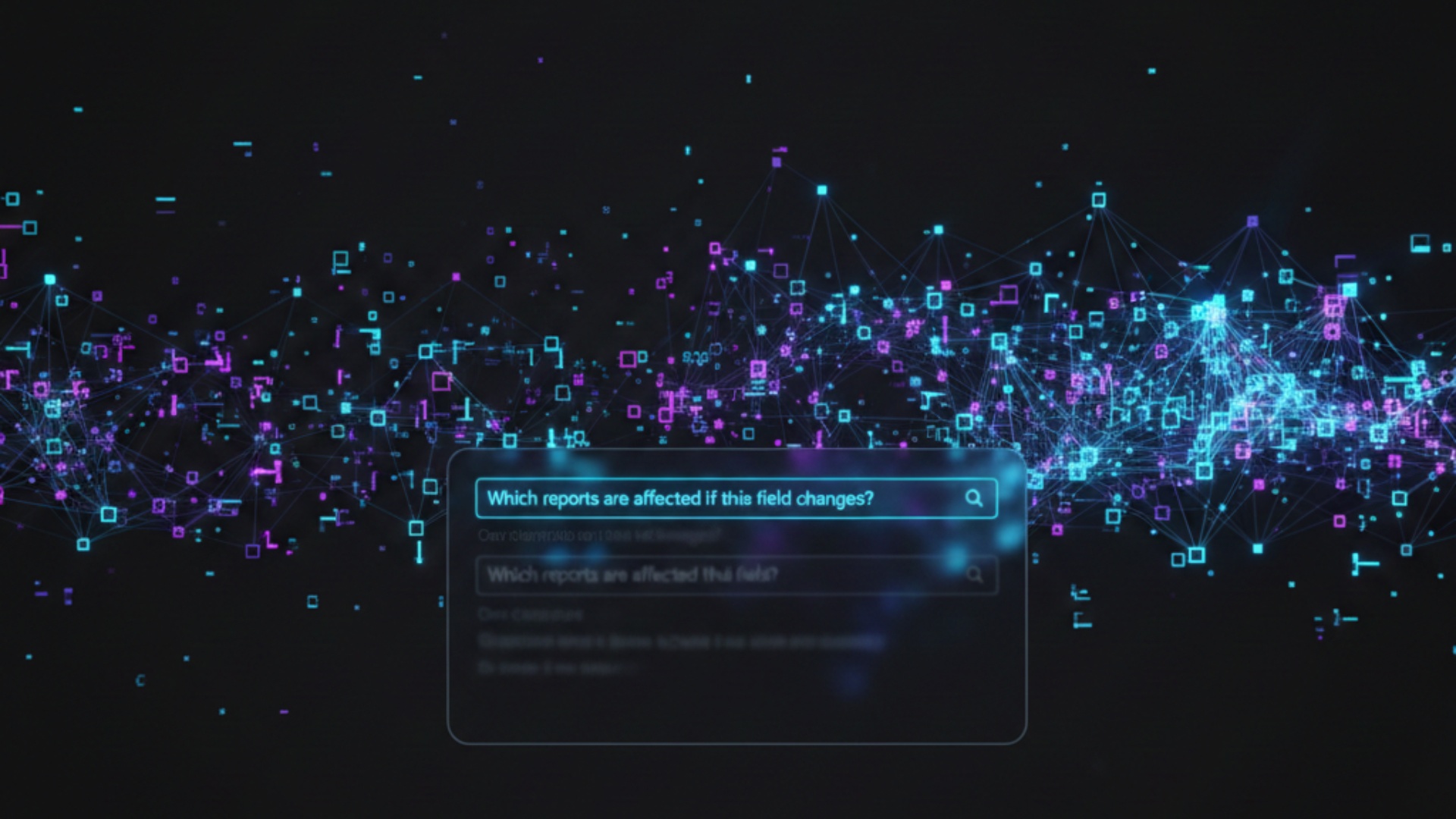
On top of this model, we enabled natural-language interaction, such as:
- “Which reports are affected if this field changes?”
- “Which systems and processes depend on this product?”
- “Which documents need to be updated for this regulatory change?”
The AI could trace relationships across systems, documents and data, supporting faster and more reliable decision-making.
The Result
The organisation achieved:
- faster and more reliable impact analysis,
- improved alignment between documentation, systems and data,
- reduced operational and regulatory risk,
- a scalable foundation for future AI use cases built on internal knowledge.
< Technologies Used >



< Screenshots >