
< RESOURCES / >
A Tech Leader's Guide to Nearshore Development

Nearshore development is more than a buzzword; it's a strategic approach to extending your engineering team. Let's break down what it means in practice and how it directly impacts business outcomes like time-to-market and cost-efficiency.
What Is Nearshore Development and Why It Matters
At its core, nearshore development involves partnering with a software team in a nearby country, one that shares a similar or identical time zone. This isn't traditional outsourcing to a distant location; it's about creating a cohesive, extended team that operates on the same daily rhythm.
The critical advantage is the minimal time zone difference. This seemingly small detail fundamentally changes how teams collaborate.
Imagine your team in Berlin working with developers in Budapest. An urgent question gets answered on a quick call, not in a day-late email. Daily stand-ups are simple to schedule and genuinely productive. This real-time collaboration is the key differentiator from traditional offshoring, enabling agile methodologies to function as intended.
For tech leaders, this model provides a way to access a rich pool of specialized talent and scale engineering capacity without the communication delays and project friction that often plague globally distributed teams. It's a strategic move to accelerate development while maintaining control and quality.
The Business Impact of Real-Time Collaboration
The true value of nearshore development is most evident in agile environments. When teams operate on a similar schedule, the feedback loop—from development to QA and product management—becomes incredibly tight.
This has a direct and measurable impact on the business:
- Faster Time-to-Market: Problems are identified and solved within hours, not days. Removing these communication bottlenecks allows you to ship features faster, react to market changes, and generate revenue sooner.
- Improved Code Quality: Clear, consistent communication reduces misunderstandings, leading to fewer bugs and less rework. This translates directly to a more robust product and lower long-term maintenance costs.
- Lower Management Overhead: Project managers spend less time coordinating across time zones and more time driving strategic initiatives. This efficiency gain lowers the total cost of ownership (TCO) for your projects.
- A Genuinely Integrated Team: Shared cultural context and a similar work-day rhythm make it easier to build a single, cohesive team. This "one team" culture is vital for complex projects where deep alignment with business goals is necessary.
Sidestepping Global Risks
Beyond daily workflow, a nearshore setup is an effective risk management strategy. Partnering in a stable, nearby country helps mitigate geopolitical, logistical, and legal risks that can disrupt offshore projects.
For European companies, this is particularly relevant. Engaging a partner within the EU, such as in Hungary, provides a built-in layer of legal and regulatory alignment. This simplifies compliance with complex regulations like GDPR and PSD2, reducing both administrative burden and legal risk.
Ultimately, nearshore development is a strategic choice for leaders who need to balance speed, quality, and cost. It offers the financial benefits of an external partner with the collaborative efficiency of an in-house team.
Ready to see how a nearshore team can accelerate your roadmap?
Schedule a Consultation with Our Experts
Choosing Your Model: Onshore, Nearshore, and Offshore
The decision between onshore, nearshore, and offshore models is a strategic choice that impacts your budget, project velocity, and final product quality. Each approach presents a different set of trade-offs, and the right choice aligns your development strategy with your core business objectives.
The decision balances three key variables: cost, communication, and control. While offshore models may offer the lowest hourly rates, experienced leaders evaluate the Total Cost of Ownership (TCO). This includes hidden costs like increased management overhead, rework due to miscommunication, and travel expenses for essential meetings.
This decision tree offers a clear starting point, focusing on the need for real-time team collaboration.
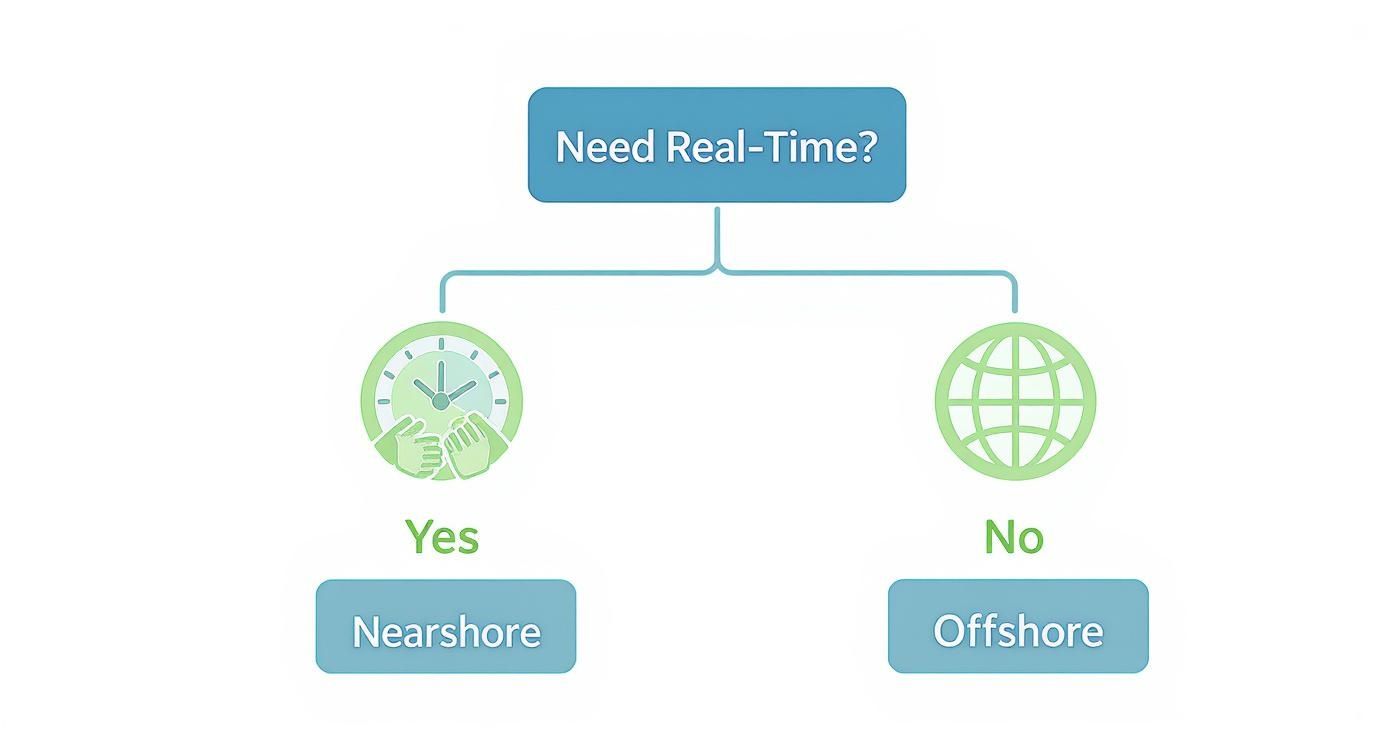
If your project relies on Agile principles and requires a constant feedback loop, a nearshore partner is almost always the most effective path.
A Practical Comparison of Development Models
Let's compare how each model performs against key business metrics. The optimal choice depends on your project's specific requirements, your company culture, and your risk tolerance. An onshore team offers maximum control at the highest cost. Offshore can provide significant cost savings but often introduces communication and agility challenges.
This is where nearshore development offers a strategic balance. It combines cost-efficiency with the high-bandwidth collaboration required for complex, fast-moving projects. For broader context on global strategies, this overview of software engineering outsourcing is a useful resource.
The primary advantage of nearshore is synchronicity. When your extended team operates on the same schedule, you eliminate the communication lag that can stall offshore projects. This enables the real-time problem-solving that is non-negotiable for keeping Agile sprints on track.
This table compares the models across factors that have the greatest business impact.
Onshore vs Nearshore vs Offshore: A Business Impact Comparison
FactorOnshore DevelopmentNearshore DevelopmentOffshore DevelopmentCostHighestModerateLowestCommunicationSeamlessHigh (Same/similar time zones)Challenging (Significant time zones)CollaborationReal-time, in-personReal-time, remoteAsynchronousCultural AlignmentHigh (Shared culture)High (Similar cultural context)Low (Potential for friction)Talent PoolLimited to local marketExpanded regional accessVast global accessCompliance RiskLow (Shared legal framework)Low (Often shared legal framework)High (Varying regulations)
This comparison highlights that while cost is a major driver, it is only one component of the overall value equation.
Key Factors for Your Decision
As you evaluate your options, focus on these critical factors:
- Communication Efficiency: How essential is real-time collaboration? An eight-hour time difference can turn a five-minute question into a 24-hour delay. Nearshore’s time zone alignment makes daily stand-ups, pair programming, and quick check-ins seamless.
- Talent Accessibility: Can you find engineers with the necessary skills in your local market? Nearshore and offshore models provide access to a global talent pool, often with deep pockets of specialized expertise.
- Total Project Cost: Look beyond the hourly rate. Factor in management time, travel for key meetings, and the potential budget impact of rework caused by communication or cultural gaps.
- Risk and Compliance: For a fintech or health-tech company in the EU, working with a nearshore partner in a country like Hungary dramatically simplifies GDPR and PSD2 compliance, reducing legal risk. For a deeper analysis, our guide on hiring vs outsourcing offers valuable perspectives.
The True Financial Case for Nearshore Development
Focusing solely on hourly rates is a common pitfall when selecting a development partner. A lower rate does not guarantee a lower final project cost. The complete financial picture emerges when you analyze the Total Cost of Ownership (TCO) and Return on Investment (ROI).
This is where nearshore development provides a compelling financial argument. While hourly rates may be higher than those in some offshore locations, the final project cost is often significantly lower due to operational efficiencies that directly benefit your budget.
Beyond the Hourly Rate: The TCO Advantage
To get an accurate financial assessment, you must account for the hidden costs that can inflate a project's budget. Nearshore models are structured to minimize these variables.
Here’s where you’ll find the key financial benefits:
- Reduced Rework Costs: Seamless, real-time communication within similar time zones minimizes misunderstandings. This leads to higher-quality code from the start, reducing the need for expensive and time-consuming fixes later.
- Lower Management Overhead: Your project managers can focus on driving the project forward instead of wrestling with scheduling conflicts. This efficiency gain directly reduces your internal management costs.
- Minimal Travel Expenses: While occasional in-person visits are valuable, frequent and costly long-haul flights are unnecessary. With a nearshore partner, short trips are often sufficient, keeping travel budgets in check.
- Faster Time-to-Market: Agile development thrives on rapid feedback loops. A nearshore team operating on your schedule accelerates the entire process, allowing you to launch products and begin generating revenue sooner.
Faster development has an immediate business impact. You're not just saving on development costs; you're capturing market share and revenue that would otherwise be lost to delays. This velocity is a crucial component of nearshore's superior ROI.
A Case Study in Smart Economics: Hungary
Central and Eastern Europe, particularly Hungary, provides a clear example of this financial model. The region offers an excellent balance of highly skilled engineers and competitive operational costs. This allows for significant financial upside without the quality compromises associated with pure cost-cutting strategies.
Developers in Hungary typically charge between $40 and $70 per hour. Even at this rate, wage differences of up to 30% can exist compared to Western European countries like Germany, enabling substantial savings while accessing top-tier talent. You can read more about these market dynamics in our analysis of Hungary's software development industry growth.
This creates a clear, CFO-ready business case: access to a deep pool of senior, EU-based talent, meaningful cost efficiencies, and a partner operating under the same regulatory framework. It's a strategic financial move that optimizes for both cost and value.
The financial argument for nearshore development is ultimately about efficiency. By reducing the friction, delays, and hidden costs associated with significant time zone and cultural gaps, you achieve a more predictable budget and a stronger ROI.
Ready to build a stronger financial case for your next project?
Request a Proposal from Our EU-Based Team
Navigating Fintech Compliance and Risk in the EU
For fintech companies, compliance is not just a regulatory hurdle; it is the foundation of the business. This makes choosing the right nearshore development partner a critical risk management decision. Selecting a team within the same regulatory environment, such as the EU, can transform compliance from a burden into a competitive advantage.
When your development partner operates under the same legal framework, you mitigate significant data-related challenges. This alignment reduces the risk of non-compliance fines, which can reach up to 4% of global annual turnover under GDPR.

The EU Regulatory Advantage
Working with a nearshore team in an EU country like Hungary means they operate under the same regulations your business does. This shared legal context offers immediate, practical benefits:
- Simplified GDPR Compliance: Regulations around data residency and cross-border data transfers are streamlined. When data is processed within the EU, you avoid complex legal arrangements, reducing both risk and administrative overhead.
- PSD2 and Open Banking Cohesion: A partner who understands PSD2's requirements for Strong Customer Authentication (SCA) and secure APIs is invaluable. They know the technical standards, ensuring integrations are built correctly and compliantly from the start.
- Smoother Security Audits: Onboarding a partner who already adheres to EU security and privacy standards simplifies internal and third-party audits. Their processes are designed to meet the same stringent requirements you face. For a technical breakdown, see our PSD2 integration guide for CTOs.
From Compliance Burden to Business Enabler
Viewing your nearshore partner through a compliance lens reframes their role. They become an asset that strengthens your regulatory posture, not just a team that builds features. This is a crucial perspective for CTOs and Chief Product Officers accountable for product integrity.
Choosing an EU-based nearshore partner means you can focus on building innovative products, confident that the compliance foundation is already secure.
This alignment directly impacts your bottom line. Building a compliant product from day one reduces the risk of costly re-architecting later on. It also accelerates your time-to-market by removing compliance roadblocks that often emerge late in the development cycle. A partner who speaks your regulatory language helps you build trust with both users and regulators.
Why Central and Eastern Europe Became a Nearshore Powerhouse
While cost savings are a factor, the primary reason tech leaders choose Central and Eastern Europe (CEE) for nearshore development is strategic access to world-class engineering talent. The region has built a reputation for technical excellence, making it a destination for companies that need specialized skills to innovate and compete.
This is the result of long-term investment in high-quality STEM education, consistently producing a large pool of qualified software engineers. CEE countries, with hubs like Hungary at the forefront, offer more than just affordable rates; they provide deep technical expertise.
More Than Just Coders—A Hub of Technical Mastery
The talent in CEE is distinguished by its quality and specialization. These professionals are often experts in high-demand fields that are difficult and expensive to hire for in Western Europe or North America.
Tapping into this ecosystem provides a distinct business advantage. It allows you to scale your team with genuine experts who can accelerate your product roadmap, not just fill seats. The talent pipeline is robust, supported by vibrant local tech communities and a growing number of innovation hubs.
What the CEE Advantage Looks Like for Your Business
Partnering with a CEE-based team provides direct access to several key benefits that impact your budget and launch timelines:
- Cutting-Edge Skill Sets: CEE is a center of excellence for skills like AI/ML, cloud infrastructure (AWS, Azure, GCP), and complex data engineering. This means you can build sophisticated products without getting bogged down in a difficult local hiring market.
- Smooth Cultural and Professional Alignment: Engineers in the region share a professional work ethic and communication style that aligns well with Western business practices. This cultural compatibility reduces friction and fosters a truly integrated team.
- A Growing, Ambitious Talent Pool: The CEE tech scene is dynamic and expanding. You are tapping into a market of driven professionals eager to work on challenging projects, bringing fresh perspectives and high motivation to your team.
This combination of talent, ambition, and alignment is fueling significant growth. The European IT service outsourcing market is projected to reach $282,149.2 million by 2030, with a substantial portion driven by the recognition of CEE's capabilities. You can explore Eastern Europe's role in the nearshore market on avenga.com.
Choosing a nearshore partner in a hub like Hungary is a strategic investment in quality. It provides the ability to execute complex projects with top-tier talent that might otherwise be out of reach, giving you a powerful competitive edge.
The rise of CEE as a nearshoring leader is about delivering exceptional value, not just cutting costs. It offers a smart, sustainable way for companies to build high-performing, scalable engineering teams.
Ready to access Europe’s top engineering talent?
Book a Call with Our Budapest-Based Experts
How to Select and Integrate Your Nearshore Partner

Selecting the right partner is the most critical decision in your nearshore development strategy. A good fit leads to accelerated development and high-quality outcomes. A poor fit results in friction, delays, and budget overruns. The goal is to build a genuine extension of your team, not just to hire external developers.
A systematic evaluation process is essential to find a partner that aligns with your technical requirements, operational cadence, and company culture.
A Practical Vetting Checklist
Move beyond sales presentations and evaluate potential partners on tangible evidence of their capabilities. A proven playbook for hiring remote developers can provide a solid framework for your evaluation process.
Your checklist should cover these core areas:
- Technical Depth Assessment: Ask for anonymized code samples or, ideally, conduct a live pair-programming session. Observing how their engineers solve a relevant problem provides direct insight into their technical skills and problem-solving approach.
- Agile Maturity and Process Alignment: Understand their workflow. Ask them to detail how they manage sprints, handle scope changes, and report progress to ensure their process can integrate smoothly with yours.
- Communication Protocols and Proficiency: Verify the English proficiency of the entire team, not just the account manager. Align on communication tools (e.g., Slack, Teams) and establish clear expectations for updates from the outset.
- Reference Checks with a Focus on Outcomes: Speak with their current and former clients. Ask specific questions: How did the partner handle unexpected challenges? How did they contribute to achieving specific business goals?
Onboarding for a Unified Team Culture
Once a partner is selected, the integration process begins. The goal is to eliminate any "us vs. them" mentality and foster a single, cohesive team. A well-structured onboarding plan is crucial for building this "one team" culture. Our guide to team augmentation offers more strategies for a smooth integration.
Effective onboarding is about more than just granting system access. It's about aligning everyone on the mission, establishing clear communication channels, and building the professional relationships that enable effective collaboration.
A structured plan should include:
- Run a Comprehensive Kickoff Session: Bring both teams together to review the project vision, business goals, and key milestones. Introduce every team member and clarify their roles.
- Establish Shared Tooling and Access: Provide immediate access to your complete toolset, including version control (e.g., Git), project management (e.g., Jira), and primary communication platforms.
- Define and Document Communication Rhythms: Schedule all recurring meetings—daily stand-ups, sprint planning, retrospectives—from day one. Ensure everyone understands the purpose and desired outcome of each meeting.
- Assign an Internal "Buddy" or Mentor: Pair each nearshore team member with someone from your in-house team to help them navigate internal processes and informal company culture.
Leveraging Local Expertise
Partners in tech hubs like Hungary offer more than just development capacity; they provide deep, specialized expertise. The Hungarian ICT market is projected to reach USD 60.41 billion by 2030, driven by a strong talent pool skilled in Python, AWS, Kubernetes, and React. Tapping into this ecosystem gives you a strategic advantage in building a high-performing team.
Ready to find a nearshore partner that acts like a true part of your team?
Book a Call to Discuss Your Project
Your Nearshore Development Questions, Answered
Here are answers to common questions that tech and product leaders ask when considering a nearshore strategy, based on practical experience.
What Are the Biggest Hidden Costs We Should Watch Out For?
The most significant hidden costs almost always stem from a poor partner selection. These costs manifest as excess management time spent resolving workflow issues, lost productivity due to communication barriers, and budget consumed by reworking low-quality code.
A thorough vetting process is the best way to mitigate these risks. Invest time upfront to assess technical skills, agile maturity, and communication proficiency. Selecting the right partner from the start will save significant time and money, providing a much clearer picture of your total cost of ownership.
How Do We Actually Make a Nearshore Team Feel Part of Our Company?
Integration begins during the selection process by assessing cultural and process fit. Once you've chosen a partner, the key is to treat their developers as you would your own employees.
This means including them in all relevant Slack channels and email distributions, using video during calls to build rapport, and ensuring everyone is aligned on the same project goals. A good partner will also be proactive in integrating their team into your operational rhythm.
Is Nearshoring Just for Big Companies?
Not at all. While large enterprises use nearshoring for scale, it is also highly advantageous for startups and mid-sized businesses. For these companies, nearshoring often provides access to senior-level talent that may be unavailable or unaffordable in their local market.
This allows smaller companies to accelerate development and enhance their technical capabilities without the high overhead of a large in-house team. The flexibility of the nearshore model is a powerful tool for businesses that need to move quickly and compete effectively.
The key benefit of nearshoring for smaller companies is that it enables them to access specialized skills that drive innovation and accelerate time-to-market, effectively leveling the playing field.
Ready to accelerate your product roadmap with a dedicated, EU-based engineering team? SCALER Software Solutions Ltd provides the senior talent and project leadership to move your critical initiatives from concept to production quickly.
< MORE RESOURCES / >

Fintech
A Guide to Epic Store Szeged and the Local Tech Scene

Fintech
A Guide to Designing a Nordic Light Office for Technical Teams

Fintech
A Tech Employer's Guide to Hungary's Social Security System

Fintech
How to Choose an IT Company That Drives Business Outcomes

Fintech
A Consultant's Guide to Part-Time Jobs in Budapest

Fintech
A Consultant's Guide to Peppol Integration for E-Invoicing

Fintech
PSD2 Integration for CTOs: Real-World Challenges and Architecture Insights

Team augmentation
Hiring vs. Outsourcing: Finding the Right Balance with Team Augmentation

Fintech
Implementing Payment Integration in Fintech: Challenges and Architectural Insights

Team augmentation