
< RESOURCES / >
A Consultant's Guide to Peppol Integration for E-Invoicing

Dealing with B2B document exchange can be a significant operational drag. Supporting ten different partners often means building and maintaining ten different point-to-point integrations, each with unique technical requirements and costs. This approach is slow, expensive, and fails to scale as your business grows.
A Peppol integration offers a strategic solution to this complexity. It functions as a universal adapter for your business systems. By connecting to the global Peppol network once, you gain the ability to exchange e-invoices, purchase orders, and other critical documents with any other member. This eliminates the need for custom builds for each trading partner, directly reducing time-to-market and development costs.
The Framework That Just Works
Peppol does not replace your ERP or accounting software. Instead, it provides a secure, standardized transport layer that works with your existing systems. It establishes a common technical language and a shared network for all participants.
This is why governments and businesses are adopting it. Over 1.4 million organizations across 98 countries are already connected, and adoption is accelerating. The business case is straightforward:
- Reduce Operational Costs: Automating document processing eliminates the errors and labor associated with manual data entry, leading to tangible cost savings.
- Accelerate Partner Onboarding: Connecting to a new customer or supplier becomes a simple configuration task, not a multi-month IT project.
- Ensure Future Compliance: As more countries mandate e-invoicing, a Peppol-ready infrastructure ensures you meet global standards, reducing compliance risk.
Before diving into the technical details, it's useful to understand how business system integration drives growth at a strategic level. Peppol is a powerful tool for achieving broader business objectives.
Understanding the Four-Corner Model
Peppol’s efficiency comes from its "four-corner model" architecture. In practical terms, this means you and your trading partners never connect directly. Your respective systems communicate with certified service providers (Access Points), who manage the secure exchange over the network.
This diagram illustrates how a document moves from a sender's ERP, through their Access Point, across the Peppol network to the receiver's Access Point, and finally into the receiver's ERP.
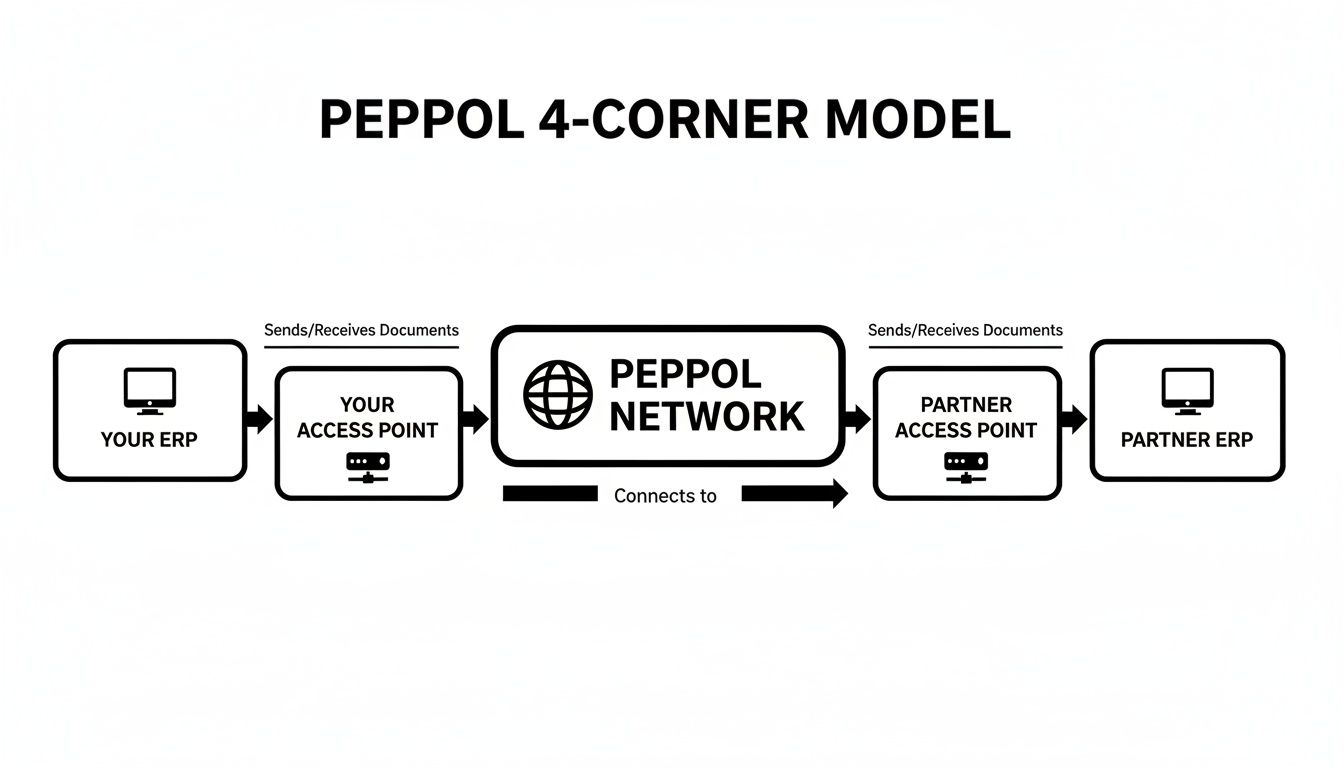
This model decouples all participants. You don't need to know what ERP or accounting software your partner uses. As long as you are both connected to the network, the exchange works seamlessly.
The Core Components of the Network
Behind this model, a few key components enable the seamless exchange. The system is analogous to the international postal service—you only need the correct address, and the system handles the routing.
Here’s a breakdown of the essential components and their impact on your business operations.
Key Peppol Components and Their Business Functions
ComponentTechnical FunctionBusiness ImpactAccess Point (AP)Your certified gateway to the Peppol network. It sends, receives, and validates all your documents.This is your single point of connection. It eliminates the need for multiple, costly point-to-point integrations, reducing total cost of ownership (TCO).Service Metadata Publisher (SMP)A digital address book that lists what document types a participant can receive and their AP's address.Ensures your invoices are sent to the right destination and can be processed correctly, accelerating payment cycles and reducing errors.Service Metadata Locator (SML)The single, central directory for the entire Peppol network. It tells your AP where to find the correct SMP for your partner.Provides the core "discoverability" function of the network, making it possible to find and transact with any participant globally, which speeds up partner onboarding.
This layered architecture is what delivers Peppol's "connect once, reach all" capability.
For instance, consider Hungary's digital tax compliance journey with its real-time invoice reporting (RTIR) system. While Peppol isn't fully mandatory yet, Hungary is an OpenPeppol member and is actively integrating the network into its strategy. This signals a clear trend: adopting Peppol is about future-proofing your business for evolving compliance landscapes.
Navigating Your Peppol Integration Path
Moving from the 'what' and 'why' to the 'how' of Peppol requires careful planning. A successful Peppol integration is a technical project where key decisions directly impact operational efficiency, cost, and the long-term ROI of the network.

This section provides technical and product leaders with practical guidance on the critical decision points, from selecting an Access Point strategy to the specifics of data mapping, helping you avoid common implementation pitfalls.
The Build vs. Buy Access Point Decision
Your first major technical decision is how to connect to the Peppol network. This comes down to a classic build-versus-buy choice for your Peppol Access Point (AP). While building your own is technically possible, it is a resource-intensive undertaking that is only practical for a very small number of organizations.
For over 99% of businesses, partnering with a certified Peppol Access Point provider is the most logical path. The rationale is clear: building an AP from scratch involves a lengthy and expensive certification process with OpenPeppol. It also commits your engineering team to the ongoing maintenance, security updates, and compliance with evolving specifications.
Choosing a provider allows you to bypass these complexities. Your team can focus on the core business logic of integrating your ERP and workflows, while the provider manages the specialized Peppol infrastructure. This approach significantly reduces both upfront costs and time-to-market.
Understanding the AS4 Protocol and Security
Peppol's security and reliability are built on the AS4 (Applicability Statement 4) messaging protocol. AS4 acts as a secure transport mechanism, guaranteeing the integrity and authenticity of your documents from end to end.
AS4 provides several features essential for B2B document exchange:
- Message-Level Security: It uses digital signatures and encryption to verify that a document has not been altered in transit and can only be read by the intended recipient.
- Non-Repudiation: The protocol offers verifiable proof that a specific message was sent by the sender and received by the recipient, which is critical for audits and dispute resolution.
- Reliability: AS4 includes built-in mechanisms to confirm message delivery, ensuring critical documents are not lost in transit.
The security model is underpinned by a Public Key Infrastructure (PKI). Every Access Point must have a valid PKI certificate from a trusted authority. This certificate enables secure identification on the network and encryption of all data, preventing man-in-the-middle attacks. Managing certificate lifecycles is a critical operational task, typically handled by your provider.
The Core Challenge: Data Mapping and Transformation
The most practical and often time-consuming part of any Peppol integration is data mapping. The Peppol network is agnostic to your internal data formats. Whether your systems generate SAP IDocs, custom XML, JSON, or CSVs, you must transform that data into a standardized Peppol BIS (Business Interoperability Specification) format.
For e-invoicing, the required standard is Peppol BIS Billing 3.0. This specification dictates the exact fields and structure for an invoice in UBL (Universal Business Language) XML.
The core work of a Peppol integration lies not in the network connection itself, but in the meticulous mapping of your internal data fields to the rigid structure of the Peppol BIS format. A single error in a tax code or unit price can lead to document rejection and subsequent payment delays.
This transformation layer is where your development team will focus its efforts. For example, your ERP might store a customer address as a single string, but Peppol BIS 3.0 requires it to be broken into discrete elements like StreetName, CityName, PostalZone, and Country. Your integration logic must perform this conversion accurately every time. This type of detailed data work is common in regulated exchanges; our guide on open banking integration in practice covers similar challenges.
To accelerate this process, teams often use mapping tools, integration platforms (iPaaS), or libraries that support UBL and Peppol SDKs. These tools can save hundreds of developer hours compared to building XML parsers from scratch. The objective is to create a repeatable, robust, and auditable process that transforms your internal data into compliant Peppol documents.
Meeting Global E-Invoicing Mandates
Governments worldwide are shifting from paper and PDF invoices to structured electronic invoicing to improve VAT collection, enhance tax transparency, and digitize their economies. For businesses operating internationally, this creates a complex and evolving landscape of compliance requirements.
A Peppol integration is a strategic asset in this environment. Instead of building bespoke connections for each country's e-invoicing platform, Peppol offers a standardized "connect once, reach everyone" framework. This allows your business to address multiple national mandates through a single, unified integration, significantly reducing the cost and risk of global operations. Before proceeding, it helps to understand what an e-invoice truly is in a structured data context.
This approach transforms compliance from a fragmented, country-by-country challenge into a centralized, efficient process. It provides a genuine strategic advantage by simplifying your IT architecture and de-risking international expansion.
A Real-World Blueprint: The Hungarian Model
Hungary provides a clear example of this trend. The country has been a leader in digital tax compliance with its real-time invoice reporting (RTIR) system, also known as NAV Online Számla, which requires businesses to report invoice data to the tax authority instantly.
Hungary is now integrating Peppol into its digital infrastructure, demonstrating how the network can complement and enhance existing national systems. Businesses with a robust Peppol integration are well-positioned to adapt to these changes without requiring a major systems overhaul.
While not yet fully mandated for all sectors, Peppol is part of Hungary's clear trajectory toward broader adoption, especially for B2G transactions, and the country is an OpenPeppol member.
One Integration, Multiple Mandates
The key takeaway from the Hungarian example is that a single Peppol connection can be adapted to meet specific local requirements.
The process works as follows:
- Standardized Format: Your system generates a standard Peppol BIS 3.0 invoice.
- Localization Layer: Your Access Point provider can add country-specific data fields or manage routing to national platforms like NAV Online Számla.
- Future-Proof Compliance: As other countries—such as Germany, Belgium, or France—introduce their own mandates, you extend your existing Peppol setup rather than starting from scratch.
The strategy is to leverage a global standard to solve local compliance challenges. This enables your company to enter new markets more quickly, with lower IT costs and reduced compliance risk. This parallels challenges in other regulated sectors, such as those detailed in our analysis of PSD2 banking integration challenges and solutions.
Adopting Peppol is not merely about satisfying today's e-invoicing rules. It is an investment in scalable infrastructure that prepares your business for the next wave of digital reporting mandates, including the EU-wide ViDA initiative.
Ultimately, a Peppol integration helps shift the compliance burden, freeing up your team to focus on business growth instead of navigating a complex web of international e-invoicing regulations.
Building Your Peppol Integration Project Plan
A successful Peppol integration depends on a well-defined project plan that aligns technical teams, business stakeholders, and your selected Access Point provider. This ensures clear expectations, cost control, and timely delivery.

Treat the integration as a business initiative, not just a technology exercise. Proper planning allows you to build a strong business case, secure the necessary budget, and deliver a solution that improves operational efficiency and ensures compliance.
The Key Phases of a Peppol Project
While project specifics vary, most integrations follow a structured path. Understanding these phases helps you manage resources and expectations effectively.
- Discovery & Provider Selection (2–4 weeks): In this phase, you analyze your internal document workflows, data formats, and technology stack. The primary goal is to select a certified Peppol Access Point provider that aligns with your technical requirements and budget.
- Technical Specification & Design (1–2 weeks): After selecting a partner, your technical team collaborates with them to define the integration specifics. This includes defining API endpoints, authentication methods, and the data mapping logic for converting your internal formats to the Peppol BIS standard.
- Development & Internal Testing (4–8 weeks): This is the core engineering phase. Your developers build the connection, implement the data transformation logic, and establish error handling within a sandbox environment.
- User Acceptance Testing (UAT) (1–2 weeks): Business users from departments like finance or accounts payable test the system with real-world scenarios to validate that invoices are generated and transmitted correctly. They also verify that error messages are clear and actionable.
- Deployment & Go-Live (1 week): Following successful UAT, the integration is moved to the production environment. This involves final configurations, network registration, and close monitoring as the first live documents are exchanged.
A Transparent Look at Peppol Integration Costs
When budgeting for a Peppol integration, the provider's fees are only one component. The total cost includes both external fees and the internal resource commitment from your team. A clear understanding of these costs is essential to avoid budget overruns.
A common pitfall is underestimating the internal effort required. While the Access Point handles network complexity, your team is responsible for ensuring the data leaving your system is clean, accurate, and correctly formatted. This often represents the most significant portion of the work.
Here is a breakdown of the typical cost components:
Cost CategoryDescriptionTypical Cost StructureOne-Time Setup FeesCovers the initial onboarding, configuration, and support from your Access Point provider to get you connected.A fixed, one-time payment.Recurring SubscriptionAn ongoing fee for using the provider's infrastructure, which includes network access, maintenance, and support.A monthly or annual fee, often tiered by document volume.Internal Resource CostThe time and salary of your developers, project managers, and business analysts dedicated to the project.This is frequently the largest cost and must be factored into the business case.
Understanding these costs helps you present a comprehensive financial plan to stakeholders. Integrating complex external systems is a significant undertaking, as we have seen in various fintech projects. For a relevant case study, see our work on payment provider integration for a financial services platform.
With a detailed plan and a transparent budget, your Peppol project is positioned for success, transforming a compliance requirement into a tangible operational improvement.
Maintaining Your Integration: Monitoring and Future-Proofing
Deploying your Peppol integration is the first step, not the final destination. The objective now shifts from project delivery to proactive operational management. A reliable system is one that functions consistently without constant intervention. This requires robust monitoring, efficient error handling, and a forward-looking strategy to stay ahead of evolving requirements.
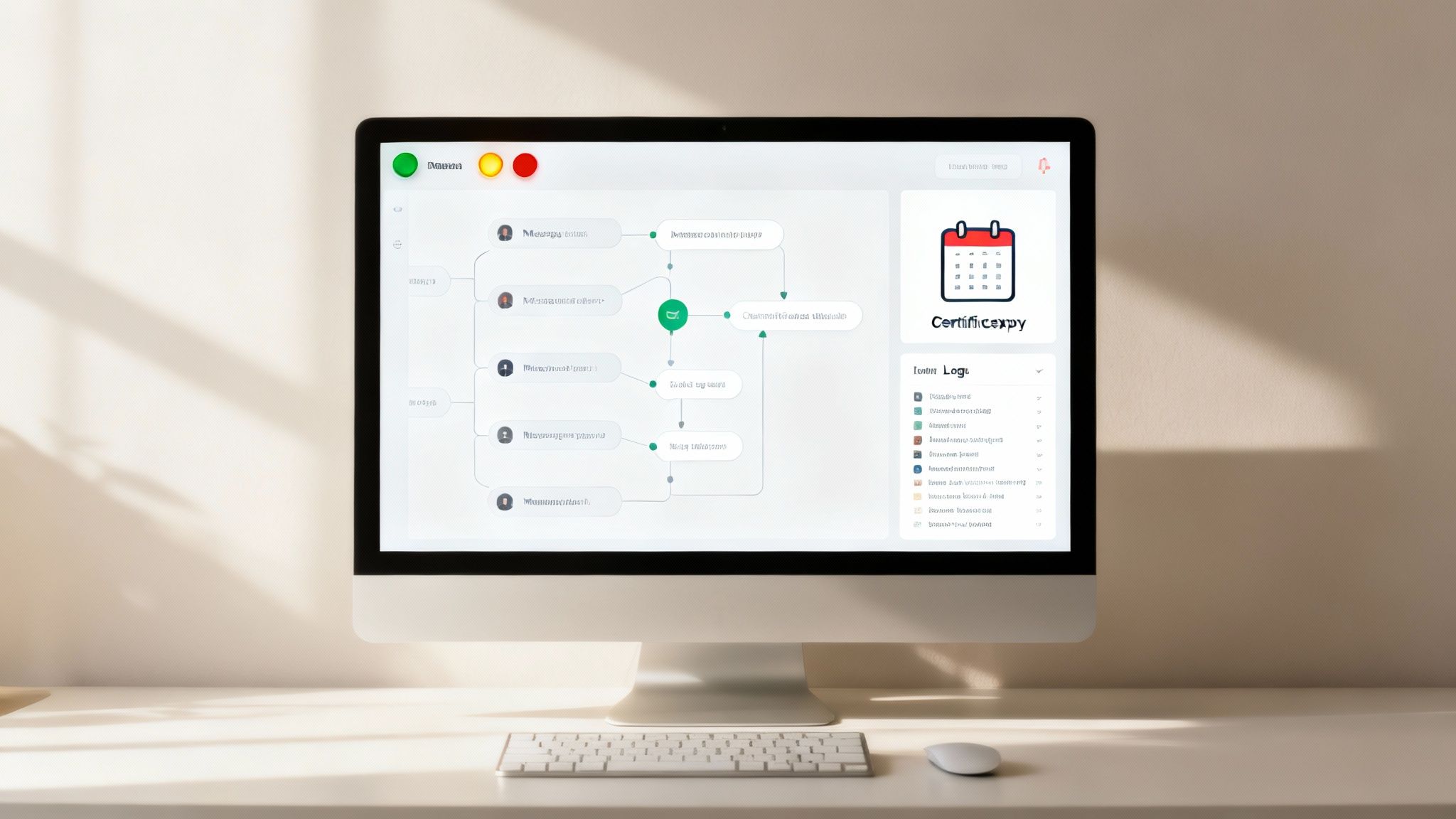
Adopting Peppol is more than solving a current invoicing problem; it’s about building a scalable foundation for future digital tax and reporting mandates. A well-monitored system ensures this investment continues to deliver value over the long term.
Establish Your Monitoring and Error Handling Processes
Once documents are being exchanged, you cannot operate without visibility. A single failed invoice delivery is not just a technical issue; it's a direct impact on your cash flow. Effective monitoring is about getting the right alerts to the right people as soon as an issue occurs.
Your monitoring strategy must provide clear answers to critical business questions:
- Was the document delivered? Did the invoice successfully reach our partner's Access Point?
- If not, what was the root cause? Was it a network issue, a data validation error, or a problem on the recipient's end?
- Are we seeing negative trends? What is our average processing time? Is there a spike in failures that indicates a systemic problem?
A reputable Access Point provider will offer a portal or API for this visibility. However, the technology is only part of the solution. Your internal teams—whether finance or IT—need a clear, documented process for handling exceptions. For example, a validation error (e.g., an incorrect tax ID) should trigger an alert for the accounts receivable team to correct the source data in the ERP, rather than becoming a forgotten entry in a developer's log file.
The purpose of error handling in a Peppol integration is not simply to log failures. It is to create a fast, clear feedback loop that enables business users to resolve data issues quickly, preventing payment delays from becoming a recurring problem.
Avoid Business Disruption from Certificate Expiry
The security of the Peppol network relies on PKI certificates, which have expiration dates. When your certificate expires, your Access Point is immediately disconnected from the network, and all inbound and outbound document flows will cease.
This is an entirely preventable risk.
Most certified providers will manage certificate renewals on your behalf, but it is your responsibility to confirm this is included in your service agreement. Document the renewal process and timeline. This simple administrative task is critical for ensuring business continuity.
Future-Proofing for ViDA and Beyond
The landscape of digital finance regulation is constantly evolving. The most significant upcoming change is the EU's VAT in the Digital Age (ViDA) initiative, which aims to standardize e-invoicing and digital reporting for B2B transactions across the EU. Peppol is well-positioned to serve as a core network for ViDA compliance.
This is where your Peppol integration transitions from a tactical tool to a strategic asset. By building on Peppol now, you are aligning your business with the technical framework that will likely underpin mandatory pan-European e-invoicing.
Hungary’s roadmap is again illustrative. The country's post-2025 plans for Peppol focus on enabling seamless cross-border e-invoicing, designed to align with EU ViDA standards. While Peppol is not yet fully integrated with the national RTIR system, it is a key component of the national VAT reform strategy. You can learn more about Hungary’s evolving e-invoicing requirements on globalvatcompliance.com.
This forward-looking approach de-risks future compliance projects, lowers the total cost of ownership of your financial IT systems, and positions your business to operate efficiently within a unified European digital market.
Frequently Asked Questions on Peppol Integration
Even with thorough planning, questions often arise during an integration project. Here are answers to some of the most common queries from technical and product teams to help you navigate the process.
How Long Does a Peppol Integration Typically Take?
While timelines vary, a realistic estimate for a well-defined project with clean data and accessible internal systems is 8 to 12 weeks. This includes provider selection, design, development, testing, and deployment.
However, several factors can extend this timeline:
- Complex Data Mapping: Integrating with legacy ERPs or multiple custom systems will increase the time spent on data transformation.
- Large-Scale Partner Onboarding: Onboarding a large number of partners simultaneously adds significant communication and testing overhead.
- Limited Internal Resources: The project can stall if key personnel from your development or finance teams are diverted to other priorities.
Is Peppol Only for E-Invoicing?
No. While e-invoicing is the most common use case, the Peppol network is designed for a wide range of business documents. It is governed by a suite of Business Interoperability Specifications (BIS) that standardize various formats.
Once connected, you can exchange:
- Purchase Orders
- Order Confirmations
- Advance Shipping Notices
- Credit Notes
Using Peppol for your entire procure-to-pay (P2P) cycle creates a highly automated workflow, reducing manual intervention and improving data accuracy from the initial order to the final payment.
Do We Need a Different Peppol ID for Each Country?
No, and this is a key advantage for international businesses. A Peppol Participant Identifier is globally unique. Once you are registered on the network through an Access Point, that single ID allows you to transact with any other participant on the network, regardless of their location.
Your Peppol ID functions as a universal business address. You use the same identifier to transact with a supplier in Germany, a customer in Singapore, or a government agency in Australia. This "connect once, reach everyone" model is fundamental to reducing the complexity of cross-border IT operations.
This global reach makes a single Peppol integration a highly strategic investment. It provides a scalable foundation for managing the growing number of e-invoicing mandates worldwide without building new connections for each country.
A successful Peppol integration requires both deep engineering expertise and a clear understanding of business objectives. At SCALER Software Solutions Ltd, our senior engineers specialize in building secure, high-performance integrations for fintechs and enterprises. If you require a partner who can accelerate your project and ensure it delivers measurable business value, we should talk.
< MORE RESOURCES / >

Fintech
A Guide to Epic Store Szeged and the Local Tech Scene

Fintech
A Guide to Designing a Nordic Light Office for Technical Teams

Fintech
A Tech Employer's Guide to Hungary's Social Security System

Fintech
How to Choose an IT Company That Drives Business Outcomes

Fintech
A Consultant's Guide to Part-Time Jobs in Budapest

Fintech
A Tech Leader's Guide to Nearshore Development

Fintech
PSD2 Integration for CTOs: Real-World Challenges and Architecture Insights

Team augmentation
Hiring vs. Outsourcing: Finding the Right Balance with Team Augmentation

Fintech
Implementing Payment Integration in Fintech: Challenges and Architectural Insights

Team augmentation