
< RESOURCES / >
A Practical Guide to Lead Generation for Your Hungarian Kft

For any Hungarian Kft operating in the competitive fintech space, your lead generation strategy is the engine of your growth. This isn't about casting a wide net and hoping for the best. It's about a systematic approach to target the CTOs, product managers, and technical leads who are actively looking for the solutions you provide.
A successful lead generation kft plan isn't marketing fluff; it's about aligning every action with clear business outcomes, whether that's accelerating time-to-market or reducing the cost of acquiring your next enterprise client.
Laying the Foundation for a Robust Strategy
Before pouring money into campaigns, the first step is to define what a "qualified lead" actually means for your business. Is it a CTO booking a demo for a new PSD2 integration? A product manager downloading a whitepaper on Open Banking? This distinction is fundamental.

Without this clarity, marketing efforts inevitably drift from what the sales team needs, burning through budget and time. Defining your Ideal Customer Profile (ICP) is where it all begins.
Defining Your Ideal Prospect
Your ideal prospects are real people grappling with tangible technical and business challenges. To get their attention, you have to understand their environment.
Hungary’s ICT sector, accounting for 7% of the nation's GDP and employing over 250,000 specialists, is your primary landscape. This isn't just a statistic; it's a deep talent pool actively working on problems—from PSD2 compliance to blockchain implementation—that your solutions are built to solve.
Your strategy must be built on this local context. Tactics like developing a strategic guide for lead generation webinars can be a powerful way to demonstrate expertise and attract high-intent leads who are ready for a technical conversation.
A common mistake is focusing on top-of-funnel metrics like website traffic. The only number that truly matters is the number of qualified leads entering your sales pipeline—prospects who match your ICP and have a genuine need for your solution.
Aligning Strategy with Business Goals
Every component of your lead generation plan must tie back to a clear business objective. If it doesn't, it's a distraction.
Connect your tactics to outcomes:
- Lead Gen Tactic: Create in-depth case studies and host technical webinars that address common implementation roadblocks. This pre-qualifies leads and educates them before they speak to sales, reducing time-to-close.
- Lead Gen Tactic: Launch a targeted content campaign with SEO-optimised articles and downloadable guides. This captures prospects searching for specific compliance and integration keywords, driving revenue from a new product line.
This tight alignment ensures your lead generation kft efforts directly fuel revenue and growth, not just vanity metrics.
Choosing Your Battleground: Partners and Channels in Hungary
Deciding where to allocate your lead generation budget is a critical moment. Hungary’s market is full of potential, but a scattergun approach is a recipe for wasted investment. This is about making calculated decisions to ensure every forint spent on your lead generation kft drives measurable growth.
The first question is whether to build this capability in-house or partner with an external specialist. There is no single right answer; it depends on your Kft’s current stage, available talent, and required speed-to-market. An in-house team offers deep product knowledge but comes with significant overhead and ramp-up time. A specialised agency can provide immediate expertise and proven processes, accelerating your market entry.
How to Identify an Effective Lead Generation Partner
If you choose to outsource, the vetting process is critical. Hungary’s advertising industry is a crowded space, with a market size of €2.2 billion and over 9,800 agencies. You need to find a partner who understands the fintech world, not just a generic B2B agency.
A great partner should operate as an extension of your team, understanding not just your revenue goals but the technical realities of your product and market.
Can they discuss your tech stack, whether it's built on React, Go, or AWS? Do they understand the practical implications of PSD2 and GDPR, or are they reciting buzzwords? These details are the foundation for earning trust with a technical audience.
A Practical Vetting Checklist
When evaluating potential agencies, look past the polished presentations and ask probing questions to gauge their strategic thinking and operational discipline. For a deeper view of the local tech landscape, our guide on finding the right IT services in Hungary is a useful resource.
Use this checklist to guide your conversations:
- Relevant Fintech Experience: Request case studies from clients similar to you. Have they generated leads for payment gateways, trading platforms, or Open Banking APIs? Be specific.
- Technical Fluency: How well does their team understand your core technologies? A partner who speaks your language can craft messaging that resonates with developers and product managers.
- Compliance Knowledge: Question them on GDPR and other key regulations. How do their processes for data capture and processing mitigate compliance risk?
- Process Transparency: What does their reporting framework look like? What tools and dashboards will you have access to? Insist on clear, frequent communication and data-backed reports.
Choosing the right partner or building the right internal team is a strategic decision that directly impacts lead quality, cost efficiency, and revenue.
Lead Generation Channel Effectiveness for Fintech Kft
Selecting the right channels is as important as choosing the right partner. Not all platforms are equally effective for reaching a sophisticated audience of developers, product managers, and financial executives in Hungary.
Here’s a breakdown of primary B2B channels and how they perform for a typical fintech Kft.
A multi-channel approach is almost always the most resilient strategy. Blend high-intent channels like Google Search with targeted, awareness-building platforms like LinkedIn to create a robust lead generation engine.
Crafting a B2B Digital Presence That Converts
For a technical audience, a visually appealing website is expected, but insufficient. Your website, blog, and social profiles must project deep expertise and build trust from the first interaction. The goal is not just to list technologies but to convert savvy visitors into qualified leads by demonstrating tangible business value.
Move beyond generic feature lists. Instead of just stating you offer an Open Banking API, present a case study. Show how a client used your integration with Stripe and TrueLayer to reduce payment processing times by 30% or cut compliance reporting overhead. This connects your technology directly to business outcomes: cost reduction and operational efficiency.
Build Authority with Content That Solves Problems
Content is the fuel for your lead generation kft's engine. Your prospects—CTOs, product managers, and senior developers—are actively searching for answers to specific, complex problems. Your content marketing must meet them at their point of need with substantive, expert-driven material.
When you publish in-depth articles on topics like automated portfolio management, PSD2 compliance solutions, or the technical details of smart contracts, you establish your firm as an authority. This is how you generate high-quality inbound leads at a lower cost per acquisition.
A common pitfall is creating superficial content that only scratches the surface. Your audience can spot a thinly veiled sales pitch from a kilometer away. To build credibility, provide genuine insights that help them solve a problem, long before they consider becoming a client.
Optimising Your Digital Channels
Great content is ineffective if it remains unseen. In Hungary's B2B tech sector, certain channels consistently outperform others. LinkedIn, with 2.00 million registered members covering 25.2% of Hungary's adult population, is a powerful tool for reaching decision-makers. Global data shows LinkedIn is 277% more effective for lead generation than other major social platforms, a trend that holds true in the local ICT sector. Furthermore, firms that actively blog generate 13x more leads at a 62% lower cost.
Search Engine Optimisation (SEO) is also non-negotiable. Your ideal customers are using Google to find solutions. A smart SEO strategy ensures your Kft appears in their search results.
Focus your efforts on these key areas:
- Technical SEO: Ensure your site is fast, mobile-friendly, and secure. A poor user experience will deter a technical audience immediately.
- On-Page SEO: Optimise service pages and blog posts for long-tail keywords your prospects use, such as "PSD2 strong customer authentication API" or "automated KYC verification for fintechs."
- Content-Led SEO: Create comprehensive pillar pages and topic clusters around your core expertise, like Open Banking or blockchain development. This signals to search engines that you are a definitive resource.
By combining authoritative content with a targeted distribution and SEO strategy, your digital presence transforms from a simple brochure into a reliable machine for attracting and converting high-value B2B leads. For guidance on execution, our guide on choosing the right web designer company can be a useful starting point.
Integrating Lead Flows With Your Tech Stack
A high-quality lead sitting in a spreadsheet is a wasted opportunity and a drain on your marketing budget. The real work begins the moment a lead is captured, and this is where many Hungarian Kfts either succeed or fail. The goal is to build an automated pipeline that delivers the right information to the right person, instantly.
This requires seamless integration between your marketing tools, CRM, and analytics platforms. Without it, your sales team is operating without crucial context. Before leads enter your systems, however, your entire digital presence must be optimised for conversion.
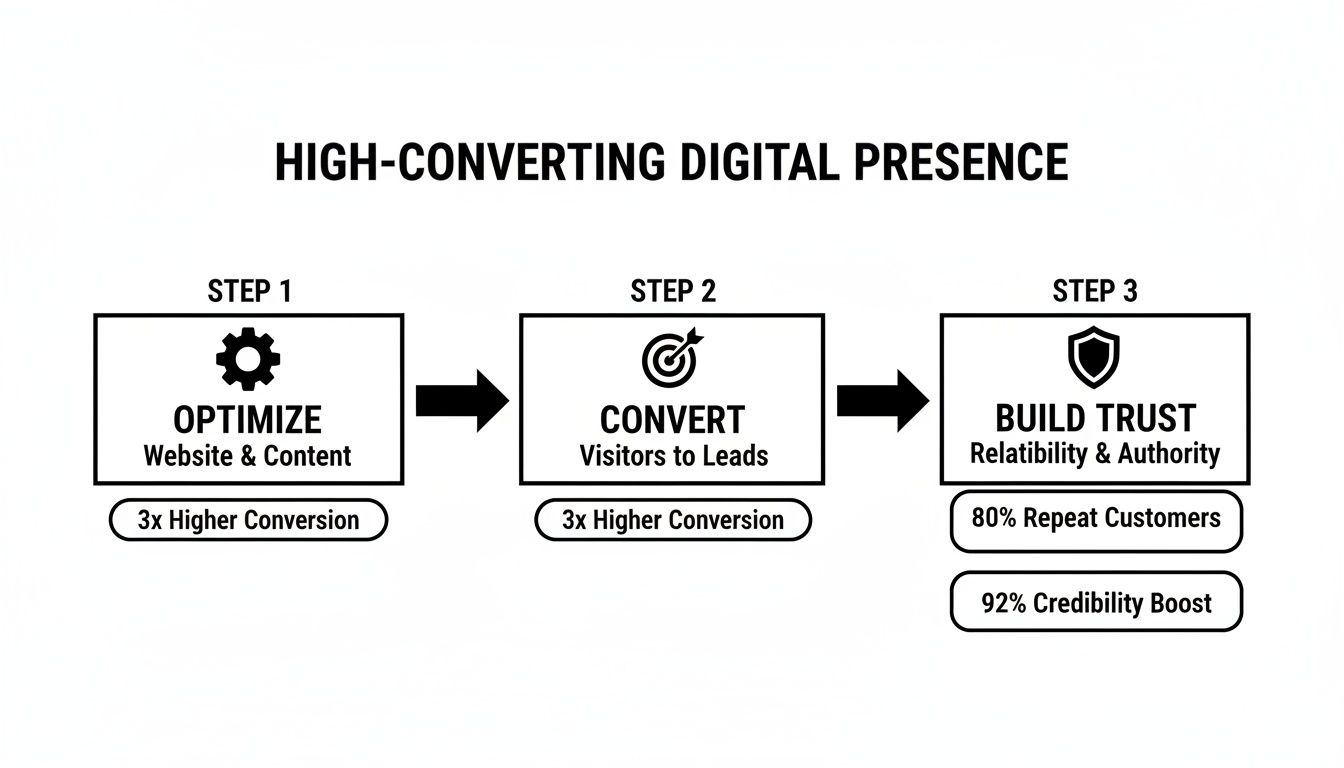
This process is the foundation for making lead integration effective.
Building Your Data Pipeline
A solid integration strategy connects disparate systems, typically using APIs to bridge lead capture forms, your marketing platform like HubSpot, and your core CRM, such as Salesforce.
For a fintech Kft, this goes beyond passing a name and email. The value is in enriching contact information with context. For instance, when a product manager from a target bank downloads your whitepaper on PSD2 compliance, that action should be logged instantly against their profile in your CRM, providing your sales team with actionable intelligence.
Key data points to integrate include:
- Lead Source Tracking: Automatically tag every lead with its origin (e.g., LinkedIn campaign, Google Ad, webinar) to measure channel effectiveness.
- Behavioural Data: Track page visits, content downloads, and demo requests to understand a lead's interests and intent.
- Product Usage Data: For freemium or free trial models, pipe key usage metrics into the CRM to identify product-qualified leads (PQLs) who are already deriving value from your tool.
This level of detail transforms a generic follow-up into a relevant, well-timed conversation.
Automating Lead Scoring and Routing
Once data is flowing into your CRM, the next step is to automate lead prioritization and hand-off. Lead scoring assigns points to leads based on their profile (firmographics) and actions (behaviour). A CTO from a target account requesting a demo is a much higher-priority lead than an intern downloading a blog post. A scoring model formalises this, directing your sales team's time to where it will have the greatest impact on revenue.
Many teams overcomplicate their initial scoring model. Start simply. Base it on a few clear data points (e.g., job title, company size) and key actions (e.g., demo request, pricing page visit). You can add sophistication later as you gather more data.
With scores in place, you can build automated routing rules:
- Score > 80: Route instantly to a senior account executive for immediate follow-up.
- Score 40-79: Add to a marketing nurture sequence to provide more information and build engagement.
- Score < 40: Monitor for future activity but require no immediate sales action.
This automation ensures rapid follow-up on your best leads, which is critical since contacting a lead within the first hour can significantly increase conversion rates. For any serious lead generation kft, aligning your tech stack with your sales process is not optional; it's essential for scalable growth.
Measuring ROI and Optimising for Performance
Lead generation activities are a wasted investment if you aren't tracking what works. This requires a constant feedback loop of measuring, analysing, and refining. Forget vanity metrics like clicks or impressions; focus on the key performance indicators (KPIs) tied directly to your Kft’s bottom line.
Without a clear method for calculating your return on investment (ROI), you are spending money without knowing if you are building a growth engine or an expensive hobby. A precise ROI calculation for your lead generation kft activities allows you to justify your budget, allocate resources effectively, and make data-driven decisions that improve performance. It’s the difference between hoping for results and engineering them.

Establishing Your Core Metrics
To measure performance effectively, track a handful of critical metrics that tell the story from initial contact to customer value.
Your dashboard should focus on these essentials:
- Customer Acquisition Cost (CAC): The total sales and marketing cost required to acquire a single new customer. Calculated by dividing total spend by the number of new customers in a given period. A rising CAC is a warning sign for profitability.
- Lead-to-Customer Conversion Rate: The percentage of qualified leads that become paying customers. This metric reflects lead quality and sales effectiveness. A low rate often indicates a disconnect between marketing and sales.
- Sales Cycle Length: The average time from initial contact to a signed contract. A shorter sales cycle improves cash flow and reduces operational costs.
These metrics are the vital signs of your growth strategy. A common mistake is focusing on top-of-funnel numbers like lead volume. A flood of poor-quality leads that never convert creates noise and busywork without generating revenue.
The table below breaks down the essential KPIs for a comprehensive view of your funnel's health and business impact.
Essential Lead Generation KPIs for Fintech
Monitoring these numbers helps identify opportunities. A strong LTV:CAC ratio, for example, is a clear signal to increase investment in your most effective channels.
Implementing Attribution and Continuous Optimisation
Once you are tracking the right KPIs, the next step is to understand which channels and campaigns are driving results. This is the role of marketing attribution. An attribution model helps you assign credit to the various touchpoints a customer interacts with on their journey.
A simple first-touch attribution model gives all credit to the first channel a prospect engaged with. A more sophisticated multi-touch model distributes credit across multiple interactions—for example, a blog post discovery, a subsequent LinkedIn ad click, and a final demo request via email.
The key is to choose a model that reflects your customers' buying process. This data fuels your optimisation cycle. When you can see which channels deliver the lowest CAC and highest conversion rates, the path forward becomes clear. If LinkedIn ads are delivering high-value CTOs while Google Ads are underperforming, you know where to reallocate your budget.
This data-driven approach removes guesswork from your marketing, transforming your lead generation kft from a cost centre into a predictable, scalable revenue driver.
FAQ: Lead Generation for Hungarian Kfts
Here are answers to some of the most common questions we hear from founders and marketing teams in the Hungarian B2B and fintech sectors.
What are the biggest lead generation mistakes made by Hungarian Kfts?
The most frequent mistake is prioritizing quantity over quality. A large volume of unqualified leads clogs the sales pipeline, wastes marketing budget, and demotivates the sales team. Another common issue is failing to integrate marketing and sales technology. When your marketing platform doesn't communicate with your CRM, it creates data silos, leading to missed follow-ups and a poor customer experience. Finally, a "set it and forget it" approach is ineffective; successful teams continuously analyze data, tweak campaigns, and refine their messaging to adapt to market feedback.
How does GDPR impact our lead generation strategy in the EU?
GDPR requires a fundamental shift in how you handle personal data. You must obtain explicit, informed consent for marketing communications. This means clear privacy policies that detail what data you collect and why. For B2B, while "legitimate interest" can sometimes be a basis for processing, the most robust and trust-building approach is to secure a clear opt-in. This involves reviewing every lead form, email sequence, and data storage process to ensure compliance. Getting this wrong can result in significant fines and reputational damage.
Being transparent about data privacy is not just a compliance task; it's a way to build trust. Prospects are more willing to engage with a company that respects their data.
Should our Kft start with inbound or outbound lead generation?
For most technology-focused B2B companies, building a solid inbound strategy is the best long-term approach. Creating genuinely useful content—such as blog posts, case studies, and whitepapers—establishes credibility and attracts qualified prospects who are already searching for a solution. Over time, this is typically more cost-effective and yields higher conversion rates. However, outbound tactics can deliver results more quickly and are effective for targeting a specific list of high-value accounts.
The optimal strategy often involves both:
- Start building your inbound engine immediately. This creates a sustainable, long-term pipeline.
- Use targeted outbound tactics concurrently. This can land key accounts and keep the pipeline active while your inbound efforts gain momentum.
This dual approach allows you to capture existing demand while building a brand that will generate leads for years to come.
At SCALER Software Solutions Ltd, we don't just build software; we engineer the technical foundations for your growth. Our expertise in fintech and B2B software development means we understand how to create systems that not only perform flawlessly but also align with your commercial goals.
Ready to accelerate your delivery with a reliable EU-based partner? Request a proposal today.
< MORE RESOURCES / >

Fintech
A Guide to Epic Store Szeged and the Local Tech Scene

Fintech
A Tech Leader's Guide to Choosing a Hungarian EU Services Kft

Fintech
A Guide to Designing a Nordic Light Office for Technical Teams

Fintech
A Tech Employer's Guide to Hungary's Social Security System

Fintech
Strategic Sourcing for Your Home Projects at Home Plus Szeged

Fintech
A Consultant's Guide to Oracle Hungary Kft

Fintech
How to Choose an IT Company That Drives Business Outcomes

Fintech
A Consultant's Guide to Part-Time Jobs in Budapest

Fintech
A Consultant's Guide to Peppol Integration for E-Invoicing

Fintech