
< RESOURCES / >
How to Choose an IT Company That Drives Business Outcomes

Selecting an IT company should be treated less like a procurement task and more like a strategic executive decision. For leaders in fintech and high-growth tech, the right partner is an extension of your core team—a force multiplier that directly impacts your ability to launch secure products, meet compliance deadlines, and outpace the competition. This isn't just about outsourcing; it's about embedding expertise to achieve specific business goals.
What a Modern IT Company Delivers
The role of a modern IT company has evolved significantly. It's no longer about handing off isolated tickets. It's an integrated partnership designed to deliver tangible business results. For a CTO or product manager, this isn't a line item; it's a critical component of your development lifecycle and your capacity to innovate.
The relationship is built on deep collaboration. Your IT partner becomes a stakeholder in your success, sharing responsibility for hitting milestones and owning strategic outcomes alongside your internal team.
Beyond Code: A Partnership Focused on Business Value
A top-tier IT partner is measured by the business value they create, not just the code they ship. Their success is your success. Did they reduce time-to-market for a critical payment feature? Did they de-risk a complex platform migration? This outcome-driven approach ensures every technical decision serves a commercial purpose.
This partnership model delivers on three key business pillars:
- Accelerated Time-to-Market: Need specialized DevOps or back-end engineers immediately? A partner provides on-demand access to talent, filling critical skill gaps without the six-month delay of a traditional hiring cycle. This keeps project velocity high.
- Reduced Development Risk: When navigating complexities like PSD2 compliance or building low-latency trading systems, leveraging a partner's domain expertise helps you avoid common architectural pitfalls and costly rework from day one.
- Increased Innovation Capacity: By offloading development and maintenance of essential systems to a partner, you free up your core team to focus on high-value, strategic work that drives long-term competitive advantage.
A true technology partner doesn’t just build what you ask; they challenge assumptions and analyze the 'why' behind the request. They bring an external perspective to ensure the final product not only functions correctly but delivers maximum business impact and is engineered for future scalability.
The Shift from Vendor to Strategic Partner
The distinction between a transactional vendor and a strategic partner is crucial. A vendor completes a task for a fee. A partner invests in understanding your business, customers, and long-term vision. They provide proactive advice, operate with transparent communication, and bring a level of accountability that makes them feel like a seamless part of your organization.
We explore this mindset further in our guide to IT consulting, which explains how strategic guidance forms the foundation of any successful project.
Ultimately, choosing the right IT company means finding a team that can integrate quickly, adapt to your processes, and make a meaningful contribution to the projects that matter most to your bottom line.
Choosing The Right IT Partnership Model
Selecting the right engagement model with an IT company is a strategic decision that directly impacts budget, timelines, and risk. The correct choice establishes a foundation for a smooth, aligned partnership aimed squarely at achieving your business objectives.
Each model offers a distinct approach to integrating talent and managing work. Understanding these differences allows you to match the solution to the problem, whether you're plugging a specific skill gap, launching a new product, or ensuring the stability of a critical system.
The first question to ask is simple: do you need a transactional vendor to complete a task, or a strategic partner to accelerate growth?
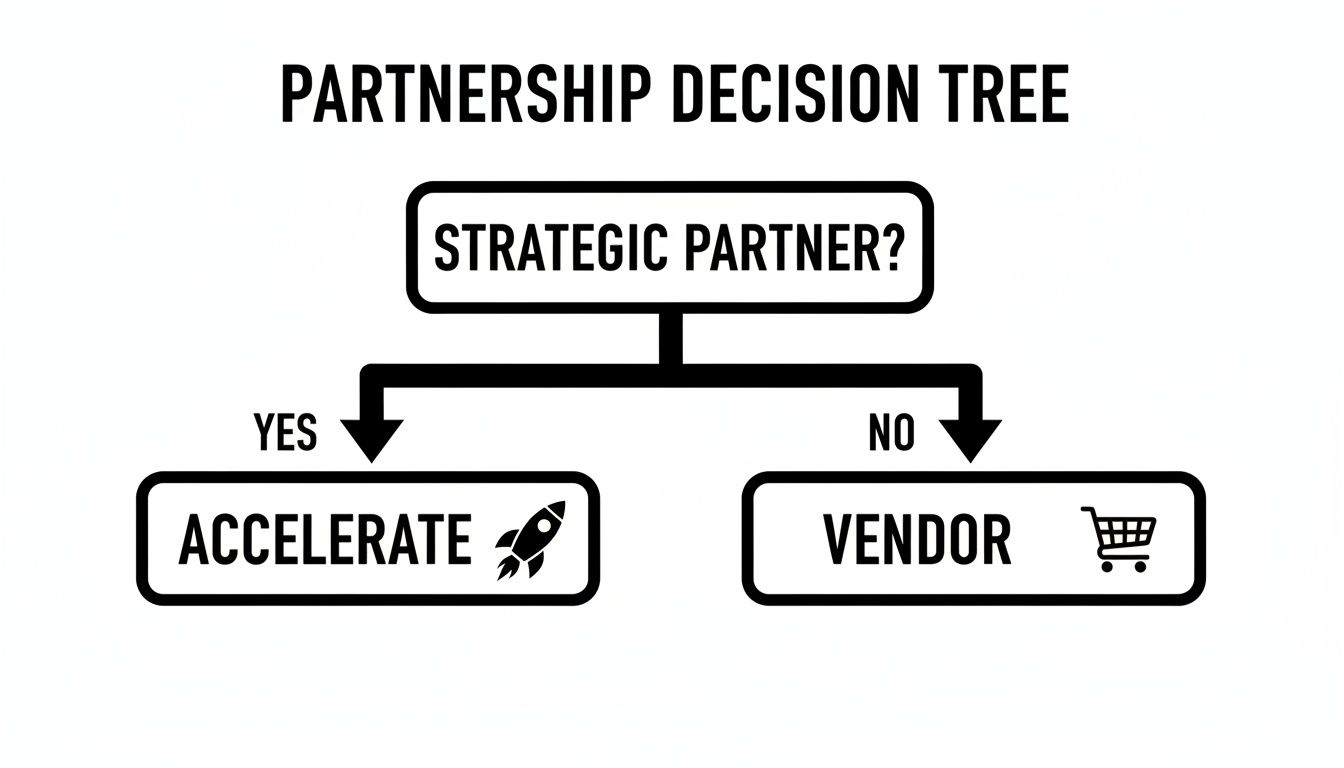
This flowchart clarifies the core choice. A vendor executes. A strategic partner helps you redefine what's possible. Let's examine the models that bring these partnerships to life.
Team Augmentation: For Targeted Skill Injection
Think of Team Augmentation as a surgical approach to closing a capability gap. You aren't outsourcing the project; you are embedding one or more expert engineers directly into your existing team. They report to your managers and adopt your processes, becoming an integral, albeit temporary, part of your organization.
This model is ideal when your core team is strong but lacks a specific, niche skill set.
- Business Scenario: Your team is building a new fintech application but lacks deep expertise in architecting a secure, scalable CI/CD pipeline with Kubernetes on AWS. Through augmentation, you embed a senior DevOps engineer for three months to architect the infrastructure correctly, mitigating the risk of costly future refactoring and accelerating deployment.
- Business Outcome: You mitigate technical risk and reduce time-to-market without the overhead and delay of hiring a full-time employee for a temporary need.
The primary advantage of augmentation is its speed and precision. You get the exact skills you need, integrated directly where they can deliver the most value from day one. It's about adding focused expertise to overcome a specific technical hurdle.
For a deeper dive, see how our team augmentation services help companies add development capacity on demand.
End-to-End Project Delivery: For Turnkey Solutions
When you need an entire project—like an MVP for a new trading platform—built from the ground up, but your in-house teams are at capacity, End-to-End Project Delivery is the solution. You delegate the entire project lifecycle to a partner who assumes full ownership of management, development, QA, and delivery against a defined scope, timeline, and budget.
This allows your internal teams to remain focused on core business operations while a dedicated external team builds and launches the new initiative. This model requires a high degree of trust and a well-defined initial scope, but the operational freedom it provides is significant. Clear communication, with regular check-ins, is essential to ensure the project remains aligned with business goals.
When considering this model, it's also important to evaluate the underlying technology approach. For instance, understanding the trade-offs in this guide on No Code vs Real Code can inform your strategy.
Managed Services: For Long-Term Operational Stability
Managed Services focuses on maintaining the health, security, and performance of your critical systems post-launch. Instead of your team handling reactive maintenance, an IT partner proactively assumes responsibility for monitoring, updates, security patching, and performance optimization. It’s a long-term partnership based on a predictable, recurring cost.
- Business Scenario: Your Open Banking integration is live and processing high transaction volumes. A managed services provider ensures it maintains 99.9%+ uptime, remains compliant with evolving security standards, and scales efficiently as your user base grows.
- Business Outcome: You gain operational peace of mind and business continuity. The risk of revenue-damaging downtime is significantly reduced, and your systems remain secure and performant, freeing your senior engineers to focus on innovation rather than maintenance.
Choosing the right service model is a strategic decision. Analyze your business objectives, your team's current capacity, and your risk tolerance to find the optimal fit for project success.
Why Industry Specialisation Is a Non-Negotiable Requirement
In high-stakes domains like fintech, payments, and trading, hiring an IT company with generic technical skills is a significant business risk. Success is not just about writing clean code; it's about deeply understanding the specific regulatory, security, and performance requirements of the industry.
Choosing a partner without domain expertise is inefficient and dangerous. They may understand engineering principles, but they will miss the critical nuances that ensure a product is compliant, secure, and commercially viable. A team that only understands the "tech" will build a solution that creates business, legal, or reputational risk. The right partner speaks your industry's language from day one, leading to faster time-to-market and reduced project risk.
The Fintech Competitive Edge
For a fintech platform, a specialized partner is one that doesn't require a primer on your operational environment. They should already be fluent in the technical and business implications of PSD2 and Open Banking. This isn't just about compliance; it's about leveraging regulatory frameworks to create a competitive advantage.
An experienced IT company will:
- Accelerate Integrations: They have direct experience with APIs from providers like Stripe or TrueLayer, allowing them to navigate common pitfalls and implement secure connections without costly delays.
- Reduce Compliance Risk: By understanding the data security and consent management rules inherent in these regulations, they build compliance into the architecture from the start, avoiding expensive retrofitting and potential fines.
- Drive Product Innovation: A team that understands the landscape can identify opportunities others miss, suggesting novel uses for Open Banking data that create differentiated product features.
Performance and Security in Payments and Trading
In digital payments and trading, performance is measured in milliseconds, and security is absolute. A generalist IT company might build a functional application, but a specialist builds a resilient, high-performance platform. This focus on non-functional requirements provides a direct business advantage.
A specialist partner will focus on what directly impacts revenue and user trust:
- Low-Latency Architecture: Every component is engineered to minimize delays, ensuring trades execute instantly and payments process without the friction that erodes user confidence.
- Robust Security: They implement stringent security protocols, from encryption standards to fraud detection systems, protecting you and your customers from financial loss and reputational damage.
- Efficient Tooling: Specialists have experience with industry-standard tools, like real-time data feeds or charting libraries from TradingView. This expertise dramatically shortens development cycles. For highly specialized projects, such as designing complex payment systems, leveraging dedicated platforms like payments-experts.com can provide an invaluable layer of insight.
When your business model relies on processing thousands of transactions per second, "good enough" engineering is a liability. A specialized partner understands that performance isn't just a feature—it's the foundation of the business.
Blockchain and Smart Contract Expertise
Blockchain is another domain where specialized knowledge is critical. The immutability of distributed ledgers means that mistakes are permanent and can be extremely costly. A partner with a proven track record in this area is an essential risk-mitigation measure.
Demonstrable expertise means they can show a portfolio of shipped projects, including securely developed smart contracts and ERC-20 tokens. This isn't about technical credentials; it’s about building trust with users and investors by demonstrating that your solution is secure and architected for long-term viability.
Your Essential IT Company Vetting Checklist
Choosing an IT partner is a high-stakes decision. The right choice accelerates your product roadmap; the wrong one leads to delays, budget overruns, and significant operational friction. It is critical to look past the sales presentation and rigorously assess a company's ability to deliver.
This process is not about checking boxes. It's a structured evaluation to find a partner who can deliver on time, on budget, and to the required quality standard.

Technical Mastery And DevOps Fluency
A partner's technical capability is the foundation of the engagement. It is not enough for them to list technologies on their website; you need proof of deep, hands-on expertise in the stacks relevant to your project. Assess whether they can simply write code or if they can build, deploy, and manage it professionally.
Request anonymized examples of projects built using React, Node.js, Go, or .NET. Probe their DevOps practices. Do they have certified AWS or Azure engineers with practical experience? Evaluate their fluency when discussing CI/CD, containerization with Docker, and orchestration with Kubernetes. A team with genuine expertise will discuss these topics with confident clarity. You can explore the technologies that matter in our guide to modern IT services.
Security And Compliance Protocols
In fintech and payments, security and compliance are foundational requirements. A single data breach can destroy customer trust and result in severe financial penalties. Your vetting process must place their security posture under intense scrutiny.
Examine their processes in detail:
- Data Protection: How do they ensure GDPR compliance? Request to review their data handling policies. Do not accept vague assurances.
- Secure Coding: Do their developers adhere to secure coding practices like the OWASP Top 10 to mitigate common vulnerabilities?
- Audits and Certifications: Have they undergone third-party security audits or achieved certifications like ISO 27001? While not always mandatory, it demonstrates a serious commitment to security.
Evasive or unclear answers on these topics are a significant red flag.
A mature IT company integrates security into its entire development lifecycle, rather than treating it as an afterthought. This should be evident in their people, processes, and tools.
Integration Speed And Onboarding Efficiency
You engage an external partner to increase velocity. Therefore, the speed at which their engineers can integrate into your team and begin delivering value is a critical metric. A slow, cumbersome onboarding process negates the benefit and delays your time-to-market.
Require them to walk you through their standard onboarding plan. A well-structured plan will have clearly defined steps for environment setup, knowledge transfer, and first-sprint planning. The objective is for their developers to be contributing meaningful code within the first one to two weeks, not spending a month on administrative overhead.
Communication And Project Transparency
Misalignment is a primary cause of project failure. A partner's communication methodology is a strong indicator of their transparency and collaborative approach. You require a real-time, unfiltered view of progress, challenges, and decisions.
Look for a partner that operates with a structured communication rhythm:
- Daily stand-ups for tactical synchronization.
- A dedicated Slack channel for immediate issue resolution.
- A shared Jira or Asana board that acts as the single source of truth.
- Regular demos and retrospectives to maintain project alignment and continuously improve processes.
This structured approach minimizes surprises and ensures you remain in control.
The IT Services sector in Hungary is substantial, with revenues projected to reach $2.06 billion by 2025. This growth supports local expertise in complex full-stack development and cloud solutions. In 2023, Hungarian IT service exports totaled €33,664 million, representing 20.9% of the country's total exports, and the IT outsourcing market is forecast to grow to $1.16 billion by 2029. This thriving ecosystem produces top-tier talent equipped for demanding fintech and blockchain projects.
Pricing Models And Value Alignment
Finally, ensure their pricing model aligns with your project's needs and risk tolerance. The two most common models are Fixed-Price and Time & Materials (T&M).
- Fixed-Price: Best suited for projects with a stable, well-defined scope. It provides cost predictability but can be rigid and costly if changes are required.
- Time & Materials (T&M): Ideal for agile projects where requirements are expected to evolve. It offers maximum flexibility but requires diligent budget oversight.
A true partner acts as a consultant, not just a salesperson. They will help you analyze the trade-offs to find the right balance of cost, flexibility, and risk for your specific objectives, ensuring the commercial structure supports a successful outcome.
Getting on the Same Page: Tech Stacks and DevOps Culture
A partnership's success often hinges on alignment between your technology stacks and working cultures. This goes beyond sharing a project management tool; it's about a shared philosophy on how software is built, tested, and deployed reliably into production. A proficient IT company doesn't just write code; they operate within a streamlined, automated ecosystem.
This alignment has a direct impact on your bottom line. The right tech stack accelerates MVP delivery. A mature DevOps culture reduces deployment failures, mitigates operational risk, and ensures your platform can scale with your business.
Choosing the Right Tools for the Job
Selecting a tech stack is a strategic decision, not a trend-following exercise. It requires making deliberate choices that solve specific business problems, balancing development speed, application performance, and long-term maintainability.
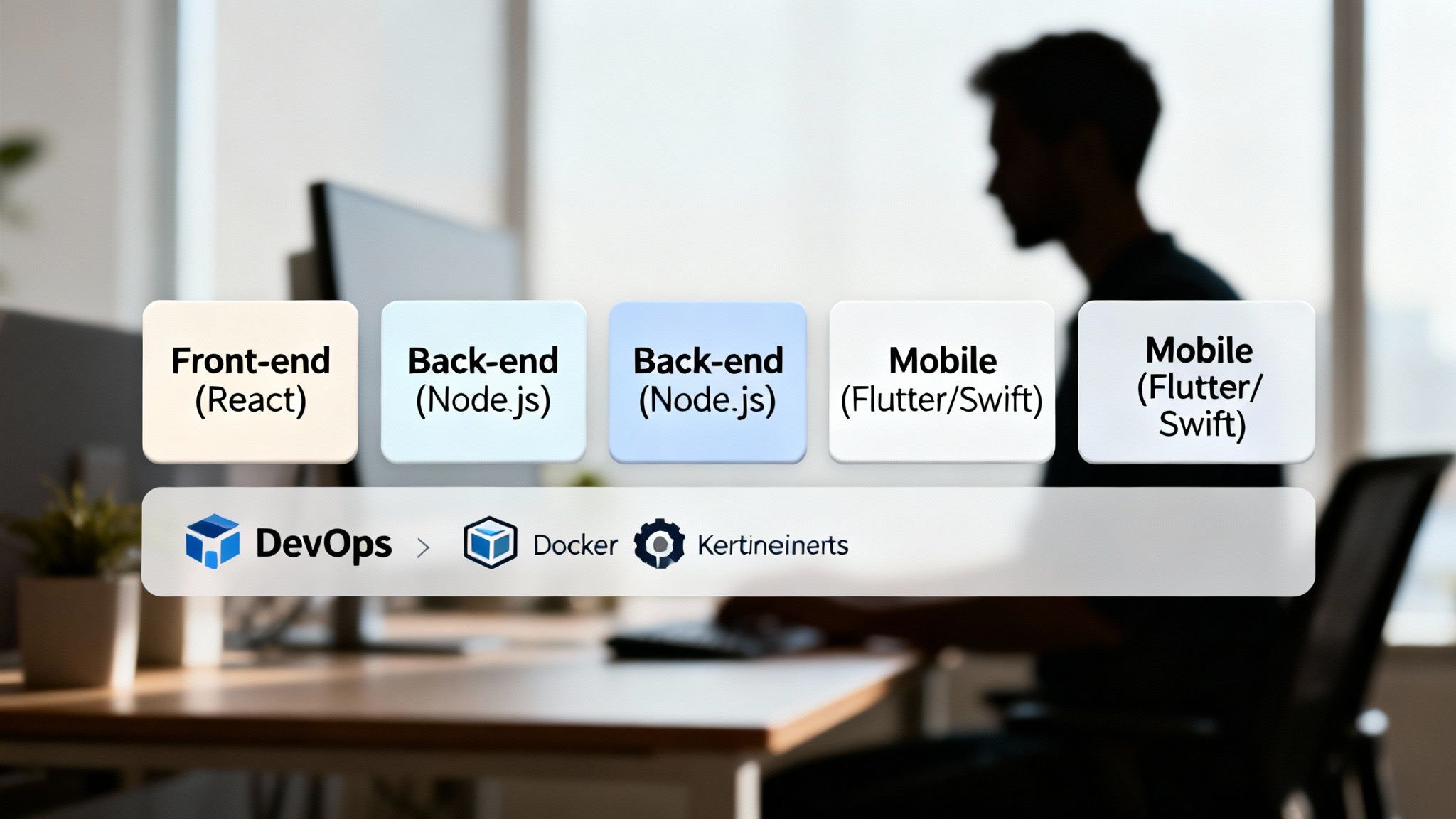
- For Web Applications: The combination of a React front-end and a Node.js back-end is popular for a reason. It enables the rapid development of interactive user interfaces, reducing the time required to launch a web MVP and begin gathering crucial user feedback.
- For Mobile Development: The native versus cross-platform decision involves clear trade-offs. Native development with Swift (iOS) and Kotlin (Android) delivers optimal performance and user experience but requires maintaining two separate codebases. A framework like Flutter allows for a single codebase for both platforms, which can significantly reduce development costs and accelerate time-to-market, though potential performance limitations for highly demanding applications must be considered.
This pragmatic approach ensures that technology choices directly support business objectives.
The DevOps Culture That Actually Delivers
Any competent modern IT company operates with a DevOps mindset. This is not merely a set of tools but a culture of collaboration and automation that removes friction between development and operations teams. The primary goal is to ship higher-quality software, faster.
A mature DevOps practice transforms code from a liability on a developer's machine into a reliable asset in production. It is the operational framework that ensures quality and velocity are inherent in every release, directly impacting revenue by enabling faster feature delivery and reducing costly downtime.
Key practices enable this culture:
- CI/CD Pipelines: Continuous Integration and Continuous Delivery automate the build, test, and deployment processes. This eliminates manual errors, maintains code in a constant state of readiness, and facilitates frequent, low-risk releases.
- Containerisation: Tools like Docker package an application and its dependencies into a standardized container, ensuring it runs consistently across all environments—from a developer's laptop to production servers on AWS or Azure.
- Orchestration: As systems scale, managing numerous containers becomes complex. Kubernetes automates their deployment, scaling, and management, ensuring system resilience and the ability to handle traffic spikes without manual intervention.
This type of robust infrastructure indicates that your software partner is building for growth from the outset. Hungary's software development sector exemplifies this, with a market projected to reach €3.9 billion in 2026. This ecosystem is a valuable resource for CTOs requiring solid solutions for PSD2 integrations or secure smart contracts, where compliance and reliability are non-negotiable. You can read more about the growth of Hungary's software development market.
Mapping Out Your Partnership Journey
A successful partnership follows a clear, predictable process designed to mitigate risk and maintain alignment from the initial kickoff to final delivery. Understanding this lifecycle helps you identify a reliable partner who operates with transparency and focuses on achieving your goals.
This structured approach is the difference between a simple vendor transaction and a true collaboration aimed at delivering business outcomes, whether that's a faster launch or a more resilient, compliant product.
The Typical Engagement Lifecycle
While every project is unique, the journey from concept to a production-ready product follows a proven methodology. A professional team will guide you through these stages to ensure clarity and maintain momentum.
- Discovery Workshop: We move beyond the initial brief to deeply understand your business objectives, technical constraints, and the specific metrics that define success for you.
- Scoping and Proposal: We translate the discovery findings into a detailed project scope, technical plan, timeline, and budget, creating a comprehensive blueprint for the engagement.
- Team Onboarding: Upon approval, we assemble your dedicated team and integrate them into your environment. This involves establishing communication channels, configuring development environments, and defining the initial backlog.
- Agile Sprints: Development proceeds in short, focused iterations—typically two-week sprints. Each sprint delivers a testable increment of the product. Regular demos provide constant visibility into progress and allow for real-time feedback.
- Delivery and Handover: At project completion, we ensure a seamless transition. This includes deploying the final solution, providing comprehensive documentation, and conducting knowledge transfer sessions to empower your internal team.
From Plan to Production Success Stories
This structured process consistently delivers results. For example, we partnered with a European payment provider to launch a new gateway in just six weeks, enabling them to capture a critical market opportunity. Another startup built its TradingView-powered analytics application on time and on budget, benefiting from the predictability of our agile methodology.
This journey is particularly relevant in Hungary's ICT market, which is projected to grow from USD 35.19 billion in 2025 to USD 60.41 billion by 2030. This growth, driven by an 11.41% CAGR, makes it an ideal environment for fintechs building scalable cloud solutions for PSD2 and Open Banking. You can find more details about Hungary's impressive ICT market growth on mordorintelligence.com.
Frequently Asked Questions
How do you ensure the quality and security of the delivered code?
Our approach is multi-layered. We start with mandatory peer code reviews for all changes, as a second set of experienced eyes is one of the most effective ways to catch logic flaws. We then run a comprehensive suite of automated tests (unit, integration, and end-to-end) and strictly adhere to secure coding practices like the OWASP Top 10. Finally, our CI/CD pipeline includes integrated static analysis security testing (SAST) to identify potential vulnerabilities before the code reaches production.
What is the typical onboarding time for a new developer joining our project?
We have refined our onboarding process to be highly efficient. A new team member is typically able to contribute meaningfully to your project within 1-2 weeks. This timeframe includes environment setup, structured knowledge transfer sessions with your team, and a thorough review of project documentation and the existing codebase. Our goal is to make the integration seamless and accelerate their time-to-productivity.
How do you manage communication and collaboration across different time zones?
We establish a communication framework tailored to your team's needs. This typically includes daily stand-up meetings scheduled during a period of maximum time zone overlap, dedicated Slack channels for real-time issue resolution, and shared Jira boards to provide a single source of truth for project status. We prioritize proactive and transparent communication to ensure complete alignment, regardless of geography.
Ready to partner with an IT company that understands the connection between technical excellence and business success?
< MORE RESOURCES / >

Fintech
A Guide to Epic Store Szeged and the Local Tech Scene

Fintech
A Guide to Designing a Nordic Light Office for Technical Teams

Fintech
A Tech Employer's Guide to Hungary's Social Security System

Fintech
A Consultant's Guide to Part-Time Jobs in Budapest

Fintech
A Consultant's Guide to Peppol Integration for E-Invoicing

Fintech
A Tech Leader's Guide to Nearshore Development

Fintech
PSD2 Integration for CTOs: Real-World Challenges and Architecture Insights

Team augmentation
Hiring vs. Outsourcing: Finding the Right Balance with Team Augmentation

Fintech
Implementing Payment Integration in Fintech: Challenges and Architectural Insights

Team augmentation