
< RESOURCES / >
A Fintech Leader's Guide to High-Impact I T Services

For a modern fintech company, i t services are not a cost center—they are the core engine for growth. Moving beyond the traditional view of IT as simple support, the right technology partnership becomes a direct enabler for faster product launches, enhanced revenue streams, and robust security.
How Strategic I T Services Drive Business Outcomes
Let's set aside generic definitions. For a technology-driven business, i t services are the practical mechanisms that translate technical execution into a tangible business advantage. This isn't about maintaining systems; it's about building a competitive edge.
The concept is straightforward: a strategic partner helps accelerate your time-to-market for new products, reduces operational costs through intelligent automation, and mitigates the significant risks associated with security and compliance failures. Every technical decision must be directly tied to a measurable business outcome.
This approach reflects a major market shift. The Hungarian market for IT services, for example, is projected to reach US$2.06 billion in revenue by 2025, signaling massive demand for specialized solutions. Fintechs are increasingly moving away from large, generalist in-house teams toward specialist providers who deliver cost-effective and scalable services. Cloud solutions, in particular, are reducing infrastructure overhead while providing the agility required for rapid innovation in payments and trading. You can review the specifics of this trend in recent industry findings.
Connecting Technical Execution to Your Bottom Line
So, what does this look like in practice? A competent i t services provider does more than write code or manage servers. They operate as an extension of your team, focused on achieving specific business objectives.
- Accelerated Time-to-Market: Need to launch a new feature before a competitor? A partner can deploy specialized engineering talent to meet your deadline without disrupting your existing product roadmap. This directly translates to capturing market share sooner.
- Reduced Operational Costs: By automating manual processes or delegating complex cloud infrastructure management, you free up your internal team. They can shift their focus from routine maintenance to high-value product innovation, leading to greater efficiency and lower overhead.
- Mitigated Risk and Compliance Burden: In fintech, a security breach or compliance failure can be an existential threat. An expert partner with deep knowledge of regulations like PSD2 ensures your architecture is secure and compliant by design, helping you avoid significant fines and reputational damage.
The objective is to transform technology spend from an operational expense into a predictable engine for growth. Aligning engineering efforts with core business strategy creates a powerful mechanism for innovation and profitability.
This guide provides a framework for making critical decisions—from selecting the right delivery model to vetting vendors—so you can turn your technology investments into a measurable competitive advantage.
Ready to align your technology and business objectives? Book a discovery call with our team.
Choosing the Right I T Services Delivery Model
Selecting the appropriate i t services delivery model is a foundational decision with long-term consequences for your project. This choice directly impacts your level of control, cost structure, and the speed at which you can deliver your product to market.
The central question is whether you need targeted expertise or a fully outsourced function. Let's examine two common models—staff augmentation and managed services—to determine the best fit for your needs.
Staff Augmentation: For Speed and Control
Staff augmentation involves adding specialized professionals to your existing team. This model is ideal when you have strong internal leadership but face a critical skill gap or an urgent deadline. You bring in one or more expert engineers who integrate into your team, report to your managers, and adhere to your established processes.
With this approach, you maintain complete control over the project's direction, architecture, and codebase.
This model is optimized for two primary business outcomes:
- Reduced Time-to-Market: It is the fastest method for acquiring specific expertise. Whether you need a senior fintech engineer with deep PSD2 knowledge or a cloud security specialist, staff augmentation fills the gap in weeks, not months.
- Maintained Project Ownership: Your internal leaders retain full control, ensuring the final product aligns perfectly with your company's vision and avoids creating managing technical debt by conflicting with existing standards.
For instance, if your team is developing a new payment gateway and encounters challenges with complex API integrations, augmenting with a specialist can resolve the issue without derailing your entire roadmap. This tactical approach is further detailed in our guide to nearshore development.
This decision tree illustrates how different business priorities—speed, cost, and risk—guide the selection of the optimal model.
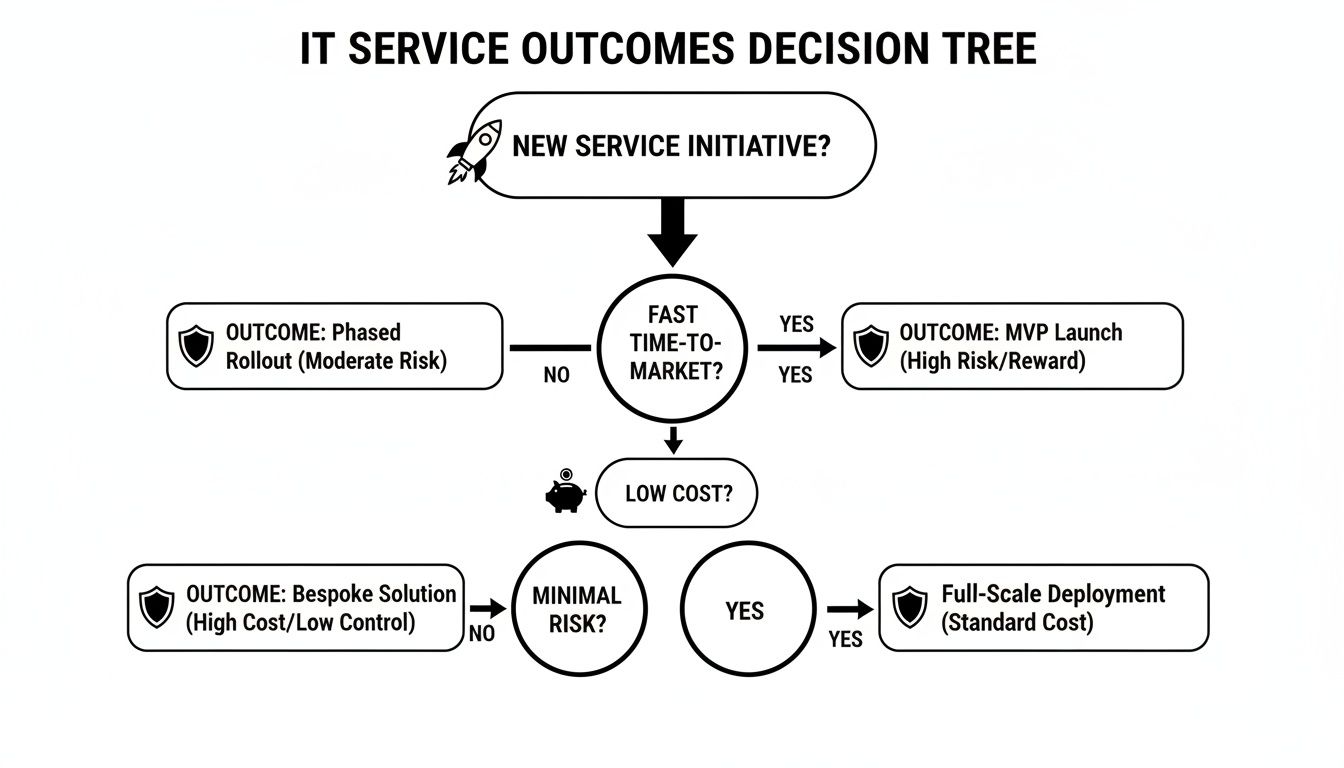
As shown, when the primary driver is rapid market entry while maintaining strict project control, staff augmentation is typically the most effective choice.
Managed Services: For Predictability and Focus
Managed services represent a different approach. Instead of embedding individuals, you delegate an entire business function to a partner who assumes full responsibility for the outcomes. This could involve managing your complete cloud infrastructure, providing 24/7 cybersecurity monitoring, or handling all application support.
The relationship is governed by a Service Level Agreement (SLA) that defines performance metrics, uptime guarantees, and response times. The model is designed for predictability and operational efficiency.
With managed services, you transition from managing people to managing outcomes. This frees your senior internal talent from addressing daily operational issues, allowing them to concentrate on core product development.
The business benefits are clear:
- Predictable Costs: Most managed services operate on a fixed monthly or quarterly fee, making your IT operational expenses stable and easier to budget.
- Reduced Operational Burden: Delegating complex functions like cloud cost optimization or database administration to a specialized team significantly reduces the management load on your senior technology leaders.
- Access to Specialized Tools: Your partner provides their own advanced tools and platforms, giving you enterprise-grade capabilities without the substantial upfront investment.
Consider a scaling fintech. Instead of building a Security Operations Center (SOC) from the ground up, it can be outsourced to a managed service provider. This provides immediate access to enterprise-level threat detection without the high costs and complexities of hiring and equipping an internal team—a clear win for both financial management and risk mitigation.
IT Services Delivery Model Comparison
The choice between these models depends on your specific objectives, resources, and risk tolerance. This table summarizes the key differences to help you identify the best fit for your project.
Ultimately, the right model is not just about acquiring talent; it's about establishing a partnership structure that directly supports your business strategy. Whether you require surgical expertise or a fully managed function, clarity on your primary objective will guide you to the correct choice.
Navigating Fintech Security and Compliance
In the fintech sector, security is not a feature; it is the foundation of the business. If a potential IT services partner lacks deep, demonstrable expertise in financial security and compliance, the conversation should end. This is not about generic cybersecurity but about addressing the unique, high-stakes challenges inherent to the financial industry.

A credible partner understands that trust is built into the architecture. They must demonstrate a history of building secure API integrations and robust data handling protocols that meet stringent regulations like GDPR. The key differentiator is the ability to architect secure, scalable, and compliant systems from the outset, rather than addressing security as an afterthought.
The business outcome is straightforward: avoiding catastrophic data breaches, preventing costly regulatory fines, and building the essential customer trust required for scaling your business.
Architecting for Open Banking and PSD2
The shift to Open Banking, driven by regulations such as the Payment Services Directive 2 (PSD2), has fundamentally changed how financial data is shared. While this presents significant opportunities for innovation, it also introduces new security vulnerabilities. Your IT partner must be proficient in this environment.
This requires the design and implementation of systems capable of handling:
- Strong Customer Authentication (SCA): This involves a careful balance between implementing compliant multi-factor authentication and ensuring a seamless user experience to prevent cart abandonment.
- Secure API Endpoints: Every API connecting your platform to a third party is a potential attack vector. Your partner must be an expert in security standards like OAuth 2.0 to ensure data is accessed only by authorized parties.
- Consent Management: A compliant system requires a robust mechanism for managing user consent, ensuring that data is used only for its intended purpose and that users can easily revoke access.
As you navigate these complexities, it's worth looking at specific solutions that can ease the burden, like on-demand KYT compliance via Elliptic integration, which helps automate critical verification processes.
Proactive Security Measures for Fintech Platforms
A reactive approach to security is a recipe for failure. An effective partner adopts a defensive posture, integrating security into the development lifecycle from the very beginning. This "security-first" mindset goes beyond firewalls to encompass the entire development process.
This proactive stance is particularly critical in Hungary. The local ICT market is expected to grow from $35.19 billion in 2025 to $60.41 billion by 2030, driven largely by the financial sector's demand for cloud and cybersecurity services to meet PSD2 requirements.
A secure architecture is one that assumes it will be targeted. The goal is to build multiple layers of defence that contain and neutralise threats before they can cause significant damage. This "defence-in-depth" approach is the standard for any serious fintech platform.
Key proactive services should include:
- Threat Modeling: Before development begins, your partner should identify potential security weaknesses in the application's design and plan mitigation strategies.
- Secure Coding Practices: This includes training developers to avoid common vulnerabilities like SQL injection and cross-site scripting (XSS) and using automated tools to scan code for vulnerabilities during development.
- Regular Security Audits: Continuous vulnerability scanning and periodic, in-depth security assessments are essential for identifying new risks as your platform evolves. Our guide on penetration testing as a service provides a detailed breakdown of this process.
By standardizing these practices, your IT partner integrates security as a core component of your product, thereby protecting both your revenue and your reputation.
Need a partner who understands fintech security from the inside out? Request a proposal to see how we can build a compliant and resilient platform.
Vendor Selection and Onboarding Checklist
Selecting the right partner for i t services is a critical decision for any technology leader. A successful partnership accelerates your roadmap and reduces risk, while a poor choice leads to friction, technical debt, and costly delays. This checklist is designed to help you vet potential vendors with confidence, moving beyond sales pitches to assess true capability.

A thorough evaluation process is your best defense against partnerships that fail to deliver. Focus on evidence over claims to ensure alignment on technology, process, and business objectives from day one.
Assessing Technical and Domain Expertise
First, you must verify that a potential partner possesses deep and relevant technical expertise. Do not accept a generic list of technologies; require proof of successful project delivery using your specific tech stack.
- Request Relevant Case Studies: Ask for examples of work similar to yours in scope and complexity. Look for evidence that they have solved comparable business problems, such as integrating complex payment gateways or building secure analytics platforms.
- Probe their Fintech Knowledge: General software development experience is insufficient for fintech. Your partner must understand the domain, whether it involves blockchain, Forex trading platforms, or the nuances of PSD2 compliance.
- Meet the Actual Engineers: Insist on speaking directly with the senior engineers who would be assigned to your project. This allows you to assess their communication skills and technical depth firsthand, cutting through any sales rhetoric.
Evaluating Process and Communication
Technical expertise is of little value if a partner's project management is disorganized. Misalignment in this area is a primary cause of project failure, leading to missed deadlines and budget overruns.
A strong partnership is built on transparent and predictable communication. You should never be uncertain about your project's status or struggle to get clear answers from your partner's team.
To assess their workflow, ask pointed questions:
- Project Management Methodology: How do they manage projects? Whether they use Agile, Scrum, or another framework, they should be able to articulate why they use that system and how it benefits you as the client.
- Communication Cadence and Tools: What is the agreed-upon schedule for check-ins, such as daily stand-ups or weekly demos? Which collaboration tools (e.g., Slack, Jira, Teams) do they use to ensure seamless integration with your in-house team?
- Escalation Paths: What is the process for escalating and resolving issues? A clear, documented procedure for problem resolution is the hallmark of a mature and organized partner. For more regional context, our guide on evaluating i t services in Hungary offers additional insights.
Mapping Out a Friction-Free Onboarding
A smooth onboarding process sets the tone for the entire engagement. A competent partner will have a structured plan designed to integrate their team quickly and efficiently with minimal disruption to your operations.
A solid onboarding plan should include:
- Clear Documentation: Access to all necessary project documentation, code repositories, and system credentials should be organized and available from day one.
- Defined First-Week Goals: The initial week should focus on environment setup, initial code reviews, and small, achievable tasks that allow the new team members to build momentum and become familiar with the codebase.
- Cultural and Team Introductions: The partner’s team should be properly introduced to key stakeholders on your side to foster strong working relationships from the outset.
By following this checklist, you can systematically de-risk your vendor selection and establish a partnership poised for success from the start.
Ready to partner with a team that meets these standards? Request a proposal to see how we can help you achieve your goals.
Structuring Pricing and Contracts
Understanding the different pricing models for IT services is crucial for aligning financial agreements with project needs. The goal is not simply to find the lowest cost but to select a contract structure that supports your objectives and prevents issues like scope creep and budget overruns.
The right contract provides clarity, protects against unforeseen costs, and ensures that the financial arrangement facilitates, rather than hinders, project success.
Time & Materials: For Agility and Flexibility
The Time & Materials (T&M) model is straightforward: you pay for the actual hours worked on your project at a pre-agreed hourly or daily rate. This is the most flexible option, ideal for projects with evolving requirements or those where not all details are defined upfront.
T&M is well-suited for innovation-driven projects or iterative development cycles. Its primary benefit is agility, allowing you to change direction, add features, or pivot based on customer feedback without renegotiating the entire contract. However, this model places the financial risk on you, requiring tight project management and open communication to control the budget.
A T&M contract is founded on trust and transparency. It is most effective in a strong, collaborative partnership where progress and resource allocation are clearly visible.
Fixed Price: For Predictability and Control
The Fixed Price model is the opposite of T&M. You and your partner agree on a precise scope of work for a single, predetermined price. This model works well for projects with well-defined and documented requirements, such as building a Minimum Viable Product (MVP) or a single, contained feature.
The main advantage is predictability. You know the exact cost upfront, which simplifies budgeting and shifts the financial risk to the vendor, who must absorb any cost overruns as long as the scope remains unchanged.
The drawback is its rigidity. Any change, no matter how small, typically requires a formal change request, which can increase costs and extend deadlines. This inflexibility can stifle innovation if new opportunities arise mid-project.
Retainers: For Ongoing Support and Maintenance
A retainer is designed for long-term partnerships, particularly for ongoing maintenance, support, or having expert resources on call. You pay a fixed monthly amount to secure a block of your partner's time or guarantee their availability when needed.
This model offers several key benefits:
- Priority Access: You receive priority service. When issues arise, you have experts ready to resolve them, minimizing costly downtime.
- Proactive Maintenance: It incentivizes a proactive approach. Instead of merely reacting to problems, your partner is motivated to prevent them from occurring.
- Stable Costs: Like a fixed-price contract, a retainer makes your operational IT support a predictable and budget-friendly expense.
The right model depends on your project's specific goals. A fixed price offers security for well-defined projects. T&M provides the freedom needed for exploration and adaptation. A retainer is ideal for securing a reliable, long-term partner.
Ready to find a pricing model that fits your project? Request a proposal, and we'll help you structure a contract that delivers results.
Measuring the ROI of I T Services
How can you demonstrate that your investment in i t services is delivering value? To build a compelling business case, you must move beyond simple cost savings and connect your investment to tangible business outcomes like revenue growth, risk mitigation, and operational speed.
When you can draw a direct line from your technology partner's contributions to bottom-line results, the nature of the conversation with stakeholders changes fundamentally.
Time-to-Market as a Revenue Driver
In the fintech industry, first-mover advantage can be a decisive factor. The right IT partner can significantly shorten your development timeline, allowing you to launch new products or features months ahead of competitors. This is not just a project management success; it is a direct driver of revenue.
Consider the projected monthly revenue of a new feature. If your partner enables you to launch three months earlier than planned, you capture three additional months of revenue that would have otherwise been lost.
Example: A new feature is projected to generate €50,000 in monthly revenue. By engaging an expert team, you launch four months ahead of the internal schedule. The ROI is not merely a completed project but €200,000 in early revenue that directly impacts your financial performance.
This reframes the cost of i t services from an expense into an investment in revenue acceleration.
Quantifying Risk Reduction
What is the value of a compliance failure that never occurs? A partner with deep expertise in fintech regulations helps you avoid catastrophic events that can result in substantial fines, reputational damage, and customer attrition.
While you cannot precisely measure a non-event, you can estimate the potential cost of failure by examining the fines imposed on other companies for PSD2 or GDPR violations. The cost of a specialist partner is often a fraction of the potential financial and operational impact of a major compliance breach.
This is particularly relevant in a rapidly growing market like Hungary, where the Other IT & Computer Service Activities industry is projected to reach €1.8 billion in 2025. The growth in IT outsourcing, expected to reach $1.16 billion by 2029, is fueled by the demand for partners who can navigate complex, secure integrations reliably.
Attributing Growth to New Capabilities
Finally, establish a direct link between your partner's work and your key growth metrics. Did their expertise enable you to enter a new market, offer a new service, or handle a higher volume of transactions?
- New Revenue Streams: If your partner developed the backend for a new subscription service, you can attribute the resulting monthly recurring revenue (MRR) directly to their efforts.
- Increased Transaction Volume: If they optimized your platform to handle 50% more transactions per second, calculate the additional revenue generated by this increased capacity.
- Improved Customer Retention: If a new feature they built led to a measurable decrease in customer churn, quantify the lifetime value of the customers you retained.
By focusing on these hard metrics, you shift the discussion from IT as an expense to IT as a strategic driver of business growth.
Ready to build a business case for IT services that delivers measurable results? Book a discovery call with our team.
Frequently Asked Questions About I T Services
Choosing a partner for your IT services involves more than technical considerations; it's about establishing trust, defining ownership, and ensuring effective day-to-day collaboration. Here are answers to common practical questions to help you make an informed decision.
How do you integrate an external team with our company culture?
True integration is achieved by embedding the external team into your daily operational rhythm from the outset, not just by adding them to a Slack channel.
This means they participate in your daily stand-ups, contribute to sprint planning sessions, and use the same collaboration tools as your in-house team. The goal is to eliminate the "us vs. them" dynamic before it can form. When everyone is aligned on the same objectives and priorities, you create a single, cohesive team, ensuring seamless collaboration and clear accountability.
Who owns the intellectual property and the code?
This is non-negotiable: you do. Any reputable partner will ensure that your intellectual property is fully protected.
Your contract must contain an explicit clause assigning all intellectual property rights for the work created directly to you. This is a standard and critical provision.
Every line of code, piece of documentation, and design produced during the project must be unequivocally defined as your property. There can be no ambiguity. You must retain full ownership and control over your core business assets.
How much of my team's time will this engagement require?
The time commitment required from your team depends entirely on the delivery model you select. It is essential to choose a model that aligns with your available internal resources.
- Staff Augmentation: This model requires the most significant hands-on involvement from your team. You will manage the augmented engineers directly, just as you would your own employees, with your project managers and tech leads assigning tasks and reviewing work.
- Managed Services: This is the most hands-off approach. Your team's role is primarily strategic, defining desired outcomes and monitoring performance against the Service Level Agreement (SLA). The partner handles all day-to-day management.
- End-to-End Delivery: This model involves a collaborative partnership. Your product owners and key stakeholders will be deeply involved in the initial discovery and strategy phases and will provide regular feedback during demos. However, the day-to-day execution is managed by the partner.
At SCALER Software Solutions Ltd, we help you select the right model and build a partnership that delivers results without overburdening your team. We provide the senior talent and leadership necessary to take your most critical projects from concept to production.
Ready to build a partnership that drives your business forward? Book a discovery call with our team.
< MORE RESOURCES / >

Fintech
A Guide to Epic Store Szeged and the Local Tech Scene

Fintech
A Guide to Designing a Nordic Light Office for Technical Teams

Fintech
A Tech Employer's Guide to Hungary's Social Security System

Fintech
How to Choose an IT Company That Drives Business Outcomes

Fintech
A Consultant's Guide to Part-Time Jobs in Budapest

Fintech
A Consultant's Guide to Peppol Integration for E-Invoicing

Fintech
A Tech Leader's Guide to Nearshore Development

Fintech
PSD2 Integration for CTOs: Real-World Challenges and Architecture Insights

Team augmentation
Hiring vs. Outsourcing: Finding the Right Balance with Team Augmentation

Fintech