
< RESOURCES / >
A Guide to Designing a Nordic Light Office for Technical Teams
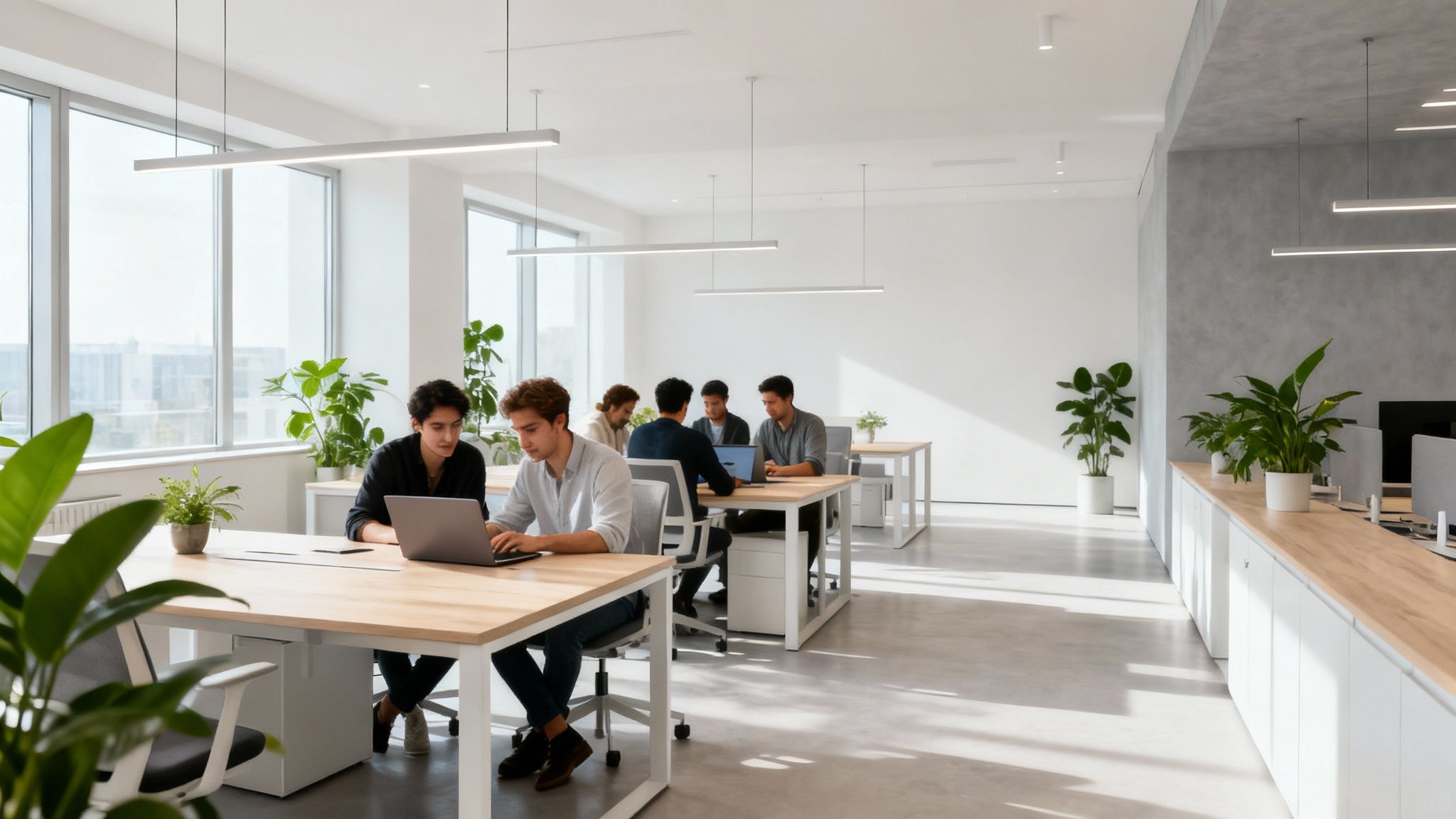
A Nordic light office is more than an aesthetic—it's an engineering-led approach to workspace function. The methodology focuses on creating a bright, calm, and functional environment by maximizing natural light and deploying artificial light strategically. The business outcome is a physical space that supports deep, focused work and facilitates seamless collaboration for technical and product teams.
The Business Case for a Nordic Light Office
For tech companies competing for elite talent, the workspace itself is a competitive advantage. Transitioning to a Nordic light design is a strategic move that directly addresses the core requirements of developers, engineers, and product teams. It creates an environment engineered for focus, well-being, and effective collaboration.
This is not a superficial trend; it is about constructing a physical space that actively supports your team's performance and delivers measurable business results.
Driving Tangible Business Outcomes
The benefits extend beyond aesthetics and directly impact the bottom line. A well-designed physical environment creates the conditions for higher efficiency, improved output, and a more resilient team.
- Accelerated Time-to-Market: An environment that reduces visual strain and cognitive fatigue allows developers to sustain focus for longer periods. This translates directly to faster problem-solving, fewer bugs, and more predictable project delivery.
- Reduced Operational Risk: Well-lit, organized spaces are proven to lower the rate of human error. For teams managing critical infrastructure or sensitive data, a calm, focused environment is a practical defense against costly mistakes and compliance failures.
- Increased Revenue and Talent Retention: An exceptional workspace is a powerful tool for attracting and retaining top-tier engineers. Lower employee turnover reduces recruitment costs, preserves institutional knowledge, and minimizes project disruption, thereby protecting revenue streams.
The core principle is straightforward: A workspace designed around human biology—specifically our need for light and a connection to nature—is a workspace that performs better. It removes operational friction and enables skilled teams to execute effectively.
An Environment Built for Deep Work
Ultimately, a Nordic light office is an investment in the cognitive performance of your most valuable asset: your people.
The strategic use of daylight, specific artificial light temperatures, and natural materials are not decorative choices. They are functional, carefully selected elements designed to support the intense cognitive load inherent in software development and product management. Next, we will examine the specific components that create a high-functioning workspace.
Let's break down the core components of a functional Scandinavian-inspired office. This is a design philosophy, and successful implementation for a technical team requires understanding the principles behind it.
This approach is built on three core, interconnected ideas. Executing these fundamentals correctly will produce a space that genuinely enhances focus and minimizes the distractions that impede deep work.
Each element has a purpose. We are not just creating an aesthetic; we are building a functional environment to support the intense cognitive work your engineering and product teams perform daily.
It All Starts with Natural Light
This is the most critical element. Scandinavian design originated in response to long, dark winters, leading to a focus on capturing and amplifying every available source of sunlight. The positive impact of natural light on mood and alertness is well-documented—a crucial factor for developers tackling complex problems for extended periods.
This requires a fundamental reconsideration of the typical office floor plan. Prime real estate with the best window access should be allocated to primary work areas and collaborative zones, not executive offices.
- Desk Layout is Key: Position desks perpendicular to windows, not directly facing towards or away from them. This simple adjustment reduces screen glare while allowing soft, ambient light to fill the space.
- Keep Windows Uncluttered: Avoid heavy blinds and thick curtains that obstruct light. Opt for translucent roller shades or smart glass to control glare without darkening the room.
- Bounce That Light Around: Surfaces play a critical role. Light-colored flooring and walls with a semi-gloss or satin finish act as soft reflectors, pushing daylight deeper into the office.
Use a Deliberate, Functional Color Palette
In a Nordic office, color is a tool for focus, not decoration. The palette is intentionally constrained to create a calm, uncluttered visual environment. Loud colors and busy patterns consume mental energy that could otherwise be directed toward productive work.
The palette typically consists of soft whites, cool grays, and muted blues, complemented by the warmth of natural wood tones. This approach is highly practical. White walls, for instance, can reflect up to 80% of light, making the entire space feel brighter and more expansive.
A controlled color scheme reduces visual “noise.” It creates a serene backdrop that allows your team to concentrate on their code, not the color of the wall. This is how you create a space that supports the deep work required for quality engineering and product strategy.
Bring Nature Inside (Biophilia)
Finally, integrating a connection to the natural world is essential. This practice, known as biophilic design, taps into our innate need to be around nature and is a proven method for reducing stress and improving cognitive function.
Implementation is straightforward:
- Incorporate Plants: Strategically placed plants improve air quality and have a tangible calming effect.
- Use Natural Materials: Utilize light woods such as birch, ash, or oak. Incorporate wool for textiles and leather accents. These materials add warmth and a tactile quality that plastics and metals lack.
- Think in Organic Shapes: Select furniture and lighting with simple, curved lines. These softer forms mimic natural shapes and make the office feel less rigid and more inviting.
Technical Lighting Specifications for Your Tech Team
Effective office lighting requires more than just aesthetically pleasing fixtures. For an environment housing developers, designers, and engineers who spend hours focused on screens, the technical specifications of lighting are paramount.
Subpar lighting is a significant productivity inhibitor. It causes eye strain, drains mental energy, and can degrade cognitive performance when your team needs to be at its sharpest. Here, we move beyond aesthetics into the science of a high-performance workspace.
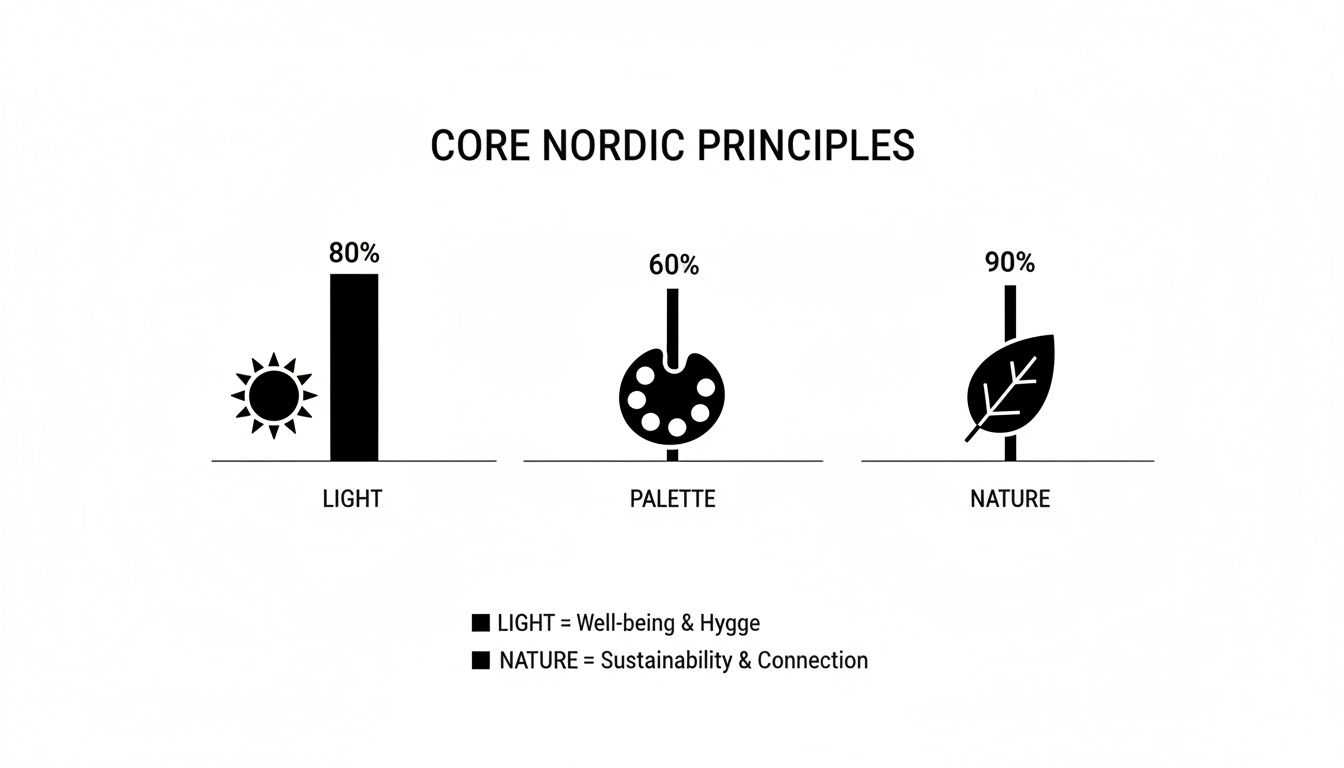
Data confirms what experience teaches us: light is the foundation. All other elements—the color palette, the natural materials—are there to support and enhance it.
The Three Metrics That Matter
When engaging with architects or electrical contractors, it is crucial to use precise terminology. Forget vague terms like "bright" or "warm." Three specific metrics define the quality of your office lighting.
- Illuminance (Lux): This measures the amount of light hitting a surface. For general office walkways and breakout areas, 300-500 lux is a suitable baseline. However, for detailed work such as coding, debugging, or QA, the target should be 500-750 lux directly on the desk surface. This is non-negotiable for preventing eye fatigue.
- Color Temperature (Kelvin): This metric describes the perceived warmth or coolness of light, measured in Kelvin (K). Avoid the warm, yellow glow typical of residential lighting (around 2700K). For a tech office, a cool, neutral white between 4000K and 5000K is optimal. This range closely mimics natural daylight, which is proven to boost alertness and concentration, particularly during mid-afternoon productivity dips.
- Color Rendering Index (CRI): CRI indicates how accurately a light source reveals the true colors of objects. For any office, a CRI of 80+ is acceptable. For teams that include designers or UI specialists, a CRI of 90 or above is highly recommended. High CRI creates a more natural, comfortable environment and ensures consistency between on-screen colors and their real-world appearance.
The Power of Layered Lighting
A common error is to illuminate an entire office with a single type of fixture, such as a grid of overhead panels. While efficient, this approach creates a sterile and inflexible environment. A true Nordic design uses a layered approach, blending different light sources to create a space that is both functional and adaptable.
This strategy eliminates harsh shadows and gives individuals a greater sense of control over their personal workspace.
The objective is not merely to make the office bright, but to provide the right kind of light for the right task. Layering ambient, task, and accent lighting allows you to build a dynamic environment that adapts to different work modes, from collaborative sprints to individual deep work.
The following table provides a comparison of how different lighting technologies can be applied across a typical tech office.
Lighting Technology Comparison for a Tech Office
As the table illustrates, a one-size-fits-all approach is ineffective. The key is to match lighting specifications to the function of each zone, creating a cohesive yet varied environment.
Integrating these technical details is a project in itself. For related insights on managing complex initiatives, our guide on software project management offers valuable parallels.
Combine broad ambient light from fixtures like linear pendants with focused task lighting from desk lamps. For a more detailed look at workstation specifics, this guide on optimizing office cubicle lighting offers practical advice. By weaving these elements together, you create a lighting system that not only looks good but actively contributes to your team’s well-being and daily output.
Choosing the Right Layout, Furniture, and Materials
Here, the principles we’ve discussed become tangible. A successful Nordic light office is not merely a collection of aesthetically pleasing items; it is a cohesive system where layout, furniture, and materials work together to support a modern tech team. The objective is to design a physical environment that reduces friction and supports both collaborative energy and intense individual focus.
In practice, this means abandoning rigid, one-size-fits-all floor plans in favor of flexible zones, each designed for a specific type of work. Your layout should be a tool that serves your team, not a constraint they must adapt to.
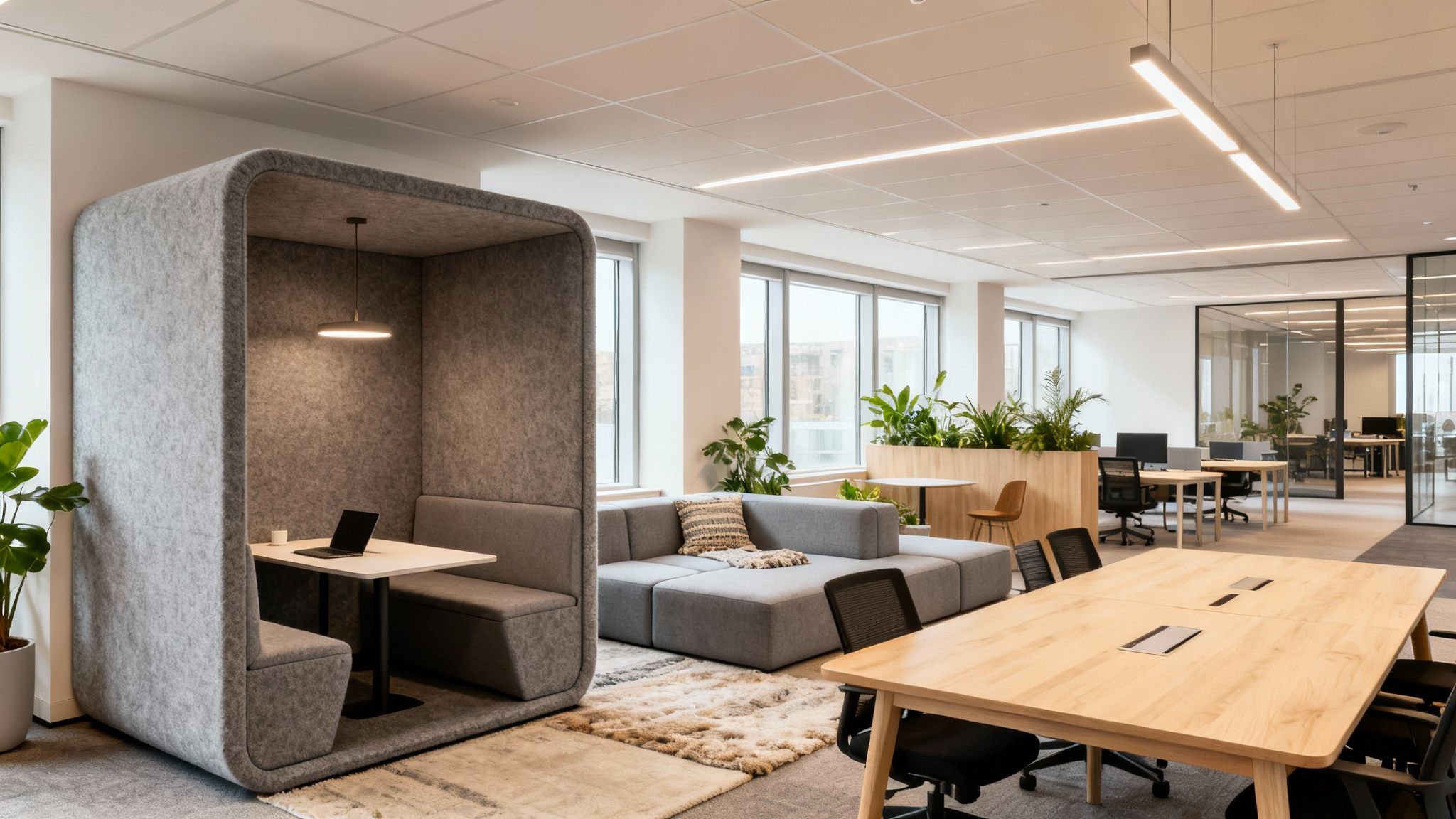
Creating Functional Zones for Agile Workflows
An intelligent layout anticipates the natural rhythm of a development cycle. It provides distinct spaces that allow teams to transition between tasks without losing flow or disrupting others.
- Collaborative Hubs: These are high-energy zones equipped with large whiteboards, modular seating, and ample power outlets. They are designed for daily stand-ups, sprint planning, and ad-hoc brainstorming sessions. The key is flexibility; furniture should be easily reconfigurable.
- Quiet Focus Pods: Deep work, such as debugging complex code or writing technical documentation, requires acoustic isolation. These spaces are non-negotiable and can be implemented as single-person acoustic pods or designated "library rules" areas with sound-absorbing wall panels.
- Informal Breakout Areas: Comfortable lounge chairs and small tables placed near windows encourage the spontaneous conversations where complex problems are often solved, away from the formality of a desk or meeting room.
The primary business outcome of a zoned layout is efficiency. By providing the right space for the right task, you minimize costly context-switching for your developers. This directly translates to higher-quality output and faster project velocity.
Selecting Materials That Enhance Well-being and Focus
The materials you choose are as important as the furniture. In Nordic design, materials are selected based on their tactile qualities, acoustic properties, and connection to the natural world.
- Light Woods: Ash, birch, and light oak add warmth and natural texture, preventing a minimalist space from feeling cold or sterile. Use them for desks, flooring, or as accent details.
- Acoustic Panels: Open-plan offices are inherently noisy. Mitigate this with sound-absorbing felt panels installed on walls or suspended from the ceiling. They offer an effective acoustic solution while adding a subtle design element.
- Natural Textiles: For upholstery, choose durable, natural materials like wool, linen, or leather. They provide a more comfortable and inviting feel than synthetic alternatives.
A Real-World Example: Nordic Light in Budapest
This approach is not just theoretical; it has been successfully implemented in major commercial projects. The Nordic Light office complex in Budapest, developed by Skanska, is a prime example. Completed in 2016, the 26,200 square metre complex demonstrates how these principles can be applied at scale to create a high-performance work environment. You can learn more about the Nordic Light project's development and impact on Skanska's site.
Ultimately, every choice—from furniture with clean lines and ergonomic support to minimalist forms that reduce visual clutter—should support people in performing high-quality work over long periods without burnout. Remember, effective office removals tips for packing and organising furniture are critical for a smooth transition into your new space.
Budgeting Your Office Transformation
A compelling design requires a solid financial plan. Transitioning to a Nordic light office is not merely an expense; it is a strategic investment in your team's productivity and your ability to retain top talent. To build a robust business case, you must understand the associated costs and timelines.
A full Nordic-style renovation is a significant project. The final cost will vary based on your location, the condition of your current space, and the quality of materials selected. The most effective way to manage the budget is to think in terms of cost per square metre. This metric provides a clear benchmark for planning and prevents scope creep.
Breaking Down the Costs
Here is a typical cost allocation for a mid-to-high-end office fit-out. Use these percentages as a starting point for your financial planning.
- Lighting Systems: 20-25%
This category includes high-CRI, specific color temperature LED fixtures, smart controls, and installation. Cutting costs here undermines the core objective of the project. - Furniture & Ergonomics: 30-35%
This is typically the largest portion of the budget, covering high-quality, ergonomic desks, chairs, and collaborative furniture. Investing in durable, well-designed pieces reduces long-term replacement costs and supports team well-being. - Flooring & Finishes: 15-20%
This includes light wood flooring, acoustic underlays, paint, and wall treatments. These choices directly impact light reflection and sound management. - Acoustic Treatments: 10-15%
This covers specialized items like felt panels, ceiling baffles, and quiet pods. In an open-plan office, this is a critical investment in concentration, not an optional extra. - Contingency: 10-15%
Always allocate a buffer for unforeseen issues and changes.
Understanding Market Value and Timelines
This investment also relates to asset value. Premier properties designed with these principles command higher lease rates because they provide a superior work environment. This is evident at the Nordic Light complex in Budapest, where rates reflect its top-tier design. For a deeper analysis, review Budapest's commercial real estate trends on cushmanwakefield.com.
A well-designed office is an asset that attracts top talent and drives productivity. The budget is not for an aesthetic upgrade; it is for creating a high-performance work environment.
Executing a project of this scale often requires specialized skills to maintain momentum while your core team remains focused on their primary objectives. External support can be invaluable. If you need to augment your team with project management expertise, you may find our guide on effective team augmentation useful.
From initial design to final installation, a typical office transformation can take three to six months, depending on project scope and supply chain logistics.
Conclusion
This guide has aimed to clarify one key point: a Nordic light office is not an aesthetic choice but a high-performance environment engineered to support your technical team's best work.
By prioritizing natural light, intelligent materials, and a function-first design, you create a workspace that enhances deep focus, facilitates effective collaboration, and improves overall well-being. This is a tangible investment that delivers returns in talent retention, productivity, and innovation.
These advantages are especially critical in competitive talent markets. For those hiring in the region, our guide to finding remote jobs in Hungary provides additional context on the local tech landscape.
If you are ready to build a workspace that provides a competitive edge while your developers remain focused on your product, we should talk. Contact SCALER Software Solutions Ltd to see how our team augmentation and project execution can help you achieve your goals faster.
Frequently Asked Questions
When CTOs and Product Managers consider a Nordic-style office, several questions consistently arise regarding cost, implementation complexity, and functional suitability for diverse tech roles.
Is this going to exceed my budget?
Not necessarily. While there is an upfront investment, a Nordic light office is not inherently more expensive than other high-quality fit-outs. The key difference is in resource allocation. The budget prioritizes functional, durable choices—such as superior lighting and ergonomic furniture—over purely aesthetic or trend-driven items. These are investments that yield long-term returns by reducing costs associated with employee turnover and low productivity.
Consider it a capital expenditure on your team's performance capability rather than a simple decorating budget.
Can we implement this without major demolition?
Yes. Significant improvements can be achieved without major structural changes. Small, strategic modifications can have a substantial impact on your current workspace.
- Start with lighting. Upgrading existing fixtures to high-quality LEDs with a color temperature between 4000K-5000K is often the single most effective change.
- Maximize daylight. Clear obstructions from windows and reduce visual clutter to make the space feel brighter and more open.
- Introduce natural elements. Add live plants and replace key furniture pieces, such as a meeting table or shelving, with items made from natural wood to immediately enhance the environment.
How does this design support coders, designers, and PMs?
The design's flexibility is one of its greatest strengths. A Nordic light office is not about forcing everyone into a single, uniform environment. The core principle is to create distinct zones that cater to the different work modes across your technical team.
The design's inherent flexibility allows you to build an environment that supports both deep, individual focus and dynamic group collaboration. It accommodates the entire product development lifecycle under one roof.
For example, bright, open areas are ideal for collaborative whiteboarding sessions or team stand-ups. For developers who require deep focus, you can create quiet zones with acoustic paneling, install dedicated focus pods, or designate specific "heads-down" areas. The design empowers individuals to choose the workspace best suited to their immediate task.
Ready to build a workspace that gives your team a competitive edge? The expert engineers at SCALER Software Solutions Ltd can help you accelerate your roadmap while your team stays focused on product goals. Learn more about our team augmentation and project execution services.
< MORE RESOURCES / >
Fintech
A Guide to Epic Store Szeged and the Local Tech Scene

Fintech
A Tech Employer's Guide to Hungary's Social Security System

Fintech
How to Choose an IT Company That Drives Business Outcomes

Fintech
A Consultant's Guide to Part-Time Jobs in Budapest

Fintech
A Consultant's Guide to Peppol Integration for E-Invoicing

Fintech
A Tech Leader's Guide to Nearshore Development

Fintech
PSD2 Integration for CTOs: Real-World Challenges and Architecture Insights

Team augmentation
Hiring vs. Outsourcing: Finding the Right Balance with Team Augmentation

Fintech
Implementing Payment Integration in Fintech: Challenges and Architectural Insights

Team augmentation