
< RESOURCES / >
A Practical Guide to Software Project Management

Software project management isn't just about Gantt charts and deadlines. It's the disciplined process of guiding a product from concept to launch, ensuring it solves a real business problem. Think of it as the strategic framework that balances time, cost, and quality to convert a technical build into tangible business value.
Why "Winging It" Is a Recipe for Failure
In a competitive market, shipping quality software on time isn't optional—it's essential for survival. Effective software project management provides the structure that prevents a promising project from descending into chaos. Without it, teams suffer from scope creep, missed deadlines, and budget overruns, all of which directly impact revenue, market share, and investor confidence.
This guide provides a practical look at how disciplined management solves the real-world challenges modern software teams face. The goal isn't rigid control, but an intelligent, flexible approach that connects technical execution to business outcomes.
The Business Case for a Structured Process
Implementing a formal management process isn't about adding bureaucracy. It’s about building a predictable, efficient system that delivers measurable business results. For a deeper dive into how time tracking fits into this, check out this excellent ultimate guide to project management with time tracking.
Here’s what a structured process delivers:
- Faster Time-to-Market: Clear priorities and organized workflows enable teams to ship features faster, giving you a crucial competitive edge.
- Improved Cost Efficiency: Disciplined planning and resource allocation minimize wasted effort and prevent budget blowouts, protecting your bottom line.
- Enhanced Product Quality: A structured process integrates quality checks from the beginning, reducing bugs, rework, and long-term maintenance costs.
- Reduced Project Risk: By identifying and planning for technical, financial, and operational risks upfront, you prevent them from derailing your project later.
Ultimately, software project management is about converting technical effort into revenue. It ensures the product your team builds aligns with market needs and strategic business goals.
Mastering these principles moves you beyond just building software. You start building a repeatable engine for innovation that drives the business forward.
Navigating the Software Project Lifecycle
Every successful software project follows a clear roadmap. Regardless of the methodology, there is a natural progression from idea to a market-ready product. This isn't about creating red tape; it's a logical path that prevents costly early mistakes that impact time, budget, and quality down the line.
Mastering this lifecycle is the core of effective software project management. It transforms a potentially chaotic creative process into a series of predictable stages, aligning everyone from stakeholders to junior developers on the project's objectives.
Think of it as a domino effect: greater speed enables more efficiency, which ultimately delivers a higher-quality product.
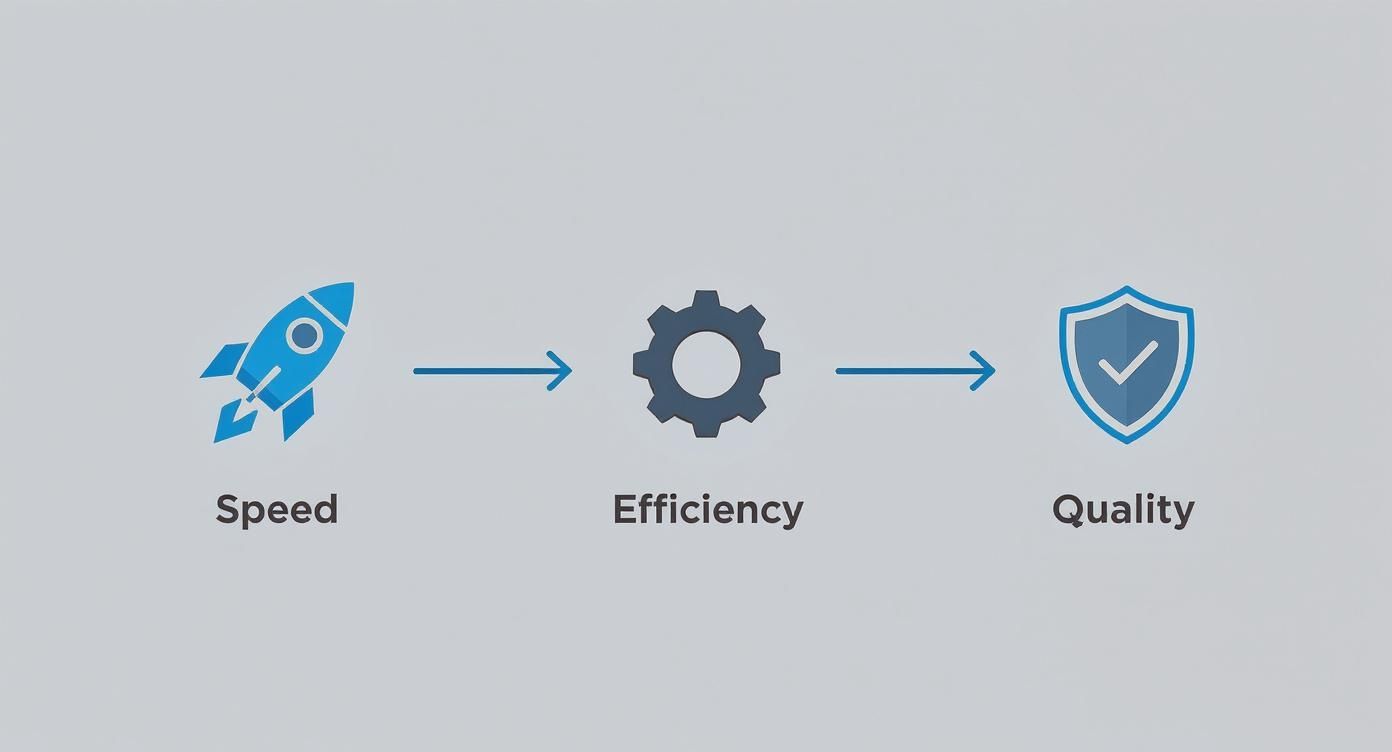
This is a powerful flow. When you increase development velocity, operations become more efficient. That efficiency frees up the team to focus on high-impact work, which directly improves the quality of the final product—a virtuous cycle that builds a sustainable competitive advantage.
Discovery and Definition
This is where projects are often won or lost. Before a single line of code is written, you must validate the "why" and "what." Skipping this phase is the fastest way to guarantee scope creep, budget overruns, and a product no one uses. A rigorous discovery phase is about de-risking the project by killing bad ideas before they consume resources.
Key activities in this phase include:
- Stakeholder Interviews: Meet with key business and technical leaders to define what success looks like. Translate their strategic goals and constraints into achievable technical requirements.
- User Research: Identify the target user and their core problems. Understanding their world is critical to building a solution they will actually adopt, not just a list of features.
- Technical Feasibility Assessment: Can this be built within the given constraints? Identify potential technical roadblocks, integration challenges, and architectural decisions early to mitigate risk.
Planning and Roadmapping
With a clear definition, the planning phase translates the "what" into a realistic "how" and "when." This is where strategy meets execution. A solid plan provides the predictability needed to secure budgets, assemble the right team, and manage stakeholder expectations. It's the blueprint for the entire project.
Key deliverables from this phase include:
- A Product Roadmap: A high-level, visual summary of what you’re building and why, outlining major features, milestones, and strategic goals.
- Resource Allocation: Define who is doing what and when. Proper allocation prevents burnout and ensures the project maintains momentum.
- A Risk Register: Identify potential threats—technical, market, or personnel-related—and create a mitigation plan for each.
Execution and Monitoring
This is where the plan is put into action and code is written. It's the longest phase, involving the daily work of designing, building, and testing. Effective management here is not about micromanagement but about removing obstacles, ensuring clear communication, and maintaining focus. You must adhere to the plan while being agile enough to adapt to inevitable changes.
The manager's primary role during execution is to create an environment where the development team can be maximally productive. This means protecting them from distractions and ensuring they have the tools and support needed to succeed.
Delivery and Iteration
A project isn't "done" at deployment. The final phase involves a controlled release, gathering user feedback, and planning for the future. Modern software project management views delivery as the beginning of a new feedback loop, not an end.
This iterative approach is how great products are built. Learnings from each release are channeled directly back into the next discovery and planning cycle, creating a continuous loop of improvement. The teams that learn the fastest, win.
Choosing Your Project Management Methodology
Selecting the right methodology is a critical business decision, not just a technical one. It’s about aligning your team's workflow with the project's goals and constraints. The right choice leads to faster delivery, improved efficiency, and a product that truly meets market demands.
The decision depends on your project's nature. Are requirements likely to evolve? Is the primary goal to eliminate waste and maximize value, or is speed the top priority? Each methodology offers a different playbook for success.
The Agile Approach for Products That Evolve
Agile is a mindset focused on iterative development and continuous feedback. It’s the standard for projects where requirements are not fully known at the outset.
The business logic is clear: it dramatically reduces the risk of building the wrong product. By shipping functional software in small increments, you can validate ideas with real users early and often. This allows you to pivot based on market feedback without wasting months on features nobody needs, ensuring the final product delivers real value.
Scrum vs. Kanban: Organising the Work
Within Agile, Scrum and Kanban are two of the most popular frameworks for translating principles into action.
Scrum: Best suited for complex projects that require a predictable rhythm. Work is done in fixed-length sprints (typically two weeks) with defined roles and ceremonies. The key business benefit of Scrum is predictability and focus, keeping the entire team aligned on a shared goal.
Kanban: Ideal for teams handling a continuous flow of tasks with shifting priorities, such as support or maintenance. It's a visual system that helps manage workflow and limit work-in-progress to prevent bottlenecks. Kanban’s primary benefit is improved flow and efficiency, making it clear where processes are breaking down.
Lean Principles and DevOps Practices: Building Smarter and Faster
While Agile focuses on iteration, other approaches are laser-focused on efficiency and speed.
Lean software development aims to ruthlessly eliminate waste to deliver maximum value to the customer. "Waste" can be anything from inefficient processes and unnecessary features to time spent waiting on approvals. By adopting Lean principles, you can reduce development costs and accelerate delivery.
A Lean mindset forces a continuous evaluation: "Does this feature add real value for the user?" If not, it's eliminated. This disciplined prioritization is how you build high-impact products efficiently.
DevOps is a cultural and technical approach that breaks down silos between software development (Dev) and IT operations (Ops). The goal is to shorten the development lifecycle through automation of builds, testing, and deployment. The impact is significant: 78% of teams report deep integration of DevOps practices, often in conjunction with Agile, now used by 68% of businesses. You can explore more software development statistics to see these industry trends. By integrating development and operations, DevOps accelerates time-to-market while improving stability.
Comparing Software Project Management Methodologies
This table helps clarify the strengths of each approach.
The most effective teams often blend principles from several methodologies to create a hybrid model tailored to their specific needs.
Building Your High-Performing Software Team
A brilliant methodology and a perfect plan are useless without the right people. In software development, assembling a team with clearly defined roles is the bedrock of success. Role clarity eliminates confusion, prevents tasks from being dropped, and focuses every team member's expertise on the same objective.

Think of it like a surgical team where each member has a specialized function, and success depends on seamless collaboration. When roles are well-defined, the project runs smoother, moves faster, and carries far less risk. This directly improves development velocity and product quality.
Core Roles and Their Responsibilities
While team structures can vary, most modern software teams are built around a few key roles. The interaction between these roles is what distinguishes a disjointed group from a high-performing unit.
Product Manager (The ‘Why’ and ‘What’): The voice of the customer and the business. They own the product vision, define what to build based on user needs and market analysis, and prioritize the work to maximize business value. A great Product Manager ensures the team is building the right thing.
Project Manager / Scrum Master (The ‘How’ and ‘When’): The facilitator of the process. In traditional project management, they manage timelines and budgets. In Agile frameworks like Scrum, the Scrum Master is a servant-leader whose job is to remove roadblocks, coach the team, and protect them from distractions.
Software Engineers (The Builders): The technical experts who write, test, and maintain the code. They are responsible for turning the product vision into a functional, scalable, and robust solution through effective collaboration on architecture and implementation.
Quality Assurance (QA) Engineers (The Guardians): The champions of product quality. They design and execute tests—both manual and automated—to identify defects before they reach users. Integrating QA early in the development process is a critical cost-saving measure.
How Roles Adapt Across Methodologies
Roles and responsibilities are not static; they adapt to the chosen methodology. This flexibility is a key strength of modern software development.
A Scrum team, for example, often replaces the traditional "Project Manager" title. Responsibilities are distributed: the Product Owner manages the backlog (the 'what'), the Development Team self-manages its work within a sprint (the 'how'), and the Scrum Master facilitates the process.
This shift empowers the team, fostering self-organization and accountability. This leads to faster decision-making and a stronger sense of ownership, which improves morale and productivity. The goal is not to adhere rigidly to titles but to ensure all critical functions—vision, facilitation, execution, and quality—are effectively covered.
Deciding between hiring in-house and augmenting your team with external experts is another critical strategic choice. For more on this, see our guide on hiring vs. outsourcing software development. Whether you build the team internally or partner with an external firm, role clarity is what drives performance.
How to Measure Success and Mitigate Risk
You cannot manage what you do not measure. In software development, relying on gut feelings to assess project health is a recipe for failure. You need objective data to get a clear picture of progress, enabling informed decisions that keep projects on time and on budget.

The stakes are high. A significant number of software projects—some estimates suggest 25%—either fail outright or underdeliver so severely they are considered failures. Ineffective tracking and poor risk management are almost always to blame.
A solid framework for measuring performance and managing risk is essential for maintaining stakeholder confidence and delivering a successful product.
Key Performance Indicators for Efficiency
To truly understand your team's performance, you need to look at frameworks for measuring engineering productivity. Focus on the metrics that provide real insight into efficiency and predictability.
- Velocity: This Agile metric measures the amount of work a team completes per sprint. It's a forecasting tool; consistent velocity allows for realistic deadlines and effective stakeholder management.
- Cycle Time: The time it takes for a task to move from "in progress" to "done." Short cycle times indicate an efficient workflow; increasing times signal a bottleneck that needs addressing.
- Lead Time: This measures the total time from when a task is requested to when it's delivered to the user. Lead time reflects the responsiveness of your entire system, from planning to release.
Metrics for Ensuring Product Quality
Shipping fast is pointless if the product is broken. Speed without quality creates technical debt, frustrates users, and damages your brand. Quality assurance must be an integral part of your process from the start.
A focus on quality is not just about finding bugs; it’s about building confidence. Strong quality metrics reduce the risk of post-launch failures, protect your brand's reputation, and lower long-term maintenance costs.
Key quality metrics include:
- Bug Density: The number of confirmed defects per unit of code (e.g., per 1,000 lines). A low bug density indicates high-quality code and effective development practices.
- Code Coverage: The percentage of your codebase covered by automated tests. High code coverage provides a safety net, allowing developers to refactor and add features without fear of introducing regressions. For more, see our guide on effective QA and testing strategies.
A Practical Framework for Risk Management
Every software project involves risk. While you can't eliminate it, you can manage it proactively. A simple framework helps you identify and address threats before they become crises.
- Identify Risks: Brainstorm with the team and stakeholders to list everything that could go wrong—technical challenges, budget issues, resource constraints, etc.
- Assess and Prioritise: Evaluate each risk based on its potential impact and likelihood. This helps you focus your efforts on the most significant threats.
- Develop Mitigation Plans: For high-priority risks, create a response plan. This could involve building a prototype to validate a technical approach or allocating a budget contingency.
- Monitor and Review: Risk management is an ongoing process. Regularly review your risk register in team meetings, track existing risks, and identify new ones as the project evolves.
When to Augment Your Team for Strategic Growth
Scaling your development team is a strategic decision. While hiring full-time staff is a common approach, effective software project management involves knowing when to build your team internally, buy an off-the-shelf solution, or borrow specialized talent. Partnering with an external firm can accelerate growth, but timing is crucial for maximizing business impact.
The decision to augment your team typically stems from three scenarios. First, an urgent need for a niche skill set that is difficult or time-consuming to hire for. Second, the need to accelerate a critical project's time-to-market. Third, a flexible way to manage temporary workload increases without the overhead of permanent hires.
Spotting the Right Moment to Bring in Help
Knowing when to seek external support is key. Rather than a last resort, view team augmentation as a proactive strategy triggered by specific business signals. The right partner can de-risk a project and introduce valuable external perspectives.
Key indicators that it’s time to consider augmentation:
- You Need Niche Expertise, Yesterday: Your roadmap requires specialized skills—like blockchain, AI, or complex fintech integrations—that your current team lacks. Augmentation provides immediate access to experts, avoiding lengthy recruitment cycles.
- A Key Initiative Needs to Speed Up: A competitor is closing in, or a market opportunity has a limited window. An external team can significantly shorten the development timeline.
- Your Workload Is All Peaks and Valleys: Your project involves intense development phases followed by quieter periods. Augmentation allows you to scale your team up and down as needed, optimizing costs.
Team augmentation is not just about filling roles; it's a strategic injection of specific capabilities at the precise moment they are needed. It enables you to maintain a lean core team while retaining the capacity to execute large-scale projects.
How to Choose the Right Partner
Selecting an augmentation partner requires more than a technical skills assessment. You need a team that can integrate smoothly with your culture and workflow. Communication practices, project management maturity, and a proven track record are as important as their technical expertise. Look for a partner who understands your business objectives, not just your tech stack.
Consider Hungary, whose software development sector has become a major hub in Central Europe. The industry now includes over 24,900 businesses and is projected to reach a market size of €3.9 billion in 2025. You can learn more about Hungary's expanding tech industry on IBISWorld. This growth has created a deep and mature talent pool.
To see how this flexible model works in practice, explore our guide on strategic team augmentation services. The right partnership can be the catalyst that moves your most critical projects from the backlog to the market.
A Few Common Software Project Management Questions
If you’re new to running software projects, you probably have a lot of questions. Let's tackle a few of the most common ones I hear from leaders and teams trying to get a handle on the process.
What’s the Single Biggest Challenge in Software Project Management?
It almost always comes down to one thing: managing changing requirements. We call it scope creep, and it’s the silent killer of timelines and budgets.
Agile methods are designed to accommodate change, but that doesn't mean accepting every new request. The key is a disciplined process for evaluating new requirements before they are added to the backlog. You must assess the impact of each change on the timeline, budget, and—most importantly—its alignment with the project's strategic business goals.
This requires constant and clear communication. The product owner, key stakeholders, and the development team must be aligned, ensuring any changes are deliberate, prioritized, and contribute to the overall project objectives.
How Do You Choose the Right Project Management Software?
There is no single "best" tool; the right one supports your team's existing workflow. Agile teams often prefer tools like Jira or Trello for their robust Scrum and Kanban boards. For managing multiple projects, a tool like Asana may be a better fit.
Before selecting a tool, consider these four factors:
- Ease of Use: If the software is complicated, your team won't adopt it.
- Integrations: It must integrate seamlessly with your essential tools, such as code repositories (GitHub) and communication platforms (Slack).
- Reporting: The tool should provide clear, actionable insights into key metrics like velocity and cycle time.
- Scalability: Will it support your team as it grows and your projects become more complex?
My advice: always conduct a trial. Have your team use the tool for a real sprint to determine if it genuinely improves their workflow.
What's the Difference Between a Project Manager and a Scrum Master?
These roles are often confused, but they are distinct. A traditional Project Manager is accountable for the project plan—managing the budget, resources, timeline, and scope. They actively manage project constraints to ensure delivery.
A Scrum Master, a role specific to the Scrum framework, is a servant-leader, not a top-down manager. Their primary responsibility is to coach the team, remove impediments, and ensure the Scrum process is followed. The Scrum Master empowers the team to manage itself, whereas a Project Manager often takes a more direct, hands-on management approach.
Ready to move beyond project delivery struggles and start shipping exceptional software? SCALER Software Solutions Ltd provides experienced teams to augment your staff or manage your entire project. We build secure, scalable solutions and deliver on time.
< MORE RESOURCES / >

Fintech
A Guide to Epic Store Szeged and the Local Tech Scene

Fintech
A Guide to Designing a Nordic Light Office for Technical Teams

Fintech
A Tech Employer's Guide to Hungary's Social Security System

Fintech
How to Choose an IT Company That Drives Business Outcomes

Fintech
A Consultant's Guide to Part-Time Jobs in Budapest

Fintech
A Consultant's Guide to Peppol Integration for E-Invoicing

Fintech
A Tech Leader's Guide to Nearshore Development

Fintech
PSD2 Integration for CTOs: Real-World Challenges and Architecture Insights

Team augmentation
Hiring vs. Outsourcing: Finding the Right Balance with Team Augmentation

Fintech