
< RESOURCES / >
A Strategic Guide to QA and Testing in Fintech

In the fintech sector, QA and testing is not a final checkpoint before launch—it's a core business function that directly protects revenue, manages risk, and builds customer trust. A single bug in a payment gateway, a performance lag in a trading platform, or a data error in a lending app can trigger immediate financial loss, attract heavy regulatory fines, and permanently shatter your company's reputation.
For product and engineering leaders, viewing QA as a simple bug-hunting exercise is a strategic misstep. A mature approach to quality assurance is a powerful competitive advantage. It evolves from finding flaws to proactively managing risk, ensuring every feature strengthens your market position rather than jeopardizing it. This guide provides a practical framework for building a QA and testing function that delivers clear business value.
Why Strategic QA Is a Core Business Advantage in Fintech
The fintech market is built on security, speed, and reliability, where the consequences of failure are severe. A minor glitch can lock users out of their accounts, a performance bottleneck can cause transactions to fail during peak hours, and a security vulnerability can expose sensitive financial data. A well-designed QA framework mitigates these risks and delivers tangible business outcomes.
The Business Case for Proactive Quality Assurance
Investing in a robust QA framework directly impacts your operational resilience and long-term growth. The key benefits are clear:
- Reduced Operational Risk: Rigorous testing of payment flows, trading algorithms, and data integrity catches costly errors before they lead to financial write-offs or compliance breaches.
- Faster Time-to-Market: Integrating testing early in the development cycle (a practice known as "shift-left") identifies defects when they are cheaper and faster to fix. This avoids last-minute scrambles that delay product launches.
- Stronger Customer Trust: A seamless and secure user experience is non-negotiable. When a platform performs reliably, it builds the long-term trust required for customers to feel safe managing their finances with you.
- Improved Regulatory Compliance: Specialized testing is essential to validate adherence to mandates like PSD2, GDPR, and other local regulations, protecting your business from significant fines and operational disruption.
A mature QA and testing strategy creates a predictable, high-quality delivery engine. To stay ahead, it's also worth understanding how artificial intelligence is transforming Quality Assurance with AI, enabling faster and more intelligent validation.
A robust quality strategy is the bedrock of any successful fintech product. It's not an expense to be minimized but a strategic investment in the long-term stability and trustworthiness of your brand.
Building Your Fintech Testing Pyramid
An effective QA and testing strategy is not a random checklist; it's a structured pyramid. This model guides resource allocation, focusing the most effort on fast, inexpensive, and isolated tests at the base, while reserving complex, time-consuming tests for the top. For any fintech platform, this is a blueprint for building a resilient defense against failure.
This structure helps you deliver on the three pillars every fintech depends on: trust, security, and speed.
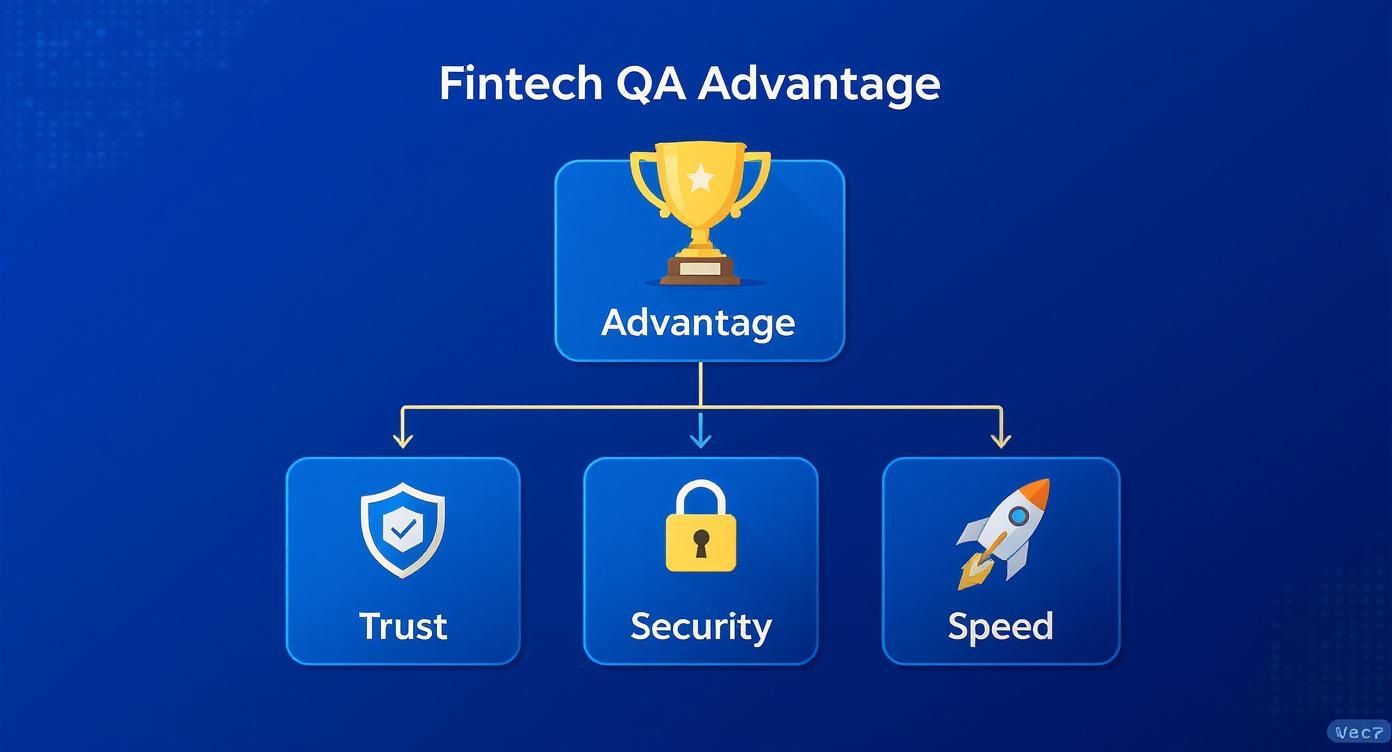
These pillars are intertwined. A lapse in security or a lag in performance instantly erodes the customer trust you've worked hard to build.
The Foundation: Unit Tests
At the base of the pyramid are Unit Tests. These are small, automated tests written by developers to verify that a single piece of code—like a function or method—behaves as expected. Think of it as checking each brick for flaws before building a wall.
In fintech, a unit test might confirm that an interest calculation function returns the correct value to the last decimal place or that a currency conversion module applies rounding rules perfectly. Because they run in milliseconds, they provide developers with instant feedback, catching bugs at the earliest and cheapest stage.
The Middle Layer: Integration Tests
Moving up the pyramid, Integration Tests connect individual code components to verify they work together correctly. For modern fintech platforms often built on microservices, this layer is critical. It ensures that services for user authentication, payment processing, and account management communicate as intended.
An integration test might simulate an API call from a mobile app to the backend to confirm a transaction is processed and the database updates correctly. These tests answer key questions:
- Does the login service properly hand off credentials to the transaction service?
- When a payment is made, does the notification service trigger an alert?
- Can the reporting engine pull accurate data from the main transaction ledger?
By validating these interactions, integration testing prevents system-wide failures that lead to lost transactions and corrupted data, de-risking every new feature release.
The Peak: End-to-End Tests
At the top of the pyramid are End-to-End (E2E) Tests. These are comprehensive simulations of a complete user journey, from login to goal completion, replicating real-world behavior in a production-like environment.
For a fintech product, an E2E test is the final dress rehearsal. It might automate a user logging in, depositing funds, executing a trade, and then verifying the portfolio balance. It proves the entire system works in concert.
Because E2E tests involve multiple services, user interfaces, and third-party integrations, they are slower and more expensive to run. That’s why they belong at the narrow peak of the pyramid. You want fewer of them, focused on your most critical business flows. Their job is to confirm that all parts of your system work in harmony to deliver a flawless user experience, directly protecting revenue and reputation.
The Fintech Testing Pyramid: Layers and Business Impact
By investing heavily in the unit and integration layers, you build a stable foundation that makes your high-level E2E tests more reliable and meaningful, allowing you to release new features faster and with greater confidence.
Specialized Testing Your Fintech Cannot Ignore
With the testing pyramid as a foundation, the next step is to incorporate specialized tests that are non-negotiable in fintech. These are critical risk management activities that safeguard your revenue, reputation, and license to operate.

Ensuring the software works is just the price of admission. To succeed, your platform must handle high traffic, defend against attackers, and adhere to regulations. This is where strategic qa and testing demonstrates its value across three pillars: performance, security, and compliance.
Performance Testing Under Pressure
Imagine your trading platform freezing during a market rally or your payment gateway crashing on Black Friday. The result is immediate: lost transactions, angry customers, and a direct hit to your revenue. Performance testing helps you avoid this scenario.
Performance testing isn't about finding functional bugs; it's about identifying your system’s breaking point. It answers crucial business questions:
- How many concurrent users can our platform support before performance degrades?
- What is the maximum transaction throughput of our payment processor?
- How quickly can the system recover from an unexpected traffic spike?
By simulating real-world conditions with load, stress, and soak tests, you can pinpoint and resolve performance bottlenecks before they impact customers. It’s a proactive measure to ensure your system remains responsive when it matters most, directly protecting your revenue. The complexities of payment integration in fintech highlight why performance is paramount.
Security Testing to Protect Your Assets
In fintech, data is the most valuable asset, and trust is the currency. A single security breach can cause catastrophic financial losses and irreparable brand damage. A multi-layered security testing strategy is your primary defense against malicious actors.
This involves more than running automated scans:
- Vulnerability Scanning: Automated tools identify known security flaws in your code and third-party libraries.
- Penetration Testing (Pen-testing): Ethical hackers simulate real-world attacks to discover and exploit weaknesses in your defenses.
- Static Application Security Testing (SAST): Source code is analyzed for security vulnerabilities before the application is compiled.
The goal is to think like an attacker—find and patch vulnerabilities before they can be exploited. Exploring how platforms implement robust identity verification shows just how critical these security measures are.
In fintech, security isn't a feature—it's the foundation. Every line of code must be written and tested with the assumption that it will be targeted by attackers.
Compliance Testing in a Regulated World
The fintech landscape is a minefield of regulations, from PSD2 and Open Banking to data privacy laws like GDPR. Non-compliance can lead to massive fines, license suspension, or a complete shutdown of operations.
Compliance testing is the process of verifying that your software adheres to all applicable rules and standards set by regulators. It confirms your system correctly handles protocols for:
- Strong Customer Authentication (SCA)
- Secure data handling and storage
- Consent management for third-party access
- Accurate regulatory reporting
This type of qa and testing ensures every feature and data flow meets strict legal requirements, helping you avoid significant legal and financial risks.
Choosing Your Strategic QA and Testing Approach
Having a solid testing pyramid and specialized checks is a great start. To gain a competitive edge, you must integrate testing into your entire development process. Modern QA and testing is a philosophy woven into every step, from initial design to final deployment.
Two strategies are particularly impactful for building a high-performance quality culture: shifting left and integrating deep automation into your CI/CD pipeline. These represent a fundamental shift in how you build software, directly improving your ability to deliver high-quality products faster.
Adopting a Shift-Left Mindset
Historically, testing was treated as a final gate before release. This "shift-right" model is inefficient. Finding a critical bug just before launch triggers a fire drill, delaying the release and increasing costs. A defect found in production can cost over 100 times more to fix than one caught during the design phase.
Shift-left testing flips this model by moving quality assurance activities as early as possible in the development lifecycle.
It's far cheaper to fix a mistake on an architect's blueprint than to knock down a wall after a house is built.
This proactive approach involves QA professionals in requirements gathering and design sessions. Developers write unit tests as they build features, not as an afterthought. This continuous, early feedback loop accelerates time-to-market while reducing risk.
Integrating Test Automation into CI/CD
If shifting left helps you find bugs early, test automation provides the speed and confidence to release frequently. Integrating a comprehensive automation suite into your Continuous Integration/Continuous Deployment (CI/CD) pipeline creates an automated quality gate.
Each time a developer commits code, the CI/CD pipeline automatically runs a series of tests, from unit and integration checks to security scans. This provides near-instant feedback, letting the team know within minutes if a change has introduced a problem. This tight feedback loop powers high-velocity software delivery.
Effective automation delivers clear business benefits:
- Faster Release Cycles: Automation removes manual testing bottlenecks, enabling you to deliver new features and fixes to customers much faster.
- Fewer Human Errors: Automated tests are consistent and relentless, eliminating the variability and fatigue associated with manual regression testing.
- More Productive Teams: By handling repetitive checks, automation frees up skilled engineers and QA specialists to focus on higher-value work like exploratory testing and complex security analysis. For more on this, see our article on penetration testing as a service.
This strategic approach to QA and testing is becoming the industry standard. For example, Hungary’s IT services market, projected to reach $2.06 billion, is driven by a focus on high-quality software. A significant part of that growth comes from advanced testing services, as seen in Hungary's thriving application testing market on techbehemoths.com. Adopting these modern strategies is essential for staying competitive.
How Should You Structure Your QA Team?
A brilliant testing strategy requires the right team to execute it. Your QA team structure impacts product stability, delivery speed, and budget. For fintech leaders, choosing the right model is a critical decision.

There are three primary models. The best fit depends on your goals, whether that's cultivating deep internal product knowledge or having the flexibility to scale for a major launch.
The In-House QA Team
The traditional approach involves hiring full-time QA engineers who become part of your company culture. The primary advantage is the deep product knowledge they develop over time.
Key benefits:
- Deep Product Ownership: In-house testers understand your platform's history, nuances, and user needs, which is invaluable for ensuring quality.
- Seamless Collaboration: Co-locating QA with developers enables instant communication, faster bug resolution, and a more unified team.
- Cultural Alignment: Team members are invested in the company's mission and motivated to improve the product.
However, this model has challenges. Finding, hiring, and retaining top QA talent is expensive and time-consuming. It also offers limited flexibility—scaling up testing capacity for a new feature is difficult.
Flexible Scaling With Team Augmentation
Team augmentation is a hybrid model. You maintain a core in-house team and bring in external QA specialists to increase capacity or fill specific skill gaps as needed.
This approach provides exactly the skills you need for a specific duration without the long-term commitment of a full-time hire. It's ideal for intensive performance testing, a one-off security audit, or clearing a regression testing backlog before a major release.
Team augmentation offers the best of both worlds: you maintain control and institutional knowledge with your core team while injecting specialized expertise precisely when and where it's needed.
This model reduces hiring costs and provides instant access to a broader talent pool. Our guide to team augmentation explores how this can accelerate delivery timelines.
Strategic Partnership With Managed QA Services
The third option is to outsource your entire QA function to a specialized partner. This is a strategic move where an expert firm takes complete ownership of your quality outcomes.
A managed services partner provides proven processes, a ready-made team of experts, and specialized tools from day one. This frees your internal team to focus on innovation and product development. The provider is held accountable to specific Service Level Agreements (SLAs), so their success is tied directly to your product's quality.
This model is particularly effective in highly regulated sectors like fintech. For instance, the technical testing market in Hungary is valued at €390.9 million, driven by strict digital regulations. Partnering with a firm that understands this complex landscape is a significant advantage. You can find more details on Hungary's technical testing market at ibisworld.com.
Comparison of QA Team Models
The structure you choose for your QA and testing team is a foundational business decision that will shape your ability to ship secure, reliable, and high-quality fintech products.
From Technical Task to Business Strategy
Strategic QA and testing is not a cost center—it's a growth engine. Transitioning from a reactive, bug-fixing mindset to a proactive, quality-engineering culture is what enables a product to lead the market. The testing pyramid provides a blueprint for efficient resource allocation, while specialized testing defends against critical business risks.
When you integrate testing from the initial design phase and automate it within your CI/CD pipeline, you fundamentally change how you build software. QA evolves from a last-minute checkpoint into a continuous activity that adds value every day. This shift directly supports your most important business goals:
- Faster Time-to-Market: Catching bugs early eliminates last-minute delays and keeps launches on schedule.
- Lower Operational Risk: A thoroughly tested system is less likely to suffer a costly outage, data breach, or compliance penalty.
- Stronger Customer Trust: A reliable and secure platform becomes a pillar of your brand, fostering long-term customer loyalty.
Achieving this level of maturity in your QA and testing requires expertise and a clear plan. Partnering with a specialist provides the processes, talent, and accountability needed to build a world-class QA function tailored to the unique demands of fintech.
Ready to turn your quality assurance into a competitive advantage?
Schedule a call with our fintech QA experts to design a strategy that protects your business and accelerates growth.
Frequently Asked Questions (FAQ)
Here are answers to common questions from fintech leaders about refining their QA strategy.
What is the true cost of QA for a fintech application?
While a common benchmark is 25-30% of the total development budget, this figure overlooks the cost of failure in fintech. A more practical approach is to weigh the investment against the potential cost of a security breach, regulatory fine, or system downtime. The financial and reputational damage from a single major incident can easily dwarf the entire QA budget. A smart investment in shift-left practices and automation is a direct investment in mitigating catastrophic risk.
If we can only track one QA metric, what should it be?
If you have to choose just one, focus on the Defect Escape Rate. This metric measures how many bugs slip through your process and reach customers. A low escape rate is the ultimate indicator that your quality process is effective. It translates to fewer support tickets, higher user trust, and a lower business risk profile. While metrics like Test Automation Coverage and Mean Time to Resolution (MTTR) are important for gauging efficiency, the escape rate tells you if you are successfully protecting your users and your business.
Is 100% test automation a realistic goal?
No. Chasing 100% automation is a common pitfall that often leads to diminishing returns. Automation is incredibly powerful for repetitive tasks like regression suites, API checks, and performance tests within a CI/CD pipeline. However, it cannot replicate human curiosity or intuition. You still need skilled manual and exploratory testing to assess the user experience, find unusual edge cases, and answer the question, "Does this feel right?" A smarter goal is 80-90% automation covering critical business logic, complemented by targeted, intelligent manual testing. This hybrid approach delivers both speed and the deep insights only a human tester can provide.
Ready to build a QA strategy that protects your revenue and accelerates your roadmap?
< MORE RESOURCES / >

Fintech
A Guide to Epic Store Szeged and the Local Tech Scene

Fintech
A Guide to Designing a Nordic Light Office for Technical Teams

Fintech
A Tech Employer's Guide to Hungary's Social Security System

Fintech
How to Choose an IT Company That Drives Business Outcomes

Fintech
A Consultant's Guide to Part-Time Jobs in Budapest

Fintech
A Consultant's Guide to Peppol Integration for E-Invoicing

Fintech
A Tech Leader's Guide to Nearshore Development

Fintech
PSD2 Integration for CTOs: Real-World Challenges and Architecture Insights

Team augmentation
Hiring vs. Outsourcing: Finding the Right Balance with Team Augmentation

Fintech