
< RESOURCES / >
A Tech Employer's Guide to Hungary's Social Security System

If you're hiring tech talent in Hungary, you'll find the system is structured differently from many other countries. There isn't a single "social security number." Instead, Hungary uses two distinct identifiers for every employee: a TAJ number for health and social benefits, and a Tax ID for all fiscal matters.
Understanding this dual system is a critical business function, not just a bureaucratic task. It is the foundation of compliant hiring, ensuring your developers are paid correctly and on time, which directly impacts your project timelines and reduces operational risk.
The Two Hungarian IDs Every Tech Employer Needs to Know
For any CTO or engineering manager expanding into Hungary, navigating local administration is an early-stage challenge. The dual-ID system can seem complex if you're accustomed to a single identifier, but its logic becomes clear once you understand the distinct role each number plays.
Think of them as two separate keys required to unlock legal employment and full integration for your new hire, safeguarding both the employee and the business.

This guide breaks down these two numbers, their functions, and why securing them from day one is essential for maintaining project momentum and compliance.
Your Core Onboarding Checklist for Hungary
You cannot compliantly onboard a new Hungarian developer without securing both of these numbers. They serve entirely different functions and are required for payroll, benefits administration, and tax withholding.
Here’s the breakdown:
The TAJ Number (TAJ szám): This 9-digit number connects your employee to the national social security system. It grants access to state healthcare, sick pay, family benefits, and pensions. It is issued by the National Health Insurance Fund (NEAK).
The Tax ID (Adóazonosító jel): A 10-digit number used exclusively for tax purposes. The National Tax and Customs Administration (NAV) uses it to track income tax and other fiscal contributions. Without it, payroll processing is impossible.
To help you keep track, here’s a quick reference guide to the main identifiers in Hungary.
Key Personal Identifiers in Hungary
This table provides a concise overview of the essential numbers for any employee in Hungary.
Securing these two identifiers should be a top priority in your onboarding process.
Treat securing the TAJ and Tax ID as a critical step in your onboarding checklist. A delay here doesn't just hold up paperwork—it stalls payroll, creates friction with your new hire, and can disrupt project timelines. Getting this right from the start is a strategic move that enables faster team scaling and operational stability.
Understanding the TAJ Card's Role in Business Operations
Think of the TAJ card as the key that unlocks an employee's social welfare package. This 9-digit number connects them to state-funded healthcare, sick pay, parental leave, and their pension. It is the official confirmation that they are a contributing, fully covered member of Hungary's social security system.
For tech employers, particularly those in regulated sectors like fintech, efficient TAJ card administration is non-negotiable. A delay is more than an administrative headache; it signals disorganization to a new hire, eroding trust from day one. Ensuring your team is covered from their start date is fundamental to their well-being, your legal standing, and your employer reputation.
Business Implications of the TAJ Card
Proper TAJ administration is about maintaining operational stability and compliance. It is the backbone of your payroll, as all social contributions are linked directly to that number. Errors can introduce significant business risks.
- Compliance Risk: Failure to register employees or remit contributions correctly can trigger audits, fines, and legal action from Hungarian authorities—a costly and avoidable mistake.
- Talent Retention: Top engineers, especially those relocated from abroad, expect a smooth, professional onboarding experience. Fumbling an essential step like the TAJ card creates a poor first impression that can impact long-term retention.
- Operational Continuity: A valid TAJ card ensures an employee receives sick pay through the state system if they fall ill. This minimizes disruption and financial stress for them, allowing you to manage their absence with minimal operational impact.
How Contributions Connect to Coverage
Social security deductions on payslips fund Hungary’s welfare system. The contribution rate has evolved, decreasing from a high of 53% to the current 31.5%. This is split between the employer, who pays 13% of the gross salary, and the employee, who contributes 18.5%.
For a company like SCALER Software Solutions Ltd, which builds secure fintech platforms with EU-based teams, accurate budgeting for these costs is a core financial discipline. You can explore the historical data to see how these rates have evolved.
For a business, the TAJ card is more than an employee benefit—it's a critical component of your risk management framework. It provides proof of compliance with labor laws and ensures your team has the state-backed safety net they are legally entitled to. It protects them and your business.
Ultimately, efficient TAJ processing is a direct investment in your team's security and your company's operational integrity.
Securing a Hungarian Social Security Number: A Step-by-Step Process
Obtaining the correct ID numbers for new hires in Hungary is a foundational step for compliant operations. The process is managed by two government bodies: the National Health Insurance Fund (NEAK) for the TAJ card and the National Tax and Customs Administration (NAV) for the Tax ID.
Establishing a clear workflow from the start is key to smooth onboarding. It transforms a potential bureaucratic hurdle into a manageable checklist, ensuring new team members are on payroll and productive without delay.
The Application Process for a Social Security Number in Hungary
Every new employee must first obtain a Tax ID from NAV. This is a prerequisite for all payroll and tax functions. Only after the Tax ID is issued can you apply for the TAJ card with NEAK, which unlocks healthcare and social benefits. The sequence is critical: the Tax ID must come first.
While the Hungarian system has its unique aspects, the concept of a unique identifier is standard. For context, you can see similar principles in other countries, such as the process of applying for a National Insurance number in the UK.
The TAJ card is more than a formality; it is the gateway to a system of state-provided benefits that offers employees tangible security.
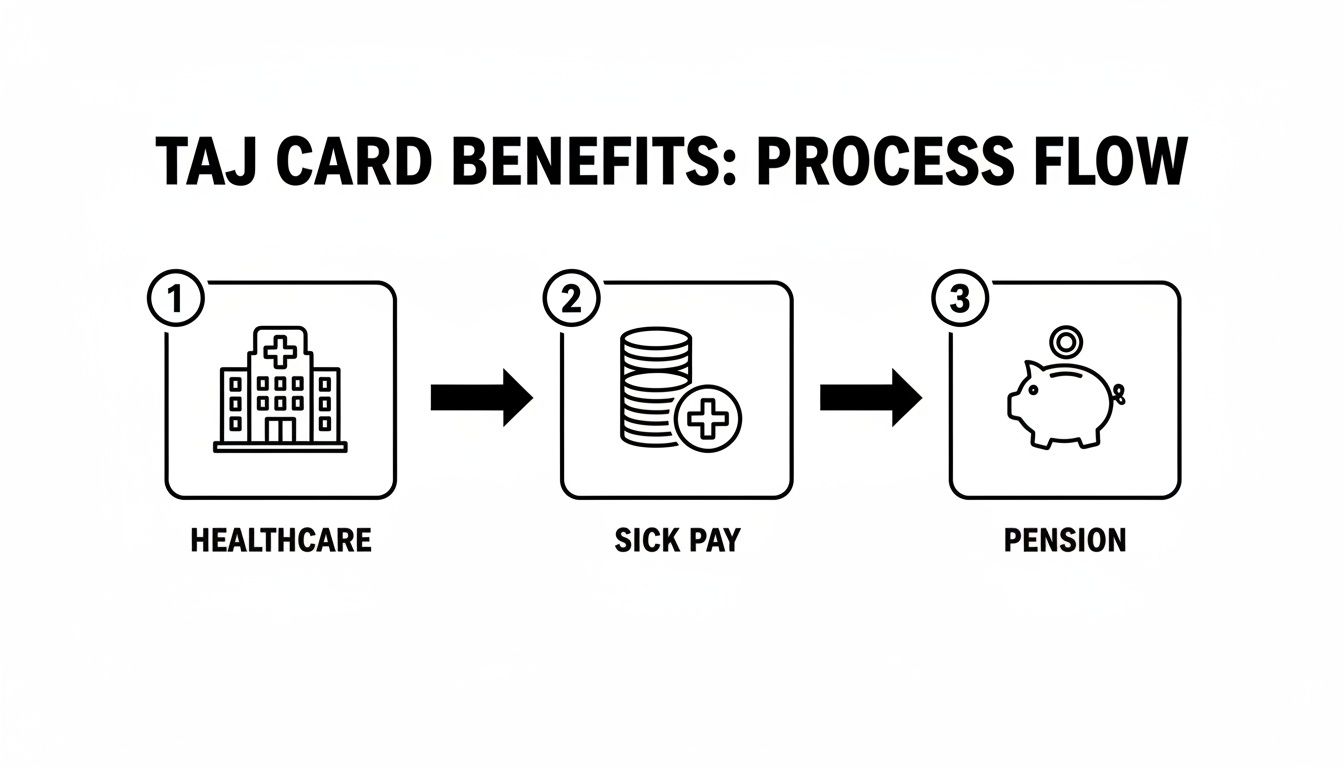
As this illustrates, the card provides a direct link to everything from medical care to long-term financial stability via the pension system.
Key Differences for EU vs. Non-EU Citizens
The required documentation and processing times differ significantly based on an employee's citizenship. This detail directly impacts your onboarding schedule and resource planning.
- For EU Citizens: The process is relatively streamlined. With a Hungarian address card and registration certificate, an EU citizen can typically obtain a Tax ID in 1-2 business days. The TAJ card usually follows within 8-15 days.
- For Non-EU Citizens: The timeline is longer. The entire process depends on first securing a valid residence and work permit. Once these are in place, the applications for the Tax ID and TAJ card can proceed, with a typical waiting period of 2-4 weeks.
The most common bottleneck is incomplete or incorrect documentation. For foreign nationals, a minor error on a passport, permit, or address card can cause delays that push an employee's start date back by weeks. Meticulous attention to detail is crucial here.
Understanding these two distinct paths is vital if you are hiring from a global talent pool. Getting these timelines right is a business imperative that allows you to make high-value talent productive faster.
Managing Employer Payroll and Compliance Obligations in Hungary
Once your new hire has their TAJ card and Tax ID, your ongoing responsibilities as an employer begin. In Hungary, this means meticulous payroll management and accurate social contribution reporting. Correct execution is essential for legal compliance.
At the core is the combined 31.5% social security contribution. This is split: the employer pays 13% of the employee's gross salary, and the employee contributes the remaining 18.5%. For tech firms hiring senior talent on high salaries, calculating and remitting these amounts correctly is non-negotiable.

This process involves more than just transferring funds. It requires timely and detailed reporting through official government portals. A misstep can result in heavy fines, operational disruption, and reputational damage—a significant disadvantage when competing for top-tier engineers.
Navigating Digitalization and System Changes
Hungary's compliance landscape is rapidly digitalizing. A major upcoming change is the complete phase-out of the physical social security booklet by 2026. This move will render the booklet obsolete and transition all administration and reporting to a digital ecosystem managed by the National Tax and Customs Administration (NAV) and the Central Statistical Office (KSH). You can discover more insights about these upcoming regulations in Hungary.
This digital shift underscores the need for robust internal systems. To adapt, many tech employers are implementing efficient HRMS systems that centralize employee data and automate compliance tasks.
Precise, automated compliance is not just an administrative goal; it's a competitive advantage. In a market where top talent has options, a reputation for seamless, reliable payroll builds the trust needed to attract and retain the best people.
Mastering these payroll obligations allows your company to operate without the risk of costly legal traps. It also sends a powerful signal to current and future employees that you are a stable, dependable employer—a significant asset when building a world-class team. For more on that, check out our guide on finding developers for remote jobs in Hungary.
Beyond Compliance: The Strategic Value of Social Contributions
It's easy to view social contributions as a line item on a payroll report—a cost of doing business. However, in Hungary, understanding the destination of these funds provides a strategic advantage, especially when building a high-performance tech team.
For leaders in demanding fields like fintech, recognizing what these payments mean for the Hungarian pension system offers a lens for building a committed, long-term team. These contributions are not just costs; they are foundational to the local talent market. This perspective transforms your benefits package from a simple perk into a tool for long-term talent retention.
The Reality of Hungary’s Pension System
A significant portion of the 31.5% social contribution—split 13% from the employer and 18.5% from the employee—is directed to the state pension fund. While this fulfills your legal obligation, the outcome for your senior engineers at retirement is worth considering.
The outlook is challenging. A late 2024 analysis revealed that of the 2 million-plus pensioners, over two-thirds (1.33 million) receive a monthly payment below the gross minimum wage. This indicates a significant gap between state provisions and the financial future your top talent expects. You can review the challenges facing Hungary's pension system in this report.
This data is a strategic signal. Relying solely on the state-mandated system may not provide the long-term financial security your most valuable team members require, which can impact your retention rates.
When the state pension system faces challenges, private benefits transition from a "nice-to-have" to a powerful tool for attracting and retaining top-tier professionals.
Turning Benefits into a Competitive Advantage
This insight reframes the conversation around employee benefits. It shifts from a cost-centric view to one of strategic investment in your team's future—and, by extension, your company's. Senior engineers and tech leads plan their careers over decades. A benefits package that addresses their future financial stability can be a key differentiator.
Here’s how you can gain a competitive edge:
- Offer supplemental pension plans: Directly contributing to a private pension demonstrates a long-term investment in your employees' well-being.
- Provide financial wellness resources: Help your team understand their contributions and how to plan for the future. This builds significant trust and loyalty.
- Benchmark your total compensation package: Analyze your entire offering—including all benefits—to ensure it is structured not just for today's market, but for long-term talent retention.
This is a calculated business decision. In a competitive talent market, demonstrating an investment in an employee's entire life cycle—from onboarding to retirement—is how you build an employer brand that wins. It ensures the people you need to build your company's future can see their future with you.
Building a Team in Hungary? Don't Let Paperwork Slow You Down.
Managing Hungary's social security system is a critical component of your operational strategy. A failure to grasp the mechanics of the TAJ card, Tax IDs, and employer contributions will lead to setbacks. It directly impacts hiring speed, legal compliance, and overall costs.
Mistakes in this area can result in project delays, financial penalties, and a reputation as an employer who is not operationally sound. In Hungary's competitive tech market, this is a significant disadvantage.
The Strategic Value of a Local Partner
This is where a local expert provides clear value. We navigate Hungary's regulatory environment daily. We can manage the administrative complexities of setting up your team compliantly, allowing you to focus on your core business: building great products.
By offloading the compliance burden, your team can focus its energy on accelerating development cycles. This means a faster time-to-market for your products, giving you a competitive edge.
We ensure your operations run smoothly, from onboarding a new hire to managing monthly payroll. Our role is to mitigate risk and streamline processes so you can scale your team efficiently.
Ready to build your Hungarian tech team without the compliance headaches? Book a call with us today.
Frequently Asked Questions (FAQ)
Hiring in Hungary involves navigating local systems that can appear complex. For tech leaders and hiring managers, these questions are common. Here are direct answers to help you avoid common pitfalls.
How long does it take for a foreign employee to get a TAJ card in Hungary?
The timeline depends on the employee's citizenship. For EU citizens with a Hungarian registration and address card, the process is efficient, typically taking 8-15 days.
For non-EU citizens, the process is longer. The TAJ card application can only begin after their residence and work permits are secured. From that point, expect an additional 2-4 weeks for the TAJ card to be issued. The most frequent cause of delay is incomplete paperwork, which can stall onboarding and impact project timelines.
Are social security contributions capped in Hungary?
No, they are not. This is a critical detail for financial planning, especially for high-paying tech roles. In Hungary, both the 13% employer social contribution tax and the 18.5% employee contribution are calculated on the full gross salary without an upper limit.
When hiring senior talent, you must factor this into your budget. Assuming a cap exists, as it does in other countries, is a common and costly budgeting error.
Can someone start working before their TAJ card arrives?
Yes. An employee can legally begin working as long as you have a signed employment contract and a valid Tax ID number. With these, you can register them with the tax authority (NAV).
However, they will not have access to state-funded healthcare until the physical TAJ card is issued. It is the employer's responsibility to initiate the TAJ application promptly to minimize this coverage gap.
To mitigate risk during this interim period, we recommend providing employees with private health insurance. This demonstrates care for their well-being and ensures a minor health issue does not become a major operational disruption.
At SCALER Software Solutions Ltd, we manage these complexities so you don't have to. We handle all Hungarian compliance requirements, ensuring your team is onboarded smoothly and efficiently, allowing you to focus on building your products.
Ready to build your Hungarian tech team without the red tape? Book a call with us today and let’s get started.
< MORE RESOURCES / >

Fintech
A Guide to Epic Store Szeged and the Local Tech Scene

Fintech
A Guide to Designing a Nordic Light Office for Technical Teams

Fintech
How to Choose an IT Company That Drives Business Outcomes

Fintech
A Consultant's Guide to Part-Time Jobs in Budapest

Fintech
A Consultant's Guide to Peppol Integration for E-Invoicing

Fintech
A Tech Leader's Guide to Nearshore Development

Fintech
PSD2 Integration for CTOs: Real-World Challenges and Architecture Insights

Team augmentation
Hiring vs. Outsourcing: Finding the Right Balance with Team Augmentation

Fintech
Implementing Payment Integration in Fintech: Challenges and Architectural Insights

Team augmentation