
< RESOURCES / >
Remote Jobs in Hungary: A Strategic Guide for Tech Talent and Employers

The market for remote jobs in Hungary is no longer just a growing trend; it's a strategic advantage for global companies. For years, Hungary has been a quiet powerhouse for tech talent. Now, it's a primary destination for senior professionals and businesses looking to accelerate product development and reduce hiring friction. This shift is driven by a deep talent pool, a vibrant startup ecosystem, and robust digital infrastructure, creating an ideal environment for high-impact remote careers.
Why Hungary is a Key Hub for Remote Tech Talent
Hungary, particularly Budapest, has cemented its position as a European centre for remote tech talent. This isn't a post-pandemic fluke; it's the result of specific economic and technological factors creating a sustainable, attractive ecosystem for skilled professionals and the companies that need them.

The data confirms this structural shift. The number of people regularly working remotely in Hungary surged from just 36,000 in 2019 to over 151,000 by 2023. This 319% increase in four years, reported by Hungary's labour force survey, signifies a fundamental change in the country's employment landscape.
Core Drivers of Growth
This expansion is fuelled by more than just lifestyle preferences. Three key drivers are making Hungary a hotspot for remote tech roles:
- Persistent Skills Shortage: Companies globally face challenges in sourcing specialized tech talent, especially in high-demand fields like cloud engineering and fintech. This scarcity compels them to look beyond local markets, opening significant opportunities for skilled professionals across Hungary.
- Government Digitalization Initiatives: Substantial public and private investment has created a reliable digital backbone for a remote-first economy. This improved connectivity and infrastructure reduces operational risk for employers, making it easier to manage distributed teams.
- Thriving Startup Ecosystem: Budapest's startup scene functions as a talent incubator, producing professionals with deep expertise in modern technologies and agile methodologies. These individuals are self-starters who thrive in the autonomous, fast-paced environment of remote work.
A Strategic Destination for Talent and Business
These factors make Hungary more than just another location with remote job listings. For businesses, it represents a strategic talent pool that can break through hiring bottlenecks, forming the core of effective nearshore development strategies. For skilled professionals, it offers access to international projects and cutting-edge technologies without the requirement of relocation.
The business outcome is clear: hiring Hungarian remote talent enables companies to launch critical products faster while controlling development costs. It transforms a hiring challenge into a competitive advantage.
This environment has created a surge in demand for specialists in high-growth niches. Companies building complex fintech solutions, payment platforms, and scalable cloud systems are actively seeking Hungarian engineers. As a result, the market for remote jobs here is not just growing—it's specializing, offering high-impact roles crucial to global business operations.
High-Demand Sectors for Remote Jobs in Hungary
To find high-value opportunities, it's essential to know which sectors are driving demand for remote jobs in Hungary. For a skilled tech or product professional, the goal is to secure a position that solves a critical business problem for a growing company.
The tech and fintech industries are leading the charge. These sectors rely on specialized skills that are difficult to source locally, forcing companies to expand their talent search globally. The post-pandemic labour shortage has intensified this trend. Y-Axis recently highlighted 78,000 job vacancies across medium and large employers, with Budapest alone accounting for roughly 32,000—many in IT and finance. For more context, see their analysis of job opportunities in Hungary.
This talent gap presents a direct opportunity for skilled remote workers to step into high-impact roles.
The Tech and Fintech Epicenter
Budapest has become a hub for companies building sophisticated financial platforms, secure payment systems, and blockchain solutions. These projects involve complex compliance requirements, high-stakes security, and the need for resilient, scalable infrastructure, which is why they seek senior Hungarian talent.
Companies in this space require engineers who are problem-solvers and understand the business logic behind their technical decisions.
A well-architected payment gateway does more than process transactions; it reduces cart abandonment, increases revenue, and builds customer trust. This is the business-oriented thinking international fintech firms are looking for.
The Most In-Demand Tech Roles
Demand is concentrated around specific skill sets that directly help companies accelerate product launches or reduce operational overhead. Mastering these technologies is a strategic move for anyone seeking top-tier remote jobs in Hungary.
The table below outlines the top sectors and the specific tech skills currently in high demand.
Top Remote Job Sectors in Hungary and Key Technologies
These roles require more than just technical proficiency; they demand an understanding of the business impact of your work.
Here’s a closer look at what makes these roles critical:
Full-Stack Developers (React, Node.js): These professionals build both the user interface and the backend logic. Their versatility accelerates feature development, providing a clear time-to-market advantage.
Mobile Engineers (Swift, Kotlin): In a mobile-first world, native mobile developers are essential. They create the secure, reliable experiences required for financial apps where user trust is paramount.
DevOps Specialists (AWS, Kubernetes): These engineers build and automate the cloud infrastructure that enables global scalability. Using tools like Docker and Kubernetes, they reduce deployment risk and control operational costs.
QA Automation Engineers: In fintech, manual testing is insufficient. Automation engineers build robust testing frameworks to ensure security and compliance with standards like PSD2, preventing costly bugs and security vulnerabilities.
Candidates who can connect their technical skills to a business outcome—whether it's improving security, enabling scale, or out-pacing a competitor—are viewed as strategic partners, not just applicants.
Navigating Legal and Tax Requirements in Hungary
Understanding the legal and tax framework is critical for successful remote work in Hungary. For professionals, the key decision is whether to operate as an employee or a contractor. For foreign companies, the challenge is to engage this talent without creating a permanent establishment or violating local labour laws.
This decision tree illustrates the career paths many tech professionals consider.
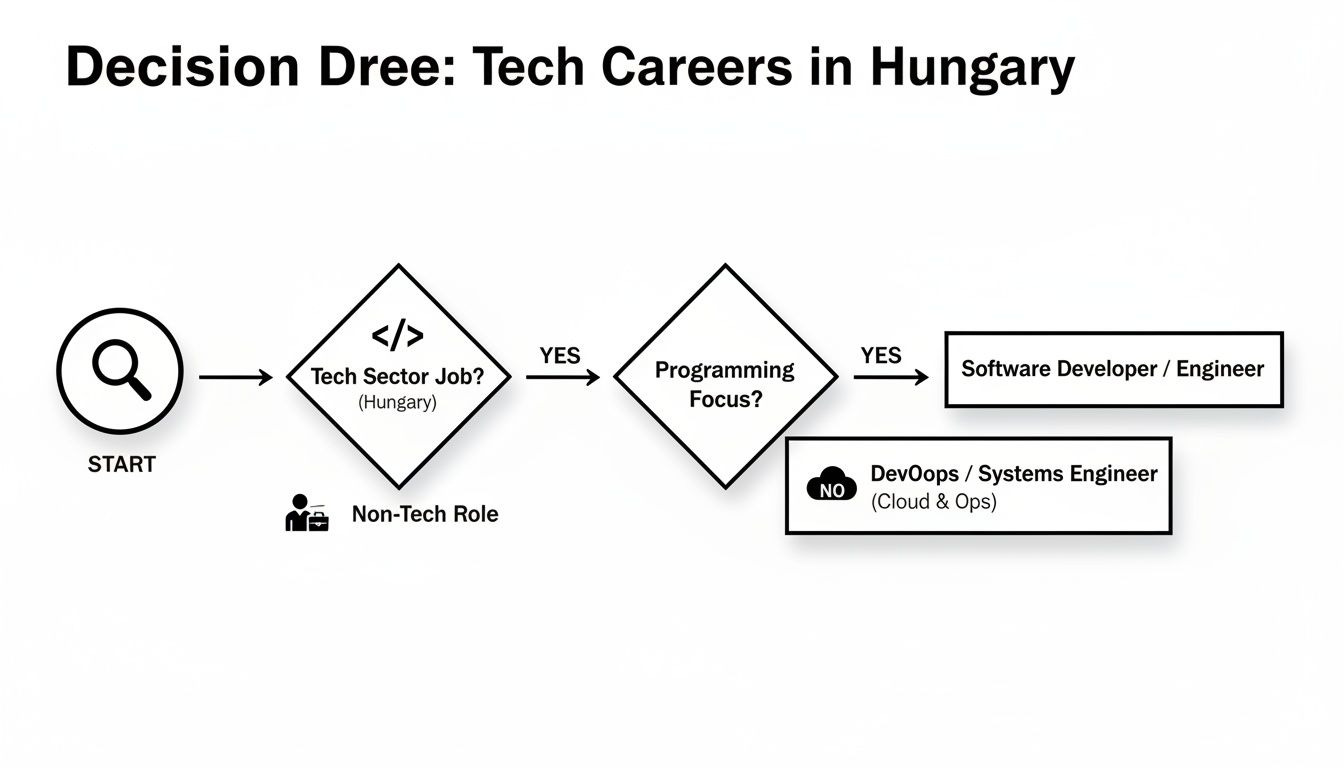
The central position of roles like DevOps highlights where specialized, high-value skills are in greatest demand.
Options for Hungarian Professionals
Your employment structure directly impacts your finances, benefits, and administrative burden.
Standard Employment Contract: This is the most secure option. The employer manages income tax and social security contributions, and you receive full protection under Hungarian labour law, including paid holidays, sick leave, and severance. It offers maximum stability with minimal personal administration.
Self-Employed Professional (Egyéni Vállalkozó): This model offers more autonomy and potentially higher net income but requires you to manage your own business. You are responsible for invoicing, tax payments, and social security contributions. The most common tax scheme is flat-rate taxation (átalányadó), which can be highly efficient if managed correctly.
Operating as a self-employed professional is a mindset shift from employee to service provider. It affects everything from tax filing to your ability to secure a mortgage and requires you to think like a business owner.
For professionals relocating to Hungary, understanding the banking system is a crucial first step. Knowing how to open a bank account in Europe as a non-resident simplifies financial management and local compliance.
Compliant Hiring for International Companies
Directly hiring a Hungarian resident onto a foreign payroll is complex and risky, potentially leading to permanent establishment issues and misclassification penalties. Two compliant and efficient alternatives exist.
Use an Employer of Record (EOR)
An Employer of Record is a third-party company in Hungary that legally employs talent on your behalf. This is the standard solution for companies hiring globally without establishing a local legal entity.
- Compliance Assured: The EOR assumes all legal responsibility for employment, ensuring adherence to Hungarian labour laws, tax regulations, and social security requirements, thereby eliminating misclassification risk.
- Speed and Cost-Efficiency: An EOR allows you to onboard new team members in days, not the months it would take to set up a Hungarian legal entity.
- Administrative Outsourcing: The EOR manages payroll, benefits, and HR administration, allowing your team to focus on core business objectives instead of navigating local bureaucracy.
Partner with a Local Agency
Engaging a local Hungarian partner, such as a development agency, is another effective approach, particularly for project-based work or building full teams. This structure simplifies the engagement to a service agreement, providing a single point of contact and ensuring full compliance.
Benchmarking Salaries for Remote Jobs in Hungary
Determining your market value is a critical step when seeking remote jobs in Hungary. Compensation is not just a number; it's an investment a company makes to solve a business problem, whether that's accelerating time-to-market, reducing technical debt, or driving revenue.
Key Salary Influencers
Your final compensation depends on several factors beyond just a job title.
- Relevant Experience: A senior engineer with a decade of experience architecting scalable systems will command a higher salary than a mid-level developer.
- Niche Technology Skills: Expertise in high-demand technologies like Go or Rust, or specialized knowledge in areas like AWS cloud security or PSD2 compliance, strengthens your negotiating position.
- Type of Employer: A well-funded international scale-up typically has a larger compensation budget than a local startup. The company's funding stage and business model directly impact salary ranges.
Frame salary discussions around the business value you deliver. Instead of stating, "I am a senior developer," present your value proposition: "My experience in cloud cost optimization can reduce your monthly AWS bill by 20%."
Realistic Salary Ranges for Remote Tech Roles
This table provides typical gross annual salary ranges for senior-level remote tech roles in Hungary. These figures are benchmarks and can vary based on the factors discussed.
Estimated Annual Gross Salary Ranges for Remote Tech Roles in Hungary (HUF)
This table offers a snapshot of typical gross annual salary ranges for various senior-level remote technology positions based in Hungary. It's designed to help both professionals and employers get a sense of the current market compensation.
Note that these are guidelines. A candidate with exceptional, difficult-to-find skills working for a top-tier international firm could exceed these ranges.
Actionable Negotiation Strategies
Securing the compensation you deserve requires a professional, data-driven conversation.
- Anchor to Value: Use market research as a starting point, but focus your discussion on the business impact you’ve delivered. Quantify your accomplishments, such as, "I led the development of a feature that increased user retention by 15%."
- Discuss Total Compensation: Look beyond the base salary. A home office budget, professional development funds, stock options, or additional paid time off are valuable components of a total compensation package.
- Maintain a Collaborative Tone: Frame negotiation as a partnership. A phrase like, “Based on the scope of the role and my track record of delivering similar outcomes, I was targeting a figure closer to X. Can we work together to bridge that gap?” keeps the conversation constructive.
Ready to build a high-performing remote team with top Hungarian talent? Schedule a call with us to discuss how we can help you find the right experts for your project.
How to Find and Secure the Best Remote Opportunities
Landing a high-quality remote job in Hungary requires a proactive and strategic approach. The best opportunities are often found through specialized channels and direct networking rather than passive browsing on large job boards.
Building Your Search Strategy
A multi-channel strategy provides the most comprehensive view of the market and maximizes your chances of success.
- Local Hungarian Portals: Sites like Dreamjo.bs and Profession.hu are excellent for understanding the local market and finding roles with companies that have a physical presence in Hungary.
- International Remote-First Websites: Global platforms like We Work Remotely and RemoteOK are ideal for finding roles with international companies offering competitive, location-independent salaries.
- LinkedIn as a Networking Tool: Use LinkedIn for more than just job searching. Follow target companies, engage with content from their technical leads, and connect directly with recruiters and hiring managers. A personalized message can put you on their radar before a position is publicly posted.
Specialized tech service firms and development agencies are another valuable channel. They are constantly seeking senior talent for high-stakes projects with international clients and can provide access to challenging, well-compensated contract work.
Tailoring Your Application for Remote Roles
Your application must demonstrate that you are well-suited for remote work. Companies hiring remotely look for specific soft skills that indicate you can thrive in an autonomous environment.
Remote hiring managers prioritize risk mitigation. They need evidence that you are a self-starter, a proactive communicator, and possess excellent time management skills. Your application is your primary opportunity to provide that proof.
Highlight experiences that demonstrate these remote-native skills:
- Asynchronous Communication: Mention your proficiency with tools like Slack and Jira, but more importantly, provide a specific example of how you used them to advance a project across different time zones.
- Autonomous Project Management: Describe a project you owned from inception to delivery, emphasizing how you defined milestones and achieved results with minimal supervision.
- Proactive Problem-Solving: Recount an instance where you identified a potential issue, communicated it clearly, and implemented a solution before it impacted the project. This demonstrates ownership and initiative.
Vetting Potential Employers
An interview is a two-way evaluation. You must vet the company's remote culture to ensure it is a genuinely supportive and well-structured environment.
A poorly managed remote setup leads to burnout. Ask targeted questions to understand their processes:
- What are your specific processes for collaboration to prevent team members from working in silos?
- What is the company's policy on flexible hours and asynchronous work across time zones?
- How do you support professional development and career progression for remote employees?
- Can you walk me through the onboarding process for a fully remote new hire?
Their answers will reveal whether they have intentionally built a culture that enables remote success or are simply offering remote work as a superficial perk.
A Hiring Manager’s Guide to Sourcing Talent in Hungary
For CTOs and engineering managers, successfully hiring and managing remote talent in Hungary requires a structured process that minimizes hiring errors and accelerates time-to-market.

Success with remote teams depends less on specific tools and more on a robust system built on trust, clear processes, and effective communication.
Crafting a Job Description That Attracts Top Talent
Your job description is your first pitch to a senior engineer. It must sell the impact of the role, not just list technical requirements. Instead of "Experience with AWS," frame it as, "You'll own our AWS infrastructure to guarantee 99.99% uptime for our core payment services." This shift attracts problem-solvers who think in terms of business outcomes.
Running an Efficient Remote Interview Process
A well-designed interview process accurately assesses skills without creating unnecessary friction for candidates.
- Initial Screen (30 minutes): A brief call to confirm alignment on core requirements and culture.
- Practical Assessment: A take-home challenge that mirrors a real-world problem they would solve in the role. This respects their time and provides deeper insight than a theoretical whiteboard exercise.
- Technical Discussion (60-90 minutes): A conversation about their solution to the take-home test, focusing on their architectural decisions and problem-solving approach.
- Team Fit Interview (45 minutes): A final conversation with potential teammates to assess collaborative chemistry.
Onboarding and Managing Your Hungarian Team
A structured onboarding process is crucial for integrating new hires and ensuring they become productive quickly. Your plan should include a detailed 30-day schedule with clear goals, introductions to key stakeholders, and immediate access to tools like Jira and Slack. Understanding the broader landscape of IT services Hungary can also provide strategic advantages.
High-performing remote teams operate on trust and clear rules of engagement. This includes daily check-ins, established expectations for response times, and comprehensive documentation to ensure alignment across time zones.
Finally, invest in proper equipment. A high-quality laptop, monitors, and an ergonomic chair are not perks; they are investments in productivity and well-being that signal a long-term commitment to your remote team.
Frequently Asked Questions: Remote Jobs Hungary
Here are answers to some of the most common questions about the remote work landscape in Hungary.
Can foreigners work remotely from Hungary?
Yes. Non-EU citizens can apply for the Digital Nomad Visa (White Card), which is designed for individuals with a verifiable income from a company outside Hungary. EU citizens have the right to live and work in Hungary without a special visa, though residency registration is required. Consulting a local tax advisor is essential for all foreign nationals.
What is the most common payment structure?
For Hungarian talent working with international companies, two models are prevalent:
- Contractor (Egyéni Vállalkozó): Many professionals operate as sole traders, invoicing for their services and managing their own taxes. The flat-rate tax scheme (átalányadó) is a popular and efficient option.
- Employer of Record (EOR): Foreign companies often use an EOR to hire professionals as full employees. The EOR handles local payroll, taxes, benefits, and compliance with Hungarian labour law, providing the stability of an employment contract without requiring the foreign company to establish a local entity.
Are remote salaries in Hungary competitive?
Yes, particularly in the tech sector. Remote salaries are strong by local standards and are increasingly competitive with those in Western Europe. While the gross salary may be lower than in cities like London or Berlin, Hungary's lower cost of living often results in higher purchasing power and an improved quality of life.
A strong offer includes more than just base salary. Evaluate the entire compensation package, including benefits, bonuses, and the inherent value of work-life flexibility.
How can companies ensure effective remote team collaboration?
Managing a distributed team requires intentional effort. Success depends on establishing clear communication protocols, fostering a culture of trust, and leveraging tools like Jira and Slack to maintain alignment. Investing time in developing effective processes is crucial for productivity and team cohesion. For a deeper dive, review an ultimate guide to managing remote teams effectively.
At SCALER Software Solutions Ltd, we connect ambitious companies with Hungary's pre-vetted, top-tier tech talent. Whether you need senior engineers to augment your team or a dedicated squad to manage a project end-to-end, we deliver secure, scalable solutions.
Request a proposal to build your high-performing remote team today.
< MORE RESOURCES / >

Fintech
A Guide to Epic Store Szeged and the Local Tech Scene

Fintech
A Guide to Designing a Nordic Light Office for Technical Teams

Fintech
A Tech Employer's Guide to Hungary's Social Security System

Fintech
How to Choose an IT Company That Drives Business Outcomes

Fintech
A Consultant's Guide to Part-Time Jobs in Budapest

Fintech
A Consultant's Guide to Peppol Integration for E-Invoicing

Fintech
A Tech Leader's Guide to Nearshore Development

Fintech
PSD2 Integration for CTOs: Real-World Challenges and Architecture Insights

Team augmentation
Hiring vs. Outsourcing: Finding the Right Balance with Team Augmentation

Fintech