
< RESOURCES / >
A Consultant's Guide to Job Opportunities in Hungary

Thinking about your next career move in Europe? Hungary presents a compelling, if nuanced, landscape for skilled professionals. The market isn't experiencing uniform growth, but specific sectors are hiring aggressively, creating a competitive environment for talent in areas like technology and engineering. For technical and product-savvy individuals, this guide provides a practical look at where the real job opportunities in Hungary are and how to secure them.
Decoding the Hungarian Job Market Landscape
To make a strategic move, you first need to understand the market dynamics. Hungary's job market is characterized by targeted, sector-specific demand rather than explosive, across-the-board growth. This means your job search must be focused on industries with clear talent shortages. The key is to position yourself as a solution to a business problem in high-demand fields like IT, advanced manufacturing, and business services.
A Data-Driven Snapshot
Let's ground this in reality. As of mid-2025, Hungary's unemployment rate hovered around a tight 4.5%. While a slight uptick from previous years, this figure still indicates a stable job market where skilled professionals are consistently in demand. This stability creates leverage for top talent.
The table below summarises the key economic indicators shaping the current job scene.
Hungary Job Market Snapshot
This market tightness directly impacts business strategy. Finding A-players requires a compelling offer, pushing companies to evaluate their talent acquisition models. This is why the conversation around hiring vs outsourcing in our detailed guide is more relevant than ever for firms looking to scale efficiently.
Key takeaway: Despite broader economic sentiment, specific Hungarian industries face a significant talent deficit. This imbalance creates a competitive environment where companies are willing to invest to secure experts who can reduce their time-to-market and mitigate project risks.
Understanding this dynamic allows you to conduct a targeted search, focusing squarely on the sectors and roles where growth is tangible and your skills deliver the most business value.
High-Growth Industries and In-Demand Roles
While the overall job market is stable, certain sectors are driving the demand for talent. Think of the economy not as a single machine, but as a collection of high-performance engines. To land a strategic role, you need to know which engines are accelerating and whether you possess the skills to fuel them.
This diagram illustrates the core tension in the market: low unemployment and a persistent talent shortage, which together are driving wage growth.
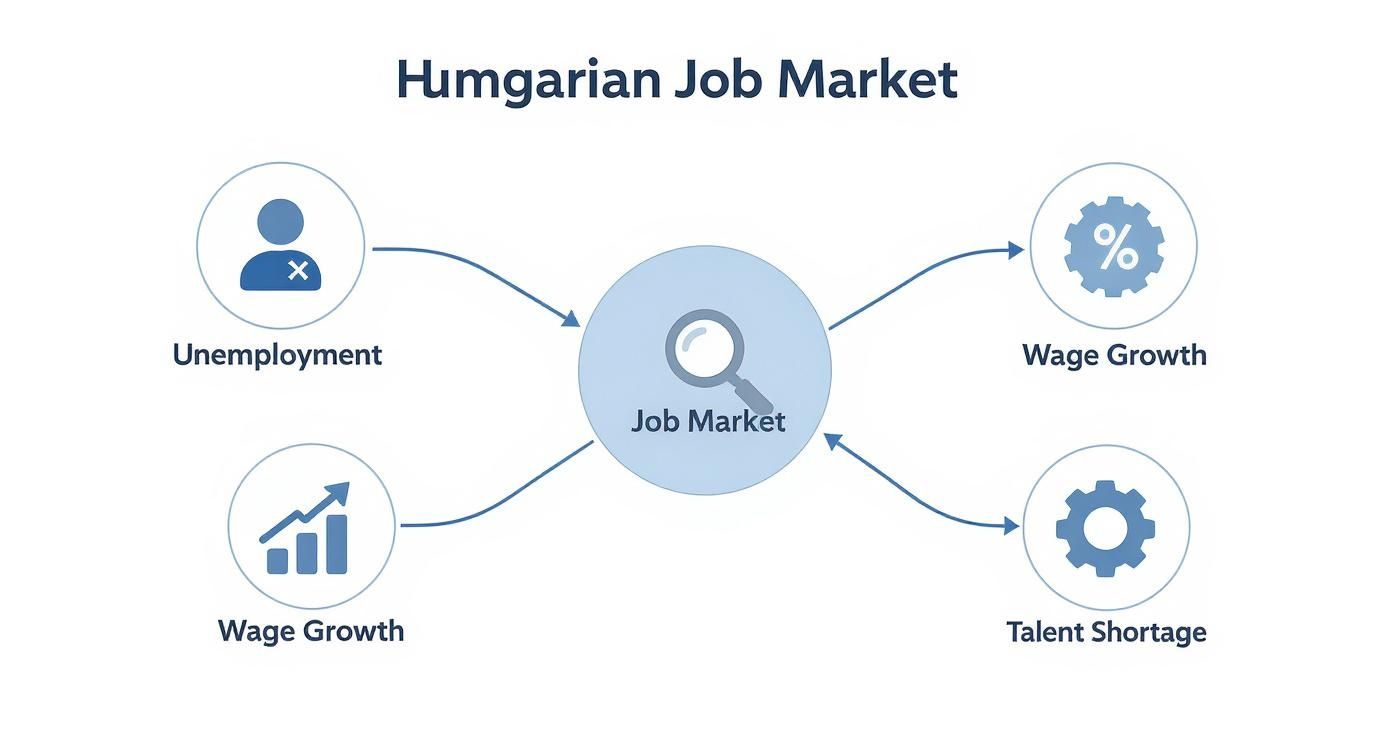
This tension is your opportunity. Companies are competing for talent, and that competition translates directly into better compensation and more interesting roles for qualified candidates.
The Tech and Fintech Powerhouse
Budapest, in particular, has solidified its position as a major European hub for IT and financial technology. This isn't about basic support roles; it's about sophisticated software development, cybersecurity, and financial innovation serving a continental market.
For companies in this space, speed to market is a critical competitive advantage. This creates a non-negotiable demand for skilled engineers who can build, secure, and scale complex systems, directly impacting revenue and market share.
Here's who they are hiring now:
- Java and Python Developers: The backbone for scalable fintech platforms and enterprise applications. Essential for core product development.
- DevOps and Cloud Engineers (AWS, Azure): Responsible for automating deployment pipelines and managing cloud infrastructure. Their work is critical for reducing operational costs and preventing revenue loss from downtime.
- React and Node.js Developers: Build the modern, responsive user interfaces that are key to customer acquisition and retention in a competitive digital landscape.
Advanced Manufacturing and Engineering
Hungary has deep roots in industrial production, with a highly advanced manufacturing sector, particularly in automotive and electronics. The primary business objective is to increase production efficiency and maintain a competitive edge through automation and smart factory initiatives.
This has created a significant demand for engineers who bridge the gap between physical machinery and digital control systems. This talent gap is persistent. Hungary currently has around 78,000 job vacancies in medium to large companies, with manufacturing, engineering, and IT consistently among the most sought-after fields. You can find more details in the EU's official economic forecast for Hungary.
The challenge for Hungarian manufacturing isn't just about volume; it's about intelligence. Engineers who can automate processes are not 'nice-to-haves'—they are essential assets for achieving cost-efficiency and sustainable growth.
The Shared Service Centre (SSC) Ecosystem
The Shared Service Centre (SSC) and Business Process Outsourcing (BPO) sector is a major employer of multilingual professionals. These centres act as the operational backbone for multinational corporations, handling finance, HR, IT support, and supply chain logistics for their European operations.
The business model is built on efficiency, standardisation, and compliance. To achieve this, they require a specific blend of talent: deep domain expertise combined with strong language skills.
- Multilingual Project Managers: Coordinate cross-border teams to ensure projects are delivered on time and within budget.
- Financial Analysts and Accountants: Fluency in languages like German, French, or Dutch is often required to manage financial operations and ensure compliance for different European markets.
- IT Support Specialists: Provide the technical support that prevents minor issues from escalating into major productivity and revenue losses.
Finding Your Fit: Hungary's Key Career Hubs
When evaluating job opportunities in Hungary, geography matters. While Budapest is the nation's economic heart, focusing solely on the capital could mean overlooking significant growth in other regional hubs. The right location depends on a balance between your career objectives, lifestyle preferences, and cost of living.

Budapest: The Tech and Business Epicentre
Budapest is the undisputed centre for careers in technology, finance, and international business. The city is home to multinational headquarters and a vibrant ecosystem of startups and scale-ups. Its robust infrastructure, large international community, and dynamic social scene make it a natural magnet for global talent.
This concentration of companies fuels a constant demand for roles in software development, project management, and finance, creating a competitive but rewarding environment. Businesses here are often exploring flexible talent models, and understanding how nearshore development can provide a competitive edge is valuable for both companies and candidates.
Debrecen: The Rising Industrial Powerhouse
In the east, Debrecen is rapidly emerging as a major industrial and manufacturing hub. Significant foreign investment, most notably from automotive giants like BMW, has created strong demand for professionals in engineering, logistics, and manufacturing technology.
- Key Focus: Automotive, electronics, and advanced manufacturing.
- Talent Needs: Automation engineers, supply chain specialists, and quality control managers.
- Business Outcome: Companies are focused on scaling production and optimising factory operations. Skilled engineers are critical for achieving cost and efficiency targets.
Debrecen offers a career path focused on tangible production and operational excellence, with a significantly lower cost of living, providing a compelling alternative to the capital.
Szeged: The Research and Development Hub
In the south, Szeged has carved a niche as a hub for R&D, particularly in software and life sciences. Home to one of Hungary's top universities, the city benefits from a strong pipeline of academic talent that feeds its growing innovation sector.
For technical professionals, Szeged offers a unique opportunity to work on deep-tech projects in a close-knit community. Companies here are often engaged in foundational research and product development, distinct from the client-facing roles more common in Budapest.
The city offers an excellent work-life balance and a lower cost of living, making it ideal for professionals who want to contribute to groundbreaking projects without the pace of a large metropolis.
Understanding Salary Benchmarks and Compensation
Compensation is a critical factor in any career decision. In Hungary, salaries are a direct reflection of market demand, skill scarcity, and broader economic trends. Approaching negotiations with reliable data is essential to securing a package that reflects your value.
Before entering discussions, it's important to know what is salary benchmarking. This practice allows employers and candidates to align on fair compensation by comparing a role against industry and regional standards. For you, this knowledge is leverage.
The Impact of Rising Labour Costs
A defining trend in Hungary's current job market is strong wage growth and rising labour costs. This is excellent news for skilled professionals, as it signifies that companies are investing more to attract and retain top talent.
The country’s labour cost index reached a record 169.7 points in mid-2025, a notable increase from 165.4 the previous quarter. This index has more than doubled since 2000, illustrating the long-term rise in the valuation of skilled work. Coupled with a year-on-year gross wage increase of 9.7%, the financial proposition of working in Hungary is increasingly attractive. You can discover more insights about Hungary's labour market on The Global Economy.
This data is more than a statistic—it's your negotiating tool. It demonstrates that businesses are willing to pay a premium for skills that reduce risk, accelerate project delivery, and drive revenue.
Typical Salary Ranges for Professional Roles
While compensation varies by city and company, Budapest serves as the primary benchmark for professional salaries. The following table provides typical annual gross salary ranges for in-demand roles to give you a concrete starting point.
Typical Annual Gross Salary Ranges in Budapest (EUR)
This table provides estimated salary ranges for common professional roles in Hungary's capital.
Familiarising yourself with these figures is the first step toward negotiating a compensation package that accurately reflects your market value.
Navigating Visas, Work Permits, and Language
Let's address the practicalities: visas, permits, and language. Missteps here can cause significant delays, impacting both your personal plans and your employer's project timelines. It is crucial to understand the requirements from the outset.
For EU/EEA citizens, the process is straightforward. You can work in Hungary without a permit, with the only administrative requirement being to register your residency after three months. For employers, this freedom of movement is a significant advantage, reducing administrative overhead and accelerating onboarding.
The Process for Non-EU Citizens
For individuals from outside the EU, the process follows the Single Application Procedure, which consolidates the residence and work permit applications.
The process is initiated by your employer. Your primary responsibility is to provide all required documents accurately and promptly, as any error can stall the application.
Here is a general outline of the process:
- Job Offer: A signed employment contract is the foundational document.
- Employer Submission: Your company submits the application along with your documents to the immigration authority (NDGAP).
- Biometrics: You will likely need to visit a Hungarian consulate in your home country for fingerprinting and a photograph.
- Approval & Visa: Upon approval, you will receive a Type D visa for entry. You can collect your official residence permit card after arriving in Hungary.
The entire process typically takes 30 to 70 days. Hiring managers must factor this timeline into project planning to avoid disruptions caused by a key team member being unavailable.
Language: English vs. Hungarian
Is proficiency in Hungarian necessary? For many professional roles, no. In the technology, fintech, and shared service sectors, English is the standard working language. You can perform your job duties effectively without speaking Hungarian.
However, viewing language solely through a professional lens is limiting.
While not required for coding or project management, learning basic Hungarian significantly improves daily life, from simple transactions to navigating local services. More importantly, it demonstrates a long-term commitment and respect for the local culture, which can build trust with colleagues and open doors to senior leadership roles that might otherwise be inaccessible. It is a soft skill that discerning hiring managers value.
Building Your Job Search Toolkit
With an understanding of the market, it's time to execute a targeted job search. A scattergun approach is inefficient. Your strategy should focus on platforms where Hungarian recruiters are actively sourcing talent.

Start with local job portals. Sites like Profession.hu and Dreamjobs.hu are the primary channels for most Hungarian companies. Setting up targeted alerts on these platforms is essential to see relevant roles as soon as they are posted.
Polish Your Digital Presence
It's not just about applying; it's about being discovered. A well-optimised LinkedIn profile is critical, as it is the primary hunting ground for local headhunters. Ensure your profile includes keywords relevant to your industry, such as specific technology stacks or business competencies.
Your LinkedIn profile is your professional brand. Recruiters search for specific skills daily. An optimised profile ensures you appear in their searches, effectively bringing opportunities to you.
For specialised fields like tech or finance, connecting with niche recruitment agencies can provide access to unadvertised roles. Exploring a recruitment agency directory can connect you with experts who understand your industry and have established relationships with top employers, streamlining your search.
Understanding modern hiring models is also an advantage. Demonstrating that you know how team augmentation can accelerate projects can give you an edge in interviews.
FAQ: Your Questions on Working in Hungary, Answered
Beyond the job description, you likely have practical questions about the work environment. Here are straightforward answers to common queries from professionals considering a move.
What is the work culture and work-life balance like?
The work culture in most international companies in Hungary is professional and increasingly flexible, aligning with Western European norms. Performance and results are prioritised, though communication can sometimes be more formal than in a typical startup environment.
Work-life balance is generally respected. While occasional long hours may be necessary to meet critical deadlines, the standard 40-hour work week is the norm, not the exception. The "hustle culture" is not prevalent, which supports sustainable performance and helps prevent burnout.
Bottom line: Expect a structured work environment where personal time is valued. The focus is on efficiency and predictability, which is a significant benefit for managing teams and budgets effectively.
How complex is the income tax system for foreigners?
Hungary's tax system is notably straightforward, which is a key attraction for international professionals. The country has a flat personal income tax rate of 15%.
This single, predictable rate applies to your entire salary. For businesses, this clarity simplifies total compensation calculations and payroll forecasting, reducing the risk of financial surprises for both the company and the employee.
Can I secure a quality role without speaking Hungarian?
Yes, absolutely. In specialised fields like IT, fintech, or at shared service centres, English is the official working language, and numerous opportunities are available. Most multinational companies conduct their business entirely in English.
However, not speaking the language can place a ceiling on your career progression, particularly for roles involving local client management or within traditional Hungarian firms. Learning basic Hungarian is a strategic investment for long-term career growth, opening doors to leadership positions and making daily life more seamless.
Ready to build your high-performing engineering team in Budapest? SCALER Software Solutions Ltd provides senior, EU-based talent to accelerate your product roadmap.
< MORE RESOURCES / >

Fintech
A Guide to Epic Store Szeged and the Local Tech Scene

Fintech
A Guide to Designing a Nordic Light Office for Technical Teams

Fintech
A Tech Employer's Guide to Hungary's Social Security System

Fintech
How to Choose an IT Company That Drives Business Outcomes

Fintech
A Consultant's Guide to Part-Time Jobs in Budapest

Fintech
A Consultant's Guide to Peppol Integration for E-Invoicing

Fintech
A Tech Leader's Guide to Nearshore Development

Fintech
PSD2 Integration for CTOs: Real-World Challenges and Architecture Insights

Team augmentation
Hiring vs. Outsourcing: Finding the Right Balance with Team Augmentation

Fintech