
< RESOURCES / >
A Strategic Guide to Team Augmentation

Team augmentation isn’t just a buzzword for hiring freelancers. It's a strategic approach to filling specific skill gaps in your team by embedding outside experts who work as part of your in-house crew. This model ensures you retain full control over the project and its direction—you’re "augmenting" your existing workforce with the exact skills you need, precisely when you need them, to achieve clear business outcomes.
What Team Augmentation Really Means for Your Business
Think of your core team as a high-performance engine. It runs efficiently, but suddenly a project requires a specialized component—say, an engineer with deep expertise in PSD2 compliance or a niche payments protocol. Rebuilding the entire engine is slow and inefficient. Team augmentation lets you slot in that specialist component for exactly as long as you need it, directly impacting your time-to-market.
This isn’t about replacing your people; it’s about enhancing their capabilities. It’s a strategic move to accelerate project delivery, hit critical deadlines, and access expertise that isn't on your payroll, all while managing costs and risks effectively.
The Strategic Payoff
Team augmentation provides a practical solution to common challenges in technology and product development. Here’s how it connects to business outcomes:
- Accelerate Time-to-Market: The traditional recruitment cycle of 2-3 months is a significant bottleneck. With augmentation, a qualified engineer can be integrated into your team within weeks. This speed can be the difference between capturing a market opportunity and ceding ground to a competitor, directly impacting revenue.
- Optimize Cost Structure: Sidestep the long-term financial commitments of permanent salaries, benefits, and equipment. This model converts a fixed personnel cost into a flexible operational expense, tying your spending directly to project needs for a clearer and more immediate return on investment.
- Maintain Full Project Control: Unlike outsourcing, your internal managers lead the project. Augmented team members report directly to you, integrate into your existing workflows, adopt your company culture, and align with your strategic goals. This mitigates project risk by keeping oversight in-house.
- Access Elite, Niche Talent: Instantly tap into a global talent pool. Need an expert in Open Banking APIs, a specific machine learning framework, or a rare programming language? Augmentation provides access to specialists you would otherwise struggle to find and hire locally, reducing recruitment risk and cost.
Team augmentation is about precision. It’s not about bloating headcount; it’s about injecting targeted expertise to solve a specific problem—whether that’s clearing technical debt, launching a minimum viable product (MVP) faster, or navigating complex regulatory hurdles.
The goal is to boost your team's capacity and skills without disrupting its core structure. For a deeper look at the process, our guide on team augmentation services breaks down the mechanics. To survey the market, you can explore top IT staff augmentation companies for additional context.
Comparing Team Augmentation to Other Staffing Models
Choosing the right staffing model is a critical strategic decision that impacts your budget, project control, and speed to market. While team augmentation is an effective way to inject specific skills, it's essential to understand how it compares to other options to determine the best fit for your business objectives.
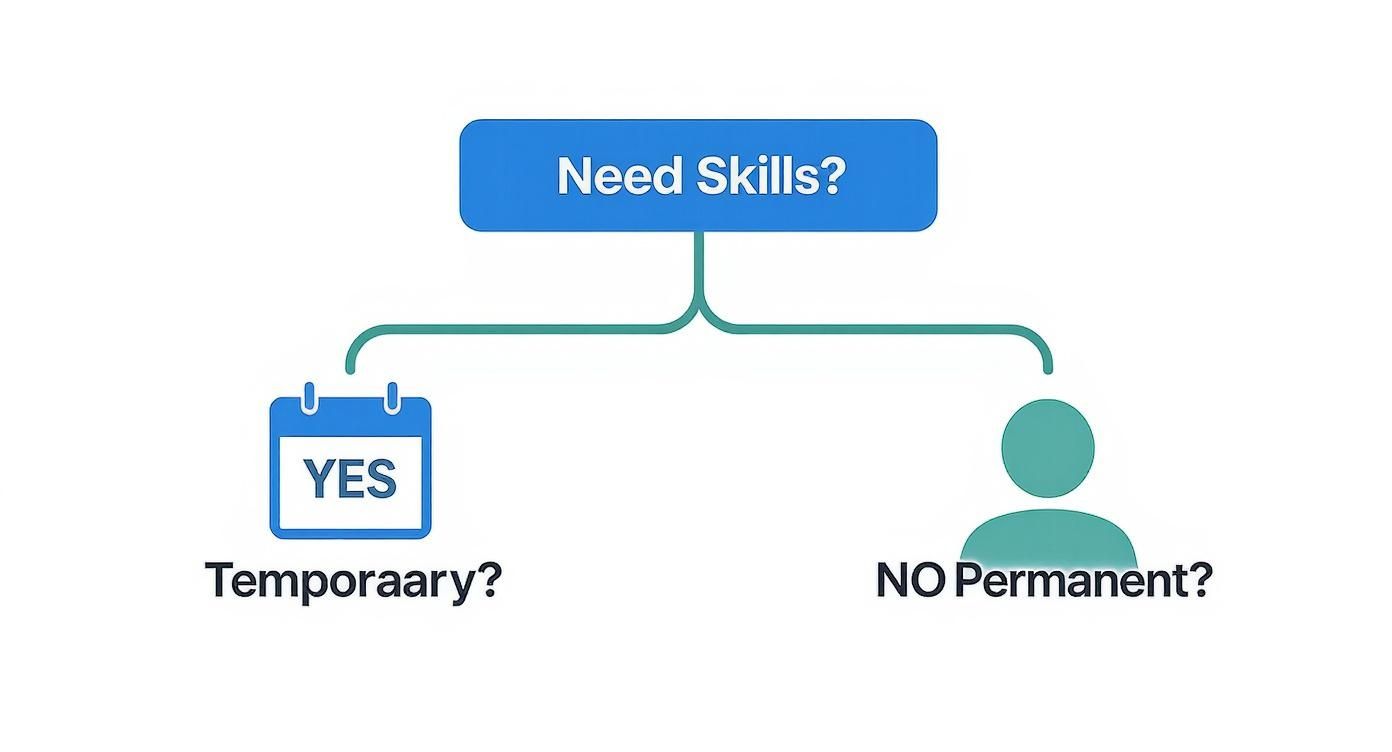
The flowchart illustrates a simple decision tree: augmentation is your answer for temporary skill gaps. If the need is permanent, direct hiring is the more logical path.
Let's break down the comparisons against the main alternatives.
A High-Level Comparison of Staffing Models
Before diving into specifics, here is a summary of how these models differ. Each is designed to solve a different business problem, so understanding the trade-offs is key.
This table provides a snapshot, but the strategic implications are in the details.
Team Augmentation vs. Project Outsourcing
Think of the difference in terms of operational control. Team augmentation is like hiring a world-class specialist to join your internal team for a complex project. They work within your environment, follow your processes, and report to your leadership. You retain complete control.
Project outsourcing, in contrast, is like commissioning a third party to deliver a finished product. You define the desired outcome, but you hand over the management of the team, tools, and methodology.
- Who is in charge? With augmentation, you are. You manage the talent day-to-day. With outsourcing, the vendor manages their own team to deliver a result.
- How integrated are they? Augmented staff are in your daily stand-ups and Slack channels. Outsourced teams typically have a single point of contact, keeping them at arm's length.
- When is it used? Augmentation is ideal when you need to accelerate a project without ceding control. Outsourcing is effective for non-core functions where you can clearly define the "what" and let a partner determine the "how." For a deeper dive, see our guide on hiring vs outsourcing.
Team Augmentation vs. Managed Services
The distinction here is simple: are you buying people or an outcome?
With managed services, you offload an entire business function, typically for the long term, such as IT helpdesk support or cybersecurity monitoring. You sign a Service Level Agreement (SLA), and the provider is accountable for maintaining that service. You don't manage the individuals doing the work, only the result.
Team augmentation is about filling a skills gap, not a function gap. You aren't asking a provider to "run our cloud infrastructure." You're asking for a senior DevOps engineer to join your team to help you run it better.
The core difference is accountability. With managed services, the provider owns the outcome of the service. With team augmentation, you own the project outcome, and the augmented staff member is accountable to you for their tasks.
Team Augmentation vs. Independent Contractors
Hiring a freelancer might seem similar to augmentation, but the operational model is different. An independent contractor is a one-person business you engage directly. This offers flexibility but places the entire burden of sourcing, vetting, and administration on you.
An augmentation partner handles that heavy lifting. They manage recruitment, screening, payroll, and HR, providing a layer of quality control and saving significant administrative effort, which reduces your operational risk and overhead. Other models like Recruitment Process Outsourcing (RPO) exist, but they involve outsourcing the entire permanent recruiting function, not just filling a temporary role.
The Core Benefits of Team Augmentation
Understanding team augmentation conceptually is one thing; seeing its direct impact on project timelines and your bottom line is another. This model addresses classic operational bottlenecks that delay launches and inflate budgets. It's not just about filling a seat—it's about leveraging your staffing strategy to create a competitive advantage.

Let's break down the tangible business results.
Get to Market Before Your Competitors Do
In a competitive landscape, speed is a primary driver of revenue. Traditional recruitment is a notorious bottleneck, with the hiring process often taking months. Team augmentation bypasses this delay by providing pre-vetted, skilled professionals who can integrate into your team in a fraction of the time.
This acceleration directly translates to business value. Launching a product or feature ahead of the competition means you begin generating revenue sooner and can capture critical market share.
The real win with team augmentation isn't just speed; it’s about converting that speed into a tangible market advantage, enabling you to build and deploy while competitors are still scheduling interviews.
Unlock Real Cost Efficiency
A full-time employee's salary is just the beginning. You also have benefits, insurance, payroll taxes, equipment, and training to consider. Team augmentation converts these fixed, long-term liabilities into a predictable and manageable operational expense.
Here’s where you see the savings:
- Reduced Overhead: Eliminate costs tied to employee benefits, hardware, and HR administration.
- No Recruiter Fees: Your partner handles sourcing and vetting, saving you the significant fees charged by recruitment agencies.
- Pay Only for What You Need: Spending is tied directly to project scope and duration. When the work is done, the cost ends, preventing the financial drag of an underutilized permanent hire.
This approach provides a much clearer view of your project's return on investment.
Gain the Flexibility to Pivot Instantly
Markets shift, priorities change, and unexpected opportunities arise. A rigid team structure cannot adapt quickly enough. Team augmentation provides the elasticity to scale your development capacity up or down without the friction of traditional hiring or layoffs.
This flexibility is a significant advantage for managing business risk. Need to double your engineering team for a critical three-month push? Done. Does a project need to be paused or scaled back? You can do it without the complexities of reassignments or redundancies. This agility ensures your team size always matches immediate business needs, preventing costly over-hiring.
The market reflects this shift. For instance, Hungary's IT services market is projected to reach $2.06 billion in 2025, driven largely by demand for flexible talent models. This trend is global. More details are available on Hungary's IT augmentation market on TechBehemoths.com.
Getting Team Augmentation Right: A Practical Playbook
Knowing what team augmentation is and executing it successfully are two different things. A solid, repeatable plan is necessary to integrate new members and ensure they are productive from day one. Without it, you risk a slow, frustrating start that wastes time and money.
It’s about seamless integration, not just filling a role.

Without a clear plan to move from contract to contribution, you create mismatched expectations and drag down your core team's productivity. Here’s how to avoid that.
Define Roles With Brutal Clarity
Ambiguity is the enemy of productivity. Before any work begins, everyone must understand what a successful contribution looks like. A job title is not enough.
Create a concise, one-page role document covering:
- The Mission: What is the single most important outcome this person is responsible for? (e.g., "Integrate the new payment gateway API and ensure it is live by Q3.")
- Key Responsibilities: List the top 3-5 tasks they will own to prevent scope creep and maintain focus.
- Decision-Making Authority: Specify what decisions they can make independently and when they need to consult others.
- Key Contacts: Name the go-to people for technical questions, product decisions, and administrative support.
This document serves as a single source of truth, aligning expectations from the start.
Onboard Fast, Onboard Well
Onboarding is not just a checklist for software access; it's about immersing someone in the project's context and your team's culture. A poor onboarding process is a surefire way to kill momentum.
The first week is critical. A well-planned onboarding process can reduce the time it takes for a new member to become productive by over 50%, converting a slow ramp-up into immediate impact.
Your onboarding checklist should be a living document that covers three key areas:
Cultural and Team Immersion:
- Schedule brief, informal introductions with key team members.
- Share your "unwritten rules" regarding communication styles and meeting etiquette.
- Assign a "buddy" from the existing team to handle small, informal questions.
Technical and Project Setup:
- Ensure all hardware and software access is granted before their first day.
- Provide clear documentation on the codebase, architecture, and local development environment.
- Walk them through the CI/CD pipeline and deployment process.
Process and Tooling:
- Provide a hands-on tour of your project management tools (e.g., Jira) and your specific workflow.
- Explain your version control system and branching model (e.g., Git flow).
- Clarify the purpose and schedule of all recurring meetings, from stand-ups to sprint planning.
- Daily Stand-ups: This non-negotiable ritual keeps everyone synced, identifies blockers, and maintains alignment.
- A Single Source of Truth: Use a tool like Confluence or Notion for all project documentation to prevent knowledge from getting lost in DMs and emails.
- Standardized Tools: Ensure everyone uses the same real-time chat (Slack, Teams) and collaborative whiteboards (Miro, Figma) for architecture and design discussions.
- Velocity or Story Points Completed: A straightforward measure of work contributed per sprint.
- Cycle Time: The time it takes for a task to move from "in progress" to "done," a key indicator of efficiency.
- Code Quality Metrics: Monitor the bug-to-feature ratio or feedback from code reviews to ensure quality is not sacrificed for speed.
- Project Milestone Achievement: The ultimate test. Is the augmented team member helping you meet delivery dates?
Time and Materials (T&M): This is the standard for most augmentation engagements. You pay an agreed hourly or daily rate for the time experts spend on your project. It’s ideal for agile development, where you need the flexibility to adapt without rewriting a contract. The trade-off is that you must maintain strong project management to control costs.
Monthly Retainer: This model is best for long-term, committed engagements. You pay a fixed monthly fee to secure a dedicated developer or team. It provides predictable costs and ensures talent continuity. This is about building sustained momentum and stability.
- Intellectual Property (IP) Rights: This is non-negotiable. The contract must state unequivocally that all code and work created by the augmented team belongs 100% to your company.
- Confidentiality and Non-Disclosure: This is a critical clause to protect your trade secrets, business logic, and any sensitive customer data the team members will access.
- Data Protection and GDPR Compliance: If you operate in a regulated industry like fintech, your contract must bind the provider to comply with regulations like GDPR. A failure here can result in significant fines and reputational damage.
- Termination Clause: Every partnership needs a clear exit strategy. The contract should define the notice period for ending the agreement and outline the offboarding process, including the handover of all code, documentation, and assets.
- Go beyond the technical interview. Dedicate time to behavioral questions. Ask how they handle feedback, manage disagreements, and approach collaboration on complex problems.
- Conduct a "chemistry check." Arrange an informal video call between the candidate and your key team members. It’s a conversation, not an interrogation, designed to gauge how well they will fit into your team's daily dynamic.
- Create a detailed Statement of Work (SoW). Be specific. Define project goals, deliverables, key milestones, and individual responsibilities.
- Schedule regular one-on-ones. A weekly or bi-weekly check-in is essential for reviewing progress, addressing blockers, and ensuring alignment. This isn't micromanagement; it's proactive course correction.
A structured approach helps new members feel integrated, giving them the confidence to contribute meaningfully and quickly. Understanding regional collaboration styles is also beneficial, a topic we cover in our guide to nearshore development.
Set Up Bulletproof Communication Channels
With an augmented team, communication is the operational backbone. You cannot over-communicate.
Keep the plan simple but consistent:
Measure What Matters: Setting Smart KPIs
Finally, you must measure effectiveness. Success isn't about hours logged; it’s about impact delivered.
Focus on Key Performance Indicators (KPIs) that connect directly to business value:
Defining these metrics upfront provides an objective way to measure the ROI of your team augmentation strategy.
Getting Contracts and Commercials Right
Let's address the commercial and legal framework that underpins a successful partnership. Getting this wrong can turn a smart strategic move into a source of budget overruns and legal headaches. The goal is to create an agreement where your vendor's success is aligned with your project's success.
Finding a Pricing Model That Fits Your Project
Your payment model should align with your project's nature. Each model allocates risk and flexibility differently.
T&M is like paying a consultant by the hour—perfect for flexible, agile work. A retainer is like having a specialist on staff—predictable, stable, and dedicated. The choice depends on whether your priority is flexibility or stability.
The Contract Clauses You Can't Afford to Skim
A well-drafted contract is your primary risk mitigation tool. While your legal team handles the fine print, product and tech leaders must understand the clauses that directly impact security, compliance, and ownership.
Here are the absolute must-haves:
Nailing these details upfront is what separates a successful team augmentation partnership from a cautionary tale. It’s how you secure top talent without exposing your business to unnecessary risk.
Common Pitfalls in Team Augmentation (and How to Sidestep Them)
Even a well-designed team augmentation strategy can encounter challenges. Understanding common pitfalls is the first step to avoiding them, ensuring your new talent accelerates your project rather than creating drag.
Let's break down the most common traps and the practical steps to steer clear.
Overlooking Cultural Fit
This is the quickest way to derail an engagement. You can hire a brilliant developer, but if they cannot sync with your team’s communication style or work ethic, friction is inevitable. This slows down progress and erodes team morale.
How to avoid it:
Letting Communication Silos Form
When augmented team members feel like outsiders, they hesitate to ask questions or share ideas. This leads to knowledge silos, duplicated work, and bugs that should have been caught earlier. You end up paying for an expert whose full value you cannot access.
The real risk of poor communication isn't a missed Slack message; it's a breakdown in shared ownership. When augmented staff are truly integrated, they don't just work on the project—they become accountable for its success.
Be deliberate about communication. Establish daily check-ins, ensure everyone has access to the same documentation and tools, and actively include augmented members in all relevant discussions.
Setting Vague Expectations
Ambiguity is the silent killer of productivity. If new team members lack a clear understanding of their role, responsibilities, and success metrics, they are set up to fail. This leads to scope creep, wasted time, and frustration on both sides.
How to avoid it:
By anticipating these common pitfalls, you can transform team augmentation from a simple staffing solution into a genuine strategic advantage.
Frequently Asked Questions about Team Augmentation
Here are answers to some of the most common questions leaders have when considering team augmentation.
How do you ensure augmented staff fit our company culture?
Cultural fit is as important as technical skill. A good partner understands this and will incorporate behavioral interviews and "chemistry checks" with your team into the vetting process. The goal is to assess a candidate's communication style, problem-solving approach, and ability to collaborate, ensuring they can integrate smoothly into your team’s workflow without causing friction.
What is a realistic onboarding timeframe?
Speed is a key benefit of augmentation. While a traditional hire can take months, a pre-vetted professional can be ready to start in as little as one to two weeks. A strong partner will have an efficient process for handling contracts and administration, allowing you to focus on project-specific onboarding and get your new team member productive almost immediately. This directly reduces the opportunity cost of an open role.
Who manages the augmented staff?
You do. This is a core distinction from outsourcing. Augmented team members integrate directly into your existing structure. They report to your managers, participate in your daily stand-ups and sprint planning, and receive feedback just like any other employee. The augmentation partner handles HR, payroll, and administration, but you retain full control over the day-to-day work and project direction, minimizing risk and ensuring alignment with your business objectives.
Who owns the intellectual property?
Your company owns 100% of the intellectual property. This must be stated explicitly in your service agreement. The contract functions as a work-for-hire arrangement, ensuring that every line of code, design, and piece of documentation created by the augmented developers belongs entirely to you. Any reputable provider will have this as a standard, non-negotiable clause.
At SCALER Software Solutions Ltd, we provide senior engineering talent to accelerate your roadmap. Our EU-based experts integrate seamlessly with your team to deliver secure, scalable fintech solutions without the delays of traditional hiring.
Ready to fill your skill gaps and ship products faster? Book a free discovery call with our experts today.
< MORE RESOURCES / >

Fintech
A Guide to Epic Store Szeged and the Local Tech Scene

Fintech
A Guide to Designing a Nordic Light Office for Technical Teams

Fintech
A Tech Employer's Guide to Hungary's Social Security System

Fintech
How to Choose an IT Company That Drives Business Outcomes

Fintech
A Consultant's Guide to Part-Time Jobs in Budapest

Fintech
A Consultant's Guide to Peppol Integration for E-Invoicing

Fintech
A Tech Leader's Guide to Nearshore Development

Fintech
PSD2 Integration for CTOs: Real-World Challenges and Architecture Insights

Team augmentation
Hiring vs. Outsourcing: Finding the Right Balance with Team Augmentation

Fintech