
< RESOURCES / >
A Practical Guide to i t consulting for Growth

When you hear "i t consulting," you might picture hiring temporary developers to clear a backlog. That’s one small piece of it. Strategic consulting is about bringing in a specialist to diagnose and solve a critical business problem with a precise, high-impact technology solution.
It's about tackling deep-rooted issues—like a sluggish time-to-market or navigating complex compliance—and turning them into measurable business outcomes like increased revenue, reduced cost, or mitigated risk.
What Strategic i t consulting Really Means for Your Business
Think of your in-house team as a general practitioner, essential for day-to-day operational health. An IT consulting partner is the specialist you call for a specific, critical outcome. Perhaps you need to scale a revenue-generating platform without the long-term cost of a full-time team, or you're wrestling with complex fintech regulations that are slowing you down.
This partnership connects the technology you build to the business goals you need to hit. It’s not just about writing code or managing servers; it’s about using technology as a lever to accelerate growth, reduce risk, and create a tangible competitive advantage.
Aligning Technology with Business Outcomes
At its core, effective i t consulting translates business ambitions into a concrete technology roadmap. This means every technical decision is justified by its impact on your bottom line. A key part of this is building a solid digital transformation strategy framework that makes this alignment clear from the start.
In practice, this focuses on key business outcomes:
- Accelerating Time-to-Market: Leverage specialized expertise to get new products or features launched faster, capturing revenue sooner.
- Managing Costs: Access senior-level talent for critical projects without the long-term financial commitment of full-time hires.
- Reducing Operational Risk: Implement proven architectures and security practices to build systems that are stable, compliant, and ready to scale.
- Boosting Revenue: Build and optimize the platforms that directly drive sales, attract new customers, and support market expansion.
A strategic consultant's value isn't just their technical skill. It's their ability to draw a straight line from a technology choice to a business outcome. They prevent expensive detours by showing you the most direct path from problem to solution.
Beyond Temporary Help
Modern i t consulting is also about building your team's capabilities. It fills critical knowledge gaps—whether in cloud infrastructure, mobile development, or a niche area like Open Banking integrations. This external perspective introduces fresh ideas and challenges the "we've always done it this way" mindset that can stifle innovation.
By bringing in focused expertise exactly when and where you need it, you de-risk your most critical projects, maintain momentum, and ensure your technology investments deliver a clear return.
Choosing Your i t consulting Engagement Model
You've decided that i t consulting can address your challenge. The next critical decision is structuring the partnership. This isn't just administrative; the engagement model shapes project outcomes, budget, and the level of control your internal team retains.
Think of it as choosing the right tool for the job. You wouldn't use a sledgehammer to hang a picture frame. There are three primary models, and selecting the right one aligns the consultant's work with your intended business outcome.
This decision tree can help you visualize whether to leverage internal resources or seek external expertise.
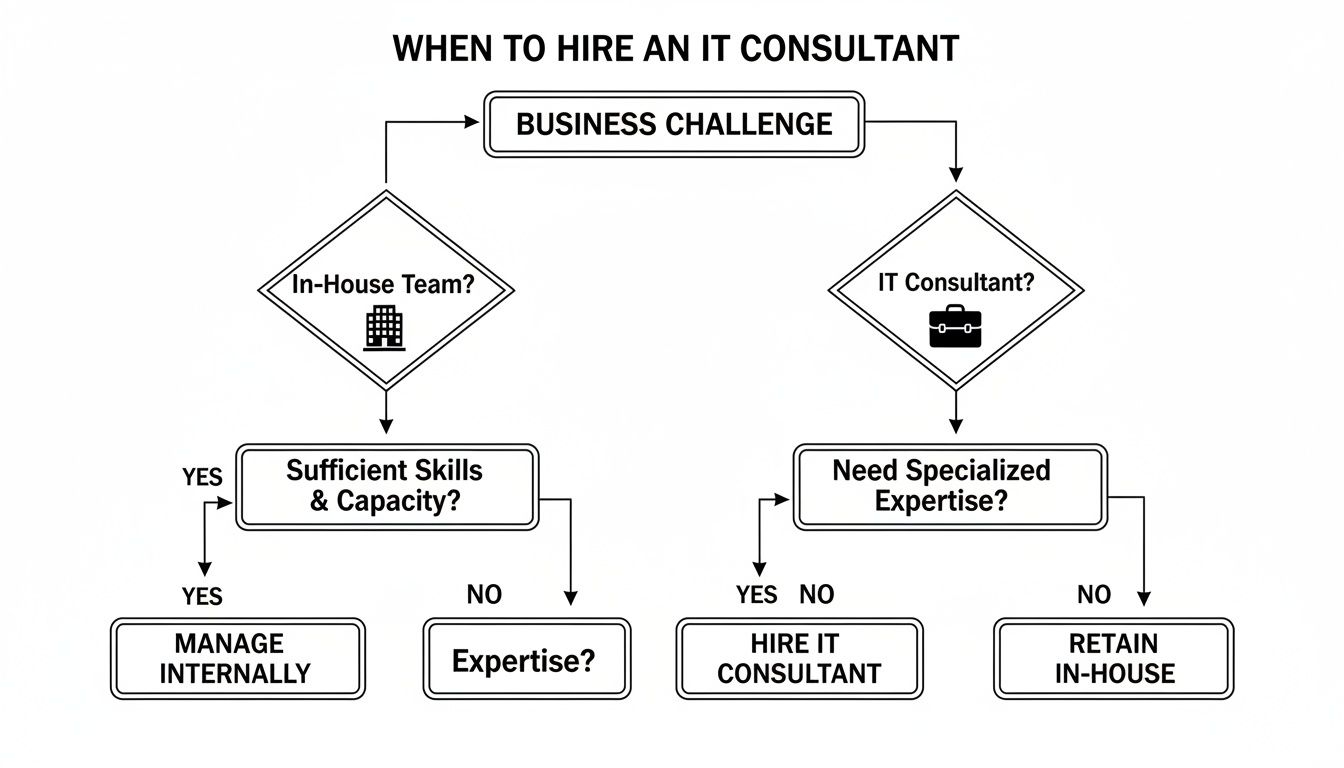
The key question is whether you have the right skills and internal capacity to tackle a specific business challenge effectively.
Staff Augmentation: Bridging Skill Gaps
Staff augmentation is the most direct approach. You bring specialists into your existing team, working under your direct management. It’s like adding a world-class striker to your football squad on a short-term loan to win a specific tournament.
This model is ideal when you have a solid project plan and management in place but are missing a specific skill set—for example, needing a senior iOS developer to complete an app. The business outcome is clear: faster time-to-market by plugging a crucial gap without the delays and costs of a full-time hire.
You maintain full control over the project's direction, while the consultant provides the missing expertise. To see this in action, explore the benefits of flexible team augmentation services designed for seamless integration.
End-to-End Project Delivery: Outsourcing Outcomes
With end-to-end project delivery, you delegate an entire project to your consulting partner. They take full ownership—from discovery and planning through development, testing, and launch—to deliver a specific, agreed-upon result.
This is the best option for large, complex initiatives where you lack the internal expertise or capacity to manage the project effectively. Examples include building a secure payment processing system from scratch or migrating your entire infrastructure to the cloud.
By outsourcing the project, you transfer execution risk to the consulting partner. This frees up your internal leadership to focus on core business strategy instead of day-to-day project management, ensuring key initiatives are delivered without derailing other priorities.
The key business outcome is reduced management overhead and de-risked delivery. You define the "what," and the consultant takes full responsibility for the "how," delivering a finished solution.
Managed Services: For Ongoing Support
Managed services is a long-term partnership where a provider takes ongoing responsibility for a specific business function, such as your cloud infrastructure or application support.
This model is for businesses that need constant, reliable support for mission-critical systems but want to avoid the cost and complexity of building a large in-house operations team. For instance, a managed services provider (MSP) could manage your entire AWS environment, guaranteeing uptime, security, and cost-efficiency.
The primary business outcomes are improved operational stability and predictable costs. You get proactive support that prevents problems before they occur, converting a variable operational expense into a fixed, manageable monthly fee.
Choosing the right engagement model is a strategic decision. Each model offers a different balance of control, cost, and responsibility. The table below breaks down the key differences.
Comparing i t consulting Engagement Models
The best model depends entirely on your needs. Are you looking for a specialist to join your team, a firm to build a solution for you, or a partner to keep things running smoothly? Answering that question is the first step toward a successful collaboration.
The Real Business Benefits of i t consulting
Engaging an i t consulting partner is a strategic move. The real value is not just getting work done; it's in the tangible outcomes that translate technical execution into a competitive edge—impacting your revenue, costs, and risk profile.
A strong consulting partnership is a value creator, not a cost center. For example, a fintech firm racing to integrate a new payment provider can leverage a partner who has done it a dozen times to complete the integration in weeks, not months. This means you start capturing revenue sooner and pull ahead of competitors. The ROI becomes clear.
Accelerate Your Time to Market
In sectors like fintech, speed is a critical advantage. An external team arrives with specialized knowledge that your in-house team might take months to develop—whether that’s deep expertise in PSD2, Open Banking frameworks, or secure trading systems. They have already encountered and solved common problems, effectively de-risking your project from day one.
This directly impacts the bottom line. Launching a new feature three months earlier can mean capturing significant market share before a rival enters. It's a strategic play to boost revenue and establish market leadership.
Access Senior Talent Without the Overhead
Hiring senior technical talent is difficult, expensive, and time-consuming. You face recruitment fees, long onboarding cycles, and high salaries. i t consulting provides direct access to the expertise you need, when you need it, without the long-term financial commitment.
This model allows you to tap into a pool of seasoned engineers, architects, and project managers for your most critical projects. Their experience reduces project risk and elevates the quality of the final product.
The core benefit is converting a large, fixed capital expenditure (hiring) into a flexible, predictable operational expense. You pay for top-tier expertise focused on a specific outcome, ensuring your investment is directly tied to project success.
Mitigate Risk and Ensure Compliance
Technical debt, security vulnerabilities, and regulatory missteps can quietly undermine growth. A sharp i t consulting partner brings an objective perspective to your architecture and processes, spotting risks that internal teams, focused on daily tasks, might miss. Their experience across numerous projects provides an instinct for what a robust, scalable, and secure system looks like.
This is especially critical in heavily regulated industries. Consultants with domain expertise can guide you through compliance requirements, ensuring your solutions are built correctly from the start. This helps avoid costly fines or redesigns and can unlock business opportunities, like achieving SOC 2 certification for startups and SMBs.
This focus on risk management provides several benefits:
- Reduced Likelihood of Breaches: Implementing security best practices protects your data and customer trust.
- Improved System Stability: A scalable architecture prevents performance bottlenecks and costly downtime as you grow.
- Simplified Audits: A well-documented, compliant system makes regulatory audits routine rather than emergencies.
The demand for specialized IT services is growing. In Hungary, for example, the IT consulting market is a significant driver of digital growth. By 2025, the industry reached a market size of €4.1 billion, with 11,606 businesses operating in the sector, reflecting a compound annual growth rate of 2.6% between 2020 and 2025.
The right i t consulting partnership is a powerful lever for growth. It helps you build better products faster, control costs, and operate with more confidence in a complex technical and regulatory environment.
Navigating i t consulting in the Fintech Sector
Fintech is not just another industry. The stakes are higher, the regulations are stricter, and there is no room for error. A generic i t consulting approach often fails because it ignores the unique technical and regulatory pressures fintech companies face daily. Success requires more than skilled developers; it demands deep domain expertise.

A specialized partner understands that every line of code can have compliance implications and that customer trust is as critical as a scalable architecture. This insight helps prevent costly security breaches, ensures regulatory compliance, and protects your reputation.
Mastering Compliance and Open Banking
Regulations like the Payment Services Directive (PSD2) and Open Banking are not just technical requirements; they are the foundation of your business. A mistake can lead to project delays, significant fines, and loss of market access.
An experienced i t consulting partner navigates this complexity, guiding you through integrations with platforms like Stripe or TrueLayer and ensuring your APIs are both functional and compliant. This turns a regulatory burden into a competitive advantage, allowing you to launch new services faster and with greater confidence.
For a fintech, compliance isn't an afterthought; it's part of the product's DNA. A partner with deep regulatory knowledge doesn't just build software—they build a defensible, compliant asset that de-risks your entire business model.
This level of specialization is in high demand. In Hungary, for example, IT-related projects constitute 42% of the country's management consulting market. Financial services firms account for 20% of that spending, highlighting the critical need for this expertise.
Building High-Stakes Financial Systems
The technical demands of fintech are uncompromising. Whether it's a secure payment system, a high-frequency trading platform, or an automated portfolio manager, the need for top-tier security, performance, and reliability is non-negotiable.
An expert i t consulting partner brings battle-tested experience in:
- Secure Payment Processing: Implementing multi-layered security, robust encryption, and effective fraud detection to protect financial data and maintain customer trust.
- High-Frequency Trading Platforms: Architecting systems for near-zero latency and massive throughput, capable of handling millions of transactions without failure.
- Automated Portfolio Management: Developing complex algorithms and solid back-testing frameworks to ensure automated investment decisions are accurate and reliable.
This isn't just about features; it's about business viability. A secure payment gateway prevents a data breach that could destroy your brand. A high-performance trading system enables you to compete. The right partner helps you build solutions that deliver.
Connecting Domain Knowledge to Business Success
Ultimately, the value of a fintech-focused i t consulting partner is their ability to translate specialized knowledge into business results. They understand the market well enough to not only execute your vision but also to challenge and improve it.
They might suggest a technical approach that reduces transaction costs or an architectural pattern that simplifies future compliance audits. This proactive guidance saves time and money, reduces risk, and accelerates your path to profitability. It's a core component of effective end-to-end I T services—the goal is a complete, business-ready solution.
Partnering with a firm that lives and breathes fintech means you're not just hiring developers. You’re gaining a strategic advisor who understands your world and knows how to help you win in it.
How to Choose the Right i t consulting Partner
Selecting the right i t consulting partner is less like hiring a contractor and more like choosing a co-pilot for your business. The wrong choice can lead to blown budgets, missed deadlines, and a product that fails to meet objectives. The right choice provides a genuine extension of your team that drives results and de-risks your most important projects.

The decision goes beyond a technical checklist. While skills are important, the evaluation should focus on how a firm thinks, communicates, and connects its work to your business goals. A partner who understands your market, such as the dynamics of nearshore development, brings a significant advantage in collaboration and cost-effectiveness.
Go Beyond the Tech Stack
Any competent firm can list the technologies they've mastered. That is the baseline. The real differentiators are in their problem-solving approach and their ability to deliver tangible value.
Examine their case studies. Look for proof they’ve solved a problem like yours. A team that helped a logistics company streamline a complex supply chain has demonstrated mastery of operational challenges—a skill directly transferable to a fintech firm building a sophisticated payment flow.
Ask questions that reveal their process:
- How do you keep your technical team focused on our business outcomes, not just the code? Strong answers will mention regular business metric reviews, dedicated product strategists, and frequent check-ins.
- Walk me through a time a project encountered a major obstacle. What happened, and how did you handle it? You're not looking for a team that has never failed; you're looking for one that communicates clearly under pressure and is committed to resolving issues.
- How do you define success? If they only talk about shipping code on time, that’s a red flag. Great partners discuss user adoption, revenue impact, or operational savings.
Use this checklist to help structure your evaluation of potential partners.
i t consulting Partner Evaluation Checklist
The goal is not to find a perfect score but to identify a partner whose approach and values align with your own. The best partnerships are built on shared goals and mutual respect.
This process will guide you toward a team that doesn't just build what you ask for, but helps you build the right thing.
Evaluate Communication and Integration
A strong partnership is built on seamless collaboration. The consulting team should feel like an extension of your own, not a siloed group working from a different playbook. Dig into their communication workflows and their philosophy on team integration.
The biggest risk in any consulting project isn't a technical bug—it's a communication breakdown. A partner who prioritizes radical transparency, provides crystal-clear progress updates, and plugs directly into your team’s tools (like Slack or Jira) turns that risk into a massive strength.
A transparent partner de-risks the entire project. They should provide direct lines of communication to the developers and project managers doing the work, not hide them behind layers of account management.
Assess Cultural Fit and Accountability
Do not underestimate cultural fit. A clash in working styles and values can create constant friction. You want a partner who is proactive, takes ownership, and is not afraid to challenge you when they see a better path forward.
Look for a team that shows genuine curiosity about your business. Are they asking sharp questions about your customers and your market, or are they just waiting for a to-do list? The first is a partner; the second is a pair of hands. That proactive mindset is what separates a project that simply gets finished from one that truly moves the needle.
Understanding i t consulting Pricing Models
Choosing the right pricing model is about aligning financial commitment with your project goals. Getting this right ensures transparency and predictability. Getting it wrong can lead to scope creep and budget overruns.
This decision defines how you manage risk, scope, and flexibility. Most engagements use one of three models: Time & Materials, Fixed Price, or a Retainer. Each offers a different balance between predictability and agility. The best fit depends on your project's nature and your desired level of control.
Time and Materials (T&M)
The Time & Materials (T&M) model is straightforward: you pay for the hours your consultants work, plus the cost of any resources they use. It's like hiring an expert plumber—you pay for their time and the parts.
This model is built for flexibility, making it a perfect match for projects where requirements may evolve.
T&M is best for:
- Agile Development: When the project isn't fully defined upfront and will be developed in iterative sprints.
- Complex Problem-Solving: For R&D challenges or discovery phases where the solution is not yet clear.
- Long-Term Engagements: When you need an expert embedded in your team for continuous support.
The key benefit is agility. You can pivot quickly without renegotiating a rigid contract, which accelerates time-to-market. The trade-off is that it requires your active involvement to manage scope and costs.
Fixed Price Contracts
A Fixed Price model involves agreeing on a single, all-in cost for a well-defined scope of work. It’s like commissioning a custom piece of furniture—you know the exact outcome and cost before work begins, providing complete budget predictability.
A fixed-price contract transfers the financial risk of delays or inefficiencies to the consulting partner. This forces thorough upfront planning and a crystal-clear scope before development starts.
This model works best when requirements are clearly defined and the scope is stable. Examples include building a specific feature for an existing application or a standard website migration. While it provides cost certainty, its rigidity can be a drawback if changes are needed.
Retainer Agreements
A Retainer is for long-term partnerships rather than single projects. You pay a recurring fee for guaranteed access to a team of experts for ongoing strategic advice, maintenance, or support.
The primary value is proactive support and strategic continuity. You have experts on call to address issues or help you capitalize on new opportunities quickly.
Businesses are allocating significant budgets for these strategic services. The Hungarian ICT market, for instance, is projected to reach USD 35.17 billion by 2025. Large enterprises drive this growth, accounting for 63.43% of spending on critical initiatives like digital transformation. You can discover more insights about the Hungarian ICT market trends on Mordor Intelligence.
Ready to find a pricing model that fits your project and budget? Book a call to discuss your needs.
FAQ: Your i t consulting Questions Answered
Here are straightforward answers to the most common questions we hear about engaging an IT consultant.
When should I hire a consultant instead of a full-time employee?
The decision comes down to the nature of the need and the required speed.
Hire a consultant for a specific, high-stakes project with a defined timeline. Examples include launching a new product quickly, navigating a complex compliance issue like PSD2, or needing senior-level architectural expertise for a few critical months. This gives you immediate access to top-tier talent without the long and costly process of a permanent hire.
If the work is core to your daily operations and is ongoing, a full-time employee is generally the better long-term investment.
What is the real ROI of IT consulting?
The return on investment from a skilled consultant extends beyond the code they deliver. It's measured by the business impact.
- Faster Revenue Generation: Launching a product months ahead of schedule means you start earning revenue earlier and capture market share before competitors.
- Reduced Upfront Costs: You avoid recruitment fees and the long-term commitment of a six-figure salary plus benefits for a role you may not need in a year.
- Risk Mitigation: An experienced expert in security and compliance can prevent a catastrophic data breach or a crippling regulatory fine. This represents a massive, though often invisible, ROI.
The most significant return often comes from the costly mistakes you don't make. A good consultant prevents you from building the wrong product or choosing an architecture that fails at scale, saving you from an expensive rebuild down the road.
How do we measure the success of an engagement?
Success should be defined by clear business metrics agreed upon before the project begins.
Track the following:
- Delivery on Commitments: Were key features delivered on time and within budget? This is the baseline expectation.
- Business Impact: Did key metrics move? Did user sign-ups increase? Did operational costs decrease? Did transaction speeds improve?
- Team Integration: How smoothly did the consultants collaborate with your in-house team? Seamless integration is a strong indicator of a successful partnership.
Ultimately, a successful engagement means the consultant solved the specific business problem you hired them to address, delivering measurable value that strengthens your company.
Ready to see how the right i t consulting partner can drive your most important projects to success? The team at SCALER Software Solutions Ltd has deep experience in fintech and product development, helping companies build the secure, scalable solutions that move the needle.
< MORE RESOURCES / >

Fintech
A Guide to Epic Store Szeged and the Local Tech Scene

Fintech
A Guide to Designing a Nordic Light Office for Technical Teams

Fintech
A Tech Employer's Guide to Hungary's Social Security System

Fintech
How to Choose an IT Company That Drives Business Outcomes

Fintech
A Consultant's Guide to Part-Time Jobs in Budapest

Fintech
A Consultant's Guide to Peppol Integration for E-Invoicing

Fintech
A Tech Leader's Guide to Nearshore Development

Fintech
PSD2 Integration for CTOs: Real-World Challenges and Architecture Insights

Team augmentation
Hiring vs. Outsourcing: Finding the Right Balance with Team Augmentation

Fintech