
< RESOURCES / >
A Tech Leader's Guide to Choosing a Hungarian EU Services Kft

When evaluating software development partners in Hungary, you’ll frequently encounter the term EU Services Kft. So, what does it mean for your project? A Kft (Korlátolt Felelősségű Társaság) is Hungary's equivalent of a Limited Liability Company (LLC) or Ltd. This legal structure immediately signals you're dealing with a registered, stable business operating under EU law, which has direct implications for your project's risk, cost, and compliance.
Understanding the Kft Structure: Business and Risk Implications
Engaging with a Kft provides a foundational layer of security. The company is a distinct legal entity, separate from its owners. This isn't a mere administrative detail; it has tangible business outcomes related to liability and operational stability.
For a CTO or product manager, verifying a partner's Kft status is a critical due diligence step. A Kft must meet specific capital requirements and adhere to governance standards defined by both Hungarian and EU law. This structure provides a clear framework for accountability and de-risks the partnership from a legal and financial standpoint.
What a Kft Designation Means for Your Business Outcomes
At its core, a Kft designation indicates a partner’s commitment to formal, professional operations. It translates directly into business advantages for you.
Here’s how this structure connects to clear outcomes:
- Reduced Counterparty Risk: The limited liability model means the company’s assets and debts are separate from the owners’ personal finances. This structural separation minimises the risk of operational disruption tied to individual financial issues.
- Improved Operational Stability: Kfts are mandated to maintain financial transparency and follow corporate governance rules. This points to a mature, more dependable operational setup, reducing the likelihood of project delays or partner failure.
- Enforceable Contracts and IP Protection: You are entering into agreements with a recognised corporate entity. This provides legal weight to your SLAs, intellectual property rights, and deliverable clauses, ensuring your commercial interests are protected.
A Kft designation serves as a baseline credential. It confirms you are dealing with a legitimate, regulated business, which is the first step in de-risking any outsourcing or team augmentation strategy.
To clarify, here is a breakdown of the key attributes of a Hungarian Kft and their impact on your business.
Key Characteristics of a Hungarian Kft
In essence, the "Kft" designation provides assurance that a potential partner is a stable, regulated entity. This forms a solid foundation for any technology partnership, reducing your exposure to operational and financial risks.
Why Hungary is a Strategic Tech Hub
The prevalence of tech-focused Kfts is a direct result of Hungary's emergence as a key technology hub within the EU. The country's services sector is the primary driver of its economic growth, fostering an environment where software and digital services companies can thrive.
For technical leaders sourcing partners, this economic stability points to a mature and reliable market. You can explore the data further at Hungary's Central Statistical Office for additional context.
Navigating Hungarian and EU Fintech Compliance
For a technical leader, navigating Hungarian regulatory requirements is about managing project risk and ensuring market viability. A misstep in compliance can lead to costly rework, delays, and legal penalties. Partnering with a firm that has embedded local compliance expertise into its development process is a strategic decision that directly impacts your time-to-market and budget.

These regulations are not just administrative hurdles; they are the architectural blueprints for building secure and market-ready fintech products. An effective partner treats compliance as a core product feature, not an afterthought.
Hungary's regulatory framework is tightly aligned with the EU's, particularly following the implementation of critical directives like the Payment Services Directive 2 (PSD2). Additionally, the ongoing migration to ISO 20022 payment standards and the upcoming NIS2 directive are creating significant demand for advanced cybersecurity and integration expertise.
Key Directives and Their Business Impact
A potential partner's depth of knowledge on these regulations is a strong indicator of their ability to handle complex projects and protect you from compliance failures.
- PSD2 and Open Banking: This directive is the foundation of modern European fintech. A partner with hands-on PSD2 experience understands how to build secure APIs for third-party access to customer account data, enabling innovative payment and financial management solutions. Their expertise directly accelerates your product development and reduces compliance risk.
- NIS2 Directive: This directive expands cybersecurity obligations, demanding robust security measures and stricter incident reporting for a wider range of sectors. A partner who is already aligned with NIS2 principles is proactive about security, which translates to a more resilient product and protects your brand reputation. Our guide on Open Banking integration in practice demonstrates how we apply these principles.
- ISO 20022: This is the emerging global standard for financial messaging. Adopting ISO 20022 future-proofs payment systems, ensuring interoperability with global financial networks. This reduces operational friction and lowers long-term maintenance costs.
There is a significant difference between a partner who is merely aware of these standards and one who has delivered solutions under them. The former leads to project delays and rework; the latter leads to a faster, more reliable time-to-market.
Beyond EU-specific rules, international security frameworks are critical. For any fintech service, understanding standards like the ones detailed in security compliance frameworks like SOC 2 is essential. It validates your security posture against global benchmarks, building trust with enterprise customers and partners.
How to Evaluate a Hungarian Software Partner

Selecting the right Hungarian software partner requires moving beyond the sales pitch to an objective evaluation of their capabilities. For a CTO or tech lead, this assessment should focus on measurable criteria: technical depth, project management maturity, and evidence of successful delivery in relevant domains.
The objective is not just to find a team proficient in your tech stack, but a partner who understands your business context. This means examining their portfolio for concrete evidence of solving problems similar to yours, particularly in regulated industries like payments, fintech, or trading.
Look for Verifiable Proof of Expertise
First, you must validate their claimed capabilities. Generic case studies are insufficient. You need specific examples that mirror the complexity and regulatory constraints of your own project.
- Review Relevant Case Studies: Request detailed breakdowns of projects in your specific domain. If you are building a PSD2-compliant payment solution, a case study on an e-commerce platform offers little insight into their ability to navigate financial regulations.
- Analyse their Technical Portfolio: Go beyond a list of technologies. Ask how they implemented a complex architectural pattern or solved a specific performance challenge. This differentiates teams with true engineering depth from those who simply list keywords.
- Speak with Technical References: Connect with their former clients, specifically the technical leads or product owners who worked with them daily. Inquire about communication, problem-solving, and how they managed scope changes or unexpected technical hurdles.
A partner’s true value is not just in the code they deliver, but in the problems they anticipate. True expertise is about identifying risks early and navigating complex requirements before they escalate into costly issues.
Ask the Right Questions About Their Process
How a team operates is as critical as what they can build. An incompatible development methodology or a rigid team structure can impede productivity and create friction. When vetting a potential EU services Kft, you must scrutinize their operational playbook. Our guide on selecting the right I.T. company provides a framework for this evaluation.
Critical Questions for Your Vetting Process
- What is your ratio of senior to junior engineers assigned to projects? This ratio directly impacts the quality of the output and the level of management overhead required from your side. A higher proportion of senior engineers typically results in better code quality, stronger mentorship, and faster problem resolution.
- How do you adapt your Agile process to fit a client’s existing workflow? Look for flexibility. A team that rigidly adheres to a dogmatic Agile process may struggle to integrate with your company's culture. An experienced partner knows how to tailor ceremonies and communication to create a seamless, low-friction workflow.
- How do you manage scope creep and evolving priorities? Their response reveals their project management maturity. A strong partner will have a defined process for evaluating change requests, communicating the impact on timeline and budget, and securing your approval before implementation.
The Strategic Choice: Generalist vs. Specialist EU Services Kft
When evaluating a firm like an EU Services Kft, you face a critical decision: partner with a generalist capable of a wide range of tasks, or a specialist with deep domain expertise in your industry. While a generalist offers broad skills, a specialist is essential when operating in complex, highly regulated environments.
This choice is not just about technical proficiency; it’s about understanding the business context behind the code. A generalist can build a functional application. A specialist understands the regulatory landscape, specific security threats, and nuanced business logic that define your industry. This domain knowledge directly translates to reduced risk, accelerated time-to-market, and a more robust final product.
When Deep Domain Expertise is a Requirement, Not a Preference
In sectors like fintech, payments, or trading, a superficial understanding of the domain is a significant liability. A single compliance error or security oversight can result in severe regulatory fines, loss of customer trust, and lasting brand damage.
Consider these scenarios where specialist expertise is non-negotiable:
- PSD2 and Open Banking: Any developer can read API documentation. A specialist, however, has a deep understanding of Strong Customer Authentication (SCA) flows, knows the specific security protocols mandated by regulators, and can integrate with services like TrueLayer or Stripe in a compliant manner.
- Forex and Trading Platforms: Building a trading platform requires more than integrating a real-time data feed. A specialist partner has experience architecting low-latency systems, integrating with advanced charting libraries like TradingView, and implementing the robust security required for high-value financial transactions.
- Secure Payment Integrations: Implementing a payment gateway is one thing. Designing a PCI DSS-compliant, high-availability payment architecture that scales without failure during peak loads is another. A specialist prevents costly downtime and protects your revenue stream.
Choosing a partner is analogous to selecting a guide for a challenging expedition. For high-risk, high-reward projects in regulated industries, you need a guide who has successfully navigated that specific terrain before.
Direct Access to Senior Talent for Targeted Impact
Modern technology leaders require flexibility. A strategic team augmentation model offers a superior alternative to traditional outsourcing. Instead of handing off a project, you integrate senior, EU-based engineers directly into your existing team.
This approach eliminates lengthy recruitment cycles and allows you to scale your team strategically. You can add specialized skills for a new feature, increase development velocity to meet a deadline, or bring in an expert to tackle a complex integration. It is a direct and efficient way to accelerate your roadmap.
To help you decide, here is a direct comparison based on project needs.
Service Comparison: Generalist vs. SCALER
The conclusion is clear. For standard applications with low regulatory risk, a generalist can be a suitable choice. However, when operating in high-stakes environments like fintech, partnering with a specialist is the most effective way to ensure success and mitigate risk.
Partner with SCALER to Accelerate Your Fintech Delivery
Selecting a partner in Hungary is about more than securing development resources. It’s about finding a strategic ally who understands the nuances of operating in regulated industries. You need a partner who treats compliance not as a checkbox, but as a foundational principle for building secure, scalable, and commercially successful products.
At SCALER, our value proposition is straightforward: we provide direct access to elite, EU-based senior engineers to accelerate your time-to-market. Understanding the technical and regulatory complexities of areas like blockchain development is critical for planning, and this is where a specialist partner delivers immense value.
This decision framework helps clarify when to choose which type of partner based on project risk.
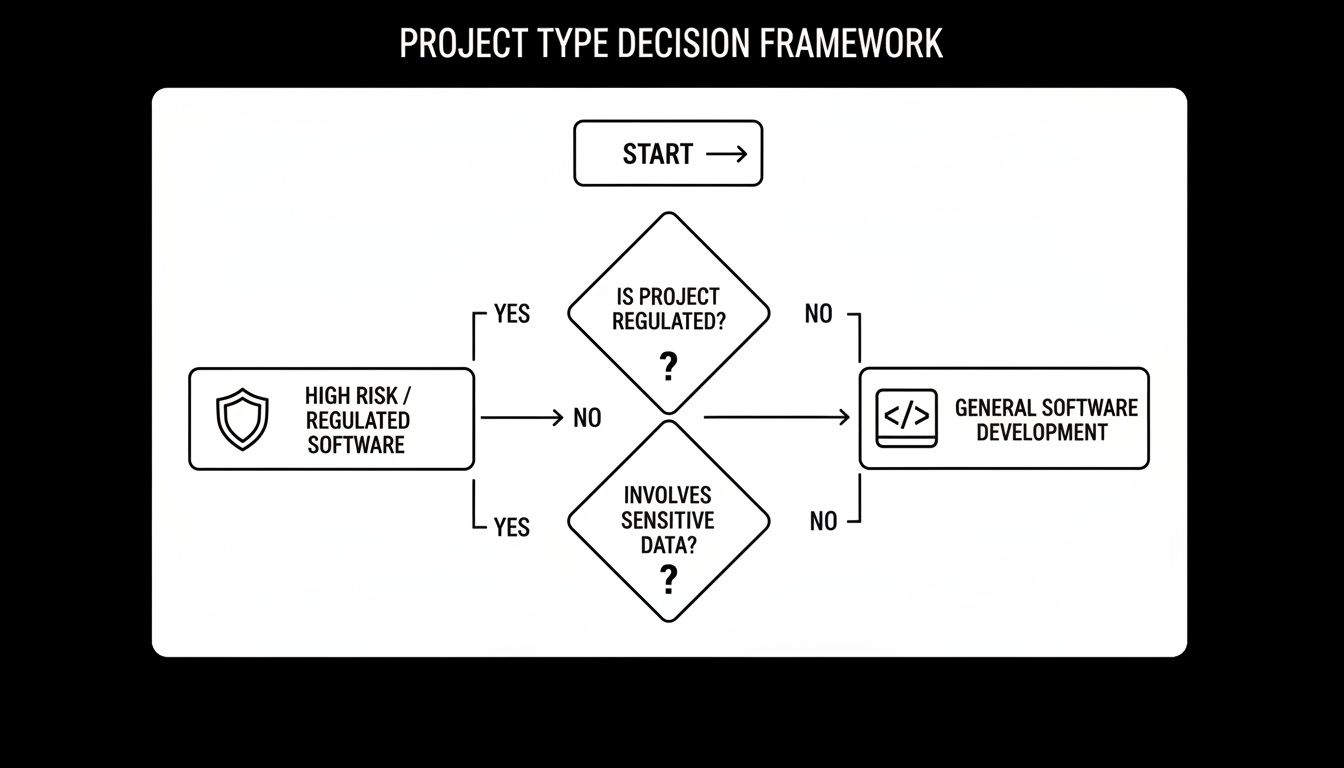
The key takeaway is this: while a generalist firm like a standard EU Services Kft is well-suited for many software projects, initiatives with high regulatory stakes and technical complexity demand specialised expertise. This is the surest path to achieving your business goals while maintaining compliance.
Let's develop a clear plan to achieve your specific objectives. See how we can help when you book a call with our expert team.
FAQ: Evaluating Hungarian Software Partners
For technical leaders evaluating Hungarian software firms, getting clear answers to key questions is essential for making an informed decision that aligns with business objectives, mitigates risk, and accelerates your product roadmap.
What are the primary business advantages of partnering with a Hungarian Kft?
Engaging with a Hungarian Kft, such as an EU Services Kft, is a strategic decision that offers several business advantages. You gain access to a deep pool of EU-based engineering talent at a competitive cost structure, allowing you to achieve high-quality outcomes without exceeding your budget.
The primary benefit lies in risk mitigation. A Kft is a formal Limited Liability Company, providing legal and operational stability. Furthermore, these teams operate within the EU regulatory framework, possessing inherent expertise in standards like GDPR and PSD2. This ensures your product is built for compliance from day one, significantly reducing your business risk and speeding up market entry.
How is communication managed with a Budapest-based team?
Budapest's location in the Central European Timezone (CET) provides a significant operational advantage, ensuring substantial workday overlap with teams across Europe and the UK, as well as a functional window for the US East Coast. This timezone alignment minimizes communication latency.
Effective partners like SCALER prioritize seamless communication through established processes and tools.
- High English Proficiency: Technical discussions, project management, and strategic planning are conducted fluently in English, eliminating language barriers.
- Standardised Tools: Teams are proficient in the tools your organization already uses, such as Slack, Jira, and Confluence, enabling plug-and-play integration into your existing workflows.
- Cultural Alignment: A shared professional culture and work ethic ensure that the augmented team feels like a natural extension of your in-house staff.
What specific expertise should I look for in a PSD2 project?
For specialized domains like PSD2 and Open Banking, general software development skills are insufficient. A mistake in this area can lead to significant compliance penalties and security vulnerabilities. Your evaluation must focus on verifying deep, domain-specific experience.
You need to see tangible proof of their expertise in regulated financial technology.
A true specialist partner does not just build software; they act as a consultant, helping you navigate compliance, architect for security, and de-risk the entire project from concept to launch.
Ask pointed questions about their experience with security protocols like Strong Customer Authentication (SCA). Request specific examples of secure API integrations they have delivered for other fintech clients. A partner like SCALER will have a portfolio of relevant case studies demonstrating the specific expertise required for such a high-stakes project.
Ready to partner with a team that has proven expertise in fintech and complex software solutions? SCALER Software Solutions Ltd provides the senior talent required to accelerate your roadmap. Request a proposal today and let's build your next product.
< MORE RESOURCES / >

Fintech
A Guide to Epic Store Szeged and the Local Tech Scene

Fintech
A Practical Guide to Lead Generation for Your Hungarian Kft

Fintech
A Guide to Designing a Nordic Light Office for Technical Teams

Fintech
A Tech Employer's Guide to Hungary's Social Security System

Fintech
Strategic Sourcing for Your Home Projects at Home Plus Szeged

Fintech
A Consultant's Guide to Oracle Hungary Kft

Fintech
How to Choose an IT Company That Drives Business Outcomes

Fintech
A Consultant's Guide to Part-Time Jobs in Budapest

Fintech
A Consultant's Guide to Peppol Integration for E-Invoicing

Fintech