
< RESOURCES / >
How to Hire a Web Designer Company for Enterprise Projects

Choosing the right web designer company for a critical project isn't about rushing into interviews. The groundwork that determines success or failure happens before you ever speak to a candidate. It begins with a disciplined process of translating high-level business goals into a concrete technical roadmap.
Getting this right aligns expectations from the start, mitigating risk and ensuring the final product delivers measurable business value. This guide outlines a practical framework for technical and product leaders to navigate this process effectively.
Translating Business Goals into Technical Requirements
A clear technical brief serves as the bridge between your business vision and the engineering team tasked with execution. Without it, you invite scope creep, budget overruns, and a final product that fails to meet user needs. A well-defined plan enables strategic, outcome-focused discussions with potential partners, moving beyond superficial conversations about aesthetics.

This process forces specificity on what the platform must accomplish, which directly impacts your time-to-market and reduces development risk. A foundational step is clarifying the required skill sets; for example, understanding the distinction between a web developer vs web designer is crucial.
From User Stories to Core Features
The most effective way to start is by mapping user stories. Avoid a simple feature list. Instead, frame requirements from the user's perspective to maintain focus on delivering value. For instance: "As a new user, I need to connect my bank account via Plaid to fund my investment portfolio."
Once you have these stories, distill them into a prioritized feature list. This requires discipline. Separating "must-haves" from "nice-to-haves" is essential for managing the initial scope and budget, which directly impacts project cost and time-to-market.
- Mission-Critical Features: These are the non-negotiables required for launch. For a fintech application, this includes user authentication, secure transaction processing, and a core dashboard for viewing balances.
- High-Priority Features: These add significant value but could be deferred to a subsequent release if necessary. Examples include advanced reporting or push notifications.
- Future Enhancements: Long-term roadmap items should be documented but parked to avoid complicating the initial build.
By tiering features, you aren't just making a list; you're building a pragmatic roadmap for a Minimum Viable Product (MVP). This approach accelerates time-to-market, allows for rapid collection of user feedback, and prevents investment in features that lack market demand, thereby optimizing development cost.
Defining Technical and Compliance Requirements
For any enterprise or fintech project, the technical brief must extend beyond functional features to include non-functional requirements. These details allow a prospective agency to grasp the project's complexity and provide an accurate proposal, reducing the risk of unexpected costs.
Be prepared to specify your preferred technology stack (e.g., React front-end, Node.js back-end) and infrastructure (e.g., AWS, Azure). Crucially, articulate your compliance and integration needs. For example, any project handling payments in Europe must be architected for PSD2 and Open Banking compliance from day one.
List required third-party APIs, such as Stripe for payments or TrueLayer for data aggregation. This level of detail demonstrates thorough preparation and helps filter out agencies lacking the necessary domain expertise, saving time and minimizing future compliance risk.
How to Evaluate a Web Designer Company's Technical Expertise
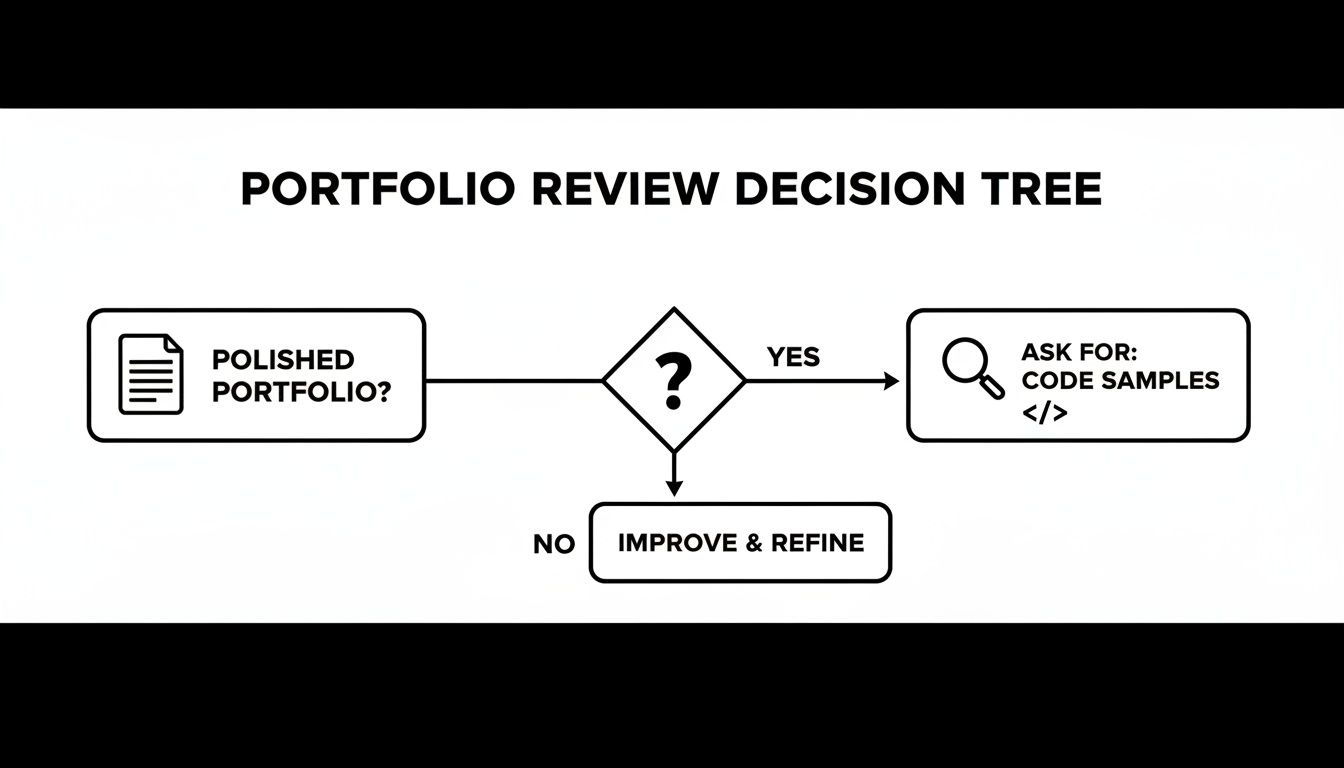
A polished portfolio is a starting point, but for enterprise platforms where security and scalability are non-negotiable, it is insufficient. Technical due diligence is required to validate a potential partner’s proficiency with your specific technology stack.
Request anonymized code samples or architectural diagrams from past projects that mirror your project's complexity. The goal is not to critique coding style but to assess how they structure solutions, model data, and solve real-world engineering problems. This analysis separates genuine experts from agencies with only superficial knowledge.
Assessing Fintech and Security Competence
In the financial technology space, security cannot be an afterthought; it must be integral to the architecture. A partner's approach to compliance and regulation directly impacts your operational risk and revenue protection.
Pose direct questions about their experience with common fintech challenges:
- Secure Payment Gateways: How have they integrated with processors like Stripe or Adyen? Can they describe their process for tokenization or managing payment intents?
- Sensitive Data Handling: What are their standard procedures for data encryption, both at rest and in transit? How do they manage API keys and other secrets?
- Regulatory Familiarity: Can they provide a specific example of a project where they successfully navigated PSD2 or other regional financial regulations?
Seek specific, confident responses. Vague answers may indicate a lack of hands-on experience, which could expose your project to costly vulnerabilities and regulatory delays. This guide on choosing a B2B SaaS product design agency provides additional criteria for evaluation beyond a portfolio review.
Vetting DevOps and Delivery Maturity
A well-designed application is useless if it cannot be shipped to users reliably and efficiently. A mature web designer company understands this and will have strong DevOps capabilities that directly accelerate your time-to-market. A modern, dependable delivery pipeline is impossible without a solid foundation in automation.
A partner’s fluency in DevOps is a clear indicator of their operational maturity. It demonstrates an understanding that building the software is only half the battle; deploying and maintaining it efficiently drives long-term business value and lowers total cost of ownership.
Probe into their DevOps practices. Ask about their experience with CI/CD (Continuous Integration/Continuous Deployment) pipelines using tools like Jenkins or GitHub Actions. Inquire about their expertise with containerization via Docker and orchestration with platforms like Kubernetes. These are not buzzwords; they are foundational technologies for building scalable, resilient systems capable of handling enterprise-level demand. Our guide on selecting a web designer company further details why these technical skills are so critical.
Choosing the Right Engagement Model for Your Project
The engagement model you choose with a web designer company is a strategic decision that dictates budget, timeline, and control over the final product. The two most common models, fixed-scope and team augmentation, serve distinct needs. Selecting the appropriate one is critical to mitigating risk and achieving project goals.
When Fixed-Scope Projects Make Sense
A fixed-scope model offers predictability. You and the agency agree on a precise set of deliverables, a firm deadline, and a single price before work begins. This model is suitable for projects with clearly defined and stable requirements, such as building a Minimum Viable Product (MVP) or developing a self-contained feature.
The primary business outcome is cost certainty, which simplifies budgeting and financial planning. The trade-off is rigidity. If market feedback necessitates a pivot or a new opportunity arises mid-project, a formal change order is typically required, leading to increased administrative overhead, cost, and delays.
The Agility of Team Augmentation
Conversely, team augmentation is designed for flexibility. Instead of outsourcing a project, you integrate senior engineers from the agency directly into your team. This model is ideal for complex, long-term initiatives where requirements are expected to evolve. It allows you to fill specific skill gaps, enhance team capacity, or accelerate a critical roadmap item.
The key benefits are speed and knowledge retention. New developers can onboard and begin contributing quickly, reducing time-to-market. Because they are embedded with your staff, all project knowledge and business context remain within your organization, eliminating the risk associated with a formal handoff. This model is highly effective for acquiring specialized skills without the overhead of a full-time hire. You can learn more about how to find skilled developers for your team to see if it aligns with your needs.
Team Augmentation vs. Fixed-Scope Project Comparison
This table outlines the key differences to help you determine the optimal engagement model for your project’s needs, budget, and timeline.
Ultimately, the optimal choice depends on your project's specific context. A fixed-scope agreement provides a predictable path to a known destination. Team augmentation provides an expert crew to help navigate evolving requirements.
Why Hungary's Tech Ecosystem Is a Strategic Choice
A development partner's location is a strategic variable that impacts budget, project risk, and regulatory navigation. For CTOs and product managers, partnering with a web designer company within the EU offers significant advantages. Hungary, particularly Budapest, has emerged as a top-tier hub for software development.
This is not a search for the lowest cost but for an optimal balance of deep technical talent, cultural alignment with Western teams, and a stable business environment. Hungary’s EU membership provides a secure foundation for developing complex, mission-critical applications.
Inherent Regulatory Alignment and Reduced Risk
Partnering with a Hungarian firm provides automatic alignment with EU regulations. For any fintech project, compliance must be integrated into the architecture from the outset, not addressed as an afterthought.
- GDPR Compliance: Your partner will operate under GDPR by default. This inherent understanding dramatically reduces your risk of non-compliance and associated financial penalties.
- PSD2 and Open Banking: Teams in Hungary are fluent in the technical standards required for secure financial integrations. This accelerates the development of payment and data aggregation features, as your agency will not require education on foundational EU directives.
This built-in familiarity means your budget is allocated to product development rather than legal consultations on EU law, providing a direct path to a faster launch.
A Deep and Mature Talent Pool
Hungary's technology sector is the result of long-term investment in STEM education, creating a rich talent pool of engineers proficient in modern enterprise technology stacks, including React, Node.js, and cloud platforms like AWS and Azure. For a more detailed analysis, see our guide on IT services in Hungary.
The country's digital sector features numerous specialized agencies. A recent market analysis shows 155 companies competing in this space. Firms like VALMAX deliver web design projects starting from $10,000, while others like Works. Hungary Kft. focus exclusively on UI/UX design. This specialization is crucial when seeking a web designer company capable of handling the nuances of a complex fintech solution. More data is available in this report on Hungarian web designers.
Choosing a partner in a mature EU tech hub like Budapest is about more than outsourcing. It's about engaging a team that operates on the same regulatory wavelength and can contribute strategically from day one. This alignment reduces onboarding friction and accelerates time-to-market.
Ultimately, a partnership in this region provides access to highly skilled, EU-based talent that can integrate seamlessly into your existing teams. The business outcomes are a smoother development process, reduced project risk, and a faster path to launching a secure, compliant product.
Ensuring a Smooth Partnership Kickoff
You have selected your web designer company. The real work begins now. A structured kickoff is the single most important factor in keeping your project on time and within budget. A successful start eliminates ambiguity, aligns both teams, and builds the momentum required to achieve the first milestone.

This is the transition from discussion to execution. The goal is to formalize the relationship and establish clear rules of engagement so the team can deliver value immediately rather than spending weeks determining how to collaborate.
Formalize the Agreement with a Robust SLA
Before any code is written, a detailed Service Level Agreement (SLA) is essential. This document serves as the project's constitution, defining responsibilities, setting expectations, and preventing miscommunication. A vague SLA is a significant risk indicator; a comprehensive one provides clarity and reduces project risk.
Ensure your SLA explicitly covers these key areas:
- Communication Protocols: Define the cadence of collaboration. Specify daily stand-ups, weekly demos, primary points of contact, and required tools like Slack or Jira.
- Code Ownership and IP: This is non-negotiable. The SLA must state that all intellectual property and code developed for the project belong to your company, protecting your most valuable asset.
- Security and Compliance Standards: Mandate that your partner adheres to your internal security policies and relevant regulations (e.g., GDPR). This establishes shared responsibility for compliance.
- Performance Metrics: Define how success will be measured. Outline key performance indicators (KPIs) such as bug resolution times, deployment frequency, and code test coverage to ensure accountability and quality.
A well-crafted SLA is not about mistrust; it is about building a transparent framework for a productive partnership. It aligns both parties on the definition of success and the process for achieving it.
Your Essential Onboarding Checklist
With the legal framework in place, focus on practical onboarding. A disorganized start can cost weeks of productivity. A structured checklist, however, accelerates the team's integration and directly reduces time-to-market.
Use this actionable checklist for the first week:
- Grant System Access: Provide immediate access to code repositories (GitHub, GitLab), project management tools (Jira), and communication platforms (Slack, Teams). Avoid letting access become a bottleneck.
- Conduct Documentation Review: Provide all essential documents: technical briefs, architectural diagrams, brand guidelines, and user stories. Schedule a dedicated walkthrough to answer questions and provide critical context.
- Schedule the Kickoff Meeting: The agenda should include team introductions, a review of project goals, and a detailed discussion of the objectives for the first sprint.
- Define the Communication Cadence: Formalize the meeting schedule outlined in the SLA to establish a predictable, professional rhythm for the project.
Following these steps creates an environment where your new partners can integrate seamlessly and begin contributing to project outcomes immediately.
Ready to partner with a web designer company that prioritizes a seamless kickoff and rapid delivery?
FAQ: Key Questions for Hiring a Web Designer Company
Investing in a new development partner naturally raises questions. Here are concise answers to common inquiries from technical and product leaders.
What is the difference between a web designer company and a full-stack agency?
A web designer company typically focuses on the user interface (UI) and user experience (UX)—the visual and interactive elements of an application. Their primary objective is creating an intuitive and engaging user journey.
A full-stack agency, however, manages the entire technology stack. This includes front-end design, back-end development (databases, server-side logic), cloud infrastructure, and DevOps. For a complex fintech application requiring secure API integrations and robust data processing, a full-stack partner is essential. This integrated approach consolidates ownership, reducing the communication overhead and risk of errors that can occur between separate design and engineering teams.
How can I effectively assess a partner's security expertise?
Go beyond asking, "Do you follow security best practices?" Instead, ask for specifics. Inquire about their experience with standards like ISO 27001 or SOC 2. Discuss their secure coding practices and how they mitigate common vulnerabilities like SQL injection or cross-site scripting (XSS).
A competent partner should be able to discuss penetration testing, secure code reviews, and their experience with regulations like GDPR or financial directives like PSD2. If they cannot provide concrete examples of how they have secured applications similar to yours, it is a significant red flag.
A potential partner's approach to security directly reflects their operational maturity and the level of risk they are prepared to transfer to you. Vague answers signal inexperience—a risk that is unacceptable in enterprise and fintech domains.
What are common red flags when evaluating agencies?
Be vigilant for these warning signs:
- Hesitancy to provide relevant references: If an agency is unwilling to share client references or case studies matching your project's complexity, proceed with caution. A portfolio of simple marketing websites does not demonstrate capability for building a scalable, enterprise-grade application.
- Vague technical answers: Evasive or unclear responses to technical questions suggest a lack of deep expertise.
- Inflexible processes: A rigid, "one-size-fits-all" methodology that does not adapt to your project's unique requirements is problematic.
- Unrealistically low pricing: Abnormally low quotes often indicate the use of junior talent or a fundamental misunderstanding of the project scope. Both scenarios lead to missed deadlines, poor quality, and significant cost overruns.
What is a realistic timeline for onboarding a new development partner?
A professional partner should integrate quickly. For team augmentation, a senior engineer should be contributing code within one to two weeks. This timeframe typically covers administrative setup, introductory meetings, and system access provisioning.
For larger, fixed-scope projects, budget two to four weeks for the initial discovery and planning phase. This investment is not a delay; it is a critical step to de-risk the project by solidifying the scope and technical architecture before development begins. An efficient onboarding process is a clear indicator you have hired a capable web designer company.
Ready to partner with a team that integrates quickly and delivers with precision? SCALER Software Solutions Ltd provides the senior engineering talent you need to accelerate your most critical projects.
< MORE RESOURCES / >

Fintech
A Guide to Epic Store Szeged and the Local Tech Scene

Fintech
A Guide to Designing a Nordic Light Office for Technical Teams

Fintech
A Tech Employer's Guide to Hungary's Social Security System

Fintech
How to Choose an IT Company That Drives Business Outcomes

Fintech
A Consultant's Guide to Part-Time Jobs in Budapest

Fintech
A Consultant's Guide to Peppol Integration for E-Invoicing

Fintech
A Tech Leader's Guide to Nearshore Development

Fintech
PSD2 Integration for CTOs: Real-World Challenges and Architecture Insights

Team augmentation
Hiring vs. Outsourcing: Finding the Right Balance with Team Augmentation

Fintech