
< RESOURCES / >
A CTO's Guide to Vetting a Web Design Company

Choosing the right web design company is a strategic technical decision. For a CTO or product leader, it's not about finding a team to build a simple website; it's about partnering with an engineering group that can translate business requirements into a secure, scalable, and high-performing digital product. The right partner will accelerate your time-to-market, mitigate compliance risks, and contribute directly to revenue growth. A poor choice introduces technical debt and slows you down.
This guide provides a structured framework for vetting a potential web design company, ensuring your decision is based on technical competence and clear business outcomes, not just an impressive portfolio.
Defining Clear Outcomes Before You Start Your Search
The most critical work happens before you contact a single web design company. Moving from a vague objective like "we need a new website" to a precise set of measurable business goals is essential. This initial step transforms the selection process from a subjective design review into a strategic partnership evaluation.
As a technical leader, your primary task is to define what success looks like in concrete business terms. Are you aiming to reduce customer onboarding friction by 30% to improve conversion rates? Is the goal to launch a new fintech feature ahead of a competitor? Or is it about resolving a specific PSD2 compliance gap that poses a significant business risk?
Document Your Core Business Objectives
Start by documenting these high-level goals. This exercise creates a clear project mandate and establishes a scorecard for evaluating every potential partner. Your objectives must be specific, measurable, and directly tied to a tangible business outcome.
Here’s a practical framework:
- Business Goal: Reduce manual support ticket volume by automating the user verification process.
- Technical Outcome: Implement a secure, self-service identity verification workflow integrated with our existing CRM.
- Success Metric: Achieve a 50% reduction in support tickets related to user verification within six months post-launch.
This level of clarity ensures that all stakeholders—from your internal team to the chosen development partner—are aligned on the definition of success.
This strategic flow is straightforward: define goals, map out critical user flows, and create a scorecard to maintain an objective evaluation process.
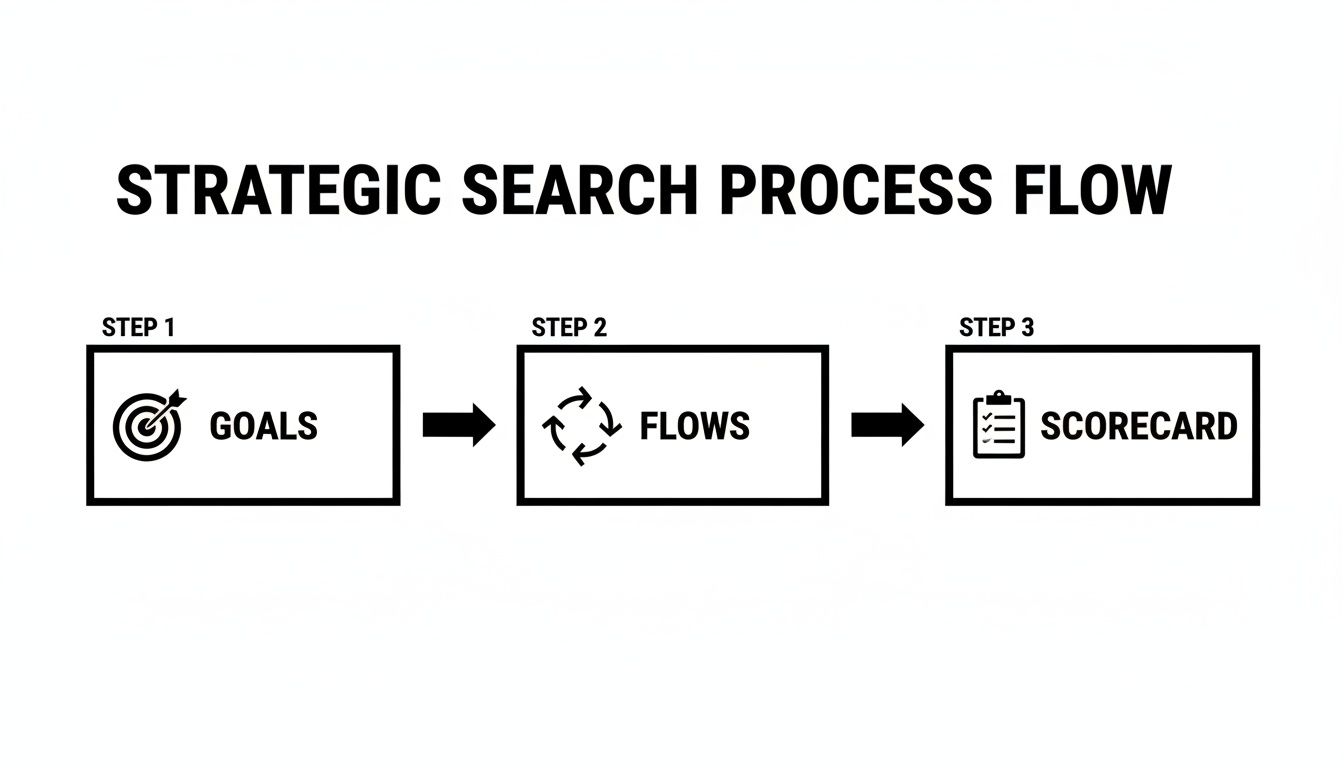
Adhering to this process ensures your final decision is driven by business needs, not subjective design preferences.
Establish Technical Guardrails and User Flows
With your goals defined, the next step is to map out critical user journeys and outline non-negotiable technical constraints. You don't need to architect the entire solution, but you must identify the hard requirements that will dictate the project's success.
For example, will the new platform need to support 10,000 concurrent users without performance degradation? Does it require integration with a legacy system via a specific, and perhaps dated, API? Documenting these constraints provides a powerful filter to eliminate agencies that lack the necessary technical expertise.
By creating a detailed scorecard based on these outcomes and constraints, you equip yourself to evaluate potential partners objectively. This scorecard becomes the foundation for your request for proposal (RFP) and subsequent interview questions.
Budgeting requires a realistic view of the total investment. For context, resources like this guide on understanding the true cost of website design can provide valuable benchmarks. If exploring global talent, understanding the market for IT services in Hungary can also inform your financial planning. This preparatory work ensures you select a partner equipped to solve your business problems, not just one that delivers visually appealing mockups.
Evaluating the Technical Depth of a Web Design Company
A compelling portfolio is a prerequisite, not a differentiator. For a CTO, the definitive test of a potential web design company is its engineering capability. Can their team build a secure, scalable, and maintainable application that aligns with your existing technology stack and future roadmap? A mismatch here leads to increased costs, heightened security risks, and a significant drag on your ability to innovate.
Your evaluation must go beyond a surface-level checklist of technologies. True expertise is demonstrated through a proven track record of sound architectural decisions and a mature engineering culture. The technical choices your partner makes will directly impact your product's performance, security posture, and total cost of ownership.

Probing Beyond Stated Stack Proficiency
Simply asking, "Do you work with React?" is insufficient. You must investigate their practical experience and architectural decision-making process. If your environment is built on Next.js and deployed via AWS, your questions should be targeted and specific.
- Cloud & DevOps Culture: Go beyond "Do you use AWS?" Ask them to describe a challenging CI/CD pipeline they have implemented. How do they approach automated testing? What is their philosophy on infrastructure as code (IaC) using tools like Terraform or CloudFormation? Their answers will reveal their operational maturity.
- Containerization: Discuss their practical experience with Docker and Kubernetes. Ask how they would approach containerizing your specific application and managing orchestration for high availability. This line of questioning exposes their real-world operational competence.
- Fintech-Specific Experience: For financial applications, the technical stakes are higher. Question them on their experience with secure payment gateways like Stripe. Have they developed components for a complex trading platform? What is their experience with blockchain technologies, if relevant to your roadmap?
This approach shifts the conversation from a sales pitch to a peer-level technical review, allowing you to accurately assess their capabilities.
Tying Technical Choices to Business Outcomes
Every technical decision has a direct business impact. A well-architected system built by a competent partner reduces technical debt, which translates directly into a faster time-to-market for new features. A robust DevOps culture minimizes deployment risk and improves reliability, which in turn builds user trust and protects revenue streams.
Your objective is to find a partner who understands that code is a means to an end. They should be able to articulate how their choice of a particular database or caching strategy will reduce latency, improve user experience, and ultimately help you achieve your business goals.
The expanding tech talent pool in Central Europe offers a strategic advantage. Hungary's IT services market, home to numerous skilled web design and development firms, is projected to reach $2.06 billion in revenue by 2025. This growth provides access to EU-based engineers proficient in modern technology stacks, facilitating team augmentation and the development of secure, robust web solutions. You can explore more about Hungary's web development landscape on Techbehemoths.com.
By rigorously vetting a web design company's technical depth, you ensure you are acquiring more than a front-end interface; you are investing in a high-performance foundation engineered for business growth.
Assessing Security and Compliance Posture
For technical leaders, particularly in regulated industries like fintech, security is not an optional feature—it is the bedrock of the product. When you engage a web design company, you are entrusting them with sensitive data and your organization's reputation. A superficial inquiry about their security practices is inadequate. You must conduct a thorough assessment of their security and compliance expertise from the outset.
This diligence is a critical risk-mitigation activity. The right partner builds security into the development lifecycle, preventing costly delays and rework. A partner with a robust security posture provides peace of mind and significantly reduces long-term costs associated with remediating vulnerabilities and managing security incidents.

Moving Beyond Surface-Level Security Questions
It is imperative to move beyond generic security questions and probe into their daily operational practices. A competent and experienced partner will not only expect but also welcome this level of scrutiny. Their responses will reveal their proficiency in handling sensitive projects.
Focus your inquiry on three critical areas:
- Secure Coding Practices: How is security integrated into their software development lifecycle (SDLC)? Ask about their use of static application security testing (SAST) tools. What does their code review process entail for identifying security vulnerabilities? How do they ensure their developers remain current on the latest OWASP Top 10 risks?
- Data Encryption Standards: Verify their commitment to data protection. What are their standard protocols for encrypting data in transit (TLS standards) and at rest (AES-256)? Request they describe a project where they implemented end-to-end encryption for sensitive user data.
- Regulatory Experience: In fintech, this is non-negotiable. Ask for specific examples of their work with regulatory frameworks like PSD2. Have they handled Open Banking API integrations, perhaps with a provider like TrueLayer? An inability to discuss these topics fluently is a significant red flag.
Validating Their Security Track Record
Verbal assurances are insufficient; you require independent validation. A security-conscious agency will have a history of subjecting their work to third-party audits. This practice separates seasoned professionals from those who merely pay lip service to security.
A partner’s willingness to discuss past third-party security audits is a strong indicator of transparency and confidence in their processes. It demonstrates they treat security as a core engineering discipline, not a marketing talking point.
Ask directly about their experience with independent security assessments. Do they regularly engage third parties for penetration testing? Can they provide redacted reports or summaries of findings? Understanding how they proactively identify and remediate vulnerabilities offers deep insight into their security maturity. Our guide on penetration testing as a service explains why this is so critical.
This in-depth assessment ensures you select a partner who architects security from the ground up, rather than treating it as an afterthought. This proactive approach is the only way to effectively lower your risk profile, ensure compliance, and protect your customers' trust.
Selecting the Right Engagement Model
The choice of an engagement model is a strategic decision that directly impacts project execution, budget, and outcomes. How you collaborate with your chosen web design partner is as important as what you build together. An appropriate model can accelerate project velocity, while a poorly matched one can introduce friction, budget overruns, and misaligned expectations that derail your time-to-market.
Your decision should align with your project's objectives, your in-house resource availability, and your budgetary constraints. Let's analyze the most common models.

Fixed Price Contracts
A Fixed Price model is suitable for projects with a clearly defined, static scope, such as a straightforward marketing site or a tightly specified MVP. You agree on a set price for a specific list of deliverables, which provides cost predictability and minimizes financial risk.
However, this rigidity presents a challenge. Any deviation from the initial scope—often referred to as scope creep—requires a formal change request process, which can introduce delays and increase the final cost. This model is only effective if your requirements are thoroughly documented and unlikely to change.
Time & Materials (T&M)
Under a Time & Materials (T&M) model, you pay for the actual hours and resources consumed. This model offers maximum flexibility, making it ideal for complex projects where requirements are expected to evolve. It allows you to pivot, add features, and refine the product based on emerging business needs and user feedback.
The primary benefit is agility. The corresponding risk is budget uncertainty. Without disciplined project management and transparent reporting from your partner, costs can escalate. This model requires a high degree of trust and continuous communication to ensure alignment and control.
Dedicated Team and Team Augmentation
For long-term, large-scale initiatives, a Dedicated Team or Team Augmentation model is often the most effective approach. This model provides a full-time team of designers and engineers who function as an integrated extension of your in-house team. This fosters deep product knowledge and ensures cultural alignment.
This approach combines the flexibility of T&M with greater stability and integration. In Hungary, for example, many top-tier web design agencies excel in this model, offering seamless communication and accountability. You can explore the top-rated web design firms in Hungary on GoodFirms to see examples.
When you choose this model, the relationship evolves from a client-vendor dynamic to a strategic partnership. You build a single, cohesive unit focused on a shared goal—an essential structure for projects with an evolving roadmap.
This is particularly valuable for product managers who need to scale their teams quickly without the overhead of traditional hiring. Our guide on leveraging team augmentation for agile development provides further details on this strategy.
Comparison of Engagement Models
This table compares the three primary engagement models across key business factors to help you select the best fit for your project.
Ultimately, the optimal model is the one that best aligns with your project's specific needs. The key is to match the commercial structure to your strategic objectives to ensure a successful business outcome.
Making a Confident Final Decision
With the initial vetting complete, it's time to assess the human element. You need to look beyond polished presentations to understand how a potential partner thinks, solves problems, and communicates under pressure. The goal is to determine if the selected web design company can truly operate as a seamless extension of your own team.
To achieve this, it is essential to speak directly with the individuals who will be responsible for your project's execution: the lead engineers, designers, and project managers. Their responses to challenging, scenario-based questions will be far more revealing than any portfolio.
Probing Questions for Key Personnel
Move beyond generic interview questions and present them with realistic, challenging scenarios. A team's ability to handle ambiguity, pressure, and unexpected obstacles is a true indicator of its maturity and competence.
Consider asking the following questions:
- For the Lead Engineer: "Walk me through your process for onboarding a new developer mid-project. How do you ensure they become productive quickly without disrupting the current sprint's velocity?"
- For the Project Manager: "Describe a situation where a project faced significant scope creep. How did you manage stakeholder expectations and team capacity to realign the project with its original goals and budget?"
- For the Lead Designer: "How do you handle a scenario where a key stakeholder provides subjective design feedback that contradicts user research data and established usability best practices?"
Analyze their answers carefully. They will reveal critical information about their internal communication protocols, documentation standards, and their capacity for managing difficult but necessary conversations—all essential components of a successful long-term partnership.
A partner’s willingness to openly discuss past failures and the lessons learned is a far more powerful signal of competence than a curated list of successes. It indicates humility, a commitment to continuous improvement, and a realistic understanding of the software development process.
The Final Decision Checklist
Consolidate your findings into a final evaluation scorecard. This tool helps transform subjective impressions into an objective, data-driven decision. It should serve as a weighted summary of all evaluation criteria, from technical alignment to cultural fit.
Your checklist should include at least the following:
- Technical & Security Alignment: Does the firm meet all non-negotiable stack and compliance requirements? (Yes/No)
- Process Maturity: How robust are their methodologies for managing scope changes, communication, and reporting? (Scale of 1-5)
- Cultural Fit: Does their communication style and problem-solving approach align with your team's culture? (Scale of 1-5)
This structured approach enables a direct, head-to-head comparison of your shortlisted candidates. In a competitive tech hub like Central Europe, this level of diligence is crucial. Budapest, for instance, hosts numerous web development firms with high Clutch ratings, indicating a track record of reliable project management and positive ROI. You can discover more insights about Budapest's top web development agencies on edvido.com. Making an informed decision ensures you are not just hiring a vendor but securing a strategic partner who can accelerate your time-to-market.
Frequently Asked Questions (FAQ)
Even with a thorough evaluation process, several key questions often arise during the final decision-making stage. Here are concise answers to common queries from CTOs and product managers.
What should my true budget account for?
Focus on the Total Cost of Ownership (TCO), not just the initial development quote. A comprehensive budget should include ongoing costs for maintenance, hosting, security monitoring, and compliance. A transparent web design company will provide a detailed cost breakdown and explain how their architectural choices (e.g., monolithic vs. microservices) will impact your long-term operational expenses and scalability. This conversation is essential for avoiding unforeseen costs that can erode your project's ROI.
Who owns the intellectual property and source code?
The contract must explicitly state that you, the client, retain 100% ownership of all custom source code and associated intellectual property upon final payment. Any arrangement where the agency retains ownership or licenses the code back to you introduces significant business risk, complicates future development, and can become a major obstacle during M&A or due diligence activities. This is a non-negotiable term.
A contract that ensures your full IP ownership is a hallmark of a professional and trustworthy partner. It confirms that your investment is building a tangible company asset, not creating a long-term dependency.
What does post-launch support typically include?
After your application goes live, the engagement typically transitions to a support and maintenance agreement. This retainer ensures your digital product remains secure, performant, and reliable for your users.
A standard support plan should cover:
- Bug Fixes & Security Patches: Proactive remediation of vulnerabilities and resolution of issues identified post-launch.
- Performance Monitoring: Continuous monitoring of server health, application performance, and key user experience metrics.
- Minor Enhancements: Implementation of small, iterative improvements that do not require a full project scope.
Before signing, ensure the Service Level Agreement (SLA) clearly defines response times, issue prioritization protocols, and the precise scope of included services. For additional information, please see our dedicated frequently asked questions (FAQ).
A partnership with the right web design company is a strategic investment in your product's future. By applying a rigorous, outcome-focused evaluation process, you can select a team that will not only deliver a high-quality product but also serve as a true extension of your own, accelerating your path to market and driving measurable business results.
Ready to partner with a technical team that understands your business goals? Request a proposal to discuss how we can help you build secure, scalable web solutions that deliver.
< MORE RESOURCES / >

Fintech
A Guide to Epic Store Szeged and the Local Tech Scene

Fintech
A Guide to Designing a Nordic Light Office for Technical Teams

Fintech
A Tech Employer's Guide to Hungary's Social Security System

Fintech
How to Choose an IT Company That Drives Business Outcomes

Fintech
A Consultant's Guide to Part-Time Jobs in Budapest

Fintech
A Consultant's Guide to Peppol Integration for E-Invoicing

Fintech
A Tech Leader's Guide to Nearshore Development

Fintech
PSD2 Integration for CTOs: Real-World Challenges and Architecture Insights

Team augmentation
Hiring vs. Outsourcing: Finding the Right Balance with Team Augmentation

Fintech