
< RESOURCES / >
A Technical Guide to Facebook Marketplace Budapest

Navigating a C2C platform in a new city requires a strategic approach, not just casual browsing. For anyone looking to source items, liquidate assets, or simply find a bargain in Hungary, Facebook Marketplace Budapest is the dominant platform. It functions as the city's de facto digital flea market, leveraged by locals and expatriates for everything from IKEA furniture to consumer electronics. This guide provides a technical and business-oriented framework for using it effectively.
Why Facebook Marketplace Is Budapest's Dominant C2C Platform

The platform's success is a direct result of market penetration and network effects. In Hungary, Facebook commands 98.03% of the social media market share, making it a ubiquitous utility rather than just a social network. This pre-existing, high-density user base provides an unparalleled liquidity pool for second-hand goods, a critical business advantage that standalone C2C apps struggle to replicate. You can analyze Hungary's broader app market statistics at 42matters.com.
This built-in audience means faster asset turnover for sellers and greater inventory for buyers, reducing the time-to-transaction for all parties.
The Business Case for Facebook Marketplace in Budapest
The platform's dominance isn't merely about user numbers; it's about the efficiency it creates within the local Budapest market. The data translates directly to tangible business outcomes for users.
This data isn't academic. It explains why items sell quickly and why buyers can source specific goods within a tight radius, minimizing logistical costs and delays.
The Hyper-Local Network Effect
The core value proposition of Marketplace in Budapest is its dense, intra-city network, which creates an efficient micro-economy.
- For sellers: Listings gain immediate, high-volume local exposure. This reduces holding time for unwanted assets and often leads to more competitive pricing, maximizing revenue.
- For buyers: A high frequency of new listings increases choice and price competition. The ability to source items within one's own kerület (district) drastically cuts down on logistical friction and acquisition cost.
The platform operates less like a sterile e-commerce site and more like a community-driven exchange. Transactions often occur between neighbors, students, and local businesses within a few kilometers, streamlining the entire process from discovery to pickup.
From a cost-benefit perspective, using Facebook Marketplace in Budapest is a strategic decision. It reduces friction by connecting users directly to the largest available pool of local buyers and sellers, which saves time and improves financial outcomes.
How to Optimize Your Search Strategy
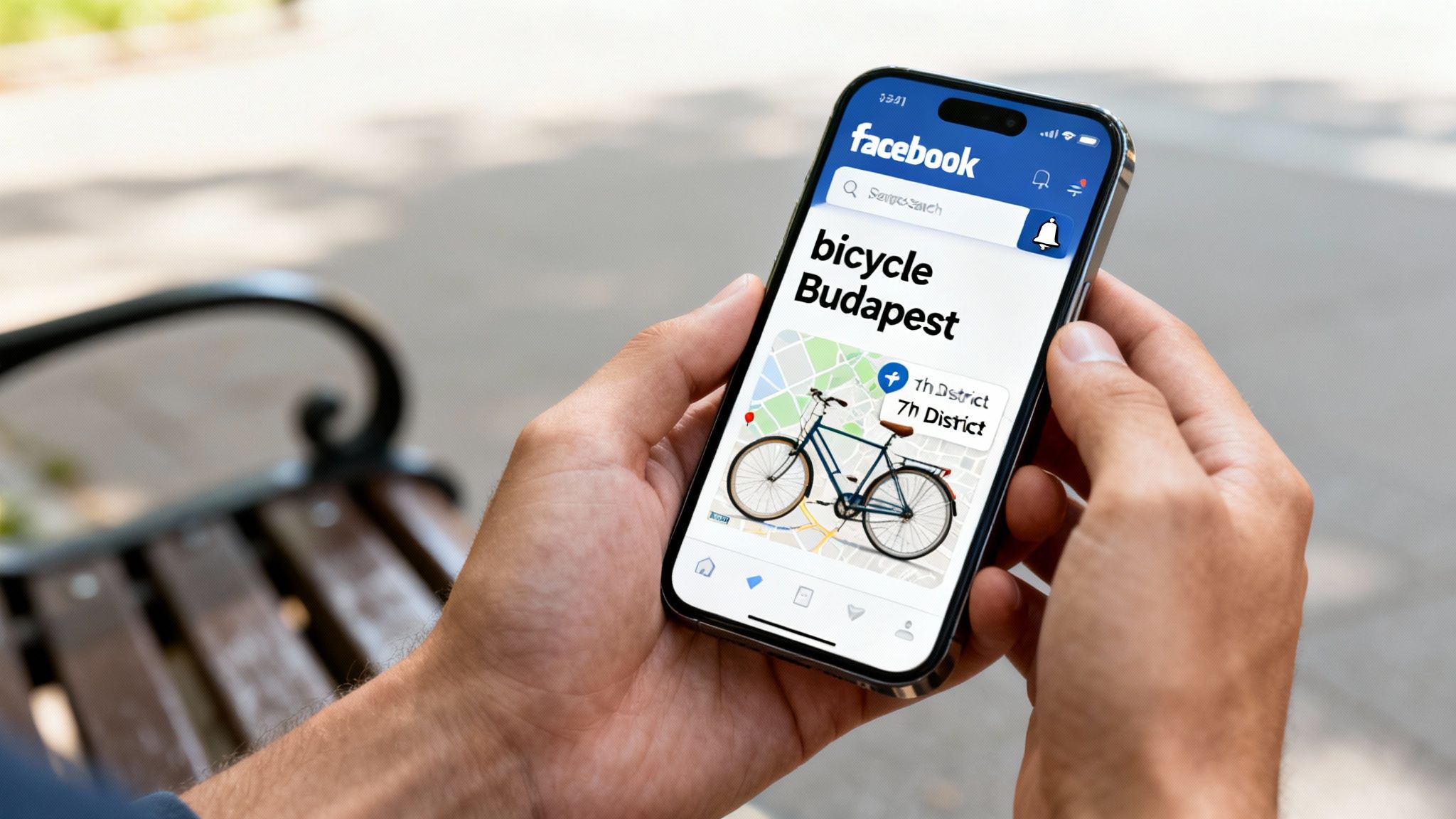
To operate efficiently on Facebook Marketplace Budapest, a passive search is insufficient. A targeted, data-driven approach is required to minimize time spent and maximize the quality of results. The platform's default search parameters are often too broad, leading to irrelevant results and logistical inefficiencies.
Your first action should be to constrain the search radius. This simple configuration change immediately filters out listings that are not logistically or economically viable to acquire.
Refining Your Geographic Search Parameters
Constraining the search radius is a critical first step. For most of Budapest, a 5-10 kilometer radius is optimal. This ensures potential pickups are accessible via public transport or a short Bolt ride, directly reducing the time and cost associated with procurement.
For even greater precision, filter by specific districts (kerület). Searching for items exclusively within "VII. kerület" (Erzsébetváros), for example, isolates hyper-local listings, making pickups logistically trivial.
Using Local Keywords for Expanded Results
A significant portion of listings are posted exclusively in Hungarian. Relying solely on English search terms severely limits your access to available inventory. Integrating basic Hungarian keywords is a tactical move to unlock this hidden supply.
eladó: Meaning "for sale." Prepending this to a search term (e.g., "eladó kanapé" for "sofa for sale") often surfaces more direct, motivated sellers.- Item Names: Search for "
bicikli" instead of just "bicycle," or "íróasztal" instead of "desk." - Condition Terms: Refine searches using terms like "
újszerű" (like new) or "használt" (used) to pre-qualify items.
For high-demand or specific items, saved searches and alerts are essential tools. By automating the monitoring process, the platform notifies you of new listings that meet your criteria, giving you a first-mover advantage. This is particularly valuable for time-sensitive acquisitions, such as furnishing a flat while managing other responsibilities like securing employment. Our guide on finding student jobs in Budapest offers further context on this.
How to Quickly Vet a Listing
Before initiating contact, perform a 30-second analysis of the listing to mitigate risk and avoid wasting time. This is a crucial step in your due diligence process.
A well-structured listing with high-quality assets is a strong signal of a reliable counterparty. Conversely, low-effort posts with blurry photos or minimal descriptions often correlate with unresponsive sellers or misrepresented goods, increasing transaction risk.
Evaluate the details: Are the photos clear and comprehensive? Is the description specific? What is the seller's profile history and rating? A reputable seller typically has an established profile with a history of positive interactions. This level of scrutiny transforms a speculative search into a calculated acquisition strategy, improving your success rate on the platform.
Engineering a High-Conversion Listing

Creating an effective listing is the primary driver of sales velocity. In a competitive environment like Budapest's digital marketplace, a listing must be engineered to capture attention, provide critical information, and build buyer confidence.
The process begins with high-quality visual assets. Clear, well-lit photographs are non-negotiable. Use natural light whenever possible and capture the item from multiple angles. Crucially, document any defects or wear. This transparency builds trust and pre-qualifies buyers, reducing time wasted on inquiries that will not convert.
For items with unique aesthetic value, such as antiques, the quality of photography is paramount. This guide to photographing antiques provides technical advice applicable to any high-value item.
Writing Descriptions That Convert
The title functions as the primary SEO hook. "Used Chair" is ineffective. A specific title like "IKEA Poäng Armchair, Natural Oak, Good Condition" targets qualified buyers and improves search visibility.
For the description, the optimal strategy on Facebook Marketplace Budapest is to provide it in both Hungarian and English. This simple action doubles the size of your addressable market.
A standardized structure improves readability and conversion:
- Technical Specifications: Lead with dimensions, age, and condition.
- Full Disclosure: Clearly state any imperfections. This manages expectations and filters out unsuitable buyers early in the process.
- Logistical Details: Specify the pickup district (kerület) and any assistance you can offer with moving the item.
Investing this effort upfront minimizes low-quality inquiries and attracts serious buyers, acting as an effective lead qualification filter.
Strategic Pricing and Tagging
Pricing must be data-driven. Research comparable listings to establish a market baseline. Analyze what similar items are actually selling for, not just their initial asking price. Price competitively, but incorporate a margin for negotiation, locally known as alkudozás.
An optimized price point can reduce the sales cycle by over 50%. It attracts qualified leads quickly, minimizing lowball offers and the carrying cost of an unsold item.
Finally, implement a comprehensive tagging strategy. Think from the buyer's perspective. For a dining table, use tags like "étkezőasztal," "dining table," "IKEA," and "wooden table." Effective tagging is the mechanism that connects your supply with active demand, converting impressions into sales.
Transaction Security and Closing the Deal
Once you've identified an item and engaged the seller, the focus shifts to negotiation and secure execution of the transaction. A systematic approach here mitigates risk and ensures a successful outcome.
Initiating Communication
All initial communication typically occurs within Facebook Messenger. Maintain a professional but direct tone. Negotiation, or alkudozás, is a standard part of the process. This is not about aggressive low-balling but a structured back-and-forth.
A reasonable opening offer is 10-15% below the list price, particularly for items that have been available for over a week.
A concise message in Hungarian can be more effective. "Szia! Nagyon tetszik a szék. Esetleg 8000 Ft-ért el tudnám vinni a héten?" ("Hi! I really like the chair. Would it be possible to take it for 8000 Ft this week?") is a clear, polite, and actionable opening that signals serious intent.
Selecting a Secure Meetup Location
Personal security is non-negotiable. For portable items, all transactions must occur in a high-traffic public location to minimize risk.
Recommended secure meetup locations in Budapest include:
- Major Metro Stations: Deák Ferenc tér, Kálvin tér, and Nyugati pályaudvar offer high visibility, constant foot traffic, and CCTV surveillance.
- Shopping Centre Entrances: The main entrances of Allee, Westend, or Mammut are neutral, public, and safe.
- Busy Public Squares: Locations like Móricz Zsigmond körtér or Széll Kálmán tér are suitable due to their high public presence.
This decision tree helps in planning a secure transaction.
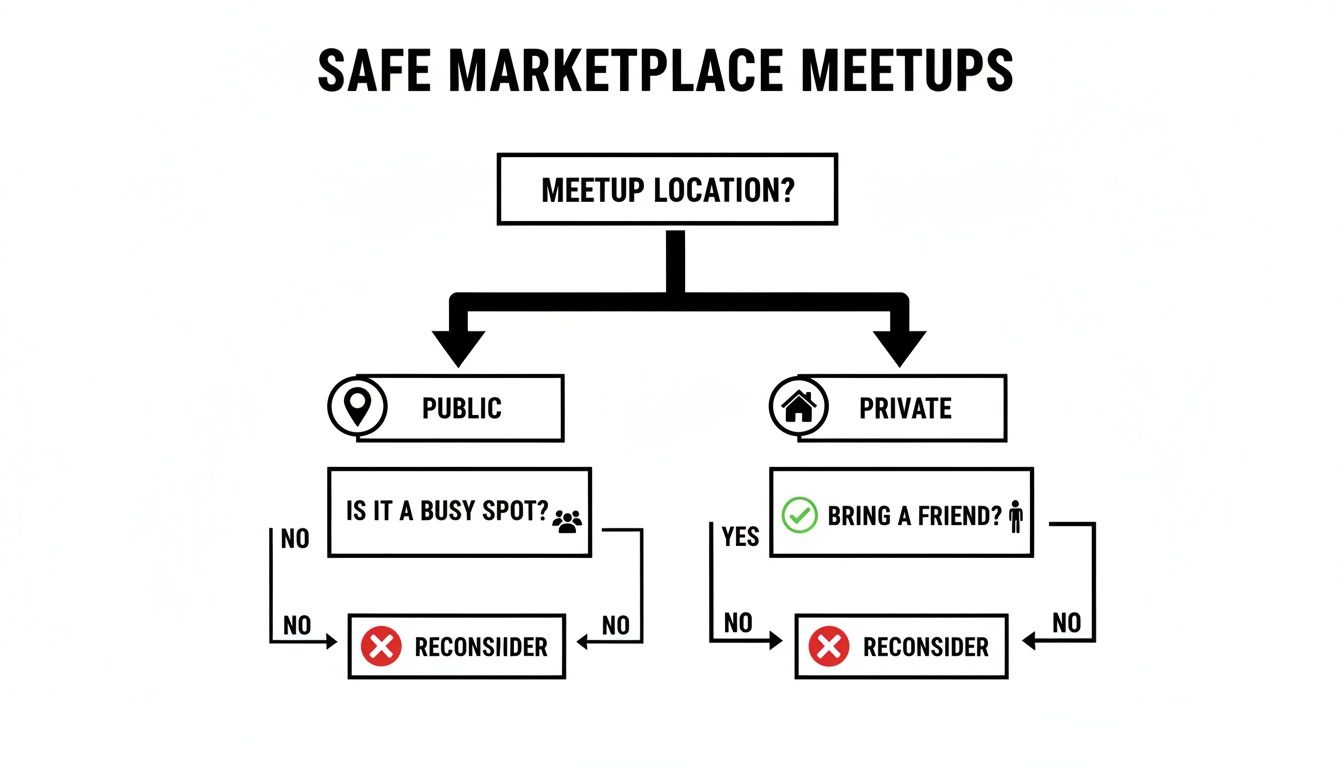
The key principle is control. You dictate the terms of the meeting. For home pickups of large items, never attend alone.
Payment Execution and Risk Management
For most transactions on Marketplace in Budapest, cash remains the primary settlement method. The standard is cash on delivery (utánvét), where payment is rendered after a physical inspection of the item. This is the most secure method for both parties, as it eliminates digital payment fraud risk.
Conduct a final, thorough inspection of the item before any funds are exchanged. For electronics, verify functionality. For furniture, check for structural integrity. This is the final go/no-go checkpoint.
While instant bank transfers via platforms like Revolut are used for larger transactions, payment should only be initiated after you have taken physical possession of the goods. Never agree to upfront payments or deposits. Requests for advance payment are a primary indicator of a potential scam. Adhering to an in-person, post-inspection payment protocol is the most effective risk mitigation strategy.
Navigating Payments and Common Fraud Vectors
The financial settlement phase of a transaction carries inherent risks. While most deals on Facebook Marketplace Budapest are legitimate, understanding common fraud patterns is essential for risk management.
The core principle is to identify and reject transactions that deviate from standard protocols. Be suspicious of any seller pushing for advance payments through non-reversible methods, as these offer zero recourse. Similarly, as a seller, be wary of buyers offering to overpay and requesting a refund for the difference—a classic fraudulent payment scheme.
Standard Payment Protocols in Budapest
Executing payment correctly requires an understanding of local norms. While digital solutions are prevalent, traditional methods often provide superior security for C2C transactions.
- Cash (
Készpénz): This remains the preferred method for in-person transactions due to its immediacy and absence of digital fraud risk. Best practice is to bring the exact amount to avoid complications with making change. - Revolut/Instant Bank Transfer: Increasingly common for higher-value items. The non-negotiable rule is: do not initiate the transfer until you are in physical possession of the item. The payment and the exchange of goods must be simultaneous.
A common scam involves creating false urgency to pressure a buyer into a premature bank transfer. A legitimate seller will accommodate an in-person inspection before payment. If pressured, terminate the engagement. The risk is not justified.
Counterparty Due Diligence
Protecting yourself involves basic due diligence on the other party. A few clicks can provide significant insight.
Hungary has a Facebook user base of approximately 7.11 million, with a high concentration of users in the 25-34 age demographic active on Marketplace. More data is available from Hungarian social media usage on Statista.com. This large user base necessitates individual vetting.
Examine the user's profile. Does it appear authentic, with a history of activity and connections? A newly created profile with no photo or friends is a significant red flag. Insist on keeping all communication within Messenger. Attempts to migrate the conversation to another platform like WhatsApp are a common tactic used by scammers.
For businesses managing high-volume transactions, implementing robust payment infrastructure is a complex challenge we have experience solving, as demonstrated in our work on payment provider integration for financial services.
Below is a comparison of common payment methods and their associated risks.
Payment Method Risk Analysis for Marketplace Transactions
In summary, physical cash remains the most secure and effective payment method for face-to-face transactions in Budapest, as it eliminates nearly all digital payment risks and finalizes the deal instantly.
Local Alternatives and Supplementary Resources
While Facebook Marketplace Budapest holds the largest market share for C2C transactions, a comprehensive sourcing strategy should include alternative local platforms. Diversifying your search can uncover unique inventory and provide valuable market price intelligence.
An item may be priced more competitively on another platform, or you might find a niche community focused on the specific category you are targeting.
Hungarian Online Classifieds Platforms
Two major Hungarian platforms dominate the traditional online classifieds market. Understanding their distinct functions is key.
- Jófogás: This is Hungary's equivalent of Craigslist or Gumtree. It is a comprehensive classifieds site for everything from real estate to furniture. Its user base is vast and predominantly Hungarian.
- Vatera: This platform functions more like eBay, with a focus on auctions. It is an excellent resource for sourcing collectibles, antiques, and other specialized items where bidding can result in favorable pricing.
Hyper-Specific Facebook Groups
Some of the most valuable transactions occur within smaller, curated Facebook Groups. These communities often provide a higher level of trust and more relevant inventory than the broader Marketplace.
Search for groups like "Used stuff for sale in Budapest" and various expatriate-focused forums. Transactions within these groups benefit from community accountability. For expats, these groups are also critical sources of information on topics ranging from housing to employment. Our guide on English teaching jobs in Budapest provides more context.
Leveraging these niche groups provides access to a pre-qualified market. The accountability is higher, and the items listed are often tailored to the community's needs, reducing search time and improving the quality of results.
A practical note for international users: maintaining a stable internet connection is crucial for timely communication. To ensure you don't miss notifications about a desired item, consider options for eSIM and mobile data for Hungary.
Finally, do not overlook offline channels. Budapest's second-hand shops (használtcikk kereskedés) are excellent sources for unique furniture and home goods. For a true local experience, the Ecseri Piac flea market offers access to inventory not available online.
Frequently Asked Questions (FAQ)
Here are concise answers to common technical and logistical questions about using Facebook Marketplace in Budapest.
What asset categories have the highest velocity on Facebook Marketplace Budapest?
The highest turnover is seen in consumer electronics, IKEA furniture, bicycles, and general household goods. The city's transient population of students and expatriates creates constant demand for items needed to furnish temporary accommodations. Brand-name apparel and accessories also represent a liquid market and can be sold quickly if priced according to market conditions.
What is the optimal communication protocol: English or Hungarian?
While English proficiency is common among younger Hungarians in Budapest, initiating contact in Hungarian is a strategic courtesy. A simple 'Szia, ez megvan még?' ('Hi, is this still available?') is an effective opening. It is generally acceptable to transition to English for more detailed discussions.
Pro Tip: For sellers, providing the listing description in both Hungarian and English is a zero-cost action that doubles the addressable market, directly impacting sales velocity and final price.
This small investment in localization makes your listing more accessible and reduces communication friction.
How are logistics for large items typically handled?
For bulky items such as furniture, the responsibility for transport almost universally falls on the buyer. Listings will typically specify pickup only from a designated district (kerület). Buyers commonly use on-demand services like Bolt Van or short-term van rentals to manage logistics.
As a seller, you must clearly define the pickup location and specify the level of assistance, if any, you will provide with moving the item. Finalizing these logistical terms before agreeing on a price is critical to prevent transaction failure at the point of pickup.
At SCALER Software Solutions Ltd, we apply systematic thinking to solve complex problems—from navigating a C2C marketplace to engineering enterprise-grade software. If your business requires secure, scalable, and efficiently delivered software solutions, our EU-based engineering team is ready to assist.
Book a discovery call with our team and let's talk about your project.
< MORE RESOURCES / >

Fintech
A Guide to Epic Store Szeged and the Local Tech Scene

Fintech
A Guide to Designing a Nordic Light Office for Technical Teams

Fintech
A Tech Employer's Guide to Hungary's Social Security System

Fintech
How to Choose an IT Company That Drives Business Outcomes

Fintech
A Consultant's Guide to Part-Time Jobs in Budapest

Fintech
A Consultant's Guide to Peppol Integration for E-Invoicing

Fintech
A Tech Leader's Guide to Nearshore Development

Fintech
PSD2 Integration for CTOs: Real-World Challenges and Architecture Insights

Team augmentation
Hiring vs. Outsourcing: Finding the Right Balance with Team Augmentation

Fintech