
< RESOURCES / >
Front End Back End Development: A Strategic Guide for Leaders

To build a successful digital product, you must master the relationship between its front end and back end. The front end is what your users see and interact with; the back end is the engine that powers the entire operation. Getting this relationship right isn't just a technical exercise—it's a critical business decision that directly impacts cost, risk, and time-to-market.
Front End vs. Back End: More Than a Technical Definition
Think of a high-end restaurant. The front end is the dining room—the decor, the service, the menu you hold. It's the entire customer experience. The back end is the kitchen—a highly organised system where ingredients are sourced, complex dishes are prepared, and payments are processed securely. A seamless connection between these two operations is what delivers an effortless experience.
This separation of concerns is a core principle of software architecture. It allows specialised teams to work in parallel on different parts of a product, significantly accelerating development and reducing time-to-market. For a deeper technical dive, you can explore guides on modern web application architecture that detail how these components interact.
Why This Separation Directly Impacts Business Outcomes
In a sector like fintech, this division is fundamental to success. A clean, intuitive front end builds user trust and drives adoption. However, it's the secure, scalable back end that handles transactions, manages complex financial logic, and ensures regulatory compliance. Understanding how to invest in both allows you to make smarter strategic decisions.
- Cost Management: You can allocate budget strategically—either to a new user-facing feature that drives revenue or to strengthening core back-end infrastructure to reduce operational risk.
- Risk Mitigation: A fortified back end is non-negotiable for meeting compliance standards like PSD2. It protects both your business and your customers from financial and reputational damage.
- Scalability & Growth: A well-architected back end must handle a tenfold increase in user load without degrading the front-end experience, enabling business growth without costly re-engineering.
This isn’t just theory. The Hungarian ICT market is projected to grow from $35.19 billion in 2025 to $60.41 billion by 2030, driven by innovations in fintech and cloud services where the front end and back end synergy is paramount. You can explore the data on the Hungarian software market to see this trend in action.
This guide will break down how to make this critical relationship work for your business.
The Front End: Translating User Experience into Business Value
The front end, also known as the client-side, is every touchpoint a customer has with your product. Every button, layout, and interaction shapes their perception of your brand. It's far more than visual design; it's the entire user journey made tangible.
The primary function of front-end development is to translate UI/UX designs into responsive, interactive applications that perform flawlessly on any device. Performance is not a feature—it's a requirement. A few seconds of load time or a confusing navigation flow can directly lead to customer churn.
How a Polished Front End Drives Revenue
In fintech, a seamless front end is a competitive necessity. It simplifies complex actions like transferring funds or opening an investment account, making them feel intuitive and secure. This has a direct impact on your bottom line.
A frictionless front-end experience is a direct driver of revenue. When an application is easy to use and reliable, users complete transactions, leading to higher conversion rates and increased customer lifetime value.
The diagram below illustrates how these pieces fit together. A user interacts with the front end in their browser, which in turn communicates with the back end to perform tasks and retrieve data.
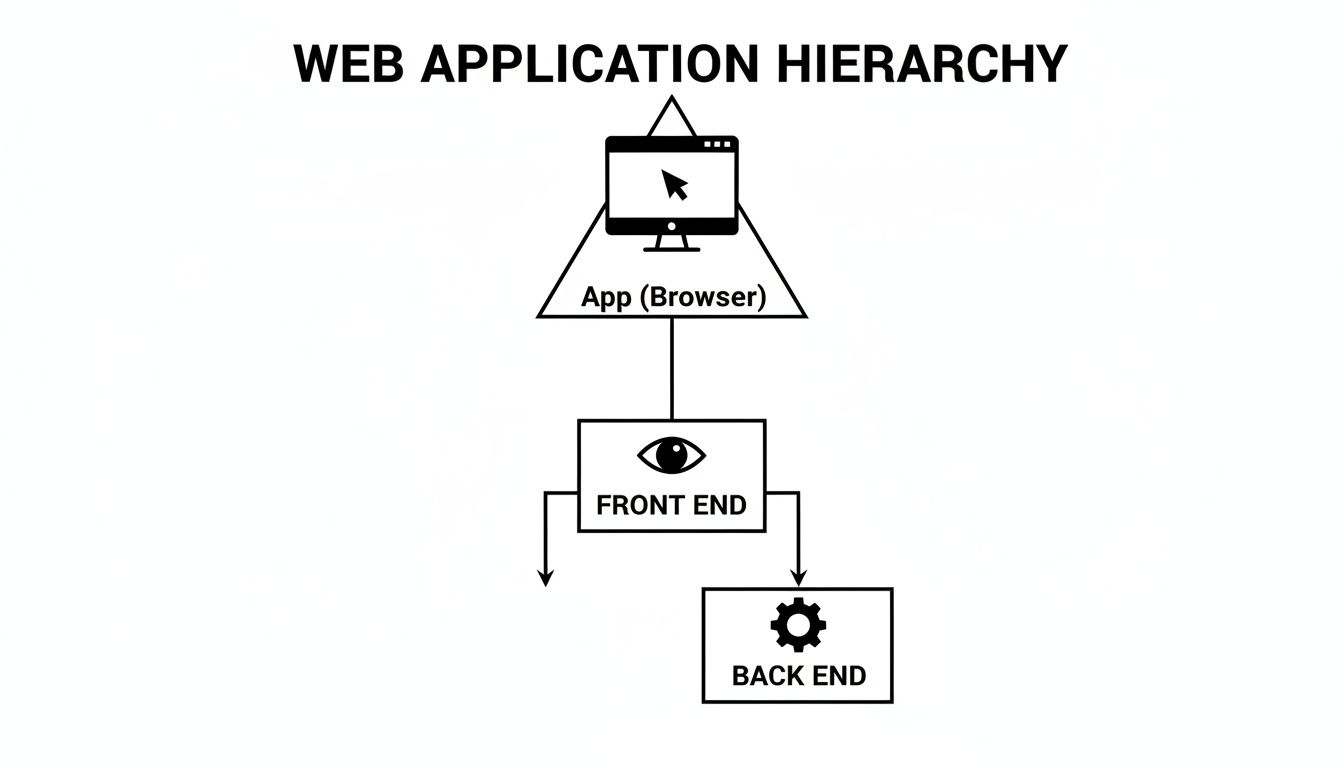
The user only ever experiences the front end, but its functionality is entirely dependent on the workhorse back end operating behind the scenes.
To clarify the distinct roles, here is a direct comparison of the two domains.
Front End vs. Back End: At a Glance
These two sides of the development coin have distinct, equally critical roles in delivering a successful digital product.
Choosing the Right Front-End Technologies
Selecting a front-end technology stack is a strategic decision that balances user experience goals with business timelines. The right tools accelerate time-to-market and reduce long-term maintenance costs.
- Web Applications: Frameworks like React and Next.js are industry standards for modern web applications. Their component-based architecture allows for reusable UI elements, which significantly speeds up development and simplifies future updates.
- Mobile Applications: For native mobile apps, Swift (iOS) and Kotlin (Android) provide superior performance and deep integration with device hardware. Given that 57% of users won't recommend a business with a poorly designed mobile site, a reliable native experience is a clear business advantage.
The optimal stack delivers a high-quality user experience while aligning with your team’s expertise and project roadmap. This strategic choice helps avoid technical debt and ensures a smoother path to launch.
This clear separation between the front end and back end allows specialists to focus on their respective domains, ensuring both the user-facing interface and the core engine are built to the highest standards.
The Back End: The Foundation of Logic, Security, and Scale
If the front end is the user-facing interface, the back end is the powerful, unseen engine that drives the entire system. Often called the server-side, it's the mission control centre where business logic is executed, data is managed, and the application's security and reliability are ensured.
Users never interact with the back end directly, but its performance is felt in every click. It processes requests from the front end (via APIs), manages complex databases, handles secure user authentication, and executes the sophisticated calculations that define your service.

How a Solid Back End Drives Business Value
Investing in a high-quality back-end architecture is a strategic business decision that pays dividends in lower operational costs, reduced risk, and increased revenue potential.
- Ensures Data Integrity: The back end is the sole guardian of your data, enforcing business rules to keep information accurate, consistent, and secure—a fundamental requirement for any financial service.
- Serves as the First Line of Defense: From preventing unauthorized access to encrypting sensitive data, the back end is your primary defence against security breaches, protecting both your users and your business's reputation.
- Enables Scalable Growth: As your user base grows, a scalable back-end architecture handles increased traffic and data loads without performance degradation, allowing your business to expand without hitting a technical ceiling.
In the regulated fintech space, the back end is where compliance with standards like PSD2 is engineered into the system's core. Getting this right from the start avoids costly refactoring and potential regulatory penalties.
A poorly architected back end is a significant business liability. It creates vulnerabilities, risks data loss, and leads to system instability—all of which erode user trust. Conversely, a strong back end provides a competitive advantage built on speed, security, and scalability.
Core Technologies for a Modern Back End
Choosing the right back-end technologies is critical for building a secure, future-proof solution. The goal is to select tools that deliver high performance, offer robust security features, and have strong community support for long-term viability.
Key technologies in modern back-end development include:
- Nest.js (Node.js): Excellent for building efficient and scalable server-side applications with TypeScript, offering a structured architecture that improves developer velocity.
- Go (Golang): Known for its high performance and concurrency, making it ideal for high-throughput systems like payment processors or trading platforms.
- .NET: A robust Microsoft framework widely used in enterprise applications for its comprehensive security features and powerful tooling.
- PostgreSQL: A powerful, open-source relational database renowned for its reliability, feature set, and strict adherence to data integrity.
This distinction between front-end and back-end expertise is a key driver of Hungary's software development sector, a market projected to reach €3.9 billion in 2025 across more than 24,000 businesses. Firms like SCALER specialize in integrating these technologies to deliver complete, end-to-end solutions. You can find more details in this Hungarian software development industry report.
By pairing the right technologies with expert architecture, you build a back end that meets today’s needs and is ready for tomorrow’s challenges, minimizing technical risk and positioning your product for long-term success.
How the Front End and Back End Communicate: The Role of APIs
The front end and back end don't communicate directly. They interact through an intermediary known as an API (Application Programming Interface). This separation is a cornerstone of modern software design, creating a flexible and manageable system.
Returning to our restaurant analogy: if the front end is the dining room and the back end is the kitchen, the API is the waiter. The waiter takes an order (a request from the front end, e.g., "retrieve my account balance"), delivers it to the kitchen (the back end), and returns with the finished dish (the requested data). This interaction follows a clear, predictable set of rules.

This decoupled architecture is highly effective because the front end doesn't need to know the inner workings of the back end. It is agnostic to the database structure or the back-end programming language. It only needs to know how to place an order according to the API's rules.
The API Contract: A Blueprint for Development Velocity
The rules governing the interaction between the front end and back end form an API contract. This is a formal specification that defines how requests must be structured and what responses can be expected. It acts as a detailed menu for the front end to follow.
A well-defined API contract is a powerful tool for accelerating development. It enables front-end and back-end teams to work in parallel, building against a mock or simulated API long before the back-end implementation is complete. This decoupling can reduce development time by 30-50% on complex projects.
By establishing this blueprint early, both teams can build their respective components with confidence, knowing they will integrate seamlessly. This parallel workflow is a significant advantage for meeting tight deadlines. This is especially crucial for teams managing complex projects, as outlined in these effective strategies for integrating agile front-end development with waterfall back-end systems.
Common API Architectural Styles
Two dominant architectural styles shape modern API design, each suited for different use cases.
- REST (Representational State Transfer): The most established and widely used approach. REST leverages standard web protocols (HTTP methods like GET, POST, PUT, DELETE) to perform operations on resources. It is reliable, scalable, and well-understood by developers, making it a solid choice for many applications.
- GraphQL: A query language for APIs developed at Facebook. GraphQL empowers the front end to request exactly the data it needs in a single call, reducing unnecessary data transfer. This efficiency is particularly valuable for mobile applications where network bandwidth is a concern.
The choice between them depends on project requirements. REST provides structured simplicity, while GraphQL offers surgical precision. For fintech applications, the API layer also serves as a critical control point for enforcing security and access policies, a key element detailed in our guide to PSD2 integration for CTOs.
Ultimately, the API is the glue that unites a separate front end and back end into a single, cohesive product.
Architecting for Fintech: Security and Compliance by Design
Building for fintech is fundamentally different from other software development. Security and compliance are not features to be added later; they must be foundational principles of the architecture from day one. Every decision, from a UI element to a database schema, must be viewed through a security-first lens.
Here, the distinction between front end back end responsibilities is critical for effective risk management. Proactive security design is the bedrock of user trust and regulatory approval. Treating it as an afterthought leads to costly refactoring, project delays, and compliance failures that can jeopardize the entire business.
Fortifying the Front End User Experience
Security begins at the first user interaction. The front end serves as the initial line of defence against common web attacks that target users directly. The objective is to create a secure perimeter around the client-side application.
This requires a defensive development mindset. For example, all user inputs must be rigorously sanitized to prevent threats like Cross-Site Scripting (XSS), where attackers attempt to inject malicious code into your application.
Key front-end security measures include:
- Input Validation: Strictly validating all user-submitted data against expected formats before it is passed to the back end.
- Content Security Policy (CSP): Implementing strong CSP headers to control which scripts and resources the browser is permitted to load, mitigating many XSS attack vectors.
- Secure Authentication Flows: Ensuring client-side handling of login forms, password resets, and session management is implemented carefully to prevent credential theft.
Building a Resilient Back End Core
While the front end protects the user, the back end protects the entire system. It is here that a multi-layered security fortress must be constructed to safeguard sensitive financial data and enforce the business logic required for compliance with regulations like PSD2 and Open Banking.
The back-end architecture must be designed to withstand sophisticated attacks and guarantee data integrity at all times. This requires a combination of secure coding practices, robust infrastructure, and stringent access controls.
A secure back end is a core business asset. It reduces financial risk, earns regulatory trust, and provides a scalable foundation for secure integrations with third-party services like Stripe or TrueLayer without exposing core systems.
Pillars of back-end security include:
- Robust Authentication and Authorization: Using battle-tested protocols like OAuth 2.0 to manage user access and permissions without compromise.
- End-to-End Data Encryption: Encrypting data both in transit (using TLS) and at rest (in the database) to render it useless to unauthorized parties.
- Secure API Design: Implementing rate limiting, proper error handling, and strict validation on all API endpoints to prevent abuse and data leakage.
This level of rigour is essential for building a product that earns user and regulatory trust. As Hungary's software revenue is projected to reach €561 million by 2028, demand for developers with deep front end and back end security expertise will continue to grow. You can discover insights on European software revenue to understand the market better.
A secure architecture requires continuous vigilance. Integrating comprehensive security checks throughout the entire development lifecycle is non-negotiable, as detailed in our guide on QA and testing strategies.
Structuring Your Development Team for Success
Deciding how to structure a development team is a critical leadership decision. The central question is whether to hire versatile full-stack generalists or dedicated specialists. The right answer depends on your product's maturity, complexity, and business objectives.
The wrong team structure creates friction, slows down velocity, and accumulates technical debt—risks that are unacceptable in a high-stakes industry like fintech.
Specialists vs. Generalists: The Core Trade-Off
During the early stages of a product or when building a Minimum Viable Product (MVP), full-stack developers are invaluable. Their ability to work across the entire stack provides the speed and agility needed for rapid iteration and market validation. A small team of generalists can deliver a functional product quickly.
However, as a platform matures and complexity increases, the value of deep specialisation becomes clear. In regulated industries like fintech, specialised expertise is not a luxury—it is a requirement for survival.
In complex systems, relying solely on generalists can become a significant business risk. Specialists bring a depth of knowledge that prevents costly architectural mistakes, mitigates security vulnerabilities, and ensures the platform is built on a foundation that can scale without expensive refactoring.
Hiring specialists is a strategy for de-risking critical components of your product.
- Dedicated Front-End Experts: Obsess over creating a user experience that is performant, accessible, and compliant. Their deep knowledge of modern frameworks and browser performance directly impacts user adoption and retention.
- Dedicated Back-End Experts: Architect secure, scalable systems that can withstand high loads. Their focus is on data integrity, API security, and efficient processing—all non-negotiable for handling sensitive financial data and meeting regulatory standards.
A Flexible Approach with Team Augmentation
The choice is not binary. A hybrid approach often provides the best of both worlds, allowing you to adapt your team's composition to project needs. This is where flexible talent models become a strategic advantage.
For example, your core team may consist of skilled full-stack developers, but an upcoming feature requires deep expertise in back-end security or cloud infrastructure. Instead of a lengthy and costly hiring process, you can strategically augment your team with a specialist for the required duration.
This model optimises your budget while accelerating milestones. To see this in practice, explore our customised team augmentation services. We seamlessly integrate senior engineering talent into your existing team, providing the specialised depth you need without sacrificing the agility that drives your business forward.
Build Your Next Fintech Solution with SCALER
Ultimately, front end and back end are not two separate disciplines but two integrated components of a single system. A clear understanding of this relationship informs smarter decisions about your technology stack, team structure, and product roadmap. This balance directly impacts development velocity, cost efficiency, and business risk.
At SCALER, this is our expertise. We are equally adept at crafting intuitive user experiences in React and Next.js and building resilient, high-performance back ends in Nest.js and Go. We specialize in navigating the complexities of fintech and cloud infrastructure to deliver solutions that are secure, scalable, and compliant by design.
We bridge the gap between complex back-end logic and the seamless front-end experience your users demand. Our focus is on transforming technical execution into tangible business outcomes—increased revenue, reduced risk, and deeper user trust.
Ready to build a solution that provides a genuine competitive advantage? Our team is ready to help you align your architecture with your business goals.
Book a chat with our experts to discuss your project needs.
Frequently Asked Questions
When it comes to front-end and back-end development, business and product leaders often have key questions. Here are the answers.
Can different programming languages be used for the front end and back end?
Yes, and this is standard practice in modern, high-performance systems. Decoupling the front end and back end allows you to select the optimal technology for each domain.
For instance, you might use a JavaScript framework like React to build a responsive user interface while using Go on the back end for its exceptional performance in handling concurrent data requests. This is a strategic advantage, as it allows each part of your application to perform its function most effectively, resulting in a better user experience and a more efficient system.
What is the role of a full-stack developer?
A full-stack developer is a generalist engineer proficient in working on both the user-facing front end and the server-side back end. They understand the entire application, from a user's click in the browser down to the database query.
For an early-stage product or MVP, a full-stack developer's versatility accelerates development. However, for complex, high-stakes platforms like fintech applications, specialists are often the wiser investment. The deep knowledge a dedicated front-end or back-end expert provides is invaluable for mitigating security risks and building a truly scalable and compliant architecture.
How does DevOps fit into front end and back end development?
DevOps acts as the operational bridge between front end and back end development. Practices like Continuous Integration and Continuous Deployment (CI/CD) create a unified, automated pipeline for building, testing, and deploying software.
This automation enables teams to release updates rapidly and reliably. When a developer commits code, automated tests run across both the front end and back end to ensure system integrity. The result is a faster time-to-market, higher release quality, and reduced operational overhead.
Ready to architect your front end and back end for success? The team at SCALER Software Solutions Ltd builds the secure, scalable fintech platforms that businesses rely on.
< MORE RESOURCES / >

Fintech
A Guide to Epic Store Szeged and the Local Tech Scene

Fintech
A Guide to Designing a Nordic Light Office for Technical Teams

Fintech
A Tech Employer's Guide to Hungary's Social Security System

Fintech
How to Choose an IT Company That Drives Business Outcomes

Fintech
A Consultant's Guide to Part-Time Jobs in Budapest

Fintech
A Consultant's Guide to Peppol Integration for E-Invoicing

Fintech
A Tech Leader's Guide to Nearshore Development

Fintech
PSD2 Integration for CTOs: Real-World Challenges and Architecture Insights

Team augmentation
Hiring vs. Outsourcing: Finding the Right Balance with Team Augmentation

Fintech