
< RESOURCES / >
Top 12 Java Frameworks for Web Applications: A Consultant's Guide
Selecting the right Java framework is a critical decision that directly impacts your product's time-to-market, development cost, and long-term scalability. The landscape of java frameworks for web applications is vast, with mature enterprise standards coexisting with lean, cloud-native newcomers. An improper choice can lead to technical debt, performance bottlenecks, and increased operational overhead, ultimately hindering your ability to compete effectively. This is particularly true for sectors like fintech, where security, compliance, and performance are non-negotiable business requirements.
This guide provides a pragmatic analysis for technical leaders and product managers. We will evaluate each framework's architecture, ecosystem, and ideal use cases, connecting technical capabilities to tangible business outcomes like accelerated feature delivery, robust security, and efficient scaling. For applications requiring real-time data processing, a framework's compatibility with stream processing engines is key, such as leveraging Apache Flink Java support for high-throughput data pipelines.
We've organized this resource to be scannable and practical. Each entry includes a concise summary, an assessment of its strengths and limitations, and specific implementation considerations tailored for startups, established enterprises, and regulated fintech environments. Whether you are building a high-performance microservice or a complex enterprise platform, this list will help you make an informed, strategic choice that aligns with your business goals.
1. Spring (Spring Framework and Spring Boot)
As the de facto standard for enterprise Java, the Spring ecosystem offers a comprehensive platform for building robust, scalable applications. Its core principles of inversion of control (IoC) and dependency injection simplify development, while Spring Boot drastically reduces the boilerplate code required to get a production-ready application running. This significantly accelerates the initial development phase, directly improving time-to-market and reducing upfront costs.
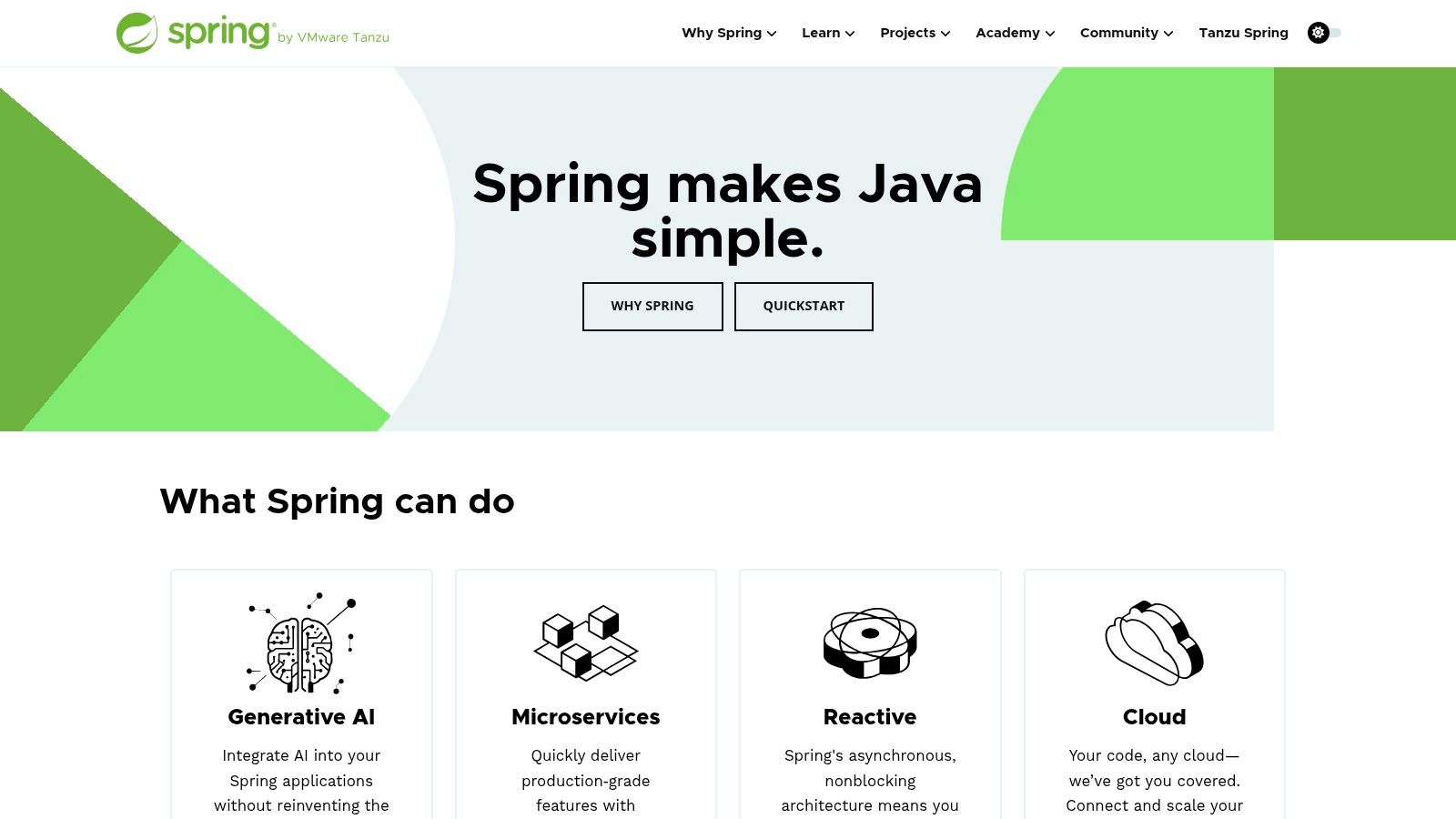
For businesses, especially in fintech where security and reliability are paramount, Spring's vast ecosystem translates to lower risk. Finding experienced developers is easier, and its extensive libraries for security, data access, and cloud integration mean less time is spent building foundational components from scratch. This makes it one of the most dependable java frameworks for web applications available today.
Key Considerations for Technical Leaders
- Best For: Enterprise-grade systems, microservices architectures, and applications requiring high security, such as payment gateways or trading platforms. Its maturity makes it a low-risk choice for long-term projects.
- Strengths: The Spring Initializr tool allows for rapid project bootstrapping, while Spring Boot's autoconfiguration intelligently sets up your application based on its dependencies. This allows teams to focus on business logic rather than configuration.
- Limitations: The sheer size of the ecosystem can present a steep learning curve for new developers. While the framework itself is open-source, official enterprise support is typically provided by third-party partners like VMware.
Spring's battle-tested security modules and proven data transaction patterns are non-negotiable advantages for fintech applications. You can learn more about how Spring compares to other Java web frameworks to make an informed decision for your next project.
2. Jakarta EE (Eclipse Foundation)
As the community-driven successor to Java EE, Jakarta EE provides a vendor-neutral set of specifications for building modern, enterprise-grade Java applications. It maintains the stability that enterprises have relied on for years while evolving under the stewardship of the Eclipse Foundation. This ensures a standardised, reliable foundation for complex systems, which minimises vendor lock-in and reduces long-term maintenance risk.
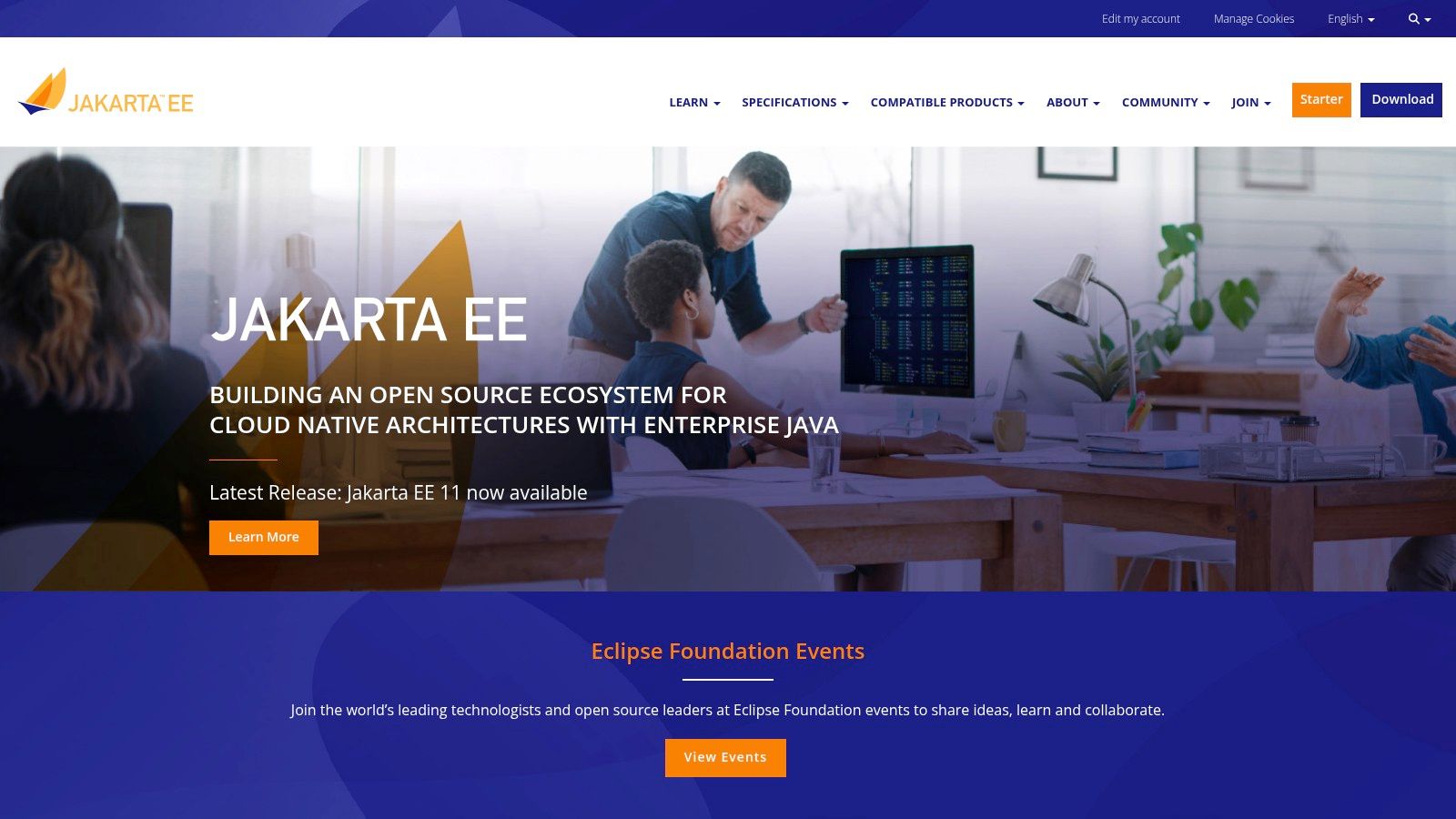
For organisations with existing Java EE investments, Jakarta EE offers a clear and stable migration path, preserving years of development effort. Its rich set of APIs for web services (JAX-RS), persistence (JPA), and messaging (JMS) makes it a comprehensive choice among java frameworks for web applications. This standardisation simplifies talent acquisition and ensures that skills are transferable across different compatible application servers like WildFly, Open Liberty, and Payara.
Key Considerations for Technical Leaders
- Best For: Large-scale enterprise applications, government systems, and businesses requiring application portability across various server environments. Ideal for projects that prioritise long-term stability and adherence to open standards.
- Strengths: The core benefit is standardisation. Developers can build an application against Jakarta EE specifications and deploy it on any compatible runtime, offering immense flexibility and preventing vendor dependency.
- Limitations: The specification-first approach can lead to slower adoption of modern programming paradigms compared to more opinionated frameworks. The need to choose and configure a separate application server can add initial complexity.
Jakarta EE's battle-tested standards provide a dependable bedrock for building secure, scalable, and interoperable enterprise solutions. You can explore the specifications and compatible products at the official Jakarta EE website.
3. Quarkus
Designed from the ground up for containers and serverless environments, Quarkus represents a significant shift in Java development. It delivers incredibly fast startup times and a low memory footprint by optimising code at build time. This approach, leveraging GraalVM native image compilation, makes it an exceptional choice for modern, cloud-native architectures where resource efficiency and rapid scaling are critical business drivers. For fintechs deploying microservices, this translates directly to lower operational costs and improved performance.

The developer experience is a key focus, with features like live coding enabling near-instantaneous feedback, which boosts productivity and accelerates time-to-market. While its ecosystem is newer than Spring's, it is growing rapidly and integrates familiar standards like Jakarta EE and MicroProfile. This makes Quarkus one of the most compelling java frameworks for web applications for teams building for the cloud.
Key Considerations for Technical Leaders
- Best For: High-performance microservices, serverless functions (AWS Lambda), and any containerised application where startup time and memory usage are paramount. It is ideal for cost-sensitive cloud deployments.
- Strengths: Unmatched performance in containerised environments due to native image compilation. Its "developer joy" features like live reload significantly shorten the development feedback loop.
- Limitations: Building native images introduces complexity and can increase build times. The ecosystem, while expanding, is less mature than more established frameworks, which may pose a risk for projects with niche requirements.
4. Micronaut
Micronaut is a modern, JVM-based framework engineered for building modular, easily testable microservice and serverless applications. It distinguishes itself by performing dependency injection at compile-time, which eliminates reflection and results in significantly faster startup times and a lower memory footprint. This compile-time approach directly reduces operational costs and improves resource efficiency—a critical advantage for cloud-native deployments where performance is directly tied to expense.
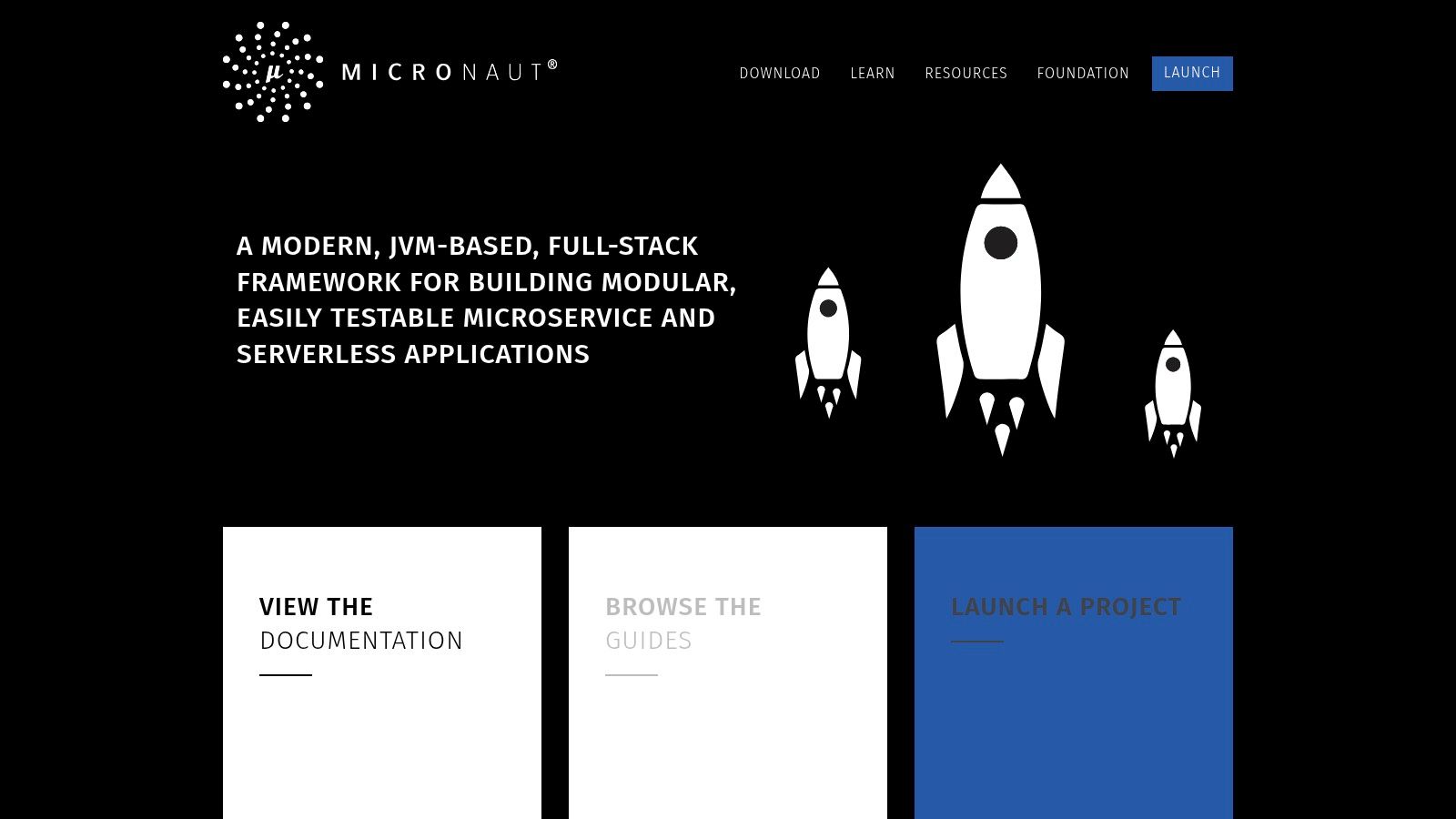
For businesses building high-performance APIs or event-driven systems, Micronaut's design offers a predictable and lean runtime. Its native support for GraalVM allows for the creation of native executables, further shrinking application size and boot times. This makes it one of the most efficient java frameworks for web applications, especially for functions that need to scale from zero rapidly.
Key Considerations for Technical Leaders
- Best For: High-performance microservices, serverless functions, and any application where low memory consumption and fast startup are business-critical. It is ideal for organisations adopting a cloud-native strategy.
- Strengths: Its reflection-free, ahead-of-time (AOT) compilation leads to a predictable, small runtime footprint. Micronaut Data simplifies data access repository logic at compile-time.
- Limitations: The community and ecosystem are smaller than Spring's, which can mean fewer third-party integrations and a smaller talent pool. Developers accustomed to reflection-heavy patterns may face a learning curve.
Micronaut's polyglot nature also supports other JVM languages, providing flexibility. You can discover the differences between Java and Kotlin to see how this might benefit your technology stack.
5. Vaadin
Vaadin offers a full-stack platform that allows developers to build rich web UIs almost entirely in Java. Its component-based architecture is particularly effective for creating data-intensive applications common in internal business tools, dashboards, and enterprise systems. This Java-first approach reduces the need for front-end expertise in JavaScript or HTML, allowing back-end teams to deliver full-featured applications faster with a unified technology stack.
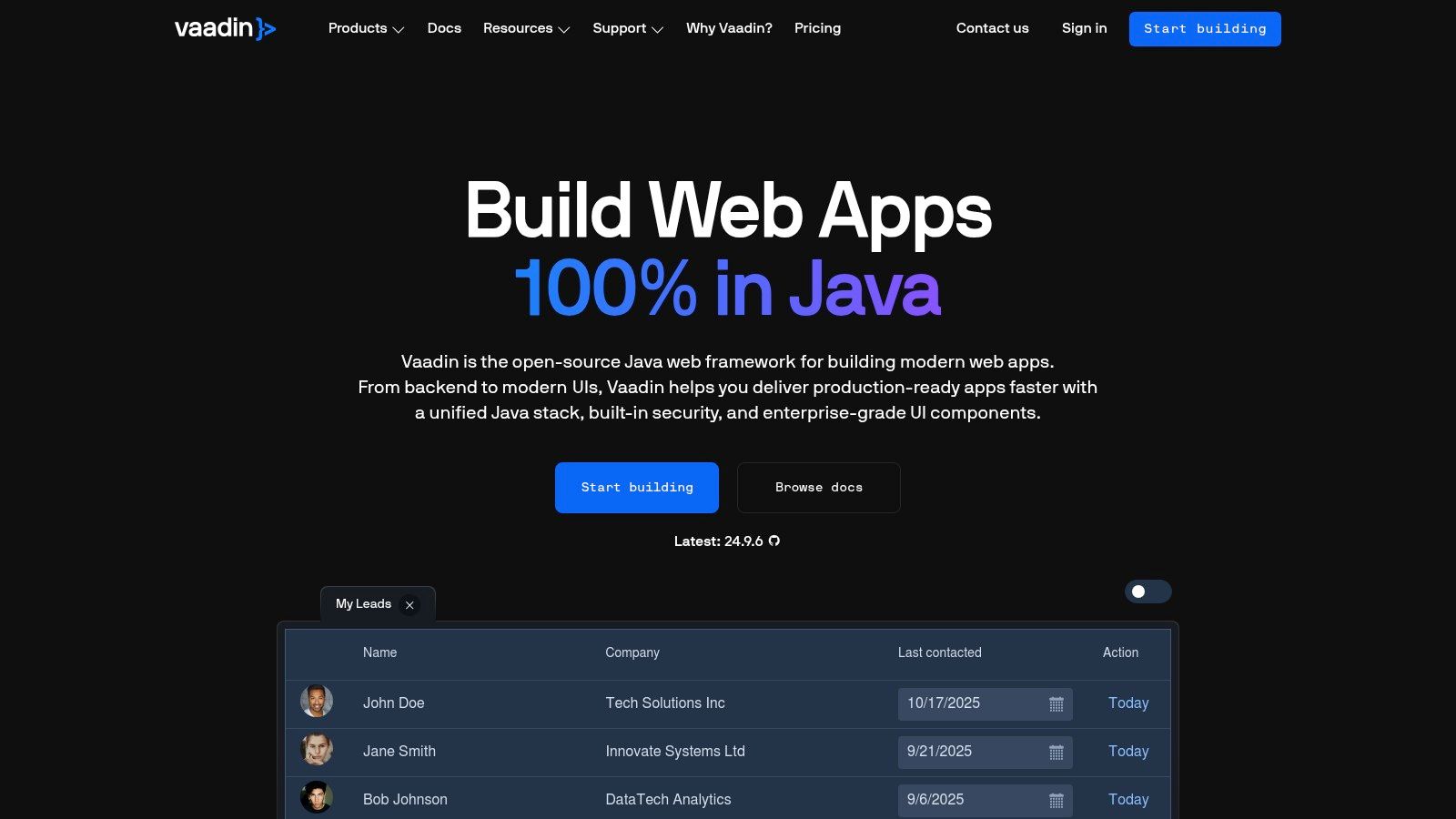
For businesses managing complex data workflows, such as CRM systems or internal admin panels, Vaadin's model can directly lower development costs and simplify maintenance. By abstracting away front-end complexities, it enables Java developers to be more productive. The platform's clear commercial support options also provide a predictable roadmap and reduce long-term risk for critical business applications, making it one of the most specialised java frameworks for web applications.
Key Considerations for Technical Leaders
- Best For: Internal enterprise applications, complex data dashboards, and situations where the development team's primary skill set is Java. It excels in projects where rapid UI development is needed without a dedicated front-end team.
- Strengths: An extensive library of pre-built UI components allows for rapid construction of sophisticated interfaces. The framework handles client-server communication automatically, which simplifies state management and security.
- Limitations: The component-centric, server-driven approach can be less flexible than modern REST-based, single-page application architectures. Advanced components and enterprise support require a paid subscription, adding to the total cost of ownership.
6. Play Framework
The Play Framework is engineered for high-velocity development and building highly scalable, reactive applications. It champions a stateless, non-blocking architecture that excels in handling concurrent requests with minimal resource consumption. This design directly translates to lower infrastructure costs for high-traffic services, a critical advantage for fintech platforms processing numerous small, asynchronous transactions like payment notifications.
For development teams, Play's "hit refresh" hot-reloading capability significantly reduces the development cycle time, allowing for faster iteration. Its native support for asynchronous I/O makes it a powerful choice among java frameworks for web applications when building real-time systems, such as live dashboards or collaborative tools. While it also supports Scala, its Java API is robust, offering flexibility without forcing a new language on the team.
Key Considerations for Technical Leaders
- Best For: Real-time applications, high-throughput APIs, microservices, and event-driven systems where low latency and high concurrency are business-critical. It's a strong fit for fintechs building responsive trading platforms or notification hubs.
- Strengths: Developer productivity is a core focus, with features like type-safe templates and built-in testing tools. Its reactive model, built on Pekko (formerly Akka), ensures efficient use of server resources under heavy load.
- Limitations: The ecosystem of third-party plugins is smaller compared to Spring, which may require more in-house development. For teams exclusively using Java, the occasional need to interact with Scala-centric tooling can introduce a slight learning curve.
Play Framework is open-source and free to use. You can access documentation and downloads directly from the Play Framework website.
7. Helidon
Developed by Oracle, Helidon is an open-source framework designed for building cloud-native microservices. It offers two distinct programming models: Helidon MP, which implements the MicroProfile standard, and Helidon SE, a more functional, lightweight toolkit. This dual approach provides flexibility, allowing teams to choose between a standards-based, declarative style or a modern, reactive one.

For businesses looking to modernise their Java stack, Helidon presents a compelling option. Its support for virtual threads (Project Loom) in recent versions significantly improves throughput for I/O-bound applications, a common scenario in systems that handle many concurrent API requests. This makes it one of the more forward-looking java frameworks for web applications for building high-performance, cloud-ready services.
Key Considerations for Technical Leaders
- Best For: Teams building new microservices that need to integrate with existing Java EE or MicroProfile ecosystems. Its lightweight nature is ideal for applications where low memory footprint and fast startup are critical.
- Strengths: Helidon’s support for GraalVM native image compilation results in fast startup times and reduced resource consumption, lowering cloud infrastructure costs. Its built-in observability features simplify operational management.
- Limitations: The community and ecosystem are smaller compared to giants like Spring or Quarkus, which can mean fewer third-party libraries and a smaller talent pool. API differences between major versions may require a learning curve for teams upgrading.
8. Dropwizard
Dropwizard takes an opinionated approach to building high-performance, RESTful web services by bundling a suite of mature and stable libraries. It integrates Jetty for the HTTP layer, Jersey for REST, and Jackson for JSON processing. This pre-packaged, production-ready stack allows development teams to bypass complex configuration and focus directly on implementing business logic, which significantly accelerates the creation of microservices and APIs.
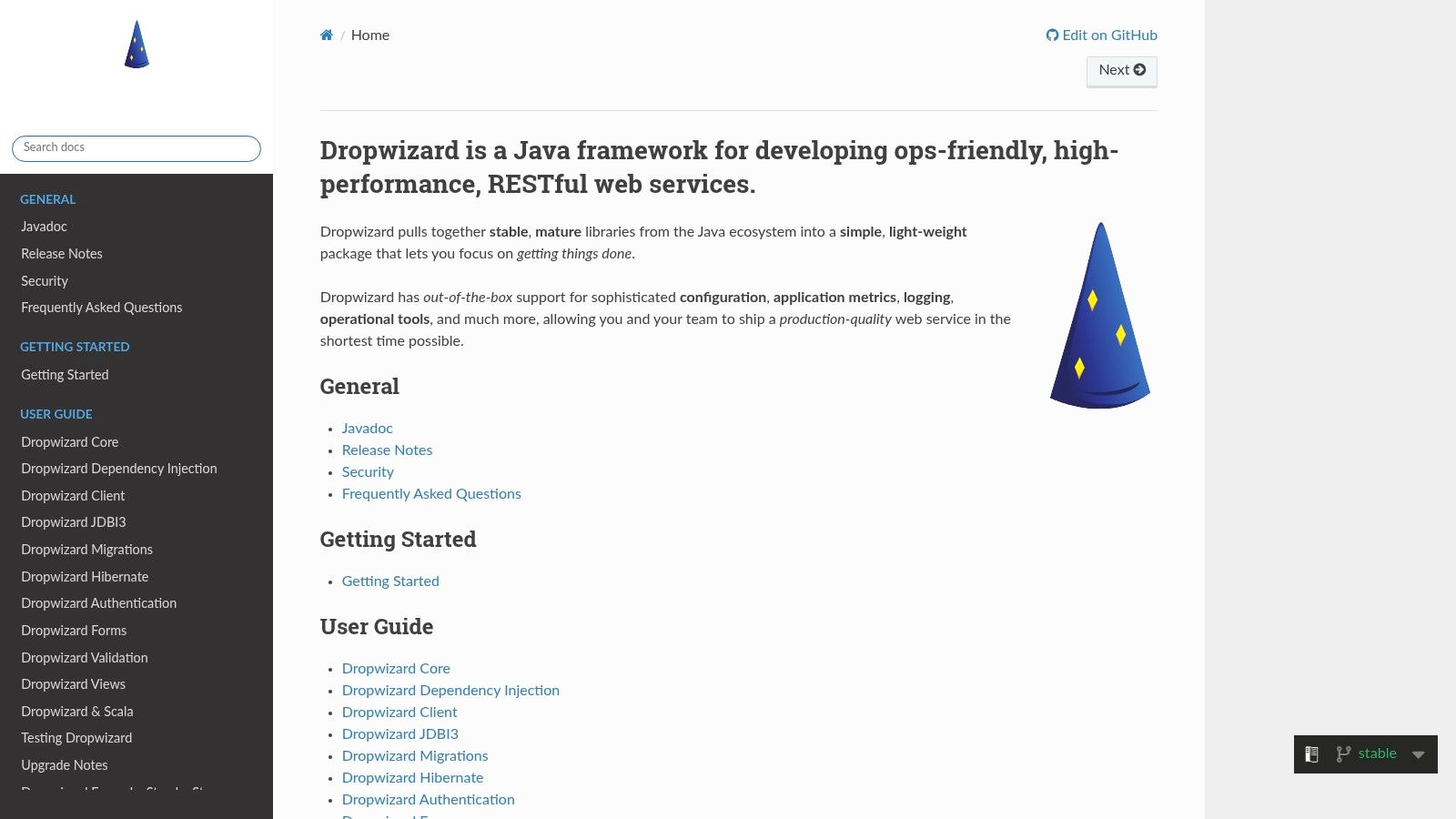
For businesses that need to launch lean, reliable backend services quickly, Dropwizard's simplicity is a major asset. It embeds operational best practices like metrics and health checks by default, reducing the operational overhead and risk associated with deploying new services. Its straightforward nature makes it one of the most efficient java frameworks for web applications when the primary goal is to build stable, maintainable REST APIs.
Key Considerations for Technical Leaders
- Best For: Fast development of RESTful microservices and backend APIs where stability and operational visibility are critical from day one. It is ideal for teams that value simplicity and convention over configuration.
- Strengths: Its all-in-one packaging of best-in-class libraries (Jetty, Jersey, Jackson) provides a stable and performant foundation. The framework's emphasis on operational readiness lowers the barrier to deploying production-grade applications.
- Limitations: The framework is highly opinionated and less extensible than ecosystems like Spring. Its smaller community means fewer third-party modules, requiring more custom integrations for needs beyond core API functionality.
The framework's minimal footprint and focus on operational health make it a strong candidate for building focused, high-availability services. You can explore the official Dropwizard documentation to get started.
9. Grails (Apache Grails)
Built on Spring Boot and Hibernate, Grails offers an opinionated approach that prioritises developer productivity. By leveraging the Groovy programming language, it embraces a convention-over-configuration paradigm, significantly reducing the boilerplate code needed for common web application tasks. This focus on speed makes it an excellent choice for building line-of-business applications, REST APIs, and MVPs where time-to-market is a critical business driver.

For businesses needing to develop CRUD-heavy applications quickly, Grails' powerful data access layer, GORM (Grails Object Relational Mapping), is a standout feature. It simplifies database interactions for both SQL and NoSQL sources, allowing development teams to focus more on business logic. This productivity boost makes it one of the most efficient java frameworks for web applications for specific use cases.
Key Considerations for Technical Leaders
- Best For: Rapid development of content management systems, e-commerce sites, and internal business applications where speed is paramount.
- Strengths: The framework's scaffolding features can automatically generate basic application screens from the data model, providing a huge initial development boost. Its seamless integration with the Java ecosystem means you can still leverage existing Java libraries.
- Limitations: The primary challenge is the requirement to learn Groovy, which can be a hurdle for teams standardised on Java. Its ecosystem and community are also smaller compared to Spring, potentially making it harder to find experienced developers.
10. JHipster
JHipster is not a framework but an open-source application generator that dramatically accelerates the creation of modern web applications. It scaffolds a complete, production-ready project by combining powerful java frameworks for web applications like Spring Boot or Quarkus on the backend with frontend technologies such as Angular or React. This approach saves weeks of initial setup, allowing development teams to focus immediately on business-critical features.

For startups and enterprises aiming to build MVPs or new platforms, JHipster offers a significant competitive advantage. It generates projects with best practices built-in, including security, CI/CD pipelines, and containerisation with Docker. This drastically reduces initial development costs and project risk by providing a standardised, high-quality foundation. The ability to quickly prototype and iterate makes it an invaluable tool for modern, agile development.
Key Considerations for Technical Leaders
- Best For: Rapidly bootstrapping new monolith or microservice projects, creating proofs-of-concept, and standardising development practices across teams. It is ideal for organisations that need to reduce time-to-market.
- Strengths: Automates the creation of a full application stack, including authentication, database integration, and deployment configurations. The "blueprint" system allows for extensive customisation.
- Limitations: The generated code can be complex and may introduce a learning curve for teams unfamiliar with the underlying frameworks. Keeping a long-running project updated with the latest JHipster versions can require careful management.
By enforcing consistency from day one, JHipster aligns perfectly with a streamlined project delivery model, ensuring predictable outcomes.
11. Maven Central (Central Repository by Sonatype)
While not a framework, Maven Central is the indispensable nerve center for virtually all modern Java development. It serves as the primary public repository where developers find and fetch dependencies for all java frameworks for web applications, including Spring, Quarkus, and Micronaut. Accessing the correct, secure, and up-to-date framework versions through this platform is a foundational step that impacts build reliability and security from day one.
For a technical leader, ensuring your team uses a trusted artifact source is non-negotiable, especially in fintech where supply chain security is a major concern. Maven Central, operated by Sonatype, is the canonical, default repository for build tools like Maven and Gradle. This eliminates the risk of using unverified or malicious libraries, a critical factor in maintaining compliance and protecting sensitive data. Its reliability ensures development workflows are not disrupted by missing dependencies, reducing project delays.
Key Considerations for Technical Leaders
- Best For: All Java development teams. It is the official, secure source for fetching framework dependencies, libraries, and build plugins.
- Strengths: As the universally trusted repository for Maven and Gradle, it provides the most comprehensive collection of Java artifacts. Its direct integration with build tools automates dependency management, improving developer productivity.
- Limitations: The platform is purely a repository and search index, not a learning resource. It assumes users already understand Java dependency management.
Using Maven Central effectively means standardizing your builds on the most stable and secure source available. You can search for any library at https://central.sonatype.com/.
12. Amazon.de (Books and learning material)
A well-curated library of technical literature is a critical asset for any development team. Amazon.de serves as an essential marketplace for books covering the entire spectrum of Java web development, from foundational texts on Spring to advanced guides on modern frameworks like Quarkus. Access to up-to-date resources empowers teams to master new technologies, reducing training time and minimizing implementation risks.

For organisations across the EU, the platform provides reliable shipping, making it a practical choice for building a company library. The vast catalogue, combined with user ratings and Kindle editions for instant access, allows technical leaders to efficiently procure learning materials. This ensures their developers stay proficient with the best java frameworks for web applications, directly impacting project quality and innovation speed.
Key Considerations for Technical Leaders
- Best For: Teams needing to deepen their expertise in specific frameworks, onboarding new developers, or staying current with the latest Java ecosystem trends.
- Strengths: An unparalleled selection of current and classic Java programming books, with user reviews helping to vet quality. The availability of Kindle e-books allows for immediate access to information.
- Limitations: Shipping costs and availability can vary. It is crucial to check publication dates to avoid purchasing outdated material that could lead to adopting deprecated practices.
For any company serious about technical excellence, providing access to high-quality learning resources is non-negotiable. You can start building your team's library at Amazon.de.
Frequently Asked Questions (FAQ)
Q1: Which Java framework is best for microservices?
A: Spring Boot is the most popular and mature choice, offering a vast ecosystem. For peak performance and low resource usage, especially in serverless or containerized environments, Quarkus and Micronaut are excellent alternatives due to their fast startup times and small memory footprints.
Q2: Are Java frameworks still relevant in 2025?
A: Absolutely. Java's performance, stability, and massive ecosystem make it a top choice for enterprise-level applications, particularly in finance, e-commerce, and big data. Modern java frameworks for web applications like Quarkus and Micronaut have adapted to cloud-native trends, ensuring Java remains competitive.
Q3: Can I build a front-end with a Java framework?
A: Yes. While most modern architectures separate the backend (Java) from the frontend (JavaScript frameworks like React or Angular), Vaadin is a framework specifically designed to let you build the entire web UI using only Java, which can accelerate development for Java-centric teams.
Q4: How does framework choice impact my budget?
A: Framework choice affects costs in several ways. Cloud-native frameworks like Quarkus can reduce infrastructure costs through lower memory usage. Mature frameworks like Spring can lower development costs by making it easier to hire experienced developers and leverage a large ecosystem of pre-built solutions. An incorrect choice can increase maintenance costs and slow down time-to-market, impacting revenue.
Choosing the right framework and architecting a robust solution requires deep, specialised expertise. At SCALER, we leverage our extensive experience with Java-based systems to help businesses build high-performance, secure, and scalable web applications. Partner with us to accelerate your development and ensure your technology choices translate directly into business success.
< MORE RESOURCES / >

Fintech
A Guide to Epic Store Szeged and the Local Tech Scene

Fintech
A Guide to Designing a Nordic Light Office for Technical Teams

Fintech
A Tech Employer's Guide to Hungary's Social Security System

Fintech
How to Choose an IT Company That Drives Business Outcomes

Fintech
A Consultant's Guide to Part-Time Jobs in Budapest

Fintech
A Consultant's Guide to Peppol Integration for E-Invoicing

Fintech
A Tech Leader's Guide to Nearshore Development

Fintech
PSD2 Integration for CTOs: Real-World Challenges and Architecture Insights

Team augmentation
Hiring vs. Outsourcing: Finding the Right Balance with Team Augmentation

Fintech