
< RESOURCES / >
How to Choose a Web Framework for Java That Drives Business Outcomes

Selecting a web framework for Java is more than a technical task—it's a strategic business decision that directly impacts your time-to-market, operational costs, and long-term risk. The right framework accelerates innovation and reduces total cost of ownership. The wrong one creates technical debt that slows your business down for years.
Why Your Java Framework Choice Is a Business Decision
Choosing a web framework for Java sets the foundation for your application's lifecycle. This decision influences development speed, operational expenses, and your ability to scale. A framework isn't just a set of libraries; it's an architectural philosophy. Aligning that philosophy with your business objectives is critical to avoiding friction and maximizing ROI.
For example, a framework optimized for minimal memory usage directly reduces your monthly cloud infrastructure costs. Conversely, a framework with a vast, mature ecosystem can de-risk integration with legacy systems, saving significant engineering time and reducing project timelines. The key is to evaluate each option based on its tangible impact on business outcomes, not just its technical features.
Key Evaluation Criteria for a Web Framework for Java
To make an informed decision, focus on these strategic pillars that connect technology to business value:
- Time-to-Market: How quickly can your team deliver a functional product? Frameworks with strong convention-over-configuration principles, like Spring Boot, are engineered to accelerate development cycles.
- Total Cost of Ownership (TCO): Look beyond initial development. Factor in hosting costs, maintenance overhead, and the availability and cost of skilled developers.
- Scalability and Performance: Will the framework support your growth? Modern, cloud-native options like Quarkus are designed for resource efficiency at scale, enabling you to handle increased user load without over-provisioning expensive infrastructure.
- Risk Mitigation: How stable and supported is the framework? A mature ecosystem provides a safety net of proven libraries, pre-built solutions, and a large talent pool, reducing integration and maintenance risks.
The table below provides a high-level comparison based on these business-centric criteria.
This guide will help you analyze each web framework for Java through these critical lenses, ensuring your technology choice provides a clear competitive advantage.
Navigating the Modern Java Framework Ecosystem
Choosing the right web framework for Java is a strategic decision that must align with your business goals, team capabilities, and budget. It's about selecting an architectural philosophy that will either accelerate or impede your progress.
The Java ecosystem offers a spectrum of design philosophies, each with trade-offs that impact project outcomes. Making the right choice means delivering measurable business value, not just a technically elegant solution. As you evaluate options, consider how they integrate with your operational pipeline, including modern DevOps automation strategies that are essential for maintaining development velocity.
From Monoliths to Microservices
Frameworks like Jakarta EE (the successor to Java EE) provide a comprehensive, standardized platform for robust, monolithic applications. While sometimes viewed as traditional, they are powerful for large-scale enterprise systems where stability and long-term support are non-negotiable.
The business case for a monolith-first framework is clear:
- Lower Upfront Complexity: A single codebase simplifies initial development and deployment, which helps control early-stage engineering costs.
- Simplified Management: Orchestrating one large application is often less complex than managing dozens of independent microservices.
- Reliable Transactions: Monoliths excel at managing complex, multi-step transactions, a critical requirement in sectors like finance and e-commerce.
At the other end of the spectrum is the microservices approach, championed by frameworks like Spring Boot. This philosophy involves breaking a large application into a collection of small, independent services. This model directly addresses the need for business agility, allowing different teams to build, deploy, and scale their components independently. This architectural choice is as foundational as language selection, a topic we cover in our comparison of Java vs. Kotlin.
A framework’s architectural philosophy is a direct reflection of its intended business outcome. A monolith prioritises initial simplicity and unified control, while microservices prioritise independent scalability and development velocity.
The Rise of Cloud-Native Frameworks
A third category, cloud-native frameworks, has emerged to address the demands of modern infrastructure like serverless functions and container platforms. Frameworks such as Quarkus and Micronaut were designed specifically for this environment.
Their core value proposition is resource efficiency, which translates directly into cost savings.
- Lower Cloud Bills: These frameworks are optimized for fast startup times and low memory footprints, which can significantly reduce monthly infrastructure spending.
- Efficient Scaling: They are engineered to scale from zero to full capacity rapidly, making them ideal for handling variable traffic without paying for idle resources.
The market reflects this evolution. The Global Java Web Development Framework Market was projected to reach USD 9,034.10 million by 2030, signaling sustained investment and confidence in Java's future. This reinforces that choosing a web framework for Java is a long-term strategic investment.
The table below summarizes how each framework's philosophy connects to specific business outcomes.
Framework Philosophy and Business Impact
Each path offers distinct advantages. The key is to match the framework’s strengths to your specific operational needs and strategic goals.
Comparing Frameworks for Enterprise Applications
Selecting the right web framework for Java requires an evaluation of how its core design will affect performance, cost, and risk. Here, we analyze three leading frameworks—Spring Boot, Quarkus, and Vaadin—through the lens of enterprise business requirements.
A solid architectural foundation is non-negotiable; a great framework cannot compensate for poor design. We recommend familiarizing yourself with Robert C. Martin's Clean Architecture principles to ensure you build systems that are maintainable and scalable, regardless of the framework chosen.
This comparison connects technical details to tangible business outcomes to help you make a strategic decision aligned with your company's goals.
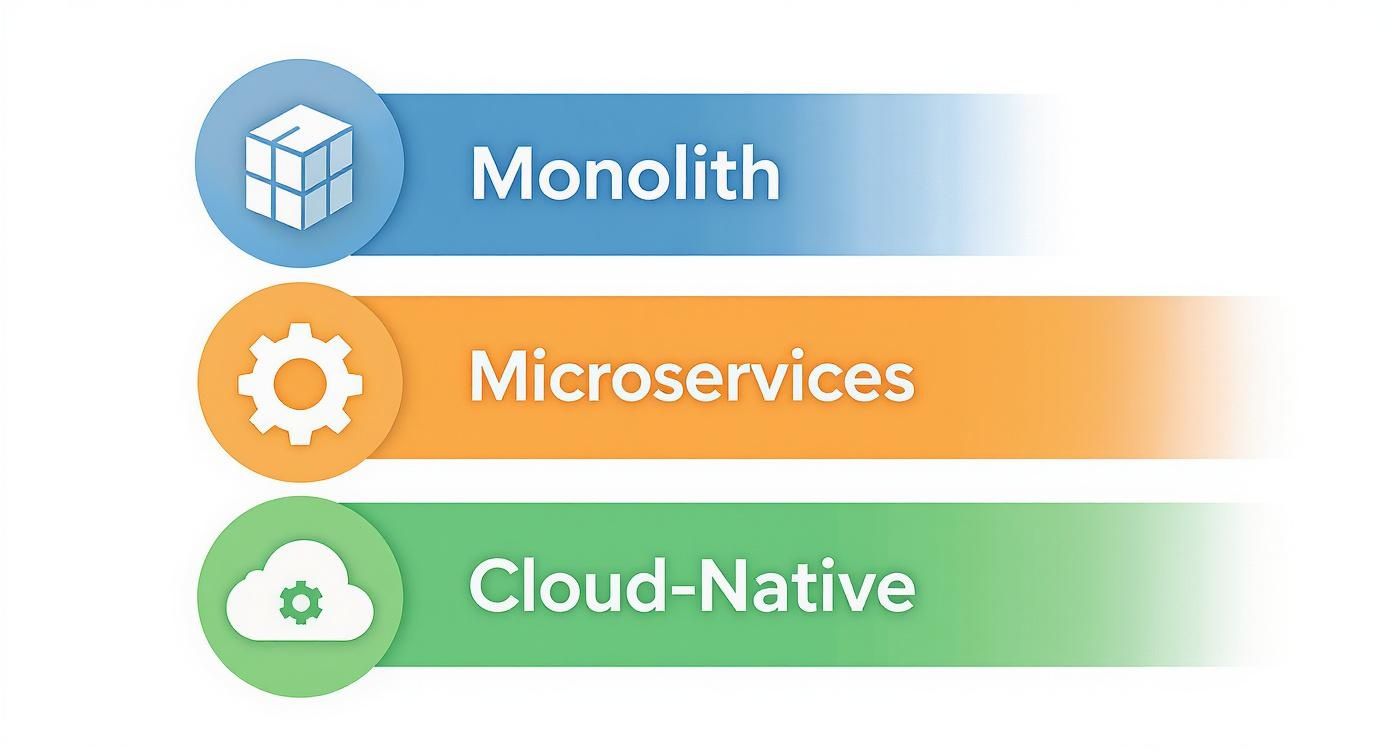
The journey from monoliths to microservices and cloud-native designs reflects a shift in how businesses solve problems, from prioritizing stability to enabling agility and efficiency.
Performance and Operational Cost
In a cloud environment, performance directly impacts your operational budget. Application startup time and memory footprint are key metrics that determine your monthly infrastructure spend.
Spring Boot, while significantly optimized over the years, is built on runtime dependency injection, which carries inherent overhead. This can result in higher memory usage and slower startup times. For the business, this may translate to needing larger, more expensive container instances that run continuously.
Quarkus was designed for the cloud. By performing dependency injection and configuration analysis at compile-time, it achieves exceptionally fast startup times and a minimal memory footprint.
The key takeaway for Quarkus is its direct impact on your cloud bill. Faster startup and lower memory means you pay for less compute, especially in serverless or auto-scaling environments where every millisecond costs you money.
Vaadin, a server-side UI framework, has a different performance profile. Its value lies in accelerating frontend development. While its server footprint is larger than a stateless REST API, the trade-off is often justified by the significant reduction in development time for internal tools.
Developer Experience and Time-to-Market
A framework's developer experience directly influences project velocity. A cumbersome workflow creates friction, slows down progress, and increases development costs.
Spring Boot offers an unparalleled developer experience. Its massive community, comprehensive documentation, and large talent pool make it a low-risk, battle-tested choice. The Spring Initializr and convention-over-configuration approach eliminate boilerplate, allowing teams to focus on business logic and accelerate time-to-market.
Quarkus provides a modern developer experience with features like live coding, which offers near-instant feedback on code changes without requiring a restart. This rapid feedback loop significantly boosts productivity. The trade-off is a less mature ecosystem compared to Spring, which may require custom integrations.
Vaadin enables backend Java developers to build rich, interactive UIs without writing JavaScript, HTML, or CSS. This is a powerful advantage for teams developing internal dashboards, admin panels, or data-intensive applications.
- Business Impact: You can potentially build an entire internal application without hiring a dedicated frontend team. That cuts costs and dramatically shrinks project timelines.
Ecosystem Maturity and Integration Risk
A mature ecosystem acts as a project's safety net, providing proven libraries, third-party integrations, and community support that de-risk long-term development and maintenance.
Spring's ecosystem is its greatest strength. With decades of development, there is a Spring module or community library for nearly any requirement, from databases and security to messaging queues.
- Key Advantage: This maturity crushes integration risk. Need to connect to a legacy system or a weird third-party API? Odds are someone has already built and battle-tested a solution in the Spring ecosystem.
Quarkus has a curated ecosystem of "extensions." While it covers common use cases well, it lacks Spring's breadth. Projects requiring niche libraries may need to invest in custom development, which introduces risk.
Vaadin has a strong UI-focused ecosystem. Its marketplace offers pre-built components and themes that accelerate the assembly of complex interfaces. It also integrates well with Spring, allowing you to use it as the view layer for a powerful backend.
Cloud-Native Readiness and Scalability
A modern web framework for Java must be optimized for the cloud, meaning it should be lightweight, easily containerized, and compatible with orchestration tools like Docker and Kubernetes.
Quarkus is a cloud-native framework by design. It was built for containers and serverless functions and can be compiled to a native executable with GraalVM, further reducing its size and startup time. This makes it an excellent choice for cost-effective, high-performance microservices.
Spring Boot has adapted well to the cloud with projects like Spring Cloud, which provides a comprehensive toolkit for building distributed systems. However, its applications are generally larger and slower to start than Quarkus applications, which can be a disadvantage in highly dynamic auto-scaling environments.
Vaadin applications can be containerized like any other Java application. However, because it maintains UI state on the server, it requires sticky session configuration when run in a cluster, adding a layer of operational overhead compared to stateless REST APIs.
The Final Verdict: It’s Situational
There is no single "best" web framework for Java. The optimal choice depends on your business context, team skills, and strategic goals.
- Choose Spring Boot when… your priority is minimizing risk with a mature, battle-tested ecosystem. It’s the safe bet for complex enterprise systems with a wide range of integrations, and it's easy to hire for.
- Choose Quarkus when… your goal is to slash cloud operational costs. It’s built for high-performance, scalable microservices and serverless functions where every millisecond and megabyte has a price tag.
- Choose Vaadin when… you need to build data-heavy internal applications—fast. It lets you leverage your existing Java team to build the UI, saving you the cost and time of a dedicated frontend team.
By evaluating these frameworks against your business drivers, you can make an informed decision that positions your project for success.
Matching a Web Framework for Java to Your Use Case
Selecting a web framework for Java without a clear business context is a recipe for costly mistakes. The choice must be driven by specific business needs, not abstract technical merits. A framework that excels in one scenario may be a significant liability in another. Let's examine common enterprise use cases to determine the right tool for the job.
Low-Latency Fintech and Trading Platforms
In high-frequency trading and other fintech applications, performance is the business model. Millisecond delays can result in significant financial losses. The business requirement is simple: speed is revenue.
For these demanding environments, Quarkus is a strong contender. Its architecture is well-suited for the low-latency, high-throughput processing financial systems require.
- Business Outcome: By compiling to a native executable, Quarkus achieves near-instant startup times and low memory consumption. This reduces infrastructure costs and ensures the system can respond to market events with minimal delay, protecting revenue and creating a competitive edge.
- Technical Justification: Its reactive, non-blocking I/O model is ideal for managing a large number of concurrent connections, such as those from market data feeds or payment gateways.
Large-Scale Enterprise Monoliths
Many organizations rely on large, monolithic applications for core business functions like ERP, CRM, or insurance platforms. For these systems, the primary concerns are stability, security, and transactional integrity. The goal is to manage risk and ensure complex business processes operate reliably.
In this context, Spring Boot remains the dominant choice. Its maturity and extensive ecosystem provide a low-risk, dependable foundation for mission-critical systems.
- Business Outcome: Spring's comprehensive security modules and battle-tested transaction management help businesses meet stringent compliance requirements like PSD2 or GDPR. The large talent pool also simplifies hiring and reduces long-term project risk.
For established enterprises, the real value of Spring Boot is its unparalleled ecosystem. It takes the risk out of integrating with legacy systems and offers proven solutions for almost every challenge imaginable, effectively safeguarding your mission-critical operations.
Agile Microservice Architectures
When the primary objective is rapid innovation and independent scalability, a microservice architecture is often the optimal choice. This approach allows teams to develop, deploy, and iterate on features independently, accelerating time-to-market.
Both Spring Boot and Quarkus are excellent choices for building microservices with a web framework for Java. The decision often comes down to a trade-off between ecosystem maturity and operational efficiency.
- Spring Boot: The preferred option for teams needing to integrate with a wide array of existing systems. Its rich ecosystem provides ready-made solutions that accelerate feature delivery.
- Quarkus: The more strategic choice when minimizing cloud operational costs is a key priority. Its resource efficiency allows you to run more services on the same infrastructure, directly reducing your monthly cloud spend.
Rapid Development of Internal Tooling
Businesses rely on a variety of internal tools, admin panels, and data dashboards. For these projects, development speed is the primary driver. The goal is to deliver a functional, secure UI to internal users quickly and cost-effectively.
This is where Vaadin offers a unique advantage. It enables backend Java developers to build rich, interactive web UIs without writing JavaScript.
- Business Outcome: Vaadin can slash development time and cost for internal apps by cutting out the need for a dedicated frontend team. Companies can use the Java talent they already have to build the entire stack, which gets projects delivered much faster.
The framework is gaining traction for these use cases. For instance, there are already 26 live websites in Hungary built with Vaadin, demonstrating its adoption for real-world applications. Discover more insights about Vaadin's adoption on WebTechSurvey.com.
By matching your choice of a web framework for Java to your project's business goals, you ensure your tech stack isn't just working—it's a strategic asset that delivers real results.
Planning Your Integration and Migration Strategy
Adopting a new web framework for Java requires more than writing code. A successful transition is a managed project that demands a clear integration strategy and a realistic migration plan. Proper planning is essential to minimize business disruption and ensure the technology shift delivers its intended benefits, such as lower operational costs and improved system reliability.
Without a well-defined plan, even a superior framework can lead to expensive delays and technical debt. The key is to manage risk and complexity by carefully considering how the new framework will interact with your existing systems, from cloud platforms to container orchestration.

Cloud and Container Integration
Modern applications are designed for the cloud, so your chosen framework must integrate seamlessly with platforms like AWS, Azure, and Google Cloud. This includes leveraging their native services for databases, messaging, and identity management to accelerate development and reduce maintenance overhead.
Containerization with Docker and orchestration with Kubernetes are standard practices for building scalable and resilient applications. Your strategy must address how easily the framework can be packaged into a container.
- Optimised Container Images: Cloud-native frameworks like Quarkus excel here, producing small, efficient container images that reduce storage costs and accelerate deployment times.
- Kubernetes Readiness: Evaluate the framework's support for Kubernetes-native features like health checks, configuration maps, and secrets. Proper integration simplifies operations and enhances system stability.
The real aim here is to build a smooth pipeline. Developers should be able to build, containerise, and deploy their work with almost zero friction. Get that right, and you directly boost your team’s speed and your ability to react to what the market wants.
Establishing Modern Observability
You cannot manage what you do not measure. A robust observability strategy—encompassing structured logging, metrics, and distributed tracing—is non-negotiable for understanding application performance and diagnosing issues in complex distributed systems.
Your integration plan must include instrumenting applications from day one. Leading frameworks like Spring Boot and Micronaut offer excellent support for tools such as Prometheus (metrics) and OpenTelemetry (tracing). This built-in support reduces implementation costs and provides immediate insight into application health, which is critical for meeting service-level agreements (SLAs). Our guide on software project management offers battle-tested frameworks for steering complex technical projects.
Modernising Legacy Applications
For businesses running on older Java EE or Jakarta EE systems, migrating to a modern web framework for Java presents an opportunity to reduce technical debt and increase agility. However, a "big bang" rewrite is often too risky and disruptive.
A phased migration is the more prudent approach. This involves gradually decomposing the monolith and rebuilding components as independent microservices using the new framework. This iterative process allows you to deliver value quickly while managing risk. For instance, you could start by extracting a single capability, like payment processing, into a new Spring Boot service. This minimizes disruption to core operations and allows your team to gain experience with the new technology in a controlled environment.
Making the Final Decision for Your Business
Choosing the right Java web framework is a strategic decision with long-term implications for your budget, team productivity, and competitive position. The objective is not to select the most popular tool, but the one that best aligns with your specific business requirements. A framework designed for low-latency trading is ill-suited for an internal dashboard, and vice versa.
To make an informed choice, move beyond technical specifications and ask critical business questions. Will this framework reduce our operational costs through improved cloud efficiency? Does its ecosystem mitigate the risk of complex integrations? Does my team have the necessary skills, or will we incur significant training costs? Your team’s existing capabilities have a direct impact on project timelines and budget. For more on building effective development teams, explore our guide to team augmentation.
The best web framework for Java is a business enabler. It should directly support what you’re trying to achieve—whether that’s getting to market faster, slashing your cloud spend, or de-risking a complex enterprise integration.
Ultimately, the framework is a means to an end. It is the foundation upon which you build, and it must be robust enough to support your company's growth, security, and scalability for the long term.
Common Questions We Hear From Leaders
When selecting a Java framework, you are making a strategic business decision, not just a technical one. Here are some of the most common questions that arise during these discussions.
How Much Does Our Framework Choice Affect Hiring?
Your framework choice significantly impacts your talent pool.
Opting for a widely adopted framework like Spring Boot gives you access to a large global community of developers. This generally makes hiring faster and more cost-effective, reducing the risks associated with onboarding.
Conversely, a more specialized framework may offer performance advantages but will have a smaller pool of available experts. This may require investing in training for your existing team or paying a premium for niche talent, which can impact your budget and timeline.
What’s the Real Budget Impact of Going Cloud-Native?
The primary impact is improved efficiency, which translates into real cost savings.
Frameworks like Quarkus are designed for the cloud. Their technical advantages, such as minimal memory footprints and near-instant startup times, directly lead to lower monthly infrastructure bills.
In a serverless or auto-scaling environment, this efficiency means you pay for less compute time and can use smaller, less expensive instances. Your infrastructure costs more closely align with actual usage, providing a clear financial benefit.
Should We Modernise Our Monolith or Start Over With Microservices?
There is no single correct answer. The best approach depends on your business goals, system complexity, and risk tolerance.
For stable, core business systems, modernizing the existing application is often the lower-risk, more cost-effective option. This allows you to improve performance and maintainability without the disruption of a complete rewrite.
However, if your primary goal is to accelerate feature delivery and scale components of your application independently, migrating to a microservices architecture may be the right decision. While it offers greater agility, it also introduces significant operational complexity that requires a mature DevOps culture to manage effectively.
Choosing the right web framework for Java is a decision that ripples through your entire organisation, from cloud spend to team productivity. At SCALER Software Solutions Ltd, we help businesses make sure their tech stack is a strategic advantage, not a liability.
If you need a partner to assess where you are, plan your next move, or bring in senior Java talent to get it done, we should talk.
< MORE RESOURCES / >

Fintech
A Guide to Epic Store Szeged and the Local Tech Scene

Fintech
A Guide to Designing a Nordic Light Office for Technical Teams

Fintech
A Tech Employer's Guide to Hungary's Social Security System

Fintech
How to Choose an IT Company That Drives Business Outcomes

Fintech
A Consultant's Guide to Part-Time Jobs in Budapest

Fintech
A Consultant's Guide to Peppol Integration for E-Invoicing

Fintech
A Tech Leader's Guide to Nearshore Development

Fintech
PSD2 Integration for CTOs: Real-World Challenges and Architecture Insights

Team augmentation
Hiring vs. Outsourcing: Finding the Right Balance with Team Augmentation

Fintech