
< RESOURCES / >
Kotlin vs Java: A Strategic Guide for Business & Tech Leaders

The choice between Kotlin and Java isn't just about syntax; it's a strategic decision with direct consequences for your business. Java offers unparalleled stability and a massive, mature ecosystem, making it a fortress for large-scale enterprise systems. In contrast, Kotlin prioritizes developer productivity, code safety, and concise, modern syntax, designed to accelerate time-to-market.
So, the core question is a business one: Are you focused on maintaining large, established systems where risk mitigation is paramount, or are you building modern applications where speed and safety provide a competitive edge?

This guide provides a decision-making framework for technical leaders and product managers, connecting language features to tangible business outcomes like cost, risk, and revenue. We'll analyze Java's battle-tested reliability against Kotlin's pragmatic, developer-centric design to determine which is the smarter investment for your specific goals. As you evaluate this internal decision, it's also wise to weigh the strategic considerations for outsourcing custom software development, as your choice of partner can significantly influence cost and delivery timelines.
By the end of this guide, you will have a clear framework to assess:
- How language choice impacts developer productivity, cost, and talent acquisition.
- The real-world performance trade-offs and their effect on infrastructure costs.
- Which language aligns with your team's existing skills and your company's long-term strategy.
Quick Comparison: Kotlin vs. Java at a Glance
This executive summary provides a high-level overview to frame the detailed analysis that follows.
This table sets the stage. Now, let’s explore the details that drive a sound business decision.
Core Philosophies and Their Business Impact
Choosing between Kotlin and Java is about selecting a development philosophy that aligns with your business strategy. This decision directly influences your development speed, maintenance costs, and your ability to ship new features efficiently.
Java was built on the promise of stability and platform independence ("write once, run anywhere"), making it the bedrock of enterprise software for decades. This focus on stability results in verbose, explicit code where every detail is spelled out. For a business, this translates to predictability and lower operational risk—critical for mission-critical applications that must remain reliable for years. The result is a massive, mature ecosystem. In regions like Hungary, over 70% of enterprise software in banking, telecom, and government sectors is built on Java, a testament to its long-term viability.
Kotlin: The Pragmatic Approach to Modern Development
Kotlin was created out of pragmatism to solve the daily inefficiencies of Java development. It’s not a replacement for Java but an enhancement, designed to make building modern applications on the JVM safer and more efficient.
This philosophy manifests in key features that drive business value:
- Conciseness: Kotlin drastically reduces boilerplate code. For instance, its data classes automatically generate getters, setters, and other standard methods, cutting the code for a simple model class by over 50%. Less code means faster development, fewer bugs, and lower long-term maintenance costs.
- Safety: Built-in null safety is a core feature. The type system forces developers to handle potential null values at compile time, not after a customer encounters a crash. This virtually eliminates
NullPointerExceptions, the most common source of crashes in Java, leading to more stable products and reduced support overhead.
By making safety a default, Kotlin shifts the burden from the developer to the compiler. This frees up your team to focus on business logic instead of writing defensive null checks, directly accelerating your time-to-market.
Connecting Philosophy to Business Outcomes
The philosophical differences between Java and Kotlin have a direct impact on your budget and operations. Java’s verbosity, while requiring more code, provides a level of explicit clarity that can be crucial for large teams working on complex legacy systems. The upfront development cost may be higher, but the long-term risk of introducing breaking changes can be lower.
Kotlin’s focus on developer productivity offers a compelling alternative. Less code leads to faster feature delivery, easier onboarding for new developers, and simpler maintenance. For a parallel analysis in a different domain, our comparison of Rust vs Go explores similar trade-offs between established and modern languages. Ultimately, your choice in the Kotlin vs Java debate should be guided by your primary business driver: rock-solid stability for legacy systems or the speed and safety required to innovate.
A Business-Focused Feature Comparison: Kotlin vs Java
Evaluating language features is essential, as they directly impact development speed, code quality, and total cost of ownership. This breakdown connects technical capabilities to tangible business results.

Let's dissect the features that most affect time-to-market, risk, and development cost.
Null Safety: Proactive Risk Management
Java's NullPointerException (NPE) is a persistent source of runtime crashes, leading to expensive emergency fixes, customer dissatisfaction, and potential revenue loss. Developers must rely on manual checks and annotations like @NotNull to prevent them.
Kotlin addresses this issue at the language level by integrating nullability into its type system.
- Java's Approach: Variables can be null by default, requiring constant developer discipline to avoid NPEs.
- Kotlin's Approach: Variables are non-nullable by default. To allow nulls, a developer must explicitly declare it with a
?(e.g.,String?). The compiler then enforces that this potential null is handled safely before the code can compile.
This is a strategic shift from reactive bug fixing to proactive risk prevention. By eliminating an entire class of common errors at the compile stage, Kotlin reduces QA costs and minimizes the business impact of production failures.
Core Feature Comparison and Business Impact
Kotlin's features are designed to solve long-standing Java pain points, translating directly to more efficient and reliable software development.
Conciseness: Accelerating Time-to-Market
Boilerplate code is the enemy of productivity. It’s repetitive, low-value code that adds no business logic but consumes development time and complicates maintenance.
Data Classes vs. Traditional Java POJOs
Consider a simple Customer object.
- In Java: A Plain Old Java Object (POJO) requires field declarations, a constructor, getters, setters, and overridden
equals(),hashCode(), andtoString()methods, often resulting in 50+ lines of code. - In Kotlin: The equivalent is a single line:
data class Customer(val name: String, val email: String). The compiler generates all necessary methods automatically.
This dramatic reduction in boilerplate allows developers to focus on building value-creating features, leading to a faster time-to-market and a lower cost per feature.
Concurrency and Scalability: Kotlin Coroutines vs. Java Threads
Handling concurrent operations like network requests is critical for building responsive, scalable applications.
- Java's Traditional Model: Relies on OS-level threads, which are resource-intensive. Managing thread pools adds complexity and can become a performance bottleneck. While Project Loom modernizes this with virtual threads, Kotlin's coroutines are a mature, widely adopted solution.
- Kotlin's Coroutines Model: Coroutines are lightweight, user-level constructs that run on a small number of system threads. This allows an application to handle thousands of concurrent operations efficiently, especially for I/O-bound tasks.
This efficiency means your application can support more users on the same hardware, directly lowering infrastructure costs. For developers, coroutines simplify asynchronous programming, reducing development time and the risk of concurrency-related bugs.
Ecosystems and Real-World Performance
A programming language is only as effective as its supporting ecosystem. When comparing Kotlin vs Java, it's crucial to analyze their frameworks, libraries, and real-world performance, as these factors dictate project scalability and maintenance costs.
Both languages run on the JVM, granting them access to a vast collection of mature libraries. This shared foundation means you can introduce Kotlin into an existing Java project without abandoning your trusted tools.

Frameworks: The Strategic Battleground
For backend development, Spring Boot has long been the dominant Java framework. Today, Spring offers first-class Kotlin support, allowing teams to leverage Kotlin's modern features within a familiar, robust ecosystem.
- Spring Boot (with Kotlin): This combination offers the stability and extensive community of Spring with the productivity gains of Kotlin. It's an ideal choice for complex enterprise applications or for teams already proficient with Spring.
- Ktor: A lightweight, Kotlin-native framework from JetBrains, Ktor excels at building asynchronous, high-performance microservices and APIs. Its minimal footprint and flexible design can lead to faster startup times and lower resource consumption, directly reducing operational costs.
The choice often depends on your architecture. For a feature-rich enterprise monolith, Spring's maturity is invaluable. For a lean microservices architecture where performance and speed are paramount, Ktor is a strong, modern alternative.
Real-World Performance: Kotlin vs Java
Faster applications lead to better user experiences, and efficient code reduces infrastructure costs. For a deeper look at available tools, our guide on Java frameworks for web applications provides a comprehensive overview.
Compilation Speed vs. Runtime Execution
At runtime, Kotlin and Java performance is virtually identical. Both compile to JVM bytecode, which is highly optimized by the Just-In-Time (JIT) compiler. Any minor differences are negligible in real-world applications.
The noticeable difference is in compilation time.
- Java: Generally has a slight edge in compilation speed due to a simpler compilation process.
- Kotlin: The compiler performs additional work, such as null-safety checks and type inference, which can add overhead to build times.
However, this is a strategic trade-off. The extra seconds the Kotlin compiler takes are spent preventing entire classes of runtime errors. Most businesses would rather accept a slightly longer build time than risk production downtime and emergency hotfixes. The cost of a slower build is minimal compared to the business cost of application instability.
Developer Productivity and Talent Acquisition
The decision between Kotlin and Java directly impacts team productivity, morale, and your ability to attract top engineering talent. These human factors often have a greater impact on project success than minor performance differences.
Developer happiness is a key business metric. Engaged developers write better code and are more productive. Kotlin consistently ranks as one of the most-loved programming languages because its modern syntax eliminates common frustrations found in older Java versions. This translates directly into faster development cycles. When engineers can express complex logic with less code, they ship features faster, shortening your time-to-market and reducing development costs.
Navigating the Talent Market
The talent pool is a critical factor in the Kotlin vs Java decision.
- Java Developers: The talent pool is vast and deep, built over decades. Finding senior engineers with extensive Spring experience is relatively straightforward, which de-risks the maintenance of large, legacy systems.
- Kotlin Developers: While the pool is smaller, it is growing rapidly. Developers who invest in learning Kotlin often represent the most forward-thinking segment of the tech community, passionate about modern development practices.
Offering projects in Kotlin can be a powerful recruitment tool. It signals that your company invests in modern technology and values the developer experience, making you an attractive employer for high-caliber talent. To build a winning team, you also need a solid recruitment strategy. These powerful strategies for attracting top tech talent can provide a competitive edge.
Gradual Adoption and Team Augmentation
Kotlin’s seamless interoperability with Java is a significant business advantage. It allows for a low-risk, gradual adoption strategy. You can introduce Kotlin for new features or modules within an existing Java application, allowing your team to learn and adapt without disrupting operations.
This phased approach is ideal for modernizing legacy systems and managing technical debt effectively. For organizations needing to accelerate this transition, flexible software development team augmentation can provide the necessary expertise to integrate Kotlin efficiently and speed up project delivery.
A Practical Framework for Your Decision
The choice between Kotlin and Java should not be about which language is "better" in the abstract, but which tool is right for your specific business context. Your project goals, team skills, and risk tolerance should guide your decision.
For new Android app development, the debate is settled: Kotlin is the definitive choice. Google's official support provides features that reduce crash rates and accelerate time-to-market, making it the low-risk, high-reward option.
For a large, stable legacy enterprise system, sticking with Java is often the most prudent course. The vast amount of existing code and the deep pool of experienced Java developers make a complete rewrite impractical and risky.
Key Questions to Guide Your Decision
To make an informed choice, gather your technical and product stakeholders and address these critical questions:
- What is the project's primary goal? (e.g., speed to market, long-term stability, risk mitigation)
- What is the current skill set of our team? How much training would be required to adopt a new language?
- What is our talent acquisition strategy? Are we aiming to attract modern developers or leverage the existing large talent pool?
- What is our architectural vision? Are we building a monolith or a microservices-based system?
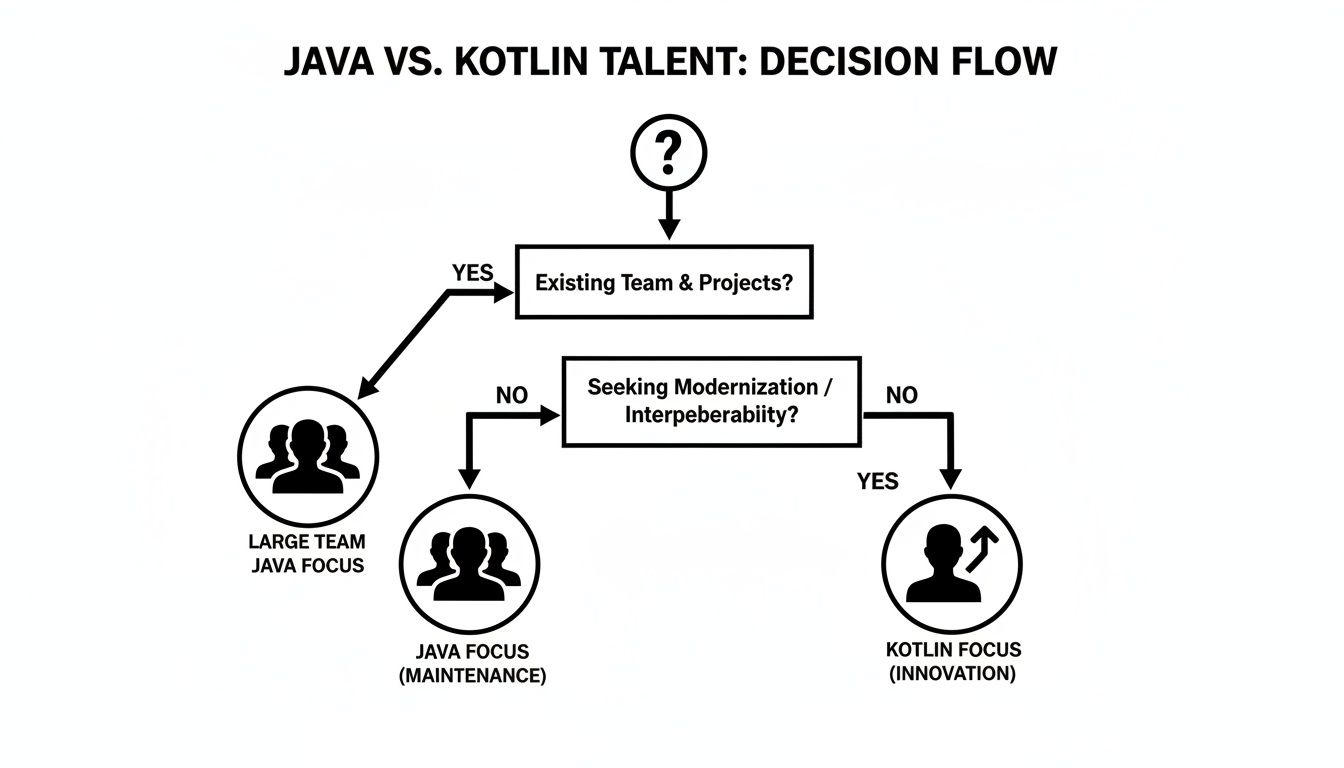
This decision framework highlights a core strategic choice: Java provides access to a broader talent pool, while Kotlin acts as a magnet for top-tier engineers seeking modern challenges.
Market trends reflect this shift. In regions like Hungary, while 60% of Android job postings still list Java, 35% now specifically require Kotlin, as noted in this growing trend on mindinventory.com. This indicates that while Java ensures a wide candidate pool, Kotlin proficiency is becoming a key differentiator for top talent.
Ultimately, the language is a tool to achieve a business objective. A clear assessment of your resources, market position, and technical roadmap will illuminate the best path forward.
Frequently Asked Questions (FAQ)
Here are direct answers to common questions business and tech leaders have about the Kotlin vs Java decision.
Is Kotlin faster than Java?
No, not at runtime. Both languages compile to JVM bytecode, so their execution speed is virtually identical. The "speed" advantage of Kotlin lies in developer productivity. Its concise syntax and safety features allow teams to write code faster, with fewer bugs. This accelerates your time-to-market and reduces long-term maintenance costs, which is a more significant business outcome than marginal runtime performance gains.
Can I use existing Java libraries in a Kotlin project?
Yes, absolutely. Kotlin is 100% interoperable with Java, which is a key business benefit. You can call Java code from Kotlin and vice versa within the same project. All your existing Java libraries and frameworks, including major ones like Spring, will work seamlessly. This interoperability de-risks adoption, allowing for a gradual migration path where new features are written in Kotlin while the existing Java codebase remains untouched. This approach protects your current technology investment while enabling modernization.
Is it harder to hire Kotlin developers?
While the pool of developers with decades of Java experience is larger, the Kotlin talent pool is growing rapidly. Many top Java developers are actively learning Kotlin to stay current. Advertising a Kotlin project can be a hiring advantage, as it signals a modern engineering culture that attracts forward-thinking talent. It positions your company as an employer of choice for engineers who value high-quality tools and a productive development environment.
Which language is better for backend development?
Both are excellent choices, and the "better" option depends on your specific needs.
- Java, with its robust Spring Boot framework, remains the standard for large, complex enterprise systems that require proven stability.
- Kotlin is rapidly becoming the preferred choice for modern backend development, particularly for microservices and APIs. Its conciseness, safety features, and strong support in frameworks like Spring and Ktor make it ideal for projects where speed and reliability are critical.
Making the right technology decision is crucial for achieving your business goals. Whether you're choosing a language, augmenting your team, or delivering a mission-critical project, a clear strategy is essential.
Schedule a strategic consultation with our experts to align your technology choices with your business objectives.
< MORE RESOURCES / >

Fintech
A Guide to Epic Store Szeged and the Local Tech Scene

Fintech
A Guide to Designing a Nordic Light Office for Technical Teams

Fintech
A Tech Employer's Guide to Hungary's Social Security System

Fintech
How to Choose an IT Company That Drives Business Outcomes

Fintech
A Consultant's Guide to Part-Time Jobs in Budapest

Fintech
A Consultant's Guide to Peppol Integration for E-Invoicing

Fintech
A Tech Leader's Guide to Nearshore Development

Fintech
PSD2 Integration for CTOs: Real-World Challenges and Architecture Insights

Team augmentation
Hiring vs. Outsourcing: Finding the Right Balance with Team Augmentation

Fintech