
< RESOURCES / >
Landing High-Impact EU Jobs in Budapest: A Guide for Tech and Product Professionals

If you're exploring high-impact EU jobs in Budapest, your timing is excellent. The city has become a significant hub for technology and fintech, attracting specialized talent with compelling career opportunities backed by a robust economic landscape.
This guide provides a practical, no-fluff roadmap for technical and product-savvy professionals. We'll connect the dots between the market dynamics, your job search strategy, and the business outcomes that matter to hiring managers—like reducing time-to-market, managing costs, and navigating compliance.
Why Budapest's Job Market is a Strategic Choice
Let's move beyond the typical travel guide narrative and analyze the data. Budapest isn't just another attractive European capital; it's an economic center with a job market that outperforms many regional peers and the EU average. This creates an efficient environment for both skilled professionals seeking their next role and for companies needing to scale their teams quickly.
For a technical expert, this means less time filtering through low-quality listings and more time evaluating opportunities that align with your career goals. For businesses, it means faster talent acquisition, which directly accelerates product development and reduces hiring friction.
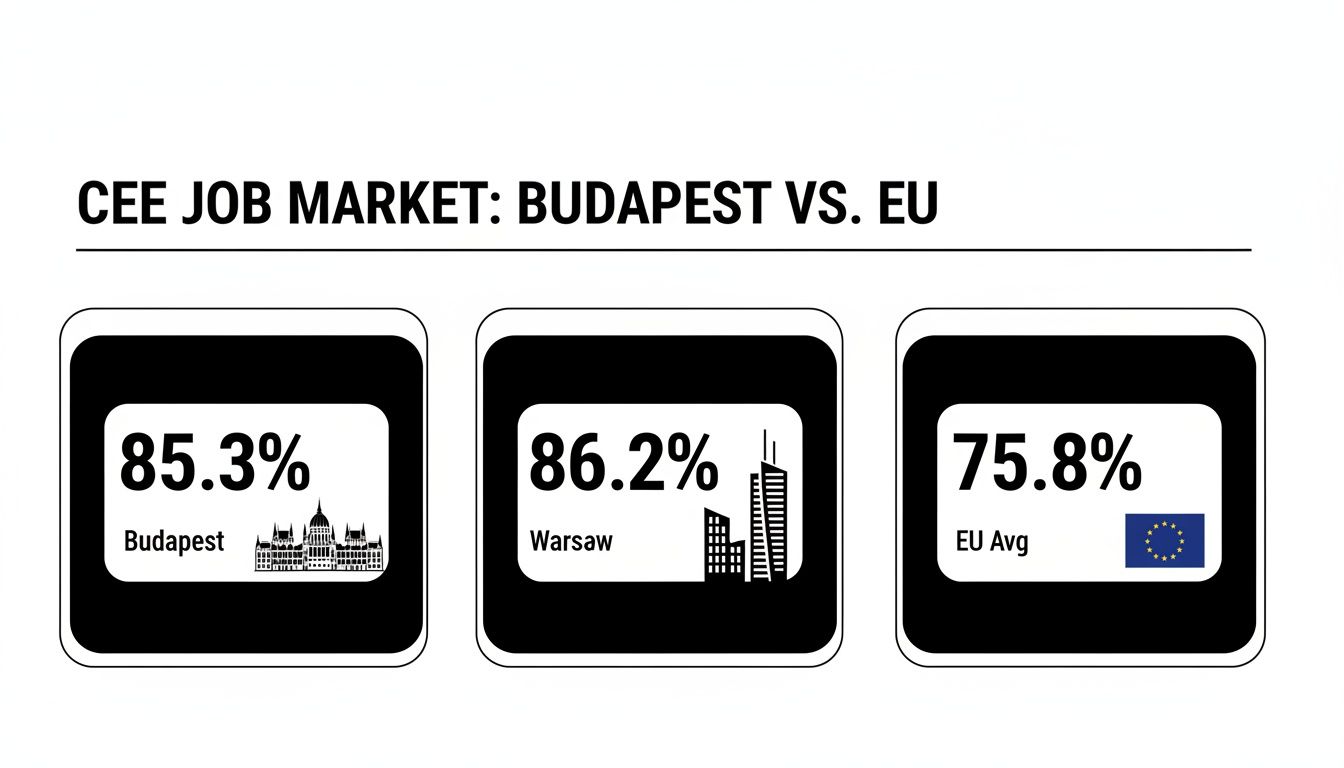
The data below illustrates how Budapest's employment rate compares favorably against Warsaw and the EU as a whole, indicating a competitive and sustainable market.
This strong performance isn't a temporary trend; it's a structural feature of the city's economy.
The Numbers Driving the Opportunity
Budapest's metrics are compelling. The city boasts an 85.3% employment rate for individuals aged 20-64. This is comparable to regional leaders like Warsaw (86.2%) and significantly higher than the 75.8% EU average.
For a specialized firm like SCALER Software Solutions Ltd, based here in Budapest, this is a distinct business advantage. It provides direct access to a deep pool of engineers proficient in technologies like React, Node.js, and AWS. More critically, we can recruit specialists with demonstrable experience in fintech, from complex PSD2 integrations to blockchain smart contracts.
A high employment rate signals a dynamic economy where specialized skills are in constant demand. It's a seller's market for talent.
The key takeaway for a job seeker: your skills are not just in demand; they are critical. The hiring process is streamlined, which de-risks the transition for both you and your future employer. This creates a mutually beneficial outcome.
This environment is particularly advantageous for professionals with expertise in high-growth sectors. The need isn't just for general software developers; it's for specialists who can architect secure, scalable systems within complex regulatory frameworks. For a broader overview, you can explore this resource on job opportunities in Hungary.
Ultimately, this combination of a thriving job market and a specific need for advanced technical skills makes Budapest a strategic location where your expertise can drive significant business impact on major projects.
The following table summarizes the key metrics that make Budapest's job market attractive for tech and fintech professionals, connecting data to clear business outcomes.
Budapest Job Market: Key Indicators
The data confirms the on-the-ground reality: Budapest is a key hub for building a career in the EU's evolving technology landscape.
How to Strategically Find EU Jobs in Budapest
A scattergun approach to job applications is inefficient. To land one of the top EU jobs in Budapest, you need a structured strategy—one that filters out irrelevant noise and targets roles that advance your career.
This requires moving beyond passive job board scrolling. An effective multi-channel strategy combines EU-wide portals, local job boards, and direct company outreach. The goal is to build a repeatable process that consistently surfaces high-quality opportunities in the tech and fintech sectors.
Leverage Key Job Platforms Effectively
Your search should begin with a combination of pan-European and Hungarian-specific platforms. Each serves a distinct purpose, and using them in tandem provides a comprehensive market view. Neglecting local sites means missing a significant portion of available roles.
EURES (European Job Mobility Portal): As the official EU portal, EURES is excellent for roles within organizations that have a formal, EU-wide hiring framework. Use it to establish a baseline for requirements and identify cross-border opportunities.
Profession.hu and Dreamjobs.hu: These are the dominant job boards in Hungary. Many multinational companies with Budapest offices post exclusively on these platforms to tap into the local talent pool. For an international candidate, these sites are a source of high-value, less-visible opportunities.
LinkedIn: An essential platform for networking and discovering roles at international tech firms. Ensure your profile is optimized with keywords like "Fintech," "Budapest," and specific technologies you specialize in (e.g., Go, Kotlin, AWS) to attract recruiters.
A common mistake is relying on a single platform. A strategic search for EU jobs in Budapest requires a blended approach. Use EURES for official listings, but leverage Profession.hu as your inside track on the local market. This dual strategy significantly increases your visibility.
If your primary requirement is an English-speaking workplace, it's beneficial to consult curated resources. We have compiled a guide specifically for this: English language jobs in Budapest.
Adopt a Proactive, Targeted Search Strategy
Simply clicking "apply" is insufficient. A proactive approach involves going directly to the source and creating intelligent alerts that deliver relevant roles to your inbox. This minimizes search time and improves application quality.
Target Company Career Pages
First, create a target list of 10-15 tech and fintech companies in Budapest where you would genuinely want to work. Make it a routine to check their career pages weekly. Many firms post new roles on their own sites days or even weeks before they appear on major job boards, giving you a significant first-mover advantage.
Set Up Intelligent Job Alerts
Avoid generic alerts like "Software Engineer Budapest." This approach leads to a high volume of irrelevant listings. Use precise keyword combinations to filter the noise.
For example:
("Senior Go Developer" OR "Golang Engineer") AND "Fintech" AND "Budapest""Cloud Engineer" AND ("AWS" OR "Azure") AND "Kubernetes" AND "Budapest""Product Manager" AND ("PSD2" OR "Open Banking") AND "Budapest"
This targeted methodology ensures you only see high-quality opportunities, allowing you to focus your energy on crafting compelling applications.
Crafting an Application That Demonstrates Business Value
In a competitive market like Budapest, a generic CV will be overlooked. To secure a top-tier EU job in Budapest, your application must do more than list past responsibilities. It needs to narrate a clear story of your business impact, one that directly addresses the challenges local tech and fintech hiring managers face.
Don't just state you "worked on an AWS project." That provides no useful information.
Instead, demonstrate how you engineered a secure, cost-optimized AWS deployment that reduced infrastructure spending by 15% while improving system uptime. Translate your technical skills into tangible business outcomes.
Frame Your Experience for High-Demand Roles
Hiring managers in Budapest's fintech sector are not seeking generalists. They are looking for specialists who can solve specific, high-stakes problems related to secure financial systems.
Your application must immediately signal that you are the solution. Tailor your CV and cover letter to highlight your most relevant expertise. Structure your experience around these in-demand areas:
- Secure Cloud Deployments: Don't just list AWS, Azure, or GCP. Detail the security best practices you implemented, the CI/CD pipelines you built for faster time-to-market, and your experience with Infrastructure as Code (IaC) tools like Terraform for cost management and risk reduction.
- PSD2 and Open Banking Compliance: If you have experience with payment gateways, API security, or regulatory frameworks, this is a critical asset. Feature it prominently. It is a major differentiator that directly addresses business risk and compliance requirements.
- Native Mobile Development: Proficiency in Swift (iOS) or Kotlin (Android) is highly valued for building the performant, secure financial applications that are essential for revenue generation and customer trust.
The most effective applications function as a series of mini-case studies. Each bullet point under a job title should answer: "What was the business problem, what did I build to solve it, and what was the measurable result?"
Quantifying your achievements is not optional; it is essential. Instead of saying you "improved performance," state that you "reduced API response latency by 200ms, driving a 10% increase in user engagement." Data-driven results speak directly to business outcomes.
Navigating CV Formats and Language Nuances
While a clean, modern CV format is generally preferred, be prepared for requests for a Europass CV, especially for roles with strong EU institutional ties. Familiarize yourself with its specific structure and purpose. For a detailed overview, this guide is an excellent resource: What Is a Europass CV and Should You Use One?.
Regarding language, professional fluency in English is the standard for nearly all tech and fintech roles. However, even basic Hungarian language skills can provide a competitive edge. It demonstrates a commitment to integrating with the team and local culture, a quality that hiring managers value.
Ultimately, your application is your first professional engagement. A sharp, well-crafted CV that speaks the language of business value is your key to getting noticed in the search for EU jobs in Budapest. To further refine your professional profile, our guide on leveraging LinkedIn for jobs in Budapest offers practical advice.
Nailing the Interview and Securing Your Offer

Securing an interview is the first step; converting it into a compelling offer requires a different set of skills. For EU jobs in Budapest, particularly in tech and fintech, the interview process is designed to assess your practical problem-solving abilities, not to test abstract knowledge.
Expect a multi-stage process focused on real-world scenarios: a technical screen, a live coding or system design challenge, and a final round centered on business acumen and team fit. Hiring managers are looking to de-risk their investment; they need to see how you think and execute.
Mastering Technical Interview Formats
The technical stages simulate actual work. You won't be asked to simply reverse a linked list; you will be presented with a business problem and expected to design a solution that is efficient, scalable, and secure.
Common formats include:
- Live Coding Challenges: These focus on algorithms and data structures within a business context, such as designing an algorithm to process financial transactions with minimal latency.
- System Design Deep Dives: This is an opportunity to showcase your architectural thinking. Be prepared to whiteboard the design for a new payment gateway or data pipeline. The key is to justify your decisions: Why this database? Why a message queue? How will you address security, scalability, and compliance?
- Take-Home Assignments: Some companies provide a small, self-contained project. This is your chance to demonstrate clean code, robust testing practices, and a clear understanding of the product's business goals.
Pro tip: Always connect your technical solutions to business outcomes. When discussing system architecture, explain how your design choices reduce latency, lower operational costs, or mitigate fraud risk. This demonstrates that you are not just a programmer but a strategic problem-solver.
Discussing Salary and Negotiating Your Offer
Salary discussions can be challenging, but Budapest's current market gives you significant leverage. The tech and fintech sectors are expanding rapidly against the backdrop of Hungary's tight labor market, with job vacancy rates around 2.1-2.8%. This indicates high demand for skilled professionals, placing you in a strong negotiating position.
When the topic of salary arises, be prepared with a well-researched range. Senior roles in Budapest's tech and fintech sectors offer competitive compensation. Use platforms like Glassdoor and consult with local recruiters to understand current market rates.
This is where you must articulate your value proposition. Improving your communication skills for interviews is critical. Confidently explain how your deep knowledge of PSD2 or your experience building secure cloud infrastructure will directly contribute to the company's revenue, cost savings, or risk management. Frame the discussion around the value you deliver—positioning yourself as an investment, not an expense.
Your Relocation Playbook for a Smooth Transition to Budapest
Landing one of the premier EU jobs in Budapest is a significant achievement. However, the relocation process itself requires careful planning to ensure a smooth transition. A well-executed move allows you to be productive from day one, rather than being bogged down by administrative tasks.
The logistics can seem daunting, but a structured plan simplifies the process. The core challenges for both EU and non-EU citizens are consistent: managing paperwork, securing housing, and organizing finances.
Handling Essential Paperwork
For EU citizens, the process is streamlined due to freedom of movement. You will still need to register your address to obtain a registration card and an address card (lakcímkártya). This card is essential for nearly all administrative tasks, including opening a bank account and signing a lease, so prioritize it upon arrival.
For non-EU citizens, the timeline starts much earlier. Your employer will typically sponsor your combined residence and work permit, but you must be proactive. Organize your required documents and begin the application process as soon as you receive a formal job offer. These processes can take several months, and delays can pose a significant business risk for your employer.
The single most important piece of advice is to digitize and back up all critical documents. Keep digital and physical copies of your passport, employment contract, rental agreement, and all official correspondence. This simple practice can prevent weeks of bureaucratic delays.
Setting Up Your New Life in Budapest
With the legal requirements addressed, you can focus on the practical aspects of settling in.
- Finding Housing: Budapest comprises 23 districts, each with a distinct character. Districts V, VI, and VII are central and popular with expatriates. For quieter but well-connected options near major tech hubs, consider Districts II, XI, or XIII. Begin your search on platforms like Ingatlan.com, but be prepared to act quickly, as desirable properties are rented fast.
- Opening a Bank Account: You will need your passport, address card, and sometimes your employment contract. Major banks like OTP Bank, K&H Bank, and Erste Bank offer services in English and have modern mobile banking applications.
- Connecting with the Tech Community: Don't wait until your first day to start networking. Budapest has a vibrant tech scene with regular meetups for Go developers, product managers, and fintech professionals. Use platforms like Meetup.com to find relevant events. Engaging with the community is the fastest way to build a professional network and understand the local tech culture.
Treat your relocation as the first project in your new role. A strategic, well-managed transition will enable you to start delivering value immediately and explore this dynamic city with confidence.
Ready to Build What's Next in Budapest's Fintech Scene?

Finding the right role is about more than just the location; it's about finding the right team. For a skilled engineer or product leader exploring EU jobs in Budapest, the primary objective is to find an environment where your work has a measurable impact—a place where deep technical expertise is the core value proposition.
If you are prepared to solve complex fintech challenges involving Open Banking, secure payments, and blockchain, then SCALER may be the right fit. We are a focused team of senior specialists who build secure, scalable solutions without the constraints of corporate bureaucracy.
We don't just write code; we architect systems that reduce financial risk, accelerate time-to-market for our clients, and embed robust compliance from the initial design phase. Our project-based model ensures you are consistently solving real-world problems that directly influence the future of finance.
Review our current openings. If you don't see a perfect match but believe your skills align with our mission, book a confidential call with us. Let’s discuss building the future of fintech together.
FAQ: Landing a Tech Job in Budapest
Here are direct answers to common questions from tech professionals considering a move to Hungary.
Do I need to speak Hungarian to get a job?
For the vast majority of tech and product roles in Budapest's international sector, the answer is no. English is the standard language of business. Daily stand-ups, code reviews, and technical documentation are conducted in English.
However, learning basic Hungarian phrases is highly recommended. It demonstrates a commitment to integrating with the team and local culture, which is valued by employers and colleagues. While not a prerequisite for employment, it simplifies daily life and helps build stronger professional relationships.
What is a realistic salary for a senior tech role?
Salaries for EU jobs in Budapest are highly competitive within the Central European region. While the gross figures may not match those in London or Berlin, the lower cost of living often results in higher disposable income.
A senior software engineer or product manager with in-demand fintech skills (e.g., PSD2, cloud security) can expect a gross annual salary in the HUF 20-28 million range. This varies based on specific expertise, company size, and negotiation. Always frame your salary expectations around the tangible business value you provide.
Pro tip: Don't focus solely on the gross salary. Hungary has a flat-rate personal income tax system that can be advantageous for higher earners. Use an online Hungarian salary calculator to determine your net take-home pay after taxes and social contributions. This provides a clear understanding of your true earning potential.
Knowing your net income is crucial for evaluating the real financial benefit of a move.
Ready to move beyond job boards and build something with tangible impact? At SCALER Software Solutions Ltd, we connect elite tech talent with high-stakes fintech projects in the heart of Europe. If you are a specialist in your field, let's discuss how your skills can drive our next major project. Explore your future with us.
< MORE RESOURCES / >

Fintech
A Guide to Epic Store Szeged and the Local Tech Scene

Fintech
A Guide to Designing a Nordic Light Office for Technical Teams

Fintech
A Tech Employer's Guide to Hungary's Social Security System

Fintech
How to Choose an IT Company That Drives Business Outcomes

Fintech
A Consultant's Guide to Part-Time Jobs in Budapest

Fintech
A Consultant's Guide to Peppol Integration for E-Invoicing

Fintech
A Tech Leader's Guide to Nearshore Development

Fintech
PSD2 Integration for CTOs: Real-World Challenges and Architecture Insights

Team augmentation
Hiring vs. Outsourcing: Finding the Right Balance with Team Augmentation

Fintech