
< RESOURCES / >
A Consultant's Guide to English Language Jobs in Budapest

Yes, you can. It's a common question, and the answer is definitive: you can absolutely find a high-quality, English-speaking job in Budapest, especially if your expertise is in technology or finance.
The city has strategically positioned itself as a key European hub for international talent, driven by a consistent flow of foreign investment and a proliferation of shared service centers. For a skilled professional, fluency in English is often the only language requirement for a senior role. This guide will provide a clear, practical roadmap for navigating this market.
Why is Budapest a Magnet for International Talent?

Budapest's emergence as a prime destination for English-speaking professionals is the result of deliberate economic shifts that have transformed the city into a critical business node within the EU.
Companies aren't just filling quotas; they're hiring international talent to drive tangible business outcomes. This strategy allows them to scale operations and accelerate time-to-market while maintaining a lower cost base than in more expensive Western European capitals.
For a jobseeker with a product-focused mindset, this environment is ideal. It signifies that your skills are in genuine demand to solve specific business problems. Your ability to articulate complex technical concepts in English isn't a soft skill—it's a core asset that reduces project risk and improves team velocity.
The Key Drivers of Demand
What fuels the consistent demand for English-speaking professionals? It boils down to three primary economic forces.
First, the significant inflow of Foreign Direct Investment (FDI). Global companies, particularly in the tech and finance sectors, have invested heavily in Budapest, establishing regional headquarters and development centers. English became the de facto corporate language to ensure seamless alignment with global operations.
Second, the dominance of Shared Service Centers (SSCs) and Business Process Outsourcing (BPOs). Budapest is a major player in this sector, hosting hubs for large multinational corporations. These centers manage critical functions like IT, finance, and HR for entire regions, making English the only practical operational language.
Finally, a vibrant startup ecosystem. Budapest's startup scene is well-funded, attracting founders and venture capital from across the globe. These companies are designed for international scale from day one and hire talent that reflects that global ambition.
These factors create a robust market for English language jobs in Budapest. A recent national analysis revealed that English is the most requested foreign language in Hungarian job advertisements, appearing in 48.3% of postings that require language skills. For professional white-collar roles, this figure is substantially higher.
Let's examine the specific sectors where these opportunities are most concentrated.
Top Sectors for English Language Jobs in Budapest
This table provides a concise overview of the industries with the highest demand for English-speaking talent, typical roles, and the underlying business drivers.
The demand is widespread and directly tied to strategic business goals, not mere convenience.
The bottom line: Hiring English-speaking technical talent enables companies in Budapest to integrate directly into the global market. It eliminates communication friction with international stakeholders and accelerates development cycles by removing language as a bottleneck, ultimately reducing project risk and cost.
Your expertise, combined with English fluency, positions you as a high-value asset, not just another candidate.
To explore this further, you can learn more about specific job opportunities in Hungary in our comprehensive guide.
Inside Budapest's Tech and Fintech Ecosystem

To be precise, technology and fintech are the primary engines powering the market for english language jobs budapest. These sectors are actively recruiting international talent capable of building secure, scalable products for the competitive European market. The demand extends far beyond basic coding proficiency.
Companies are hiring problem-solvers. Your ability to implement a feature is baseline. What truly differentiates a candidate is understanding the business reason for that feature—how it mitigates risk, accelerates time-to-market, or creates a new revenue stream.
The Technology Stacks That Matter
A brief analysis of job descriptions reveals clear patterns. Hiring managers are focused on modern, resilient technology stacks capable of handling the stringent demands of finance and B2B SaaS. The objective is to build systems that can innovate and scale without compromising security or performance.
Demand is concentrated in these key areas:
- Front-End Development: The ecosystem is heavily invested in React. Proficiency with frameworks like Next.js provides a significant advantage, particularly for building the performant, responsive UIs required by customer-facing financial applications.
- Back-End and Systems Engineering: This is where the core business logic resides. Deep expertise in .NET, Java, or Go is essential for building the secure, high-throughput back-end services that process transactions and safeguard sensitive data.
- Cloud and DevOps: Experience with AWS or Azure is a prerequisite. Companies require engineers who can architect and maintain cloud-native infrastructure that is scalable, cost-effective, and highly available.
The conversation must always connect back to business outcomes. They want to hear how you used these technologies to solve a specific problem. Did you engineer a payment gateway that increased transaction success rates? Did you deploy infrastructure that reduced latency by 30%? Those are the metrics that secure interviews.
The following table breaks down the specific technologies and skills local companies require, and more importantly, the business rationale behind that demand.
In-Demand Tech Stacks and Business Outcomes in Budapest
This is not a list of buzzwords; it's a strategic map of where the highest-value opportunities lie.
Niche Skills in Fintech and Data
Beyond the core stacks, Budapest's fintech sector rewards specialized knowledge. Experience with regulations like PSD2 or implementing Open Banking integrations is highly valued. These skills are fundamental to building compliant, innovative financial products and directly address business-critical risk and compliance requirements.
Data-related roles are also expanding rapidly. As companies collect vast amounts of information, they need specialists to derive actionable insights. If this is your area, it's worth investigating what a successful career as a data engineer entails. These professionals enable businesses to make data-driven decisions on everything from risk modeling to customer personalization, directly impacting profitability.
This demand is not a short-term trend. Labour market reports suggest Hungary will need approximately 500,000 foreign workers over the next decade to fill critical gaps, with a significant portion concentrated in Budapest's IT and business service sectors. You can read more about Hungary's job outlook on Y-Axis. For a skilled, English-speaking professional, this represents a significant market opportunity.
Crafting Your CV for the Budapest Market

Your CV and LinkedIn profile are your primary market-entry tools. A generic list of technologies is insufficient. Recruiters and hiring managers in Budapest are looking for professionals who understand the connection between technical work and business success.
The most effective strategy is to shift from describing tasks to highlighting outcomes. Do not simply list technologies; frame your experience around the value you created. This single change in perspective will differentiate your application.
Frame Your Experience Around Business Impact
In a competitive search for english language jobs budapest, quantifying your achievements is the most direct way to capture a hiring manager's attention. Every bullet point on your CV should answer the implicit question: "What was the business result of this work?"
For example, stating you "worked on a payment processing module" is generic.
Instead, demonstrate the impact: "Engineered a new payment gateway that increased transaction success rates by 15% and reduced fraudulent chargebacks, directly contributing to revenue growth and mitigating financial risk." This connects your technical execution to measurable business value.
The CVs that lead to interviews tell a story of value. They demonstrate a clear understanding that technology is a tool to solve business problems—whether that's increasing efficiency, reducing risk, or accelerating a product's time-to-market.
This mindset distinguishes a strong candidate from an average one. You are not just an engineer; you are a strategic partner who contributes to the company's success.
Strategic Presence on LinkedIn and Local Job Boards
While LinkedIn is the global standard, ignoring local platforms is a strategic error. You must be visible where Hungarian recruiters are actively sourcing talent. Optimizing your CV for both human reviewers and automated screening systems is essential; it’s worth learning about crafting a strategic resume to beat the bots and win interviews.
Focus your efforts on these key platforms:
- Profession.hu: This is Hungary's largest and most established job portal. A comprehensive profile here is non-negotiable for a serious job search.
- Dreamjo.bs: Gaining significant traction, especially with startups and modern tech companies that prioritize culture and team dynamics.
- LinkedIn: Your international professional profile. Ensure it is polished, contains relevant keywords for your domain (e.g., "Fintech," "React," ".NET"), and, crucially, lists your location as Budapest. Recruiters frequently use location filters.
On each platform, your summary should reflect the business-impact narrative. Use bullet points to make your achievements easily scannable. An outcome-driven profile simplifies a recruiter's job, which is the most effective way to get contacted.
Networking and Interviewing in Budapest
A well-crafted CV may get your application noticed, but strategic networking and effective interview performance are what secure an offer. Budapest’s tech community is relatively tight-knit, and making the right professional connections can significantly shorten your job search. This is not about accumulating contacts; it's about engaging with the individuals building the products you want to work on.
This requires being present where they are. Budapest has a vibrant schedule of technology meetups covering everything from specific languages like JavaScript to broader topics like cloud infrastructure and fintech innovation. These are not formal events but rather informal hubs where developers, product managers, and CTOs exchange ideas.
Making Professional Connections
Attending these events provides direct insight into the challenges local companies are facing and the solutions they are building. It is the ideal environment to ask intelligent questions and demonstrate your expertise in a conversational setting, far removed from a high-pressure interview.
Here are the most effective starting points for networking:
- Meetup.com Groups: Search for active groups like "BudapestJS," "CraftHub," or communities focused on DevOps and cloud technologies. They attract professionals from the city’s leading tech companies.
- Industry Conferences: Monitor for technology conferences held in or near the city. These are prime opportunities to meet hiring managers and senior engineers who are actively sourcing talent.
- Online Forums: While less personal, local developer communities on platforms like Slack or Discord can be valuable for asking specific questions and learning about unadvertised job openings.
What to Expect in a Budapest Technical Interview
Once you secure an interview for one of the many English language jobs Budapest has to offer, you will likely find the process to be practical and grounded. While standard behavioral questions are included, the primary focus is on real-world problem-solving, not abstract whiteboard exercises.
Hiring managers want to understand how you think. They are less concerned with rote memorization of algorithms and more interested in how you deconstruct a technical problem and articulate your proposed solution.
Your English fluency provides a significant competitive advantage here. The ability to clearly explain your technical decisions, discuss trade-offs, and collaborate on a solution in English is precisely the skill international companies are hiring for. It demonstrates you can integrate into a multicultural team without communication friction.
The typical interview process follows these stages:
- HR Screening: An initial conversation to discuss your background, motivation, and salary expectations.
- Technical Round: This can range from a live coding session to a system design discussion or a take-home assignment followed by a review call. The goal is to assess your practical skills.
- Final/Cultural Fit Interview: A discussion with team leads or senior managers to ensure alignment with the team's working style and the company culture.
Preparation is key. Be prepared to discuss projects from your portfolio in detail. Explain not just what you built, but why you made specific architectural or technical choices and what the resulting business outcome was. This demonstrates that you are a mature, product-focused professional—a mindset highly valued by tech employers in Budapest.
Understanding Salaries, Benefits, and Work Permits
Let's address compensation and logistics. Understanding earning potential, standard benefits, and the legal requirements for working in Hungary is essential for making an informed decision. The total compensation package, not just the salary, determines the viability of a move to Budapest.
Expected Salaries for Tech Roles in Budapest
The good news is that technology salaries in Budapest are competitive, especially when adjusted for the city's low cost of living. A developer's salary allows for a very comfortable lifestyle. While final offers depend on the company, your experience level, and negotiation, clear market rates exist.
Here is a general range of expected gross monthly salaries (in Hungarian Forint, HUF):
- Mid-Level Software Developer (React, .NET, Java): 1,200,000 - 1,800,000 HUF
- Senior Software Developer / Team Lead: 1,800,000 - 2,500,000+ HUF
- Mid-Level DevOps Engineer: 1,400,000 - 2,000,000 HUF
- Senior DevOps / Cloud Engineer: 2,000,000 - 2,800,000+ HUF
These figures are baselines. Senior specialists with in-demand niche skills can and do command higher compensation.
The Standard Benefits Package
In Budapest, the benefits package is a significant part of the total compensation. Companies compete for talent by offering a robust set of perks that improve quality of life and reduce day-to-day expenses.
A standard technology job offer typically includes:
- Private Health Insurance: This allows you to bypass public system queues and access English-speaking medical specialists efficiently.
- SZÉP Kártya (Széchenyi Recreation Card): A unique Hungarian benefit where your employer contributes a tax-efficient allowance to a card that can be used for food, accommodation, and cultural activities nationwide.
- Home Office Support: A standard post-pandemic benefit. Most companies provide a budget for equipping a home workspace with ergonomic furniture and necessary equipment.
While technology is the highest-paying sector, it is not the only option. English teaching is an established route for many expatriates. Salaries at private language schools generally range from 250,000 to 450,000 HUF gross per month. At an international school, this can increase to 600,000 to 1,000,000 HUF. It's a different career path, but a viable one. For a detailed analysis, see our dedicated guide on English teaching jobs in Budapest.
Navigating Work Permits for Non-EU Citizens
For citizens from outside the European Union, the work permit is the primary administrative hurdle. The process requires patience and meticulous paperwork.
The most common pathway is the Single Application Procedure, which combines the residence and work permits into a single application.
The critical point to remember is that your employer is your partner in this process. Reputable companies hiring internationally will have an HR team or legal counsel experienced in navigating this bureaucracy. They will provide guidance, specify the required documentation, and assist with the submission. You will not be navigating this alone.
The job search itself, from networking to the interview, is a structured process.
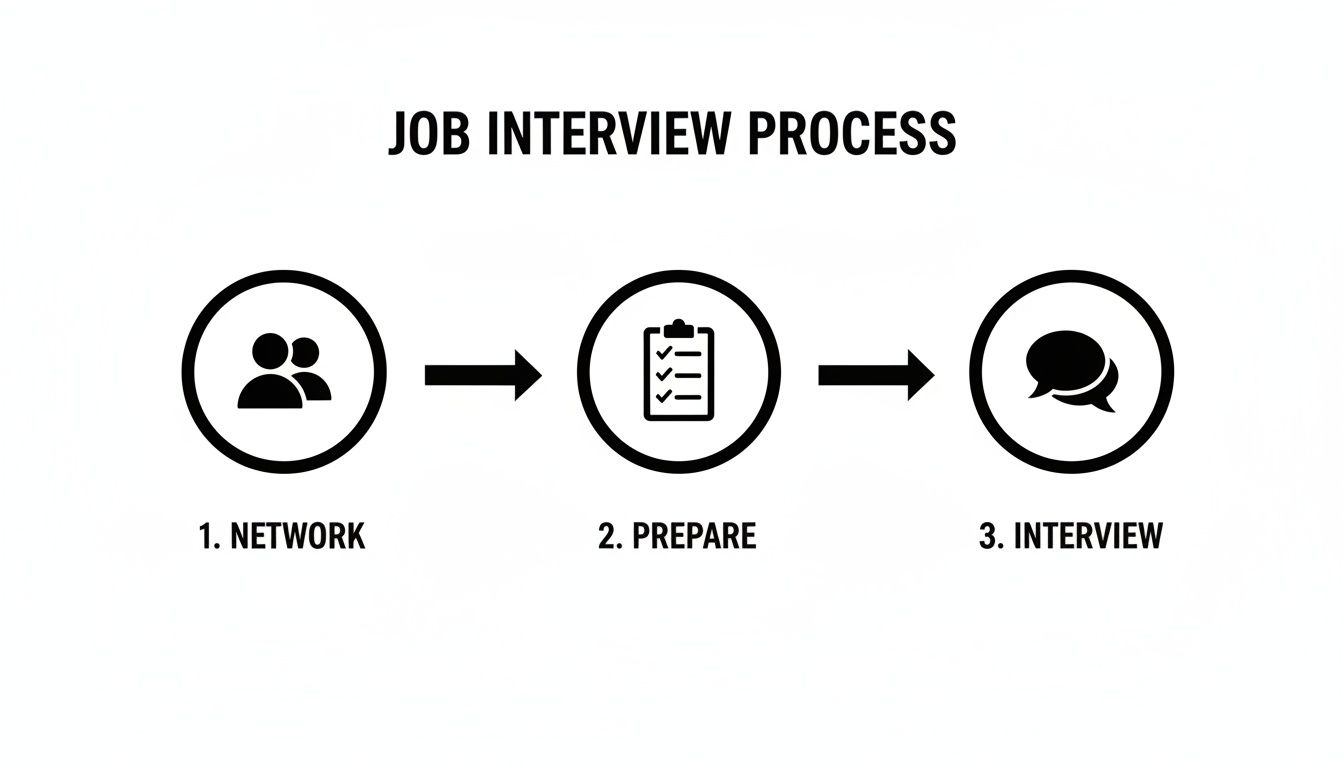
This illustrates that a successful interview is the outcome of diligent preparation. For more detailed information on the logistics of working internationally, this practical guide to visas and taxes for working remotely abroad is an excellent resource.
FAQ: Finding English Language Jobs in Budapest
To conclude, here are concise answers to the most frequent questions from professionals considering a move.
Is Hungarian language proficiency required for a tech job?
For the vast majority of roles in international technology firms, fintech companies, and shared service centers, the answer is no. English is the official working language for development teams, product strategy meetings, and all client interactions. Your career progression will depend on your technical skills and English fluency, not your Hungarian proficiency. While learning basic Hungarian is recommended for daily life, it is not a professional barrier.
How does the cost of living compare to other tech hubs?
This is one of Budapest's most significant advantages. The city offers a high quality of life at a fraction of the cost of other European tech hubs like Berlin, London, or Amsterdam. Expenses such as rent, public transportation, and dining are substantially lower. This means a competitive tech salary provides greater purchasing power, allowing for a higher rate of savings and more disposable income.
Are hybrid or fully remote roles common?
Yes, the Budapest tech sector has widely adopted flexible work arrangements. The predominant model is hybrid, typically requiring two or three days per week in the office to foster collaboration. Fully remote positions within Hungary are available but are less common than hybrid roles. It is advisable to clarify the specific remote work policy during the interview process to ensure expectations are aligned.
How can I make my application stand out?
The single most effective tactic is to focus your CV on business outcomes, not job duties. Many candidates simply list what they did. Top-tier candidates demonstrate the impact of their work.
Instead of "Worked with REST APIs," reframe it to show value:
- Example: "Engineered a new REST API that reduced data retrieval times by 40% for the company's primary mobile application, leading to a measurable improvement in user experience and engagement metrics."
When you quantify your achievements, you connect your technical work to metrics that hiring managers value: efficiency, cost reduction, or revenue growth. This approach immediately elevates your profile for English language jobs in Budapest by positioning you as a problem-solver who delivers business results.
At SCALER Software Solutions Ltd, we connect leading companies with the senior engineering talent required to build and scale exceptional products. If you need to accelerate delivery with experienced, EU-based developers who understand business objectives, we should talk. We can demonstrate how our team augmentation and end-to-end project execution services can help you achieve your goals faster and with less risk.
< MORE RESOURCES / >

Fintech
Databricks for Fintech: A Practical Guide to the Lakehouse

Fintech
A Practical Guide to the Lean Business Canvas Model

Fintech
Front End Back End Development: A Strategic Guide for Leaders

Fintech
Mastering Dictionary Comprehensions in Python for High-Performance Fintech

Fintech
A CTO's Guide to Choosing the Best Python Editor in 2024

Fintech
Software Test Automation: A Practical Guide to Faster, Safer Releases

Fintech
A Practical Guide to i t consulting for Growth

Fintech
A Fintech Leader's Guide to High-Impact I T Services

Fintech
Remote Jobs in Hungary: A Strategic Guide for Tech Talent and Employers

Fintech