
< RESOURCES / >
A Practical Guide to Building High-Performance Databricks ETL Pipelines

Are your data pipelines slow, brittle, and expensive to maintain? It’s a common challenge. Many organizations find their legacy ETL systems can’t keep up with the demands of real-time analytics, machine learning, and tightening compliance rules.
This guide is for engineers, architects, and technical leaders looking for a practical approach to building databricks etl pipelines that are efficient, scalable, and directly contribute to business outcomes.
Why Modernize Your Data Pipelines?
Legacy ETL (Extract, Transform, Load) tools often create more problems than they solve. They can be rigid, difficult to maintain, and require significant engineering overhead just to operate. For any data-driven business, this translates to direct risks: slow data can delay fraud detection, weaken risk models, and hinder the ability to react to market changes.
Moving to Databricks is more than a tool upgrade; it's a strategic shift. It involves consolidating a patchwork of siloed systems into a unified platform that manages the entire data lifecycle, from raw ingestion to complex AI.
Connecting Technical Improvements to Business Outcomes
This shift from legacy systems to modern databricks etl pipelines delivers tangible business advantages. By simplifying data architecture, you accelerate development and reduce the time-to-market for data products. The benefits are concrete and impact the bottom line.
Here’s what that looks like in practice:
- Reduced Operational Costs: Consolidating on a single platform eliminates redundant software licenses and reduces infrastructure management. Features like serverless compute further lower total cost of ownership (TCO).
- Faster Time-to-Market: Unified access and streamlined workflows empower data teams to build and deploy new analytics, reports, and ML models in days, not months, driving revenue and innovation.
- Improved Compliance and Governance: Centralized tools like Unity Catalog are critical for governance. They provide end-to-end data lineage and fine-grained access controls, which are essential for navigating complex regulatory landscapes like PSD2 and GDPR, thereby reducing compliance risk.
When data teams operate on a unified platform, they spend less time writing glue code and managing infrastructure. They can focus on delivering high-quality, trusted data that powers critical decisions, from real-time fraud alerts to customer lifetime value models.
Ultimately, modernizing your ETL is a strategic investment in a resilient data foundation. It enables teams to deliver insights faster, with less friction, while maintaining a strong compliance posture.
Choosing The Right Architecture For Your Databricks ETL Pipelines
A successful Databricks ETL pipeline begins with the right architectural foundation. A poor choice here can lead to higher costs, slower insights, and significant rework. The core decision involves balancing data latency (how quickly you need insights) with operational complexity—a critical trade-off where both speed and reliability are non-negotiable.
The optimal choice depends entirely on your business use case. End-of-day financial reconciliations have very different requirements than real-time fraud detection. Each scenario demands a distinct architectural approach for your databricks etl pipelines. Reviewing established patterns, like these 10 Data Pipeline Architecture Examples, can provide valuable perspective.
This flowchart can help guide your decision on whether to modernize or maintain your current system.
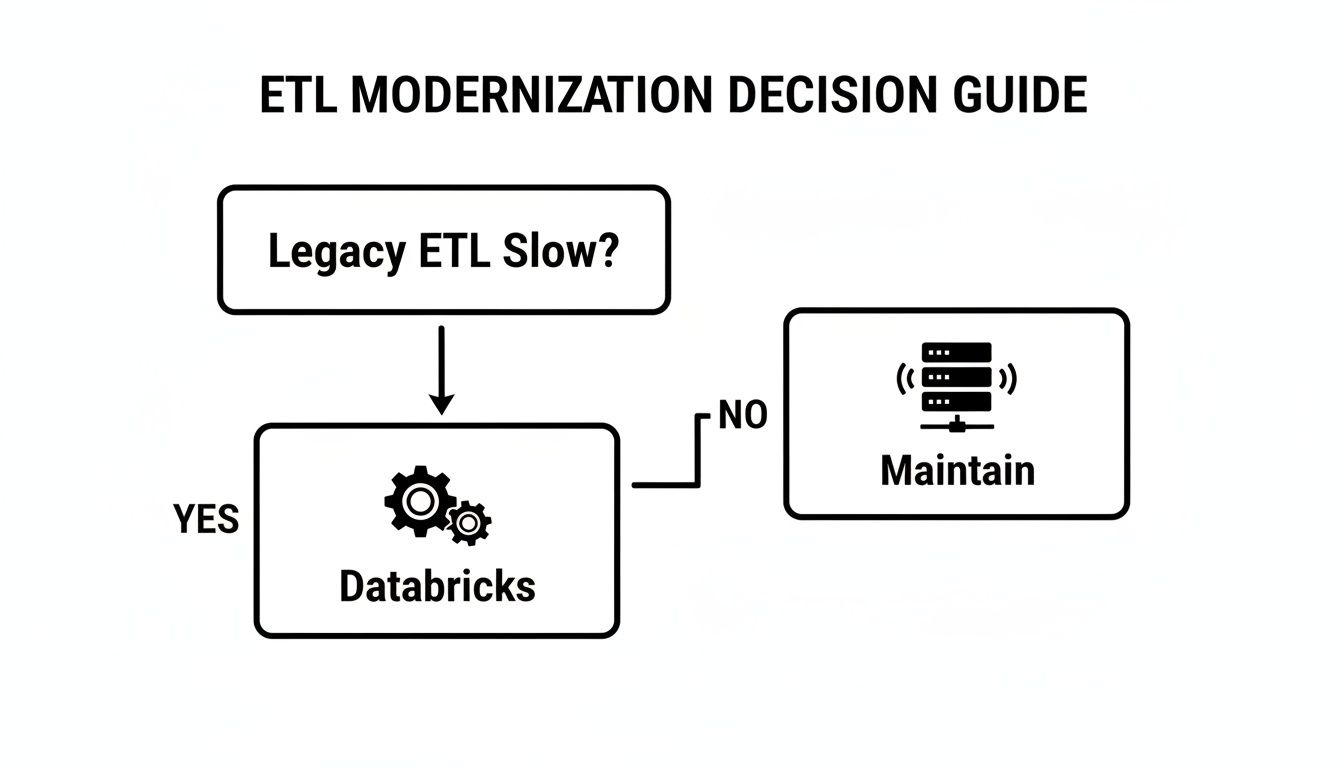
The conclusion is clear: if your legacy ETL system is a bottleneck, moving to a modern platform like Databricks is a strategic imperative that directly impacts business agility and cost.
The Batch Approach: The Multi-Hop (Medallion) Architecture
The most established pattern is the multi-hop architecture, often called the Medallion architecture (Bronze, Silver, and Gold tables). This batch-oriented model is excellent for creating clean, reliable, and well-governed datasets suitable for analytics and reporting.
- Bronze Layer: The landing zone for raw, unaltered data from source systems. The primary goal is data preservation and lineage tracking, not direct querying.
- Silver Layer: Data from the Bronze layer is cleaned, validated, and conformed into structured tables. This is where PII is masked and records from different systems are joined.
- Gold Layer: The final layer holds aggregated, business-level tables ready for BI tools and machine learning models, such as feature stores or reporting dashboards.
This model provides strong data quality control and auditability, making it a solid choice for regulatory reporting and creating a "single source of truth." The trade-off is latency; data is processed on a schedule (e.g., hourly or daily), not continuously.
The Streaming Approach: Delta Live Tables
For use cases requiring near-real-time responses—like fraud detection or live risk monitoring—a streaming architecture is essential. Delta Live Tables (DLT) offers a declarative framework that simplifies the development of reliable, maintainable streaming databricks etl pipelines.
Instead of manually orchestrating a sequence of Spark jobs, DLT allows you to define the desired final state of your data. The engine then automatically manages the dependencies, infrastructure, and data quality checks to achieve that state continuously.
DLT abstracts away much of the complexity typically associated with Structured Streaming. You declare transformations and quality rules, and DLT handles the orchestration, error handling, and incremental processing. This significantly reduces boilerplate code, allowing engineers to deliver pipelines faster with lower operational risk.
Batch vs. Streaming: A Comparison
Neither approach is inherently "better"; they are designed for different business objectives.
This table highlights the key differences:
The choice comes down to a trade-off: Multi-Hop offers granular control and structure for historical analytics, while DLT provides speed and developer productivity for operational use cases.
Making the Right Choice for Your Business
The decision between batch and streaming is not always binary; many organizations use a hybrid approach. The key is to align the architecture with the business need.
Choose Batch (Multi-Hop) when:
- The primary goal is BI reporting and historical analysis.
- Data latency of hours or a day is acceptable.
- Meticulous, multi-stage data validation is required for compliance.
- Use cases include end-of-day risk calculations or monthly financial statements.
Choose Streaming (DLT) when:
- Decisions must be made on data within seconds or minutes.
- Rapid pipeline development and operational resilience are priorities.
- The use case is operational, such as real-time fraud detection or dynamic pricing.
By aligning your architecture to these factors, you can design databricks etl pipelines that not only function technically but also directly support critical business goals, from reducing financial risk to enhancing customer experience.
Building A Resilient Data Ingestion Layer
An ETL pipeline is only as reliable as its ingestion layer. A poorly designed ingestion process leads to brittle pipelines, data loss, and constant maintenance. Traditional ingestion scripts are fragile, often breaking with schema changes or unpredictable file arrivals. For a solid overview of data flow fundamentals, this guide on how to build a data pipeline is a useful resource.
The goal is to build an ingestion layer that is both scalable and automated, ensuring raw data lands in your Bronze layer reliably and cost-effectively. Databricks Auto Loader is designed for this exact purpose. It provides an incremental and robust method for ingesting data from cloud storage, directly accelerating the availability of fresh data for compliance, analytics, and other business functions.

Why Use Auto Loader For Your Databricks ETL Pipelines
Auto Loader is an optimized service built on Spark Structured Streaming that automatically discovers and processes new files as they arrive in cloud storage like AWS S3 or Azure Data Lake Storage (ADLS). This eliminates the need for custom file-listing logic or trigger-based functions, which often become performance bottlenecks.
Its advantages translate directly into business value:
- Automatic Schema Inference and Evolution: Auto Loader can infer the schema of source data (e.g., JSON, CSV). Critically, when that schema changes—such as a new field added to transaction logs—Auto Loader handles the drift without crashing the pipeline. This prevents costly downtime and reduces engineering toil.
- Scalable File Discovery: It efficiently tracks processed files, even in directories with millions of files, guaranteeing exactly-once processing. This resilience is non-negotiable in regulated industries where data integrity for audits is essential.
- Cost-Effective Processing: By incrementally processing only new data, it avoids expensive full rescans of source directories. This directly reduces compute costs and shortens the time-to-insight.
This automated approach allows engineers to focus on high-value transformation logic rather than low-level ingestion plumbing.
A Practical Ingestion Example With PySpark
Consider a common scenario: ingesting a stream of JSON transaction files into a Bronze Delta table. This data is the foundation for downstream fraud detection models and analytics.
First, define the source and destination paths.
# Define paths for source data and the target Delta tablesource_path = "s3://your-landing-bucket/raw/transactions/"bronze_table_name = "transactions_bronze"checkpoint_path = f"s3://your-etl-bucket/checkpoints/{bronze_table_name}"Next, configure and start the Auto Loader stream. The cloudFiles format instructs Spark to use Auto Loader, infer the schema, and handle schema evolution.
# Configure and start the Auto Loader stream(spark.readStream.format("cloudFiles").option("cloudFiles.format", "json").option("cloudFiles.schemaLocation", checkpoint_path) # For schema inference and evolution.load(source_path).writeStream.option("checkpointLocation", checkpoint_path) # For fault tolerance.trigger(availableNow=True) # Process as a batch or use .processingTime('1 minute') for continuous streaming.toTable(bronze_table_name))The
cloudFiles.schemaLocationoption is critical. It tells Auto Loader where to store and track schema information, enabling it to handle changes without pipeline failure. This single option significantly increases the resilience of your ingestion layer.
This concise block of code creates a production-grade ingestion stream that handles file discovery, schema management, and fault-tolerant processing. For a financial services firm, this means new transaction data becomes available for compliance checks and analysis almost instantly, reducing risk and accelerating time-to-insight. Your databricks etl pipelines become more robust from the very first step.
Turning Raw Data Into Business-Ready Insights
Once raw data is in the Bronze layer, the transformation process begins. This is where your Databricks ETL pipelines create business value by converting disparate data sources into clean, reliable assets that power decisions.

This process follows the Medallion architecture, methodically improving data quality as it moves from Bronze to Silver and finally to the business-ready Gold layer. This disciplined approach is essential for everything from regulatory reporting to building accurate risk models.
From Bronze to Silver: Cleansing and Conforming
The journey from Bronze to Silver focuses on standardization and cleanup. Raw data is often inconsistent, with nulls, incorrect data types, or duplicate records. The Silver layer imposes order.
Key transformations include:
- Data Cleansing: Handling missing values, correcting data types, and removing duplicate records.
- PII Handling: Applying masking, hashing, or tokenization to sensitive customer data to comply with regulations like GDPR. This is non-negotiable.
- Data Conforming: Joining different datasets, such as linking customer profiles with transaction histories, to create a holistic view.
This stage transforms raw data into a trustworthy foundation. Clean, conformed tables provide analysts and data scientists with a reliable source, accelerating their work and reducing the risk of errors in downstream models.
Enforcing Data Quality with Delta Live Tables
Historically, data quality checks were often manual, inconsistent, and reactive, typically occurring after a pipeline failure. This reactive approach created a constant risk of bad data corrupting reports and models, which can have serious financial or compliance consequences.
Delta Live Tables (DLT) changes this by making data quality a proactive, built-in part of the pipeline. Using a declarative syntax called expectations, you can define quality rules directly within your transformation logic.
Expectations allow you to declare what valid data should look like. Instead of writing complex validation code, you simply state the rules. The DLT engine automatically collects metrics, flags violations, and takes your specified action.
This declarative approach improves both productivity and reliability. It embeds governance directly into the development workflow, ensuring data integrity is maintained at every stage of your Databricks ETL pipelines. The modern data engineer's role is increasingly focused on managing these automated quality systems.
Practical Data Quality Rules in DLT
DLT provides granular control over how to handle records that violate quality rules.
You can specify the pipeline's reaction to a failed expectation:
ON VIOLATION FAIL UPDATE: The strictest option. It stops the pipeline if a record fails the rule, preventing any invalid data from propagating. This is ideal for critical fields like transaction IDs where accuracy is paramount.ON VIOLATION DROP ROW: This action silently drops records that fail validation. It's useful for cleansing data where losing a small number of invalid records is acceptable.ON VIOLATION QUARANTINE: This feature isolates invalid data in a separate "quarantine" table. This keeps primary tables clean while preserving failed records for debugging or manual review.
This built-in quality framework is a key driver for modernizing ETL processes. It delivers measurable business impact by ensuring data reliability, which is critical for trust and decision-making.
Moving to Gold: Aggregating for Business Value
The final step is promoting data from Silver to Gold. Gold tables are highly refined, often aggregated, and purpose-built for specific business needs, such as BI dashboards or machine learning models.
Transformations at this stage focus on aggregation and feature engineering:
- Calculating key business metrics like weekly active users or average transaction value.
- Creating feature tables for a fraud detection model.
- Building aggregated views for financial reporting dashboards.
By creating these Gold tables, you democratize data access. Business users can query these tables directly with confidence, knowing the data is clean, validated, and relevant. This reduces reliance on the data team for ad-hoc requests and accelerates data-driven decision-making across the organization.
Operationalizing Your Pipeline With Orchestration And Governance
Building a data transformation workflow is one step; turning it into a reliable, production-grade asset is another. A pipeline is not complete until it can run autonomously, provide alerts on failure, and adhere to governance policies. This is the transition from development to operational delivery.
Effective orchestration and governance are fundamental. Without them, you risk silent data failures, compliance breaches, and unexpected cloud costs from runaway jobs. This stage builds the trust necessary for a data platform to be successful.
Choosing Your Orchestration Tool
Orchestration engines drive your pipelines by scheduling jobs, managing dependencies, and handling retries. In the Databricks ecosystem, several options exist.
Databricks Jobs: The native scheduler is tightly integrated and simple to configure via the UI or API. It is ideal for scheduling notebooks or JARs that run entirely within Databricks. For many ETL workflows, it is sufficient.
Delta Live Tables (DLT): DLT includes a powerful orchestration engine that automatically builds the dependency graph and manages incremental processing. It is an excellent fit for streaming data or complex, multi-stage batch pipelines where data freshness is critical.
External Orchestrators (Airflow, Azure Data Factory): For complex workflows that interact with services outside of Databricks, tools like Apache Airflow or Azure Data Factory (ADF) are industry standards. They serve as a central controller, triggering Databricks jobs as part of a larger process. We explore this further in our guide on integrating Databricks and Airflow.
The choice depends on your ecosystem's complexity. For Databricks-centric workflows, native tools reduce operational overhead. For coordinating multiple cloud services, an external orchestrator provides necessary end-to-end control.
Governance with Unity Catalog: The Compliance Backbone
For regulated industries, governance is a core business function. Unity Catalog is the foundation of a robust Databricks governance strategy, providing a unified layer for all data and AI assets across clouds.
Unity Catalog offers a critical combination of data discovery, fine-grained access control, and end-to-end data lineage in a single place.
The lineage feature is a game-changer for compliance and debugging. When an auditor asks about the origin of data in a report, Unity Catalog provides a visual map of its entire journey, from the raw source file to the final Gold table. This auditability is essential for meeting regulations like PSD2 and demonstrating data integrity, significantly reducing compliance risk.
This shift toward unified tooling reflects a broader industry trend. Modern lakehouse platforms allow firms to consolidate legacy tools, leading to significant cost savings. By transforming slow batch jobs into near-real-time pipelines, organizations can reduce data latency from hours to minutes, enabling faster compliance and better business outcomes.
Optimising Pipelines For Cost And Performance
Deploying your Databricks ETL pipelines is a major milestone, but the work continues. The next phase is ensuring they run efficiently, balancing fast data delivery with cost control. An unoptimized pipeline can easily become a major cost center, negating the efficiency gains you sought.
Optimization is a continuous process of refining infrastructure and code. A successful effort leads to lower cloud bills and faster time-to-insight, improving the overall ROI of your data platform. For a business, this means faster fraud alerts or more timely risk reports at a lower operational cost.
Performance Tuning For Faster Insights
Slow pipelines delay business decisions. Several levers within Databricks can significantly accelerate your ETL jobs.
- Choose the Right Cluster Type: For most ETL workloads, Job Compute clusters are more cost-effective than All-Purpose clusters. Selecting instance types optimized for memory or compute based on your workload can prevent performance bottlenecks.
- Leverage the Photon Engine: Photon is Databricks' high-performance query engine. Enabling it can accelerate SQL and DataFrame operations without code changes, particularly for the aggregation-heavy workloads common in Gold-layer transformations.
- Implement a Smart Data Layout: The physical organization of data in Delta Lake greatly impacts performance. Use partitioning for low-cardinality columns (e.g.,
date) and apply Z-Ordering on high-cardinality columns used in filters (e.g.,user_id). This technique reduces the amount of data Spark needs to scan, dramatically improving query speed.
Think of Z-Ordering as an index for your data lake. By co-locating related data, it allows queries to skip large amounts of irrelevant data, which can reduce query times from minutes to seconds.
Strategies For Cost Management
Controlling costs is as important as improving speed. A well-designed pipeline should scale resources dynamically, ensuring you only pay for what you use.
- Enable Cluster Auto-Scaling: This fundamental cost-control feature automatically adds and removes worker nodes based on workload demand, eliminating payment for idle compute capacity.
- Use Spot Instances: For non-time-critical batch jobs that can tolerate restarts, using spot instances can reduce compute costs by up to 90% compared to on-demand pricing. Because these instances can be reclaimed by the cloud provider, they are best suited for fault-tolerant workloads.
Modernizing ETL delivers tangible financial results. Companies moving to Databricks have achieved significant cost reductions and performance gains. You can discover more about these powerful data and AI use cases.
Optimizing these systems often requires specialized expertise. If your team is stretched thin, team augmentation can provide the specific skills needed to get your pipelines running at peak efficiency without long-term overhead.
Frequently Asked Questions About Databricks ETL Pipelines
Here are some of the most common questions we encounter from clients, along with practical, experience-based answers.
When should I use Delta Live Tables instead of a standard Databricks Job?
This comes down to a preference for a declarative versus an imperative approach.
With Databricks Jobs, you are in control. You write a notebook or script that explicitly defines how to execute each step. This imperative model offers fine-grained control, but you are responsible for managing dependencies and orchestration.
Delta Live Tables (DLT) is declarative. You define the final state of your data, and the DLT engine determines the execution plan. It automatically builds the dependency graph, provisions infrastructure, and manages incremental processing.
Our perspective: DLT significantly reduces boilerplate code, leading to faster delivery and lower operational risk by automating complex dependency management. For most new streaming or batch pipelines, DLT is an excellent starting point.
What is the right way to handle sensitive PII data?
In regulated industries, there is no room for error with personally identifiable information (PII). The best practice is a multi-layered defense using Unity Catalog as your central governance control plane.
Our recommended approach:
- Mask or Encrypt in Flight: Apply masking, hashing, or redaction functions directly in your transformation logic as data moves from the Bronze to the Silver layer.
- Enforce Access Controls: Use Unity Catalog to set fine-grained access controls at the row, column, and table levels. This ensures that only authorized users or service principals can access raw sensitive data, which is critical for compliance and risk management.
By embedding security directly into your databricks etl pipelines, you actively reduce the risk of a costly data breach.
Can we integrate this with our existing CI/CD process?
Yes, and you should. Your Databricks pipeline code is a production asset and should be managed with the same rigor as application code. Integrating with CI/CD tools like Azure DevOps or GitHub Actions is standard practice for automating testing and deployment.
Key components for integration include:
- Databricks Repos: To sync notebooks and code with a Git repository.
- Databricks CLI or REST API: To script deployments and trigger job runs from your CI/CD pipeline.
- Service Principals: For secure, automated authentication, allowing your CI/CD tool to access your Databricks workspace without using personal user credentials.
At SCALER Software Solutions Ltd, we build secure, high-performance data platforms that drive measurable business outcomes. If you're looking to maximize your Databricks investment, our expert engineers can work with your team to accelerate delivery and improve performance.
< MORE RESOURCES / >

Fintech
A Guide to Epic Store Szeged and the Local Tech Scene

Fintech
A Guide to Designing a Nordic Light Office for Technical Teams

Fintech
A Tech Employer's Guide to Hungary's Social Security System

Fintech
How to Choose an IT Company That Drives Business Outcomes

Fintech
A Consultant's Guide to Part-Time Jobs in Budapest

Fintech
A Consultant's Guide to Peppol Integration for E-Invoicing

Fintech
A Tech Leader's Guide to Nearshore Development

Fintech
PSD2 Integration for CTOs: Real-World Challenges and Architecture Insights

Team augmentation
Hiring vs. Outsourcing: Finding the Right Balance with Team Augmentation

Fintech