
< RESOURCES / >
Front Back End Development: A Guide to Business-Driven Architecture

When building a digital product, development is often divided into two core areas: the front end and the back end. The front end is what your users see and interact with. The back end is the server-side engine that powers it all.
This separation isn't just a technical convention; it's a strategic approach to building, scaling, and securing applications. For product and technology leaders, understanding the interplay between the front back end is fundamental to connecting technical decisions with business outcomes like speed-to-market, cost, and risk management.
The Front and Back End Partnership

Let’s set aside the technical jargon and use a practical analogy: a high-end restaurant.
The front end is the dining room. It encompasses the menu design, table layout, and service—every detail that shapes the customer’s experience and builds trust. It is the part of your application the user directly engages with.
The back end is the commercial kitchen. It's a complex system of secure supply chains, compliance checks, and precise processes that ensure every order is fulfilled correctly and safely.
Why This Synergy Matters for Business
The connection between your front end and back end is a core business concern. Misalignment creates tangible problems that affect the bottom line.
- User Adoption and Revenue: A clunky front end, slowed by an inefficient back end, drives users away. Lower engagement means fewer transactions and a direct hit to revenue.
- Regulatory Compliance and Risk: The back end manages sensitive data and enforces business rules. A failure here is not just a bug; it's a potential security breach, leading to significant fines for non-compliance with regulations like PSD2 or GDPR.
- Time-to-Market: A well-architected system allows front-end and back-end teams to work in parallel. This decoupling accelerates feature development, enabling you to respond to market changes faster than competitors.
For many projects, determining how to outsource web development is key to building both an effective user interface and the robust back-end infrastructure required to support it.
The objective is a seamless user experience where the complexity of the "kitchen" is invisible to the "diner." The user should only see a fast, intuitive, and secure service.
This guide provides a strategic framework for making architectural decisions that connect technology directly to business growth.
The Front End: The Interface of Trust

The front end is more than the visual layer of your application. It's where your business delivers value and where customer trust is earned or lost. In high-stakes industries like fintech, a well-executed front end directly influences user behavior, mitigates risk, and drives revenue.
For example, a clear interface in a trading app reduces costly user errors and can increase transaction volumes. A well-designed financial dashboard, compliant with PSD2, transforms complex data from a source of user anxiety into an empowering tool. Of course, the relationship between the front back end is critical—a brilliant interface is useless if the data it relies on is slow, inaccurate, or unreliable.
Technologies That Drive Business Outcomes
Selecting a front-end technology is a business decision, not just a technical one. The goal is to choose tools that deliver secure, fast, and reliable user experiences.
- For Web Applications: Frameworks like React and its production-grade counterpart, Next.js, are industry standards. Next.js improves initial page load times and search engine optimization (SEO) through server-side rendering. The business benefit is clear: faster load times reduce bounce rates and support customer acquisition.
- For Mobile Applications: Swift (iOS) and Kotlin (Android) are the native choices for optimal performance and security. They provide direct access to device hardware, essential for features like biometric authentication—a prerequisite for building user trust in a financial application.
A component-based approach, where complex UIs are built from small, isolated pieces of code, also accelerates development and simplifies maintenance. This directly translates to a lower total cost of ownership.
Sourcing Front-End Talent Strategically
Securing skilled front-end developers is a common bottleneck. Hungary’s strength in front back end development stems from its established role as a nearshore IT hub for Western Europe.
With a community of around 180,000 technology professionals and roughly 4,034 ICT graduates entering the market annually, the country offers a dense talent pool with expertise in modern JavaScript frameworks and mobile UI development. You can get a deeper look at the numbers and trends in this N-iX analysis of Hungary's IT outsourcing market.
The front end is a strategic function responsible for translating complex business logic and security requirements into an experience that feels simple, safe, and reliable to the end-user.
The Back End: The Foundation for Security and Scale
If the front end is the user-facing interface, the back end is the powerful, unseen engine. It is the fortress that guards data, secures transactions, and ensures your application can handle operational demands. Your core business logic resides here—and it's where your greatest risks are managed.
In fintech, the back end's role is mission-critical. It is responsible for reliable payment processing, protecting user data with GDPR-level security, and integrating with essential third-party APIs like Stripe or TrueLayer. A failure here is not a minor bug; it's a potential compliance disaster, a security breach, or a fundamental violation of customer trust. The entire front back end relationship relies on a resilient server-side foundation.
Choosing the Right Tools for the Foundation
Selecting a back-end technology is a long-term strategic decision that impacts cost, risk, and innovation speed. Different languages and frameworks are suited for different challenges.
- .NET and Java: These enterprise-grade platforms are known for robust security features and proven reliability. They are a solid choice for complex, regulated applications where stability is paramount.
- Go (Golang): Developed by Google for performance, Go excels in concurrent environments, making it ideal for high-frequency trading platforms or payment gateways processing thousands of simultaneous requests.
- Node.js: Its non-blocking architecture is highly efficient for real-time applications and APIs. A key advantage is its ability to enable rapid development and deployment, providing a competitive edge in fast-moving markets.
Your back-end architecture is a primary tool for managing business risk. It ensures your system can handle peak transaction volumes and maintains compliance with strict regulations like PSD2.
Local Expertise, Global Standards
In Hungary, the software market's demand for specialized talent has led to a clear distinction between front-end and back-end development roles.
Budapest has become an epicenter for this engineering talent. A 2025 talent report noted that 92% of C++ developer roles were located in the capital, highlighting the concentration of complex back-end work. This density of expertise allows a Budapest-based partner to assemble integrated front back end teams that operate in lockstep with EU-level security and fintech compliance standards.
To ensure your back end is secure, continuous validation is necessary. Regular Security Code Reviews for SOC 2 are essential for identifying vulnerabilities in your source code. This practice is a core component of any serious quality assurance strategy. Learn more in our guide to QA and testing for modern applications.
Connecting the Front and Back End for Business Success
A well-designed user interface is ineffective if the engine powering it is unreliable. The connection between your front and back end is what transforms a fintech concept into a dependable, high-performance application that users trust with their money. This link is built on clear communication protocols and deliberate architectural strategy.
An Application Programming Interface (API) acts as the intermediary. The front end (the "diner") makes a request. The API (the "waiter") translates that request into a precise set of instructions for the back end (the "kitchen"). This ensures a seamless flow of information. The two dominant API styles, REST and GraphQL, offer different approaches for requesting and receiving data.
Choosing Your Architectural Blueprint
Your system's architecture has significant consequences for business agility, scalability, and cost.
For years, the standard was a monolithic architecture—a single codebase where all features are tightly coupled. While simple to start, this approach often creates development bottlenecks. A small change in one area can unexpectedly break another, making updates risky and slow.
A more modern approach, particularly for complex platforms, is a microservices architecture. This strategy decomposes the application into a collection of small, independent services that communicate via APIs.
- User Authentication: One service handles logins and security.
- Payment Processing: Another is dedicated to transaction logic.
- Account Management: A third manages user profiles and history.
This separation allows teams to develop, test, and deploy each service independently. The business outcome is reduced development friction and faster time-to-market. A bug in the account management service will not bring down your payment system.
The infographic below illustrates how a robust back end functions as the central engine, managing the non-negotiable pillars of security, scalability, and compliance.
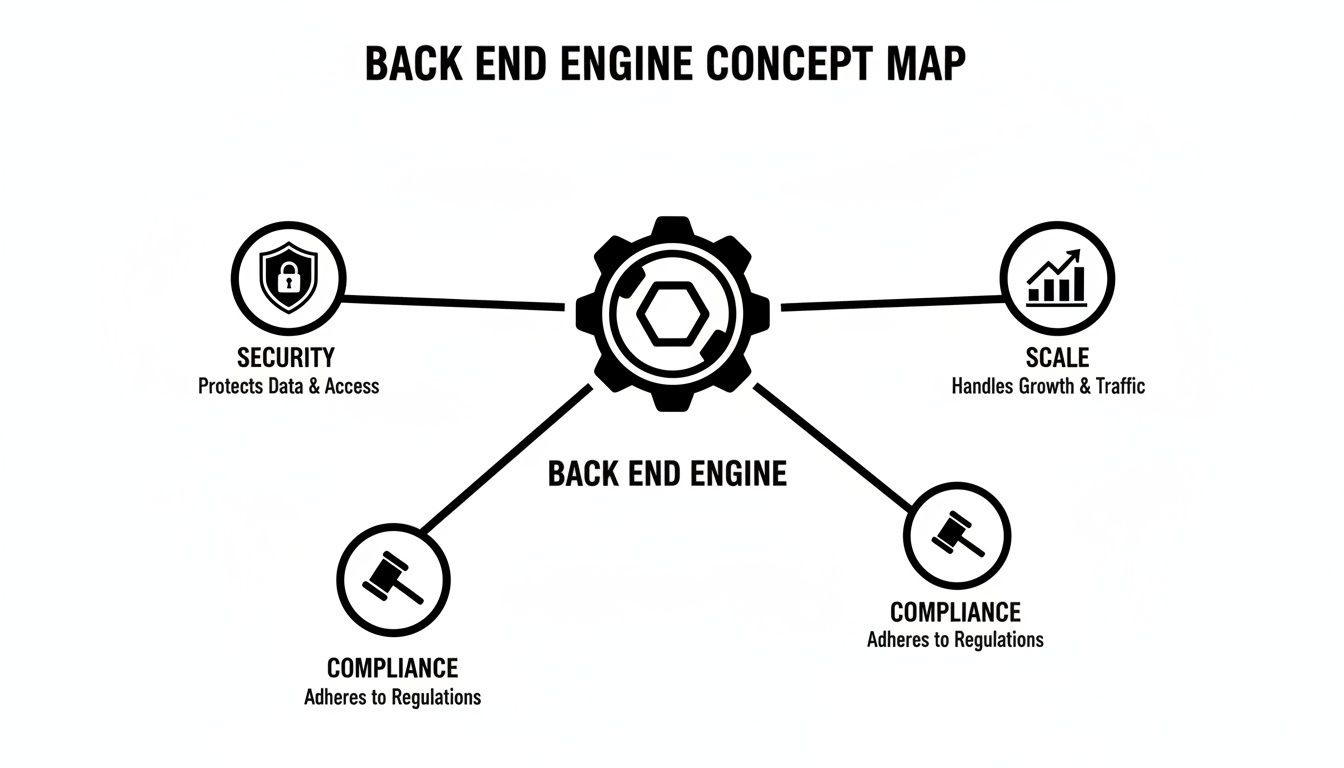
This visual reinforces that the back end is the operational core responsible for handling business-critical functions securely and at scale.
Choosing between these architectures involves trade-offs in speed, cost, and operational complexity.
Architectural Approaches: Monolith vs. Microservices
While a monolith can offer faster initial delivery, a microservices architecture is often the superior long-term choice for a growing platform that requires adaptability and scale.
Automating the Connection With DevOps
Managing the interplay between distributed services requires automation. This is where DevOps practices become essential for reliably connecting the front and back ends.
DevOps is a culture of using automation to make software delivery more predictable and less risky by breaking down silos between development and operations.
Practices like Continuous Integration/Continuous Delivery (CI/CD) create automated pipelines that test and deploy code, reducing the risk of human error. Technologies like Docker (containerization) and Kubernetes (orchestration) package each service into a self-contained unit. This ensures that code works the same way in production as it does on a developer's machine, improving stability and reducing downtime.
Assembling Your Front-End and Back-End Team
Selecting the right technology is only half the equation. The other half is assembling the right team to execute.
The skills required for front-end development are distinct from those needed for the back end. Your team structure should directly reflect your business goals, risk tolerance, and budget. The entire front back end ecosystem depends on the seamless collaboration of these specialists.
A versatile, full-stack developer might be suitable for an early-stage MVP. However, for a complex, regulated platform, a team of dedicated specialists is necessary to manage risk effectively.
Defining Key Roles and Their Business Value
To build an effective team, it is crucial to understand the business value each role provides. This is about matching specific expertise to your primary business risks and objectives.
Back-End Developers: These engineers are your first line of defense in a fintech product. They focus on security, data integrity, and regulatory compliance. Expertise in standards like PSD2 is not optional; it directly protects your business from significant compliance penalties.
Front-End Developers: These professionals are responsible for the user experience. They need a strong understanding of UX design and a commitment to accessibility. Their work drives user adoption and retention by ensuring the application is intuitive and trustworthy.
DevOps Engineers: This role connects the front and back ends by building and maintaining the CI/CD pipelines and infrastructure that automate deployments. Their work reduces human error, increases reliability, and accelerates time-to-market.
Team building is not about filling seats; it's a strategic exercise in risk management. You align your top experts with your greatest business challenges.
To Build or To Augment Your Team
A critical decision for any technology leader is whether to build a team from the ground up or augment an existing one with external experts. Each path has distinct business implications.
Building an in-house team provides full control but is often a slow and expensive process.
For many companies, partnering with a specialist firm is a more efficient approach. It provides immediate access to senior, EU-based talent that can integrate with your team from day one. If you need to de-risk hiring and accelerate your product roadmap, models like flexible team augmentation can provide senior engineering capacity without the long-term overhead.
Aligning Your Tech Stack with Business Strategy
The relationship between the front-end and back-end is the blueprint for a resilient and successful product. A well-integrated system is a competitive advantage that directly impacts revenue, compliance, and your ability to innovate.
When you make deliberate choices about your architecture and team, you align technology with business goals. For example, selecting a back-end framework is a critical decision with long-term consequences. We explore this further in our comparison of Django vs Flask.
For leaders who need to accelerate development with proven fintech expertise, SCALER provides both end-to-end project delivery and flexible team augmentation. We build secure, scalable systems that drive business growth.
A deliberate technology strategy transforms your tech stack from a cost center into a key driver of business value, ensuring every architectural decision supports your long-term goals.
Ready to align your technology with your business vision?
Book a call with our experts today to discuss your project.
Frequently Asked Questions (FAQ)
Here we address common strategic questions, connecting technical details to their business implications.
Should we hire a full-stack developer or build a specialized team?
Hiring a full-stack developer can be effective for an early-stage MVP or a smaller project. However, for a complex fintech platform, relying on a generalist introduces unnecessary business risk.
A dedicated back-end engineer focuses on secure API design, database optimization, and the security protocols your business relies on. A front-end specialist is dedicated to crafting an intuitive, compliant, and accessible user experience that builds trust.
For high-stakes applications where a single security flaw or a poor user interface can jeopardize your product, specialization is not a luxury—it is a risk mitigation strategy.
How do our tech choices affect long-term costs?
Your technology choices are financial decisions with long-term consequences. Selecting a framework like .NET for the back end or React for the front end impacts your total cost of ownership.
Sticking with mature, well-supported technologies is a strategic move that provides access to:
- A large talent pool, making hiring faster and more cost-effective.
- A global community providing reliable security updates, protecting you from breaches.
- Extensive documentation and support, reducing the time your team spends on solving common problems.
Choosing a niche or trendy framework may seem innovative initially but can become a liability due to hiring challenges, security vulnerabilities from unmaintained code, and a higher long-term maintenance burden.
When should we consider a move to microservices?
Migrating from a monolith to a microservices architecture should be a response to specific business challenges, not a pursuit of trends.
Are development cycles slowing because teams are conflicting with each other's code? Do you need to scale one part of your application (like payment processing) independently? Do you want to empower autonomous teams to innovate and deploy on their own schedules?
If the answer to these questions is yes, your monolith is likely hindering growth. These are clear indicators that a microservices approach could deliver significant value. A gradual, phased migration that prioritizes the most critical business functions is a prudent approach that minimizes risk.
Ready to build a secure and scalable front back end architecture that drives your business forward? The team at SCALER Software Solutions Ltd can help you accelerate your roadmap, whether you need to augment your team or partner on an end-to-end project.
< MORE RESOURCES / >

Fintech
A Guide to Epic Store Szeged and the Local Tech Scene

Fintech
A Guide to Designing a Nordic Light Office for Technical Teams

Fintech
A Tech Employer's Guide to Hungary's Social Security System

Fintech
How to Choose an IT Company That Drives Business Outcomes

Fintech
A Consultant's Guide to Part-Time Jobs in Budapest

Fintech
A Consultant's Guide to Peppol Integration for E-Invoicing

Fintech
A Tech Leader's Guide to Nearshore Development

Fintech
PSD2 Integration for CTOs: Real-World Challenges and Architecture Insights

Team augmentation
Hiring vs. Outsourcing: Finding the Right Balance with Team Augmentation

Fintech