
< RESOURCES / >
Django vs Flask: A CTO's Guide to Choosing the Right Framework

The Django vs Flask debate isn't about which framework is technically superior; it's a strategic business decision disguised as a technical one. Django offers a "batteries-included" toolkit designed for rapid, structured development. Flask is a minimalist "micro-framework" that provides complete architectural freedom.
Your choice directly impacts your time-to-market, development costs, and long-term maintenance overhead. Do you need the accelerated, predictable path Django provides for a complex application? Or does your project demand the surgical precision and flexibility of Flask? This guide will help you connect the technical differences to tangible business outcomes.
Django vs Flask: An Executive Summary
Selecting a web framework is a critical investment. It dictates your development velocity, scalability, and operational costs. This guide moves beyond simple feature comparisons to analyze how the core philosophies of Django and Flask affect your business.
Before diving deep, it's helpful to understand their place in the wider ecosystem. For a broader view, this comprehensive guide to the best Python frameworks for web development provides excellent context.
Core Philosophies and Business Impact
Django's "batteries-included" approach provides an integrated suite of tools out of the box, including a powerful Object-Relational Mapper (ORM) and a ready-to-use admin panel. This structure significantly accelerates the development of complex, data-driven applications like SaaS platforms or fintech systems. For business, this means a faster time-to-market and reduced initial development costs.
Flask's minimalist philosophy offers a core engine and leaves the rest to you. This flexibility is ideal for microservices, APIs, or projects with unique technical requirements where Django's built-in components would be restrictive. You start with a small footprint and empower your senior engineers to select the best-in-class libraries for each part of the stack, optimizing for specific performance or integration needs.
A simple way to frame the choice: Use Django when your goal is to build a complex application using a proven, standardized structure. Use Flask when your project requires building a custom architecture first, then building your application on top of it.
At a Glance: Strategic Framework Comparison
This table connects the key technical differences between Django and Flask to their direct impact on business strategy and project outcomes.
The decision isn't about which framework is "better," but which one aligns with your project goals, team expertise, and long-term product vision.
Comparing Architectural Philosophies and Development Speed

A framework’s philosophy dictates how your team builds, thinks, and ships code. When weighing Django vs Flask, this is the most critical distinction. It’s the difference between a framework that provides a blueprint and one that gives you a blank canvas.
Django: The Structured Accelerator
Django is famously opinionated. It provides its Model-View-Template (MVT) architecture and a clear set of conventions, guiding developers toward established best practices.
For a business, this structure is a powerful accelerator.
- Faster Onboarding: New developers can become productive quickly because the "right way" to build is already defined. This reduces onboarding costs and improves team velocity.
- Code Consistency: The enforced structure ensures a consistent, maintainable codebase, which is crucial for large teams and long-term projects. This directly lowers maintenance costs and technical debt.
- Integrated Components: Features like the built-in Object-Relational Mapper (ORM) abstract away raw SQL, speeding up development and reducing security risks like SQL injection.
For a fintech company building a compliance platform, Django’s structure is a clear advantage. The defined patterns ensure that different teams—one working on user management, another on reporting logic—adhere to the same conventions, simplifying integration and long-term maintenance.
Flask: The Flexible Foundation
Flask is unopinionated. It provides the bare essentials—a routing system and a templating engine interface—and lets you make every other architectural decision.
This minimalism is a strategic advantage for certain use cases.
- Total Control: Your team can select the best library for every task, from database interaction with SQLAlchemy to a custom authentication system. This is ideal for projects with unique constraints.
- Lightweight Footprint: For microservices or simple APIs, Django's all-in-one toolkit can be overkill. Flask's leanness results in less overhead and faster response times for simple services.
A Practical Example: User Authentication
Consider building a user authentication system.
- With Django: You get a robust, battle-tested authentication system included. It handles user models, password hashing, and session management. A developer can implement a secure sign-up, login, and password reset flow in hours, directly reducing upfront development costs and accelerating time-to-market.
- With Flask: You start from scratch. Your team must research, select, and integrate multiple libraries (e.g., Flask-Login, Flask-SQLAlchemy, Passlib). While this allows for custom solutions, it also transfers the security and maintenance burden entirely to your team. The initial build takes longer and requires senior-level expertise to ensure the result is secure and scalable, increasing both cost and risk.
Analyzing Scalability and Performance

When an application moves from prototype to production, scalability becomes a business-critical issue. Downtime translates directly to lost revenue and damaged user trust. Both Django and Flask can power high-traffic applications, but they approach scalability from different architectural starting points.
Django's Architecture for Growth
Django is designed around a "shared-nothing" architecture, which facilitates horizontal scaling. This means different components of your application can be scaled independently, providing a clear and predictable path to handling increased load.
- Database Layer: Add read replicas to distribute query load without altering your application code.
- Application Layer: Spin up more instances of your Django app behind a load balancer to handle more requests.
- Cache Layer: Scale your caching system (e.g., Redis, Memcached) independently to serve frequent requests faster.
The business value here is risk mitigation. For a SaaS product, this architecture means you can handle a sudden influx of customers without requiring an emergency re-architecture. It protects your revenue streams and user experience. For optimal results, best practices like offloading heavy tasks to a queue (e.g., Celery) and proactive optimizing website performance are essential.
Flask's Lightweight Performance
Flask's minimalist design gives it a smaller initial performance footprint. For simple, high-throughput requests typical in a microservices architecture, Flask can be exceptionally fast due to its low overhead.
However, this speed comes with a trade-off. As a Flask application grows, the architectural burden of ensuring scalability rests entirely on your team. You must design and implement the patterns for database pooling, caching, and service separation that Django provides by default.
This freedom is a double-edged sword. While it enables rapid prototyping, it can lead to significant technical debt if not managed by an experienced team. Senior developers often use patterns like the "application factory" to create configurable app instances and carefully select extensions for caching and database management to build a scalable foundation. Getting these early decisions right is crucial to avoiding costly refactoring later.
Evaluating Security Models: Built-In vs. Bolt-On

For applications handling sensitive data, especially in sectors like finance or healthcare, security is non-negotiable. The Django vs Flask comparison highlights a fundamental difference in security philosophy: built-in protection versus a bolt-on approach. This choice has direct consequences for development cost, risk exposure, and compliance readiness.
Django's Built-In Security Suite
Django is designed with a "secure by default" philosophy. It includes built-in protections against common web vulnerabilities, providing a strong defensive baseline before your team writes a single line of business logic.
Key built-in protections include:
- Cross-Site Scripting (XSS) Prevention: The Django template engine automatically escapes variables, neutralizing most XSS attack vectors.
- Cross-Site Request Forgery (CSRF) Protection: Middleware is included to validate requests and prevent CSRF attacks.
- SQL Injection Protection: The ORM uses parameterized queries, making it extremely difficult for attackers to execute malicious SQL.
For the business, this translates into lower risk, reduced overhead for meeting compliance standards like GDPR or HIPAA, and a more predictable security posture.
Django's security is like purchasing a pre-certified commercial safe. Flask provides the high-grade steel and blueprints, but your team is responsible for assembling it correctly and getting it certified.
Flask's Bolt-On Security Model
True to its minimalist principles, Flask provides no built-in security features. The responsibility for securing the application falls entirely on your development team and the third-party extensions they choose. This offers maximum flexibility but also introduces a higher risk of misconfiguration or human error.
To secure a Flask application, your team must assemble its own security toolkit. A typical setup includes:
- Flask-Login for session management.
- Passlib for secure password hashing.
- Flask-SeaSurf for CSRF protection.
- Flask-Talisman to set important security headers.
This approach requires significant senior-level expertise to implement correctly. The business implication is a higher total cost of ownership due to increased development time, the need for continuous security audits (like penetration testing as a service), and the inherent risk of relying on a custom-built security stack.
The Impact of Ecosystem and Talent Availability
The choice of a framework extends beyond the code; it includes the ecosystem of available libraries and the talent pool you can hire from. These factors directly affect your project's timeline, budget, and long-term viability.
Django's Mature and Stable Ecosystem
Django benefits from a mature, extensive ecosystem of well-maintained third-party packages. This is a significant business advantage.
- Reduced Development Costs: Instead of building common features from scratch, your team can leverage battle-tested packages like Django REST Framework for APIs or Wagtail for a CMS.
- Faster Time-to-Market: Using stable, well-documented libraries accelerates the development lifecycle.
- Lower Risk: Relying on packages used in thousands of production applications reduces the likelihood of encountering undiscovered bugs or security flaws.
The strong enterprise adoption of Django has created a large and experienced talent pool, making it easier to hire skilled developers or find expert consultants when needed.
Flask's Flexible but Fragmented Ecosystem
Flask also has a vibrant ecosystem, but it is more fragmented. For any given problem, there are often multiple competing libraries, requiring your team to invest time in research and vetting. While this provides flexibility, it also carries the risk that a chosen library may have incomplete documentation or be abandoned by its maintainer, creating future maintenance burdens.
Talent Pool and Hiring Considerations
Hiring costs and project timelines are directly impacted by talent availability. Market data consistently shows a stronger enterprise demand for Django developers. A recent analysis of Python web frameworks highlights this trend. Finding experienced Django developers is often more straightforward, which is a critical advantage when you need to scale your team quickly. For companies struggling to find specialized talent, services like flexible team augmentation can bridge critical skill gaps without the long-term overhead of direct hires.
Decision Framework: Making the Right Choice
With the technical and business implications laid out, let's consolidate this into a practical decision framework. The optimal choice matches the framework's philosophy to your project's specific requirements.
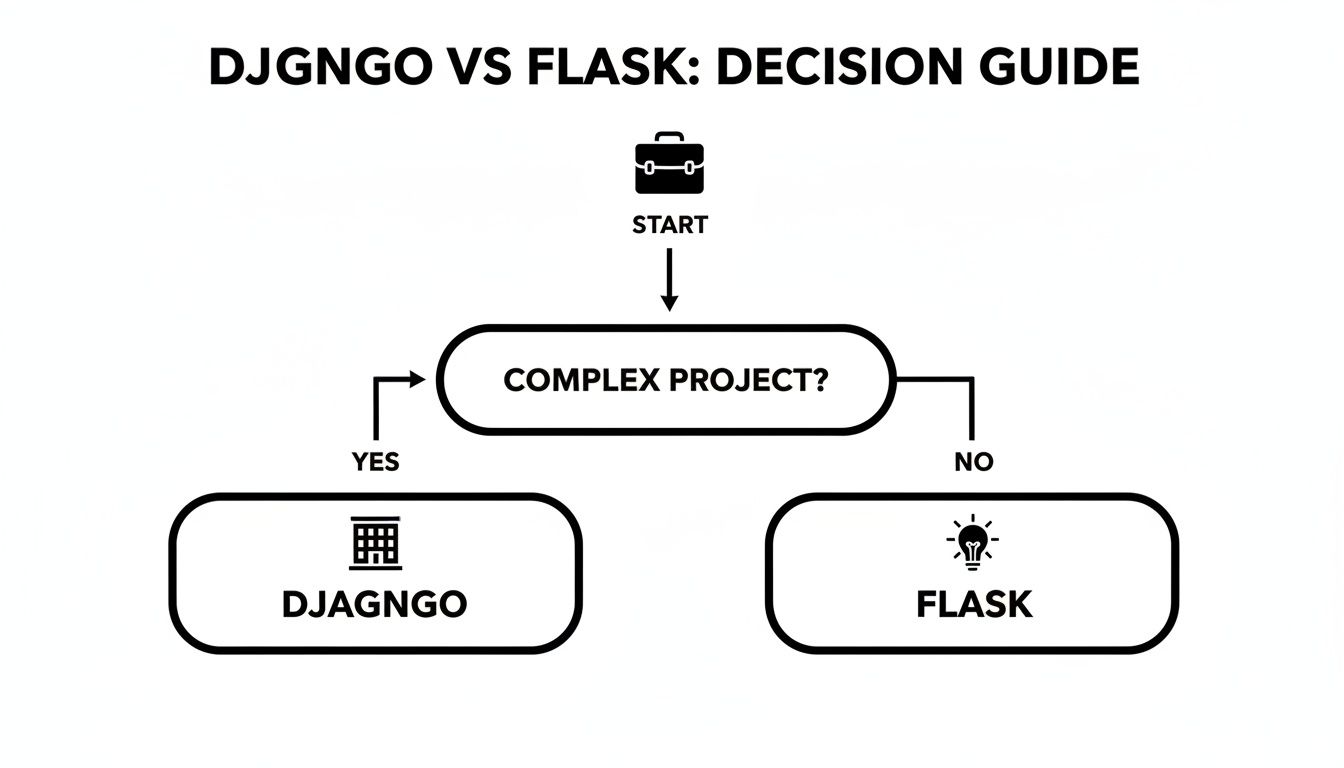
This flowchart simplifies the decision down to its core variable: project complexity and the need for structure versus flexibility.
When to Choose Django
Select Django when your priorities are rapid development of complex features, security, and long-term maintainability.
Choose Django if your project involves:
- Complex, database-driven applications: SaaS platforms, e-commerce sites, or financial systems where Django's ORM and admin panel provide a significant head start.
- Strict security and compliance requirements: The built-in security features reduce risk and simplify audits.
- Large or growing development teams: Django's conventions enforce consistency, which is vital for maintaining code quality at scale.
When to Choose Flask
Opt for Flask when your strategy requires flexibility, a minimal footprint, and fine-grained control over the architecture. For a comparison to a similarly structured environment in a different language, see our guide on choosing a web framework for Java.
Choose Flask for:
- Microservice architectures: Each service should be lightweight and independent, making Flask's minimal overhead ideal.
- Simple APIs or single-purpose applications: If your app does not require a large suite of features like a database or admin panel, Flask avoids unnecessary complexity.
- Projects with unconventional requirements: When you need to integrate with a non-standard database or a legacy system, Flask's flexibility prevents the framework from getting in your way.
Frequently Asked Questions
Here are answers to common questions we hear from technical leaders when they are in the final stages of the Django vs. Flask decision.
Which is better for REST APIs?
Both are excellent, but they serve different needs.
- Django with Django REST Framework (DRF) is the industry standard for rapidly building comprehensive, secure, and scalable APIs. It integrates seamlessly with Django's ORM and authentication, accelerating development.
- Flask is ideal for lightweight, single-purpose APIs, especially in a microservices context. It gives you complete control but requires your team to handle components like serialization and authentication manually.
Choose DRF for speed and convention; choose Flask for minimalism and control.
How difficult is it to migrate from Flask to Django?
A migration between Flask and Django is a complete rewrite, not a simple port. Their architectural philosophies are fundamentally incompatible. Moving from Flask to Django involves restructuring your entire application to fit Django's MVT pattern and rebuilding your data models with the Django ORM. The effort is significant and should be planned as a new project.
What is the real performance difference?
In a "Hello, World!" benchmark, Flask is faster due to its minimal overhead. However, this benchmark is irrelevant for real-world applications. Once you add database queries, template rendering, and business logic, the performance difference between the frameworks themselves becomes negligible. Your application's performance will be determined by code efficiency, database query optimization, and infrastructure, not the framework's routing speed.
Can I use async with both frameworks?
Yes, both Django and Flask have excellent support for asynchronous programming. Django has integrated async support across its stack, including views, middleware, and the ORM. Flask supports async views and works well with ASGI servers like Uvicorn. Using async is a critical strategy for improving throughput and reducing infrastructure costs for I/O-bound applications, such as those that rely heavily on external API calls or handle many concurrent connections.
Choosing the right framework is a foundational decision that will impact your project for years. We provide the senior engineering talent and technical leadership to help you build secure, scalable, and successful web applications.
Book a no-obligation consultation to discuss your technical roadmap.
< MORE RESOURCES / >

Fintech
A Guide to Epic Store Szeged and the Local Tech Scene

Fintech
A Guide to Designing a Nordic Light Office for Technical Teams

Fintech
A Tech Employer's Guide to Hungary's Social Security System

Fintech
How to Choose an IT Company That Drives Business Outcomes

Fintech
A Consultant's Guide to Part-Time Jobs in Budapest

Fintech
A Consultant's Guide to Peppol Integration for E-Invoicing

Fintech
A Tech Leader's Guide to Nearshore Development

Fintech
PSD2 Integration for CTOs: Real-World Challenges and Architecture Insights

Team augmentation
Hiring vs. Outsourcing: Finding the Right Balance with Team Augmentation

Fintech