
< RESOURCES / >
A Fintech Leader’s Guide to European I T Jobs

For any fintech leader, the mission is simple: deliver secure, innovative products faster than the competition. But that mission lives or dies by one thing—your access to elite technical talent. This makes navigating the world of i t jobs less of an HR function and more of a core business strategy. This guide is a playbook for making talent decisions that directly drive business outcomes like faster time-to-market and reduced operational risk.
Understanding the European IT Jobs Landscape
The real challenge for today's CTOs and Product Managers isn't just finding developers; it's building a winning team in a complex, fast-moving European market. This isn't about ticking boxes. It's a strategic game that impacts your product roadmap, your budget, and ultimately, your ability to compete. To win, you need to move past generic hiring advice and build a framework that clarifies when to hire in-house versus when to bring in flexible, external expertise.
We will get into the crucial differences between traditional in-house hiring and the speed you get from team augmentation. It's a vital comparison for any leader trying to align their team structure with business goals, whether that's launching a PSD2-compliant platform or scaling trading infrastructure. For those just starting out, a solid guide on how to start an IT career can provide a clear path into this world.
Key Strategic Considerations
When you understand market dynamics, you can make choices that directly move the needle on key business metrics. The right talent strategy can slash your time-to-market for new features and mitigate the risks of project delays or compliance issues.
Here are the core areas this guide will break down:
- Talent Acquisition Models: We’ll compare direct hiring against agile team augmentation, providing a clear picture of which model fits your immediate project needs and long-term vision.
- Role-to-Value Mapping: We'll connect specific IT roles—from backend engineers to DevOps specialists—to tangible business results like improved system scalability or lower operational costs.
- Geographic Specialisation: Tapping into the right talent hubs can provide a significant competitive edge. To see this in practice, check out our overview of nearshore software development.
- Fintech-Specific Challenges: We’ll tackle how expert talent solves concrete industry problems, from building robust Open Banking integrations to developing high-performance trading platforms.
The Reality of Europe's Tech Talent Market
Recent headlines about tech layoffs might suggest the market is flooded with talent. That is a dangerous assumption for the senior technical roles that actually reduce technical debt, architect scalable systems, and navigate compliance. The demand for truly experienced engineers remains exceptionally high.
This isn't just an HR headache; it's a direct business risk that can derail your product roadmap and increase budget pressure. To build a smarter talent strategy, you must first understand the European market's reality. Despite the noise, competition for proven, senior-level expertise hasn’t eased. In key tech hubs, it’s only intensified.
Navigating Europe's Competitive Talent Pools
While more junior talent might be available, the pool of seasoned professionals who can lead a complex project is as shallow as ever. This scarcity means longer hiring cycles, inflated salary expectations, and a higher risk of a costly bad hire. When your time-to-market is critical, waiting three to six months to fill a key role is a massive competitive disadvantage.
This is especially true in fast-growing tech regions like Central and Eastern Europe (CEE). These locations are no longer 'hidden gems'; they are now highly competitive battlegrounds for the best engineers.
A tight talent market forces you to ask better questions. Instead of, 'Who can we hire?', the real question is, 'What’s the most efficient way to get the exact skills we need to hit our next milestone?' This shift in thinking opens up more flexible and effective solutions.
A Closer Look at the Hungarian IT Market
Hungary is a perfect example of this trend. It has grown into a major IT and software development hub where the labour market is far tighter than most outsiders realise. In 2023, Hungary's overall employment rate was around 74.8%, with unemployment hovering near 4.3%. That’s an economy running at close to full capacity.
This general tightness is amplified within the specialised tech sector. Across the EU, the number of ICT specialists grew by 59.3% between 2013 and 2023, and Hungary’s growth has been just as rapid. The challenge is that this growth is happening while the country’s working-age population is shrinking.
For a fintech company considering nearshoring, this means entering a fight for a very small, sought-after group of senior engineers. This is precisely why many local firms have moved towards project-based partnerships or team augmentation. It gives them a way to tap into specialised skills without getting bogged down in the fierce, expensive permanent hiring market in Budapest.
This intense competition is why so many companies are looking beyond the traditional "hire-one-by-one" model. To get a better feel for this specific market, you can check out our detailed guide on the current state of job opportunities in Hungary.
Understanding these local dynamics is crucial. Once you see the real-world supply and demand, you can make a smarter call: do you jump into a crowded local market to compete for talent, or do you find a partner who can give you access to top-tier skills more efficiently and predictably?
Tying I.T. Job Roles to Real Business Value
Looking at I.T. jobs isn't just about scanning résumés; it’s about connecting a role to a business result. For a CTO or Product Manager in fintech, every hire—whether in-house or augmented—must be a strategic move. Their work needs to directly accelerate your timeline, reduce risk, and ultimately, support revenue growth. It's the difference between hiring a pair of hands to write code and bringing on a problem-solver who understands the why behind the what.
This becomes clear when you look at seniority. The gap between a junior developer and a senior architect isn’t just years on a CV—it's the scope of their impact. A junior developer gets a well-defined task done. A senior engineer takes ownership of an entire system, making architectural decisions that determine if your platform will scale securely and affordably over the next five years.
This hierarchy is visible not just in individual careers, but across the entire European tech market. You can see how specific regions like Central and Eastern Europe (CEE) and, more specifically, Hungary, plug into the bigger EU talent ecosystem.
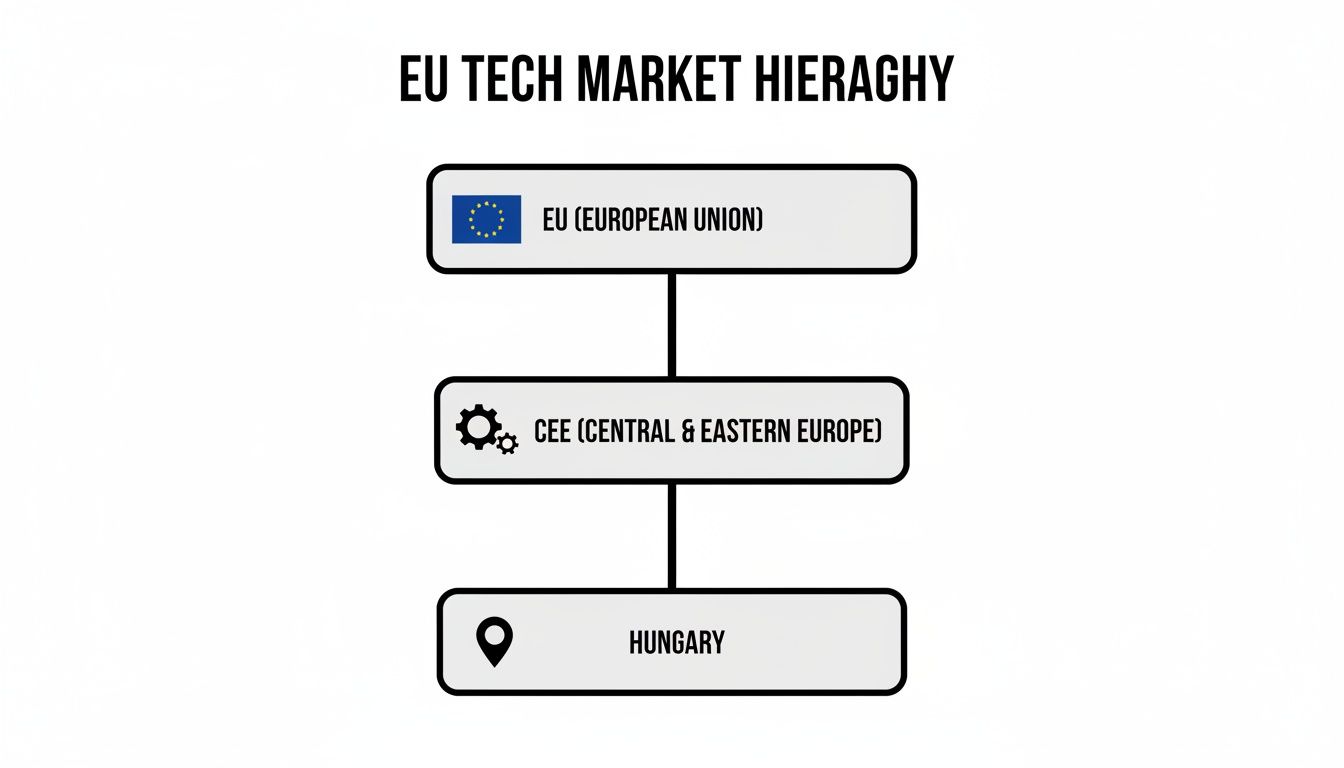
Understanding this structure shows why focusing on a talent hub like Hungary can give you access to top-tier, EU-aligned engineering talent without the high costs found elsewhere. It’s an efficient strategic play.
From Technical Skills to Tangible Results
Let's break down how key roles turn technical execution into results that matter to a fintech business. We're moving past the generic job description to focus on the concrete value each position brings.
Backend Engineers (Node.js, .NET): These individuals build the engine of your operation. A great backend engineer doesn't just write APIs; they design systems that guarantee data integrity, process transactions reliably, and integrate with third-party services. Their work ensures you meet compliance standards and avoid a headline-grabbing data breach, directly mitigating business risk.
Frontend Engineers (React): Your frontend is your business to your customers. A top-notch Frontend Engineer using a framework like React does more than improve aesthetics. They build intuitive experiences that drive user retention. In fintech, this could mean crafting complex data visualisations for a trading platform or simplifying a painful onboarding flow, directly boosting user engagement and reducing churn.
Mobile Engineers (Swift, Kotlin): For most fintechs, mobile is a primary channel. A sharp Mobile Engineer builds native apps in Swift or Kotlin that are both fast and secure. Their expertise enables features like robust biometric logins, protects sensitive data on the device, and delivers a flawless mobile banking experience that builds user trust and loyalty.
DevOps Engineers (AWS, Kubernetes): DevOps connects development and operations, directly dictating your speed of delivery. A skilled DevOps engineer automates infrastructure, deployment, and monitoring. By using tools like AWS and Kubernetes, they reduce human error, enable more frequent feature releases, and build resilient systems that minimise downtime. This translates directly to lower operational costs and improved service reliability.
The Real Difference Seniority Makes
When deciding who to bring on board, it's crucial to understand how an engineer's contribution changes with experience. Their focus shifts from implementation to strategic ownership.
Here's a quick look at how responsibilities and impact evolve, which can help you pinpoint exactly what your team needs right now.
As the table shows, a mid-level developer is your engine room. They can take a feature from idea to finished product with little hand-holding and are essential for maintaining momentum.
A senior engineer, however, plays a different game. They’re thinking three moves ahead.
A senior engineer’s most valuable contribution is often the code they prevent from being written. They spot architectural flaws before they become disasters, simplify overly complex plans, and mentor the rest of the team—saving thousands of engineering hours and stopping the kind of technical debt that can cripple a product.
Their impact isn't just measured in features shipped today, but in the health and scalability of your platform tomorrow. They ensure the system you build now can handle 10x the traffic next year without a total rewrite. That's how you safeguard future revenue.
The Soft Skills That Differentiate an Augmented Team
Technical skills are table stakes. When bringing an external engineer into your team, soft skills determine if they integrate effectively. For an augmented team member to deliver value from day one, these are non-negotiable.
Here’s what really matters:
- Proactive Communication: The ability to clearly explain a technical problem, provide updates without being prompted, and ask intelligent questions. This skill prevents misunderstandings and keeps projects on track.
- Problem Ownership: This is about taking a task and owning it from start to finish. It means not just flagging a problem but actively proposing solutions, which reduces the management burden on your core team.
- Cultural Adaptability: The ability to quickly learn how your team works—your communication tools, coding standards, and meeting rhythms. This ensures they integrate without friction and become part of a unified team.
When you partner with a firm that vets for these qualities, you're not just getting a temporary coder. You're getting a professional who thinks and acts like a dedicated member of your own team, focused on hitting your business goals.
Schedule a No-Obligation Consultation Today
The Strategic Choice Between Hiring and Augmentation
When building your tech team, the decision isn't just about finding someone who can code. It’s a strategic choice that directly impacts your budget, product roadmap, and competitive position. The question isn't simply "who do we hire?" but "what’s the smartest way to get the skills we need, right now?"
The two main paths—permanent hiring or flexible team augmentation—offer different advantages depending on whether you prioritise speed, risk, or cost.
The traditional route of hiring for permanent i t jobs is ideal for building your core team and retaining long-term institutional knowledge. These engineers grow with your company, define its culture, and own critical systems for years. But this path is slow. The hiring process alone can take months, followed by a lengthy onboarding period. Meanwhile, project deadlines are slipping.

Team augmentation, on the other hand, is built for speed and precision. It allows you to inject specialised expertise exactly when and where you need it, without the overhead and long-term commitment of a permanent hire.
A Framework for Making the Decision
To make the right choice, you need a clear framework that weighs the business outcomes of each option. This is about understanding the total impact on your business, not just comparing a salary to an hourly rate.
Go with In-House Hiring When:
- You're building core intellectual property: This is the foundational, proprietary tech that defines your competitive advantage.
- You need a permanent leader: You're looking for a long-term technical lead to set the vision, mentor the team, and shape your engineering culture.
- The role demands deep, evolving knowledge: It requires someone who can build a nuanced understanding of your business logic and customers over many years.
Choose Team Augmentation When:
- A critical project needs to move faster: You have an aggressive deadline and cannot afford a three-month hiring delay.
- You need niche, specialist skills: Your project demands expertise in an area like blockchain or specific compliance protocols that you don't need permanently.
- You need to scale up or down flexibly: You want to add capacity for a specific project phase without long-term financial commitments or HR complexities.
The real power of team augmentation is de-risking your roadmap. It sidesteps the significant financial and opportunity cost of a bad hire and turns talent acquisition from a slow, unpredictable process into a fast, reliable lever. You get predictable costs and immediate productivity.
Integration Without Friction
A common concern with augmentation is whether an external engineer will truly fit in. Will they understand your culture? Will they align with your technical standards? This is where the quality of your partner makes all the difference.
A great partner doesn't just provide a contractor; they provide a professional who is pre-vetted for both technical expertise and the soft skills needed to integrate into your team seamlessly. It's no surprise Why More Companies Are Turning To It Contractors when you consider the upside.
A top-tier augmented engineer arrives ready to contribute from day one. They quickly get up to speed on your tools, workflows, and communication rhythms, becoming an extension of your existing team. For a deeper dive into this model, our guide on strategic team augmentation breaks down the entire process.
The Hungarian Market: A Case Study for Augmentation
The structure of Hungary’s software industry provides a real-world example of why partnering can be more effective than hiring directly. A 2025 analysis showed Hungary had 24,904 software development businesses, a figure that grew at 6.7% annually between 2020 and 2025.
The challenge is that over the same period, the market itself only grew by 1.1%.
This gap points to a highly fragmented market where thousands of small firms are competing for the same limited pool of senior developers. For a foreign company trying to build a team from scratch, this means navigating a complex and capacity-constrained ecosystem.
Partnering with an established firm allows you to bypass this scramble and get immediate access to vetted, top-tier talent.
How Expert Talent Solves Real Fintech Challenges
Theory is one thing; execution is everything. For any fintech leader, the true test of a talent strategy is whether it solves real-world business problems. It’s about moving beyond the abstract idea of "hiring an engineer" and seeing exactly how specialised skills translate into market advantage, compliance, and revenue.
This is where the right talent partner makes a tangible difference. Instead of just filling a vacancy in your list of i t jobs, they bring in engineers who understand the why behind the code. They connect their technical work directly to your most critical goals, whether that’s shipping an MVP, untangling complex payment gateways, or building institutional-grade security.
From Open Banking to Trading Platforms
Let's look at a few real-world fintech scenarios. These examples show how specific technical roles, when filled by experts, can directly accelerate your product roadmap and reduce risk.
Building a PSD2 & Open Banking Integration: This is a high-stakes area where compliance is the foundation. A senior Backend Engineer paired with a DevOps specialist can architect a secure, scalable solution on AWS. They won’t just write API endpoints; they’ll implement robust authentication, manage data encryption, and build the infrastructure to handle sensitive financial data safely. The business outcome is clear: a compliant product that launches faster and builds user trust from day one.
Developing a High-Performance Trading Platform: These platforms depend on their frontend. They must display complex, real-time data without lag. An expert Frontend Developer using React can build the sophisticated data visualisations and hyper-responsive interfaces that traders demand. Their work directly impacts user engagement and retention, creating a product that feels fast and reliable—critical in a competitive market.
The Impact of Remote-First Talent Models
The way companies access this talent has fundamentally changed. Digital-first business models and remote work have reshaped the Hungarian labour market, allowing local engineers to contribute to major international fintech projects from Budapest. By 2023, Hungary had several hundred thousand people working remotely—a massive increase from 2009.
This shift mirrors a broader EU trend, where ICT specialist roles grew by over 59% between 2013 and 2023. For fintech CTOs, this means Budapest-based teams can now seamlessly integrate with product squads in London or Berlin, using cloud-native stacks while on local contracts. You can learn more about this structural shift from employment data in Hungary.
This remote-first reality gives CTOs a massive strategic advantage, allowing them to tap into a deep pool of EU-based talent in the same time zone.
A partner that operates in this distributed, compliance-aware way removes the friction of international hiring. You get the right skills for your project immediately, without the headache of setting up a local legal entity or navigating unfamiliar HR laws. It's the fastest path from a technical need to a business solution.
Solving Niche Challenges with Specialised Skills
Beyond core development, expert talent can solve the highly specific fintech challenges that often halt in-house teams.
Consider these situations:
- Integrating with Legacy Banking Systems: This requires developers who understand older protocols and can build reliable middleware to connect them to modern, cloud-based applications.
- Implementing Blockchain Solutions: From creating ERC-20 tokens to developing smart contracts, this demands niche expertise that is difficult and expensive to hire full-time.
- Ensuring Institutional-Grade Security: A security-focused DevOps engineer can implement advanced threat monitoring, penetration testing protocols, and automated compliance checks, protecting you from business-critical breaches.
By working with an augmentation partner, you get surgical access to these specialists for the exact time you need them. This approach turns a potential project blocker into a competitive advantage, allowing you to innovate faster and more securely.
Book a Call to Discuss Your Fintech Project Needs
Your Roadmap Needs the Right People
Developing a talent strategy isn't just an HR function—it's one of the most important strategic decisions a fintech company can make. The right mix of in-house experts and flexible team augmentation separates a stalled roadmap from one that accelerates. It is your path to faster innovation and a real competitive edge.
When you partner with the right experts, you're not just hiring hands. You're plugging directly into specialised skills, reducing hiring risks, and ensuring your most critical projects are delivered on time. That's a direct impact on your bottom line.
A smart approach to talent provides a straight line to hitting your milestones with greater certainty. The right partner ensures the engineers you bring in are not just technically skilled but are ready to contribute from day one.
If you’re ready to get your product roadmap moving and hit your business goals, let’s talk. We can show you how our senior, EU-based engineers can become a seamless part of your team.
Schedule a Consultation Today to Explore Your Project Needs
FAQ: Building Your Tech Team
When growing an engineering team, many questions arise. CTOs and hiring managers are always weighing their options, especially in the European IT market. Let's tackle some of the most common ones.
What is the real cost of a senior software engineer in Hungary?
It’s tempting to focus on salary benchmarks for i t jobs, but that’s only a fraction of the total cost. The sticker price of a salary never reflects the total cost to the business. Once you factor in payroll taxes, benefits, equipment, office space, and recruiter fees, the real number is always much higher.
Team augmentation cuts through this complexity. Instead of juggling a dozen hidden costs, you get one straightforward, all-inclusive monthly rate. It’s a single number that covers everything, making your budget predictable and shielding you from financial surprises. This clarity allows you to forecast with confidence and lowers your business risk.
How quickly can we onboard a new developer?
The traditional hiring process is slow. From posting a job ad to getting a new hire through their notice period and up to speed, you’re easily looking at two to four months. In tech, that’s an eternity. Every week you wait is a week your product isn't moving forward.
Our model is built to compress that timeline. We have a pool of senior, pre-vetted engineers ready to go. That means we can have a new expert integrated into your team and actively contributing in just a few weeks, not months. You get to skip the hiring marathon and jump straight to building, turning a long delay into a competitive advantage.
Is team augmentation only for short-term projects?
Not at all. This is a common misconception. People often think of augmentation as a temporary fix for a short-term project or to fill a gap while they hire. In reality, our augmented engineers often become dedicated, long-term members of a client's core team. They stay for months, even years, building deep product knowledge and becoming an integral part of the company's success.
Think of it this way: you get the stability and deep involvement of a permanent hire without the complexities of international employment contracts and local HR laws. It's a strategic partnership that gives you a dedicated expert who is fully invested, allowing you to scale your team without scaling your administrative burden.
At SCALER Software Solutions Ltd, we connect you with the senior, EU-based engineering talent you need to build faster, without the delays and overhead of traditional hiring.
Request a proposal and see how our experts can integrate with your team.
< MORE RESOURCES / >

Fintech
A Guide to Epic Store Szeged and the Local Tech Scene

Fintech
A Guide to Designing a Nordic Light Office for Technical Teams

Fintech
A Tech Employer's Guide to Hungary's Social Security System

Fintech
How to Choose an IT Company That Drives Business Outcomes

Fintech
A Consultant's Guide to Part-Time Jobs in Budapest

Fintech
A Consultant's Guide to Peppol Integration for E-Invoicing

Fintech
A Tech Leader's Guide to Nearshore Development

Fintech
PSD2 Integration for CTOs: Real-World Challenges and Architecture Insights

Team augmentation
Hiring vs. Outsourcing: Finding the Right Balance with Team Augmentation

Fintech