
< RESOURCES / >
The Real Meaning of IoT (Internet of Things Jelentése): A Guide for Business Leaders

The Internet of Things, or "internet of things jelentése" as it's known in Hungarian, describes a network of everyday physical objects—from industrial machinery to office thermostats—embedded with sensors and software to connect and exchange data over the internet. This concept moves far beyond smartphones and computers; it creates an intelligent, interconnected ecosystem that feeds real-time data directly into business operations, enabling smarter, faster decisions.
This guide is for technical and product-savvy leaders who need to understand how IoT translates from a technical concept into tangible business outcomes. We'll skip the fluff and focus on the practical application, from architecture and connectivity to security and deployment strategy.
Unlocking Business Value with IoT
The true business value of IoT isn’t in connecting gadgets; it's in the strategic shift from reactive problem-solving to proactive, data-driven optimization.
Instead of waiting for a critical machine on the factory floor to fail, an IoT sensor can detect minute changes in vibration or temperature, predicting a failure weeks in advance. This allows for scheduled maintenance, preventing costly unplanned downtime. This is what moving from reactive to proactive decision-making actually looks like in practice. It directly impacts operational costs and business continuity.
By connecting previously isolated assets, you gain unprecedented visibility into your entire value chain, uncovering inefficiencies that were once invisible. For a product leader, this is the core promise of IoT: optimizing resource allocation and eliminating operational waste.
From Data Points to Strategic Advantage
IoT isn't about hoarding data; it's about translating the right data into actionable intelligence. This empowers a business to move with greater speed and confidence, which is critical for accelerating time-to-market. A well-executed IoT project ceases to be a technology experiment and becomes a core driver of business growth and resilience.
Consider the direct business outcomes:
- Reduced Operational Costs: Predictive maintenance and intelligent resource management directly cut expenses tied to equipment failure, energy consumption, and manual inspections.
- Enhanced Efficiency: Real-time asset tracking in logistics optimizes the supply chain, while smart building systems improve facility management. The result is higher productivity and better asset utilization.
- New Revenue Streams: The data collected can unlock entirely new business models, such as usage-based insurance in fintech or performance-based service contracts in manufacturing.
The objective is to build an intelligent ecosystem where physical operations and digital insights are perfectly aligned. This convergence provides the clarity needed to reduce risk, ensure compliance, and build a more resilient business model.
Achieving this requires a disciplined approach. Like any complex software project management initiative, a successful IoT rollout demands clear goals, a solid framework, and precise execution. A clear understanding of the "internet of things jelentése" is the foundational first step.
Deconstructing the Core IoT Ecosystem
To effectively plan and budget an IoT project, you must understand its architecture. An IoT ecosystem is not a single piece of technology but a layered framework where each component serves a distinct function. Viewing it as a four-part system—from physical devices to the user-facing application—clarifies where to invest resources and how to manage risk.
This layered approach demystifies what "internet of things" means in practice by breaking it down into manageable, interconnected components. Each layer builds on the one before it, creating a value chain that transforms raw environmental data into strategic business decisions.
Let's dissect these four essential layers.
The Physical Layer: Sensors and Actuators
This is where the digital system interfaces with the physical world. Sensors are the sensory organs of your IoT system, collecting data from their environment. They can measure nearly anything, from temperature and humidity in a warehouse to the vibration patterns of industrial machinery. The quality of your sensors directly dictates the accuracy and reliability of your entire system.
Conversely, actuators are the system's hands. They receive digital commands and execute physical actions—adjusting a valve, cutting a power supply, or changing the speed of a conveyor belt. Together, sensors and actuators create a closed-loop system for real-time automation and control of physical processes, reducing the need for manual intervention and lowering operational costs.
The Connectivity Layer: Gateways and Networks
Once data is collected, it requires a secure and reliable transport mechanism. This is the role of the connectivity layer, which functions as the system's central nervous system. It transmits raw data from sensors to a central processing hub and relays commands back to the actuators.
The optimal network protocol depends entirely on the use case. Short-range options like Bluetooth are effective for an office environment, while tracking assets across a city requires long-range technologies like LoRaWAN. Gateways act as secure bridges between local sensor networks and the internet, often performing preliminary data filtering to reduce bandwidth costs and improve system efficiency. A robust connectivity layer ensures the timely delivery of critical information, which is non-negotiable for compliance and operational continuity.
The diagram below illustrates how these integrated components form a smart ecosystem that delivers tangible business results.
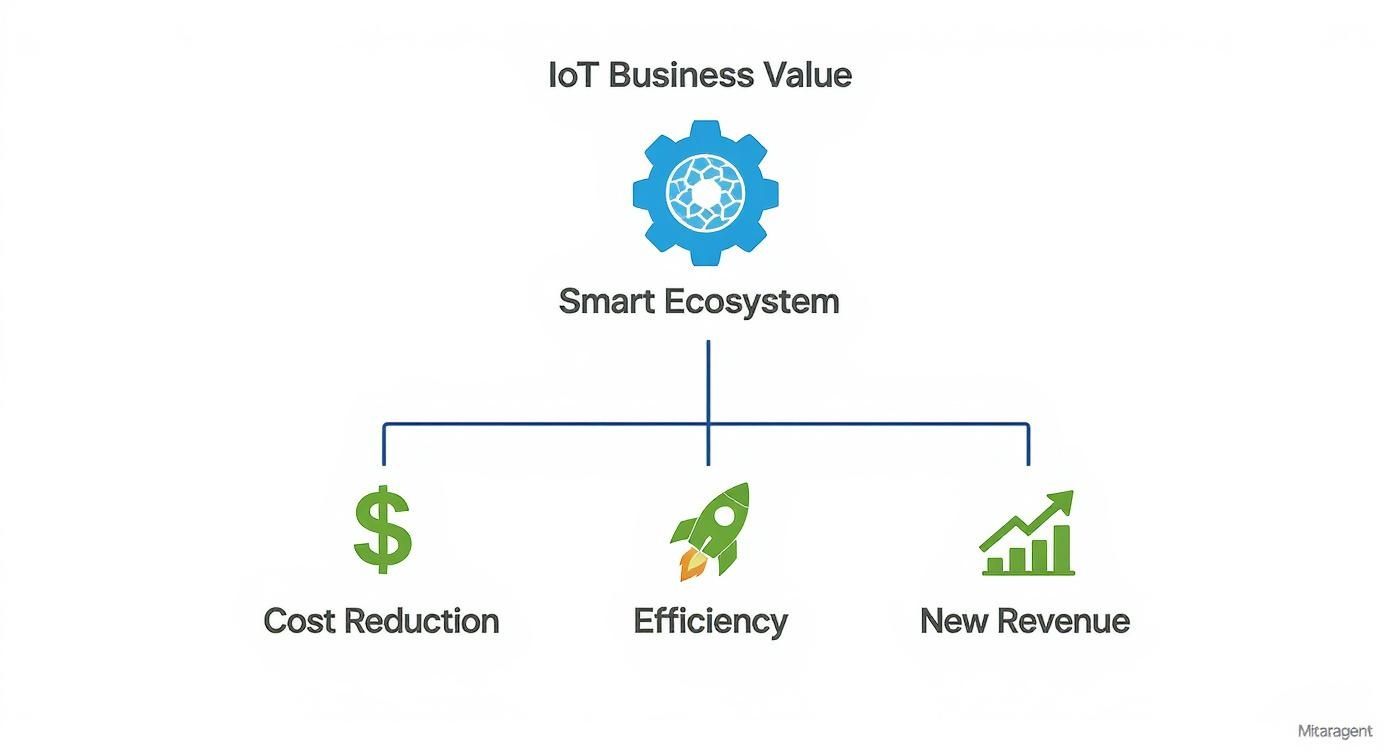
As shown, a well-designed smart ecosystem enables businesses to achieve three core objectives: cost reduction, efficiency gains, and the creation of new revenue streams.
The Processing Layer: Cloud and Data Analytics
This is the brain of the IoT operation. Raw sensor data is often voluminous and unstructured, making it unusable in its raw state. In the processing layer, typically hosted in the cloud, this data is cleaned, aggregated, and analyzed to extract valuable insights. Understanding how data analytics and IoT work together is crucial, as this is where a flood of sensor readings is converted into decisions that drive business value.
The transition from raw data points to business intelligence is where the real ROI of an IoT project is realized. For instance, machine learning algorithms can analyze sensor data to predict equipment failure, enabling proactive maintenance that can reduce operational costs by an estimated 20-30%.
The Application Layer: User Interface and Control
The final layer is where humans interact with the system. This is the user-facing application—a dashboard, a mobile app, or an integration with existing business software. It visualizes the analyzed data, sends alerts, generates reports, and provides decision-makers with the tools to monitor operations and manage physical assets remotely.
For a fintech company, this might be a dashboard displaying the real-time health of its ATM fleet. For a logistics manager, it could be a map tracking the live location of every vehicle. A well-designed application layer makes complex data intuitive and actionable, empowering teams to make smarter, faster decisions that directly impact revenue and risk.
Making the Right Call on IoT Connectivity
Selecting the appropriate connectivity protocol is a critical decision that directly impacts project cost, reliability, and scalability. It is a strategic trade-off between four key parameters: range, data rate, power consumption, and cost.
The choice of protocol must align with specific business objectives. The technology suitable for a smart office will be ineffective for monitoring agricultural assets spread across hundreds of hectares. Let's analyze the primary options to help you align technology with your goals.
Short-Range Wireless Protocols
For devices concentrated in a single location, short-range protocols are cost-effective, power-efficient, and ideal for smart buildings, retail environments, and consumer electronics.
The most common protocols are:
- Bluetooth (and BLE): Ideal for connecting devices within a room or building. Bluetooth Low Energy (BLE) is particularly valuable for battery-powered sensors that must operate for years without intervention, such as retail beacons for foot-traffic analysis or medical wearables for patient monitoring.
- Zigbee and Z-Wave: These protocols excel at creating mesh networks, where devices relay messages to one another. This extends the network's range and enhances reliability, as data can find an alternative route if one node fails. They are well-suited for smart home automation and commercial building control systems with numerous lights, thermostats, and security sensors.
Long-Range and Cellular Networks
When assets are geographically dispersed, long-range technologies are required. These are essential for logistics, smart agriculture, and smart city applications. Most fall under the Low-Power Wide-Area Network (LPWAN) category, alongside established cellular networks.
Key long-range options include:
- LoRaWAN (Long Range Wide Area Network): This protocol provides an excellent balance of long-range communication (up to 15 km in rural areas) and low power consumption. It is designed for applications that transmit small data packets intermittently, such as soil moisture sensors or utility meters. The trade-off is lower data rates for extended battery life and range, which reduces long-term operational costs.
- NB-IoT (Narrowband IoT): Operating on existing cellular infrastructure, NB-IoT offers excellent coverage and deep indoor penetration, making it suitable for smart city applications like waste management or smart parking. Leveraging existing mobile networks accelerates deployment time and reduces initial capital expenditure.
- 5G: The next generation of cellular technology, 5G delivers the ultra-high bandwidth and low latency required for advanced applications like autonomous vehicles, remote surgery, and real-time industrial automation. It enables use cases that were previously technologically unfeasible.
The choice of protocol is fundamentally a business decision disguised as a technical one. A low-power protocol reduces long-term maintenance costs, while leveraging existing cellular networks can drastically cut initial deployment time and capital expenditure.
Hungary's robust digital infrastructure supports such deployments. With 97.4% of its 11.3 million mobile connections being broadband (3G, 4G, or 5G), the country has the high-speed connectivity required for sophisticated IoT solutions. You can find more details on Hungary's digital readiness on DataReportal.
The table below provides a side-by-side comparison to help you evaluate these protocols.
Comparison of Common IoT Connectivity Protocols
Understanding the "internet of things jelentése" requires recognizing that connectivity is the critical link that transforms isolated devices into an intelligent, coordinated system that creates business value.
Where IoT Delivers Measurable Business Impact
Let's move from theory to bottom-line results. For any business leader, the true meaning of the "internet of things" lies in its ability to reduce costs, mitigate risks, and open new revenue channels.
By connecting physical assets to digital systems, you gain a level of visibility and control previously unattainable. This enables a shift from reactive problem-solving to proactive optimization based on empirical data.

Industrial IoT and Predictive Maintenance
One of the most significant applications of IoT is in the industrial sector (IIoT). Unplanned downtime of mission-critical machinery can cost thousands of dollars per minute. Predictive maintenance addresses this directly.
IoT sensors monitor equipment health in real time, tracking parameters like vibration, temperature, and power consumption. Machine learning algorithms analyze this data to identify subtle anomalies that precede a failure. Maintenance teams are alerted to schedule repairs proactively, before a breakdown occurs. This approach can reduce maintenance costs by up to 30% and cut unplanned downtime by as much as 50%, directly improving profitability.
Smart Logistics and Supply Chain Visibility
The supply chain is often a black box of potential delays and losses. IoT provides the visibility to manage it effectively. By attaching GPS trackers and environmental sensors to shipments, companies gain real-time location data and can monitor conditions like temperature and humidity for sensitive goods.
This level of visibility enables logistics managers to:
- Optimize Routes: Reroute vehicles in real time to avoid congestion, reducing fuel costs and improving on-time delivery rates.
- Ensure Product Integrity: Receive immediate alerts if a shipment of pharmaceuticals or perishable goods deviates from its required temperature range, preventing spoilage and ensuring compliance.
- Improve Asset Utilization: Track the location and status of every vehicle and container to minimize idle time and maximize operational efficiency.
This transforms the supply chain from a source of risk into a competitive advantage.
IoT Use Cases in Fintech and Financial Services
The financial sector is leveraging IoT to manage physical assets, enhance security, and create innovative insurance products. The focus is on reducing operational risk and delivering more personalized customer services.
IoT allows financial institutions to extend their digital security and operational intelligence into the physical world, bridging a critical gap in risk management and service delivery.
For example, smart ATMs are equipped with sensors to monitor cash levels, component health, and physical tampering. The system can automatically schedule cash replenishment or flag a component for preventative maintenance, minimizing downtime and improving customer satisfaction. In data centers, IoT-powered biometric sensors provide stringent access control, creating an immutable audit trail for compliance and security.
Usage-based insurance (UBI) is another transformative application. Telematics devices in vehicles track actual driving behavior, allowing insurers to price policies based on individual risk rather than broad demographic data. This creates a fairer model and incentivizes safer driving.
This technology is gaining traction rapidly. In Hungary, the Internet of Things market is projected to reach US$1.45 billion by 2025, driven by widespread digital transformation initiatives. You can explore more data on the Hungarian IoT market on Statista.
When technology is directly linked to a clear business outcome—preventing machine downtime, securing a data center, or creating a superior insurance product—IoT demonstrates its value far beyond the hype.
Managing Critical IoT Security and Privacy Risks
Security is not a feature of an IoT project; it is the foundation. A single compromised sensor can create a backdoor into your entire corporate network, leading to data breaches, operational disruption, and significant brand damage. For business leaders, understanding the "internet of things jelentése" means grappling with these severe and tangible risks.
The attack surface of an IoT system is vast, with threats ranging from physical device tampering to sophisticated cloud-based attacks. A reactive "patch-it-when-it-breaks" approach is insufficient. Risk must be managed proactively by designing security into the system from the outset.
Building a Proactive Security Framework
A robust IoT security strategy relies on a defense-in-depth approach. You cannot depend on a single point of protection. Security must be implemented at the device, network, and cloud layers simultaneously to limit liability and ensure business continuity.
Key security measures include:
- End-to-End Encryption: All data must be encrypted, both at rest on the device and in transit across the network. This renders intercepted data unusable to attackers.
- Secure Device Provisioning: Each device must be assigned a unique and non-forgeable identity during manufacturing. This prevents counterfeit or malicious devices from joining your network and compromising data integrity.
- Robust Access Control: Implement the principle of least privilege. Devices and users should only have access to the minimum data and functions required for their roles. This dramatically limits the potential damage from a compromised account.
The consequences of a security failure extend beyond immediate financial losses. A significant data breach can erode customer trust, impacting future revenue and market position. The global cost of cybercrime is projected to reach $10.5 trillion annually by 2025, underscoring that security investment is not optional.
Upholding Data Privacy and Compliance
Beyond security, data privacy is a critical business and legal concern. IoT devices often collect sensitive personal or operational data, making compliance with regulations like GDPR mandatory. Non-compliance can result in substantial fines and legal challenges.
The most effective strategy is privacy-by-design, which involves building privacy protections into the system architecture from the beginning. This not only ensures compliance but also builds trust with customers, which is a significant competitive differentiator. Given the interconnected nature of IoT, securing APIs is paramount, making it essential to adhere to essential REST API security best practices.
To identify and address vulnerabilities before they can be exploited, consider professional security assessments. Our guide on Penetration Testing as a Service provides further insights. Embedding security and privacy into your IoT strategy is a direct investment in your company's long-term viability.
Your Strategic Roadmap for a Successful IoT Rollout
Transitioning an IoT project from concept to deployment is a structured journey, not a single leap. A phased roadmap is essential for managing risk, demonstrating value at each stage, and ensuring the final solution effectively addresses the initial business problem. This approach de-risks the investment and accelerates time-to-market.
In Hungary, the ICT sector is a key enabler of such projects, with the market projected to grow at an 11.41% CAGR through 2033. This growth is driven by businesses adopting technologies like IoT to gain a competitive edge. You can find more details on Hungary's ICT market growth at DataInsightsMarket.com.
Phase 1: Strategy and Use Case Definition
Before any technical work begins, clearly define the business problem you are solving. This phase is about strategy, not technology. Identify a specific, high-impact pain point: frequent equipment breakdowns, supply chain visibility gaps, or excessive energy consumption.
The goal is to define a use case with clear, measurable success metrics. For example, success might be defined as "reducing machine downtime by 20%" or "decreasing energy costs by 15%." This focused use case will guide all subsequent decisions.
Phase 2: The Proof of Concept (PoC)
With a clear strategy, the next step is to test the core assumptions on a small, controlled scale. A Proof of Concept (PoC) is a low-cost experiment designed to validate technical feasibility and potential business value. This stage is not about building a polished product but about confirming that the technology can deliver the expected outcome.
For instance, you might deploy a few sensors on a single machine to verify that you can reliably collect the necessary data. A successful PoC provides the empirical evidence needed to secure stakeholder buy-in for further investment. For guidance on this critical stage, our guide on how to plan and execute a Proof of Concept is an excellent resource.
Phase 3: The Pilot Program
Following a successful PoC, the scope is expanded to a pilot program. This involves deploying the solution in a limited, real-world environment—for example, equipping an entire production line instead of a single machine, or one warehouse instead of the entire logistics network. The objective is to identify unforeseen challenges, refine the solution, and test its performance under operational conditions.
This phase is critical for resolving operational issues, training end-users, and building a robust business case with more accurate data. The feedback gathered here allows for crucial adjustments before a full-scale rollout, preventing costly mistakes.
Phase 4: Full-Scale Deployment and Ongoing Management
Only after a successful pilot is the project ready for full-scale deployment. This final phase involves rolling out the solution across the entire target environment. The focus shifts from development and testing to long-term operational management, including device monitoring, security updates, and performance optimization to ensure sustained value delivery.
A methodical, phased approach turns a complex technical challenge into a series of manageable, outcome-focused stages, dramatically increasing the probability of a successful and impactful IoT implementation.
Frequently Asked Questions (FAQ)
Navigating an IoT project introduces questions for both business and technical stakeholders. Clear answers are essential for managing expectations and mitigating risks. This FAQ addresses common concerns about implementing an IoT solution.
What is the real "internet of things jelentése" for our business?
The "meaning of the internet of things" for your business is specific to your operational challenges and strategic goals. Fundamentally, it means gaining real-time visibility and control over your physical assets to reduce costs, mitigate risks, and create new value. It's about transforming operational data into a strategic asset.
What kind of ROI can we realistically expect?
The ROI of an IoT project is directly tied to the use case. There is no single magic number, but the returns are typically tangible and measurable. For example, predictive maintenance in manufacturing often reduces overall maintenance costs by 20-30% and cuts unplanned downtime by up to 50%. In logistics, real-time fleet tracking can improve asset utilization by 15-20%, directly impacting fuel and labor costs. The key is to define and track specific key performance indicators (KPIs) from the outset.
How do we manage the massive volume of data?
IoT devices generate vast amounts of data. A hybrid approach combining edge and cloud computing is the most efficient way to manage it.
- Edge Computing: Processing data on or near the device itself. This is ideal for real-time decision-making and filtering out irrelevant data, which reduces latency and data transmission costs.
- Cloud Computing: Sending high-value, aggregated data to the cloud for deep analysis, machine learning, and long-term storage. This hybrid model provides both immediate responsiveness at the edge and powerful analytical capabilities in the cloud.
Should we build a custom IoT platform or buy an off-the-shelf solution?
The classic "build vs. buy" decision depends on your team's expertise, time-to-market requirements, and the uniqueness of your needs.
Choosing to build or buy isn't just a technical decision; it's a strategic one. Building offers complete control but requires significant upfront investment in time, capital, and specialized talent. Buying accelerates deployment but involves vendor lock-in and less flexibility.
Here’s a summary of the trade-offs:
For most organizations, leveraging an existing platform or partnering with an IoT solutions provider is the most pragmatic approach. It's the fastest path to realizing value without undertaking a high-risk, open-ended R&D project.
Ready to move from questions to a concrete plan? Our team has the deep engineering expertise to help you design, build, and deploy a secure and scalable IoT solution that delivers measurable business results.
< MORE RESOURCES / >

Fintech
A Guide to Epic Store Szeged and the Local Tech Scene

Fintech
A Guide to Designing a Nordic Light Office for Technical Teams

Fintech
A Tech Employer's Guide to Hungary's Social Security System

Fintech
How to Choose an IT Company That Drives Business Outcomes

Fintech
A Consultant's Guide to Part-Time Jobs in Budapest

Fintech
A Consultant's Guide to Peppol Integration for E-Invoicing

Fintech
A Tech Leader's Guide to Nearshore Development

Fintech
PSD2 Integration for CTOs: Real-World Challenges and Architecture Insights

Team augmentation
Hiring vs. Outsourcing: Finding the Right Balance with Team Augmentation

Fintech