
< RESOURCES / >
A Developer's Guide to Investing com Hungary Data and APIs

For any fintech team evaluating the Hungarian market, Investing.com Hungary is a frequent starting point. It provides a quick public view of everything from Budapest Stock Exchange (BSE) tickers to the latest movements in Hungarian Forint (HUF) currency pairs.
However, it's crucial to understand the business implications of this platform: Investing.com is a data aggregator and media portal, not a dedicated financial data API provider. This distinction is fundamental and directly impacts your product's reliability, cost, and legal risk. This guide will help you navigate its use cases and limitations to make informed technical and business decisions.
How Fintech Teams Should Think About Investing.com Hungary
Product managers and developers often look to Investing.com because its global data is free and surprisingly broad. For the Hungarian market, it offers a solid high-level overview, making it a practical tool for initial market research or validating a product concept without incurring the cost of a professional data subscription.
The platform aggregates a wide range of data on the Hungarian market, including:
- Equities: Real-time (delayed) and historical data for major Budapest Stock Exchange listings like OTP Bank (OTP) and MOL Group (MOL).
- Indices: Performance tracking for key benchmarks, most notably the BUX Index.
- Bonds: Information on Hungarian government bonds, offering a view into the country's debt market.
- Foreign Exchange (FX): Coverage of critical currency pairs involving the Forint, such as EUR/HUF and USD/HUF.
A Tool for Prototyping, Not Production
The primary value of Investing.com Hungary data within a professional development workflow is for rapid prototyping.
You can leverage its public data to quickly build a Minimum Viable Product (MVP) or a proof-of-concept. This accelerates the process of testing core features, refining the user interface, and validating business logic with stakeholders before committing to an expensive, licensed data feed. It's an effective way to de-risk the early stages of product development and secure the buy-in needed to move to the next phase.

The platform's main page provides a market snapshot that is an excellent starting point for initial analysis.
However, the data is presented for human consumption, not for machine integration. It is not structured for direct, scalable use in a commercial application. To build a viable product, you must understand its limitations, which directly impact your time-to-market and operational risk.
Available Data and Tools for the Hungarian Market

Before building a proof-of-concept, it's important to know what data is available for Hungary on the platform. The baseline data covers essential asset classes, offering a no-cost starting point for early-stage development.
This free data is sufficient for building a simple portfolio tracker or backtesting a basic trading strategy. It allows your team to prove a concept without immediate licensing costs. However, its utility is limited. As soon as your application requires greater data depth, real-time accuracy, or guaranteed uptime, you will encounter significant technical and business constraints.
Core Hungarian Asset Classes Covered
The platform aggregates data from key segments of Hungary's financial markets, which is useful for prototyping applications that require a broad market overview.
Here is a summary of what you can find on Investing.com Hungary:
- Equities: Data for major companies listed on the Budapest Stock Exchange (BSE), including blue-chips like OTP Bank (OTP), MOL Group (MOL), and Richter Gedeon (RICHTER). This covers price history, volume, and basic company information.
- Indices: The primary Hungarian market benchmark, the BUX Index, is well-tracked. Its historical performance data is essential for building market overview dashboards or performance comparison tools.
- Bonds: Information on Hungarian government bonds, including yields and maturity dates. This data can be used for developing features related to fixed-income analysis or basic risk modeling.
- Foreign Exchange (FX): The platform tracks key currency pairs involving the Hungarian Forint (HUF), such as EUR/HUF and USD/HUF. This is useful for building a simple currency converter or an FX monitoring feature.
To connect this to business outcomes, let's break down how these assets translate into practical fintech applications.
Investing.com Hungary Data Asset Breakdown
This table maps available financial instruments to potential use cases, helping teams assess if the platform meets their initial project requirements.
This data is well-suited for building user-facing features where split-second accuracy is not a critical business requirement.
Built-in Charting and Technical Analysis Tools
Beyond raw data, Investing.com provides a suite of charting tools and technical indicators. These serve as an excellent functional specification when designing the user experience for your own application.
For a technical lead, these charts offer a blueprint of retail user expectations for interactive features, such as moving averages, RSI, and MACD overlays. Using this as a model for your MVP's charting features can significantly reduce product discovery time and ensure you meet baseline market expectations without over-engineering non-essential features.
However, this baseline has a clear ceiling. The data's update frequency—often delayed by 15-20 minutes for equities—and the complete lack of programmatic access create a hard technical limit. You cannot build commercial-grade, real-time tools on this foundation. As an experienced data engineer will confirm, these limitations ultimately impact business goals by slowing the launch of revenue-generating features and introducing significant risk for any automated processes.
Widgets, Scraping, and Unofficial APIs

Once you've identified the data on Investing.com Hungary, the next question is how to integrate it. There are two paths: the officially sanctioned route and the unofficial, high-risk alternative.
Understanding the difference is critical, as your choice directly impacts your product's stability, cost, and legal compliance.
The Official Route: Embeddable Widgets
The simplest and only officially supported method for using Investing.com's data is through their embeddable widgets. These are pre-packaged components, like charts or market tickers, that you can add to a website by copying and pasting a snippet of HTML or JavaScript.
For a technical team, this is a quick win. You can deploy a professional-looking chart for the BUX Index or a live EUR/HUF ticker in minutes, accelerating MVP development.
However, this speed comes with significant business trade-offs:
- No Customization: The styling and functionality are fixed, which can conflict with your application's design system and brand identity.
- No Raw Data Access: Widgets are black boxes. You cannot access the underlying data, which prevents the development of custom alerts, portfolio analytics, or proprietary calculations.
- Forced Branding: Widgets typically include Investing.com's branding, which is unsuitable for white-label products or applications where brand consistency is key.
For any sophisticated application, these limitations are a deal-breaker. Our experience building platforms with professional charting libraries, as seen in our TradingView demo web application, highlights the importance of full control over data and presentation.
The Unofficial Route: Scraping and Private APIs
This leads to the unofficial methods: web scraping the site's HTML or reverse-engineering the private, undocumented APIs that power Investing.com's frontend.
From a purely technical perspective, this is tempting. It offers access to raw data that can be integrated into your backend services.
But building a commercial product on scraped data is like building on an unstable foundation. When Investing.com changes its website layout or API endpoints—which it will—your integration will break without warning. This leads to service outages, data corruption, and a rapid erosion of user trust.
The business risks are more severe. Web scraping is a clear violation of most platforms' terms of service, opening the door to legal action. For any fintech product, this introduces an unacceptable level of compliance risk that can jeopardize funding, partnerships, and customer acquisition.
While this guide focuses on Investing.com Hungary, it is important to understand the broader landscape of general API access for financial applications. Ultimately, the short-term convenience of scraping does not justify the long-term operational and legal risks.
Licensing, Compliance, and Data Integrity
Using data from a site like Investing.com Hungary for a commercial product is a legal and business issue, not just a technical one. Understanding the rules directly impacts your risk, compliance, and bottom line.
Investing.com’s terms of service clearly state that the data is for personal, non-commercial use. Building a paid service by scraping their feed is a direct violation, exposing your business to legal action, including cease-and-desist orders.
For a fintech startup, a compliance failure can be catastrophic. It can terminate funding discussions, invalidate partnerships, and destroy user trust. Managing this risk is a foundational, day-one priority.
Beyond legal concerns, you must assess if the data is fit for your business purpose. For any serious financial application targeting the Hungarian market, data integrity is non-negotiable.
- Accuracy and Latency: Data from public sites often has delays and inconsistencies. A 15-minute delay is acceptable for a casual investor but is a critical failure for an app providing real-time alerts or calculations. This delay directly undermines your product's value proposition.
- Historical Gaps: Free data sources often have incomplete historical data. If you are building backtesting engines or risk models, these gaps will produce flawed results, leading to poor business decisions.
Finally, operating in the EU means strict adherence to GDPR. While market data itself may not be personal, the user data you collect is. Navigating these regulations requires local expertise. Hungary's software industry has grown to 24,904 businesses, indicating a deep talent pool with experience in the European regulatory environment (IBISWorld). Partnering with an EU-based development team is a strategic advantage, reducing compliance risk and accelerating time-to-market.
Professional API Alternatives for Scalable Fintech Solutions
Investing.com Hungary is a valuable resource for market research and rapid prototyping. However, it was never designed to be the data backbone for a commercial fintech product.
Once your MVP gains traction, the focus must shift from "what can I get for free?" to "what is reliable, scalable, and legally compliant?" This transition is essential to mitigate business risk and ensure your application can deliver on its promises.
Building a production-ready financial platform requires a dedicated, professional data feed. Attempting to operate without one introduces unacceptable risks related to data accuracy, service uptime, and legal compliance, all of which can damage revenue and destroy user trust. Fortunately, the market for professional data APIs offers robust options for every stage of a company's growth.
Evaluating Enterprise-Grade Data Providers
When moving beyond the prototype stage, you are selecting a data partner, not just a data source. Established providers offer official, well-documented APIs designed for commercial use, providing guaranteed uptime, high-quality data, and developer support.
Key players in this space include:
- Refinitiv & Bloomberg: The enterprise gold standard, offering comprehensive global data for institutional-grade platforms. They come with a significant price tag.
- Twelve Data & Alpha Vantage: These providers offer flexible, developer-friendly APIs at a more accessible cost, making them an excellent choice for startups and scale-ups.
- TradingView: Known for its charting libraries, TradingView also provides high-quality data feeds ideal for building interactive, data-rich user experiences.
This is particularly relevant in Hungary, where the ICT market was recently valued at over $35 billion and is projected to reach $60.41 billion by 2030, growing at a 11.41% CAGR. This growth creates significant opportunities for fintech companies building scalable solutions. You can explore the growth drivers in Hungary's ICT market for more details.
Making the Right Choice for Your Business
Selecting the right API is a strategic business decision that balances cost, features, and risk. The table below outlines the key differences between using a free source and a professional provider for product development.
Comparison of Market Data Sources for Fintech Development
The conclusion is clear: transitioning from scraped data to a licensed API is a fundamental business decision that protects your product from disruption and legal threats.
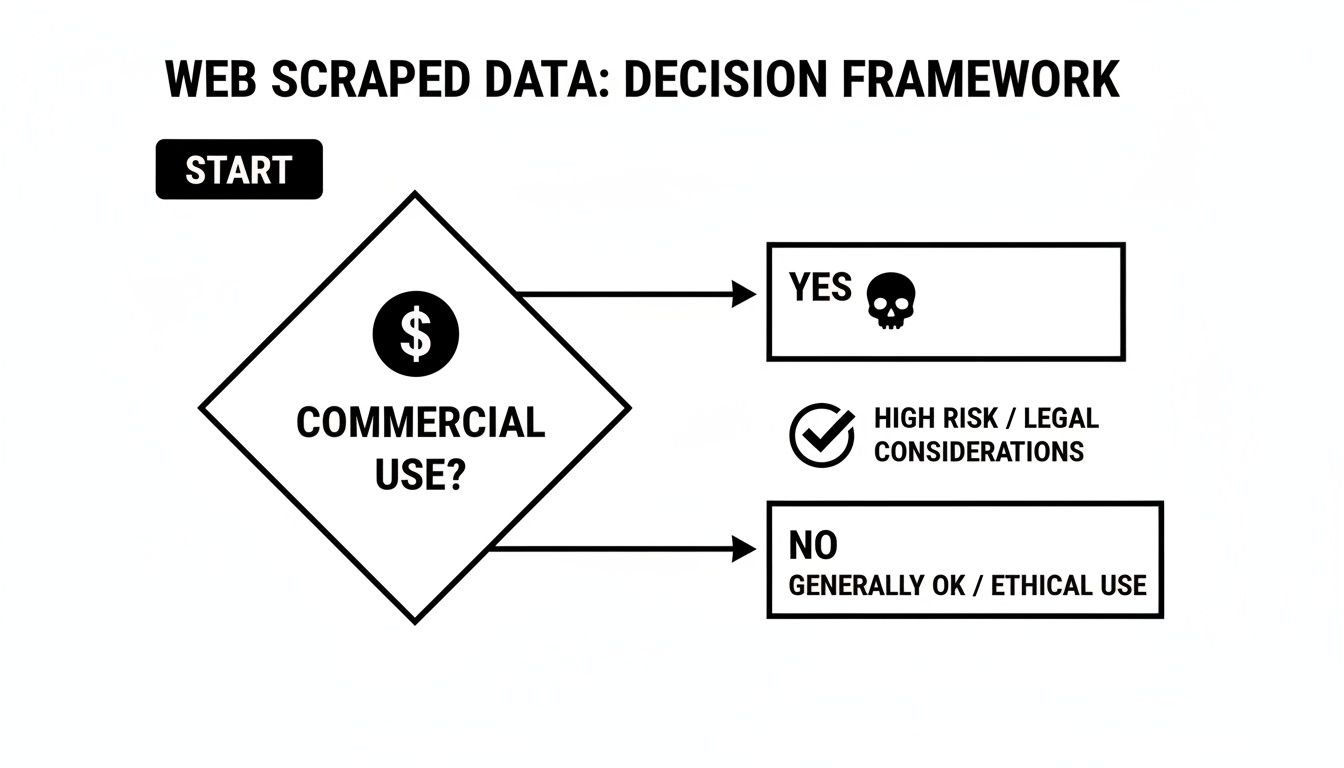
If your application serves a commercial purpose, relying on unofficial data is unsustainable. A licensed API provides the legal and technical foundation required for growth, accelerates your time-to-market for new features, and ensures your platform remains stable and compliant as you scale.
Time to Build? Why You Need an Expert Partner for the Hungarian Market
While platforms like Investing.com Hungary are useful for initial analysis, building a commercial-grade fintech product requires professional data feeds and expert integration. When you are ready to move from analysis to execution, the limitations of public data become a significant business obstacle.
Our Budapest-based team specializes in fintech development. We have built solutions ranging from TradingView-powered charting applications to secure Open Banking platforms. We have deep expertise in navigating complex data licensing and API integrations. To understand what best-in-class user features look like, it's worth reviewing the leading financial planning software solutions.
Hungary's IT outsourcing sector is a strategic hub for tech development, with revenues projected to reach $1.16 billion by 2029. This growth reflects the country's deep talent pool and favorable business environment. Learn more about the opportunities within Hungary's IT services.
We are not just developers; we are local partners who can help you build the right solution for the Hungarian and broader EU markets.
Frequently Asked Questions
Can I legally use Investing.com Hungary data in my commercial app?
No, you almost certainly cannot use scraped data from Investing.com Hungary in a commercial product without violating their terms of service. This approach introduces significant legal and operational risks. While their embeddable widgets are permissible for limited use, they do not provide the raw data needed to build a scalable application. For any serious commercial venture, licensed data from a professional provider is the only way to ensure reliability, compliance, and business continuity.
How long does it take to build a market data MVP?
With an experienced fintech development partner, a well-defined Minimum Viable Product (MVP) dashboard can typically be developed in 8–12 weeks. This timeframe includes backend integration with a licensed data API, a modern frontend (e.g., using React), and the core features required to launch and gather user feedback. An agile development approach is key to achieving this speed, as it focuses on delivering essential functionality first.
Why should I choose a Budapest-based development team?
Partnering with a Budapest-based team offers a distinct strategic advantage for fintech projects targeting the EU market. You gain access to a team with firsthand experience navigating the regional regulatory landscape, including GDPR. Furthermore, you can tap into a highly skilled talent pool at a more competitive cost than in other Western European hubs. This combination reduces project risk, ensures compliance is built-in from the start, and accelerates your time-to-market.
Ready to build a high-performance, compliant fintech platform for the Hungarian and EU markets? The experts at SCALER Software Solutions Ltd can help you navigate data integration challenges and accelerate your development roadmap.
< MORE RESOURCES / >

Fintech
A Guide to Epic Store Szeged and the Local Tech Scene

Fintech
A Guide to Designing a Nordic Light Office for Technical Teams

Fintech
A Tech Employer's Guide to Hungary's Social Security System

Fintech
How to Choose an IT Company That Drives Business Outcomes

Fintech
A Consultant's Guide to Part-Time Jobs in Budapest

Fintech
A Consultant's Guide to Peppol Integration for E-Invoicing

Fintech
A Tech Leader's Guide to Nearshore Development

Fintech
PSD2 Integration for CTOs: Real-World Challenges and Architecture Insights

Team augmentation
Hiring vs. Outsourcing: Finding the Right Balance with Team Augmentation

Fintech