
< RESOURCES / >
A Consultant's Guide to SAP Jobs in Hungary

Hungary's SAP market is expanding, driven by significant business and technology shifts. Budapest, in particular, has emerged as a key European hub for SAP talent. This isn't a temporary trend; it's a direct result of large-scale corporate migrations to S/4HANA and a strategic push toward cloud solutions. The outcome is a consistent, high demand for skilled SAP professionals who can connect technology implementation to business results.
Decoding the Hungarian SAP Job Market
Hungary, especially Budapest, has become a strategic center for SAP expertise in Central Europe. Multinational corporations have invested heavily in shared service centers (SSCs), creating a robust ecosystem alongside local IT consultancies. These organizations depend on SAP for core operations—from finance to supply chain—generating a continuous need for professionals who understand the system's business impact.
The primary driver of this demand is the enterprise-wide migration to SAP S/4HANA. Companies are moving from legacy ECC systems to modernize their operations, requiring a team of specialists. This includes functional consultants, technical developers, and project managers who can translate technical requirements into tangible business outcomes. A successful S/4HANA go-live isn't merely an IT project; it directly impacts a company's financial reporting accuracy, operational efficiency, and ability to make data-driven decisions, reducing risk and improving time-to-market.
What's Fuelling the Opportunities?
The shift to cloud infrastructure is another critical factor. Professionals with experience in the SAP Business Technology Platform (BTP) or skills in integrating SAP with cloud platforms like AWS or Azure are highly sought after. This expertise helps businesses achieve greater operational flexibility and scalability, directly impacting their ability to compete.
The market offers a diverse range of opportunities:
- Multinational Corporations: Many global companies manage their European or global operations from Budapest, offering stable, in-house roles with clear career progression.
- Consulting Firms: Major international consultancies and specialized local firms actively recruit talent for client projects across various industries.
- SAP Hungary Kft.: SAP maintains a significant presence, offering roles in development, support, and consulting. To understand the broader landscape, it's useful to review general job opportunities in Hungary.
A Closer Look at In-Demand SAP Modules
To target your job search effectively, it's essential to understand which modules and skills are most valued by Hungarian businesses. This isn't just a list of technologies; it reflects the core business challenges companies are trying to solve.
In-Demand SAP Modules and Skills in Hungary
The most valuable candidates possess deep knowledge in a core module combined with exposure to newer technologies like S/4HANA and BTP.
Market Growth and Future Outlook
Market forecasts indicate sustained demand for SAP skills, driven by ongoing S/4HANA projects and cloud adoption. The global need for SAP consultants is increasing, and key drivers—such as system upgrades and a retiring legacy workforce—are prominent in Hungary.
As an SAP professional in Hungary, your role is to help businesses modernize, mitigate risk, and maintain a competitive edge. The direct connection between your technical work and the company's financial and operational success is what makes these positions so critical.
A Realistic Look at SAP Salaries in Hungary
Understanding compensation is a critical part of your search for SAP roles in Hungary. The total package—including base salary, bonuses, and benefits—determines your financial position and career trajectory.
Compensation for SAP professionals in Hungary varies significantly based on experience, company type (e.g., multinational SSC vs. local consultancy), and module expertise. A junior consultant's offer will differ substantially from that of a senior S/4HANA architect leading a complex migration. Understanding this is key to setting realistic expectations and negotiating effectively.
Breaking Down the Numbers
Publicly available data provides a clear picture. Compensation for SAP software engineers can range from approximately HUF 9.32 million annually for junior roles to HUF 17.95 million for senior T3-level engineers. This wide range underscores the high value placed on deep experience and leadership.
Conversely, entry-level consultant roles may start with a more modest base. Some data points to hourly rates around HUF 1,500 for Junior SAP Consultants, highlighting the pay disparity between large tech firms and smaller companies. It's worth exploring these hourly figures to understand the entry-level market.
High compensation follows high-impact projects.
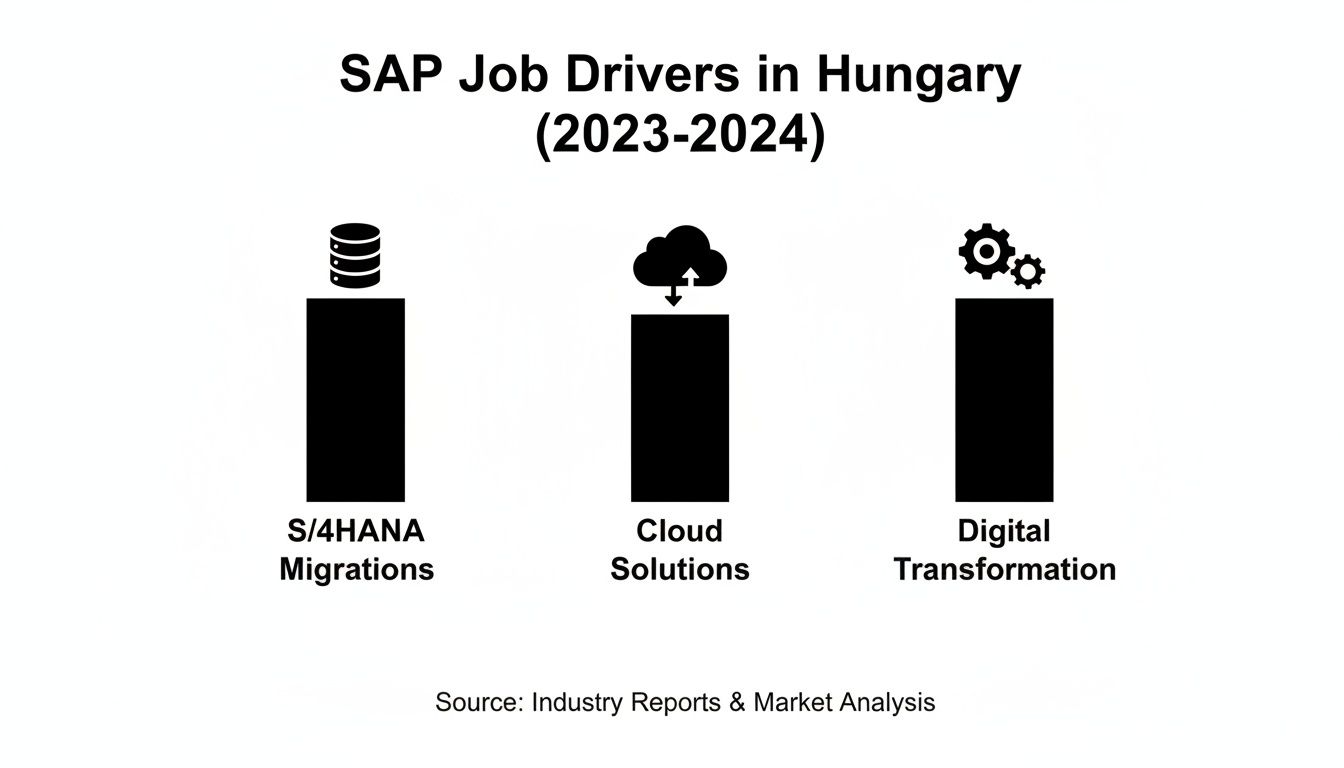
As the chart indicates, S/4HANA migrations, cloud solution adoption, and digital transformation initiatives are creating the most valuable and highest-paying roles.
Typical SAP Role Salary Ranges in Hungary (Annual HUF)
This table provides an estimated breakdown of gross annual salaries for different roles. These figures can vary based on the specific company and role requirements.
The progression is clear: specialized skills, particularly in high-demand areas like S/4HANA, significantly increase earning potential.
Look Beyond the Base Salary
A competitive offer includes more than just the gross annual salary. Hungarian companies often provide perks that add substantial value.
- Performance Bonuses: Standard in consulting and roles tied to business outcomes, annual or project-based bonuses can add 10-20% or more to your base pay.
- Benefits Package: Leading employers offer comprehensive private health insurance, gym memberships (such as the All-You-Can-Move pass), and pension contributions.
- Cafeteria System: This flexible benefits budget allows you to cover expenses like public transport, meals, and cultural events, often in a tax-efficient manner.
Evaluate the entire value proposition. A slightly lower base salary at a company with a strong bonus structure and excellent benefits could offer greater long-term value.
With these financial benchmarks, you can enter negotiations with confidence, backed by data that reflects your true market worth.
Where to Find the Best SAP Job Opportunities
A focused search strategy is more effective than a scattered approach. For the Hungarian SAP market, you must target the channels where decision-makers are most active.
Budapest is the epicenter for SAP in Hungary. While other cities have opportunities, the capital hosts the majority of multinational shared service centers, major corporations, and consulting firms. For comparison, our guide on jobs in Debrecen offers insight into another tech hub.
Finding Roles with Top SAP Employers
Focus your search on three primary avenues:
- Direct Company Applications: Monitor the careers pages of major corporations in manufacturing, automotive, and retail that run large in-house SAP teams.
- Consulting Firms: Global and specialized Hungarian IT consultancies are continuously hiring. These roles provide exposure to diverse projects and accelerate skill development.
- SAP Hungary: SAP itself is a major employer in Budapest, hiring for roles from core product development to client-facing consulting.
SAP’s Budapest office regularly lists dozens of open positions. A review of their career portal reveals a steady stream of roles for UX Designers, S/4HANA Consultants, and AI Engineers, indicating a deep investment in local talent. You can view current openings on their official Hungarian careers page.
The variety of roles on their portal demonstrates that SAP's Budapest office is a hub for both technical and business talent. Finding an opening is just the first step; you need a solid plan to stand out. For broader advice, consider these effective job search strategy tactics.
Pro Tip: Your LinkedIn profile is a key asset. Follow target companies, connect with IT recruiters specializing in the Hungarian market, and participate in SAP user groups. Many top roles are filled through professional networks before being publicly advertised.
Crafting Your CV and Mastering the Interview

In a competitive market, a generic CV is ineffective. To secure the best SAP jobs in Hungary, your application must demonstrate tangible value. Hiring managers are looking for evidence that you can solve their specific business problems, not just a list of technical skills.
Instead of stating you "worked with SAP FI/CO," quantify your impact. For example, describe how you configured CO-PA to deliver profitability insights that reduced operational costs by 5%, or how your S/4HANA migration project cut financial closing times by 20%. This language gets you noticed.
Tailoring Your CV for Maximum Impact
Your CV is a tool to secure an interview. It must be focused and aligned with the role's requirements. For a deeper look at this, review these essential resume tips to boost your interviews.
For the Hungarian SAP market, focus on these areas:
- Highlight Results, Not Tasks: Replace task lists with a "Key Achievements" section for each role. Frame your contributions in terms of business outcomes. For example: "Led the MM module go-live for a greenfield S/4HANA project, improving inventory accuracy by 15% and reducing the procurement cycle."
- Feature S/4HANA Prominently: Specify your S/4HANA project experience (e.g., greenfield, brownfield). If you have hands-on experience with the Business Partner concept, Fiori apps, or Central Finance (CFIN), make it highly visible.
- Showcase Certifications: Place your SAP certifications in a dedicated section near the top. Certifications in S/4HANA, BTP, or cloud solutions act as a powerful filter for recruiters.
- Mirror Job Description Keywords: If a job description mentions "NAV Online Számla compliance," ensure your CV explicitly states your experience with Hungarian e-invoicing regulations.
Preparing for the Technical and Behavioural Interview
Once your CV secures an interview, you must validate your skills and professional fit. Interviews for SAP jobs in Hungary typically involve multiple stages with HR, a technical lead, and a senior manager. The process will include both deep technical questions and behavioral scenarios.
The objective is to demonstrate that you are a strategic partner, not just a technician. Articulate how SAP solves real-world business challenges—from supply chain complexity and regulatory compliance to financial risk.
Be prepared to discuss specific examples. A hiring manager might ask, "Walk me through troubleshooting a failed IDoc from a 3PL provider," or "Describe a time you persuaded a stakeholder to adopt a standard SAP process over a custom development."
Your ability to provide clear, logical, business-focused answers is what differentiates a strong candidate. For those just starting, our guide on student jobs in Budapest offers tips for making a positive first impression.
Strategic Upskilling and Essential Certifications

The SAP ecosystem evolves continuously. To secure the best SAP jobs in Hungary, you must invest in ongoing skill development. This isn't about collecting badges; it's about learning to solve the complex problems Hungarian companies face, from cloud integration to local compliance requirements.
From an employer's perspective, a relevant certification validates your skills against a recognized standard and de-risks their hiring decision. In a market focused on S/4HANA, the right certification can move your CV from the "maybe" pile to the "interview" list.
Focus on Certifications That Drive Business Value
Concentrate your efforts on certifications that address current business needs. Employers are actively seeking professionals who can help modernize core systems and integrate them with the cloud.
Prioritize certifications in these areas for the best return on investment:
- SAP S/4HANA Certifications: These are foundational. Certifications like C_TS4FI (Financial Accounting), C_TS462 (Sales), or C_TS4CO (Controlling) demonstrate your proficiency in the new standard.
- SAP Business Technology Platform (BTP): As companies expand beyond their core ERP, BTP skills are in high demand. A certification like the SAP Certified Development Associate - SAP BTP Extension Developer shows you can build custom applications and integrations.
- Cloud Integration: The ability to connect SAP with other systems is a critical skill. The SAP Certified Integration Associate - SAP Integration Suite is highly valued because it proves you can integrate SAP and non-SAP systems across on-premise and cloud environments.
Practical Application Is Key
Certifications open doors, but practical skills secure the job. Employers want to see that you can apply your knowledge to solve their real-world problems. A key example in Hungary is compliance with local e-invoicing regulations like the NAV Online Számla system.
Knowing how to configure SAP to meet Hungarian-specific regulations is a high-value skill that distinguishes you from other candidates. It shows you are a problem-solver with an understanding of the local market.
Gain hands-on experience by setting up a learning environment or using SAP's platforms. Building small projects that mimic real business challenges will solidify your knowledge and provide you with compelling examples to share during interviews, proving you can deliver tangible results.
Your Action Plan to Land an SAP Job in Hungary
A structured approach is required to turn your job search into an offer. This practical action plan outlines the essential steps to get hired for SAP jobs in Hungary.
First, optimize your LinkedIn profile. Your headline and summary should be specific. Instead of "SAP Consultant," use "SAP S/4HANA FI/CO Consultant | Budapest." This simple change improves your visibility to recruiters using keyword searches.
Second, prepare a concise portfolio. A few slides covering 2-3 of your most impactful projects is sufficient. For each, outline the business problem, the SAP solution you implemented, and the measurable result (e.g., reduced closing times, improved supply chain efficiency). This provides tangible proof of your capabilities.
A Proactive Search Strategy
Move beyond passively browsing job boards. Set up targeted job alerts on major platforms and the career pages of your desired companies. This ensures you are among the first to apply when a relevant role opens.
Simultaneously, prepare for your interviews. Practice answering common questions, but focus on discussing the projects in your portfolio. Be ready to explain technical challenges, stakeholder management, and how you handled project constraints.
Candidates who can clearly connect their technical SAP skills to business outcomes—such as cost savings, risk reduction, or revenue growth—are the most successful. This is the language that decision-makers understand.
Finally, consider the practical details before you receive an offer. Understand the company's remote/hybrid work policy and, if applicable, their visa sponsorship process. Asking these questions demonstrates foresight and helps you evaluate your options effectively.
This methodical approach will help you navigate the market for SAP jobs in Hungary with confidence and secure a role that aligns with your career goals.
FAQ: Your Questions Answered
Here are concise answers to common questions from SAP professionals considering a move to Hungary.
Is English sufficient for SAP roles?
Yes. For most SAP positions in Budapest's international tech sector, English is the primary business language. Major employers like SAP Hungary operate with global teams, making English the standard for daily operations and project documentation. While Hungarian language skills are an advantage in client-facing roles with local companies, they are not a prerequisite for most technical positions.
What is the demand for junior vs. senior SAP professionals?
The market is strong for both junior and senior talent. Companies are actively recruiting junior professionals for graduate programs, focusing on training them in S/4HANA and cloud technologies. At the same time, there is a persistent need for experienced senior professionals who can lead complex migrations, design system architecture, and provide mentorship.
Senior experts who can translate technical work into business value are in high demand and command top salaries because they mitigate risk and drive project success.
Is the hybrid work model the new standard?
Yes, a hybrid model has become standard practice. Most tech companies in Hungary hiring for SAP jobs in Hungary offer a mix of office and remote work, typically requiring two or three days in the office per week. Fully remote positions exist but are less common, usually reserved for highly specialized roles. It is important to clarify the specific work model during the interview process to ensure it aligns with your preferences.
Ready to accelerate your development roadmap? At SCALER Software Solutions Ltd, we connect you with senior EU-based engineers who don’t just fill a seat—they integrate with your team to deliver secure, scalable solutions that work.
< MORE RESOURCES / >

Fintech
A Guide to Epic Store Szeged and the Local Tech Scene

Fintech
A Guide to Designing a Nordic Light Office for Technical Teams

Fintech
A Tech Employer's Guide to Hungary's Social Security System

Fintech
How to Choose an IT Company That Drives Business Outcomes

Fintech
A Consultant's Guide to Part-Time Jobs in Budapest

Fintech
A Consultant's Guide to Peppol Integration for E-Invoicing

Fintech
A Tech Leader's Guide to Nearshore Development

Fintech
PSD2 Integration for CTOs: Real-World Challenges and Architecture Insights

Team augmentation
Hiring vs. Outsourcing: Finding the Right Balance with Team Augmentation

Fintech