
< RESOURCES / >
A Fintech Leader's Guide to the Apple Vision Pro
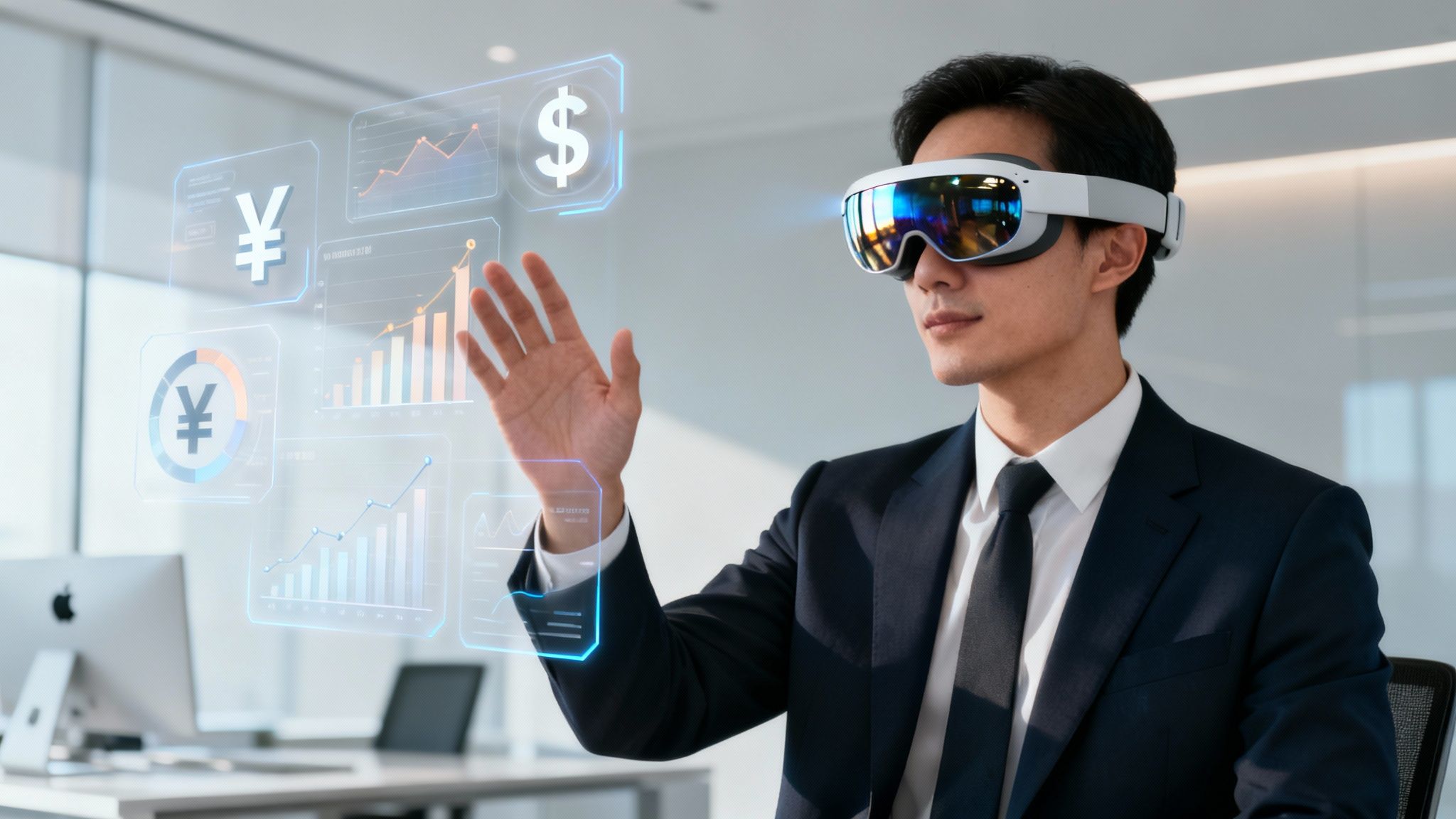
The Apple Vision Pro is what Apple calls a spatial computer. It's a device that overlays digital information onto your physical world, letting you control applications with your eyes, hands, and voice. This is a significant step beyond the flat screens we're all used to, promising a new way to interact with data. But with its high price point and a new ecosystem, it's not a consumer device—at least, not yet. It's a strategic tool aimed squarely at the enterprise.
This guide provides a clear-eyed look at the Apple Vision Pro for technical and product leaders in finance. We'll cut through the hype to focus on practical applications, the development ecosystem, security implications, and how to build a smart adoption strategy that delivers measurable business value.
Why Fintech Leaders Should Pay Attention to the Apple Vision Pro
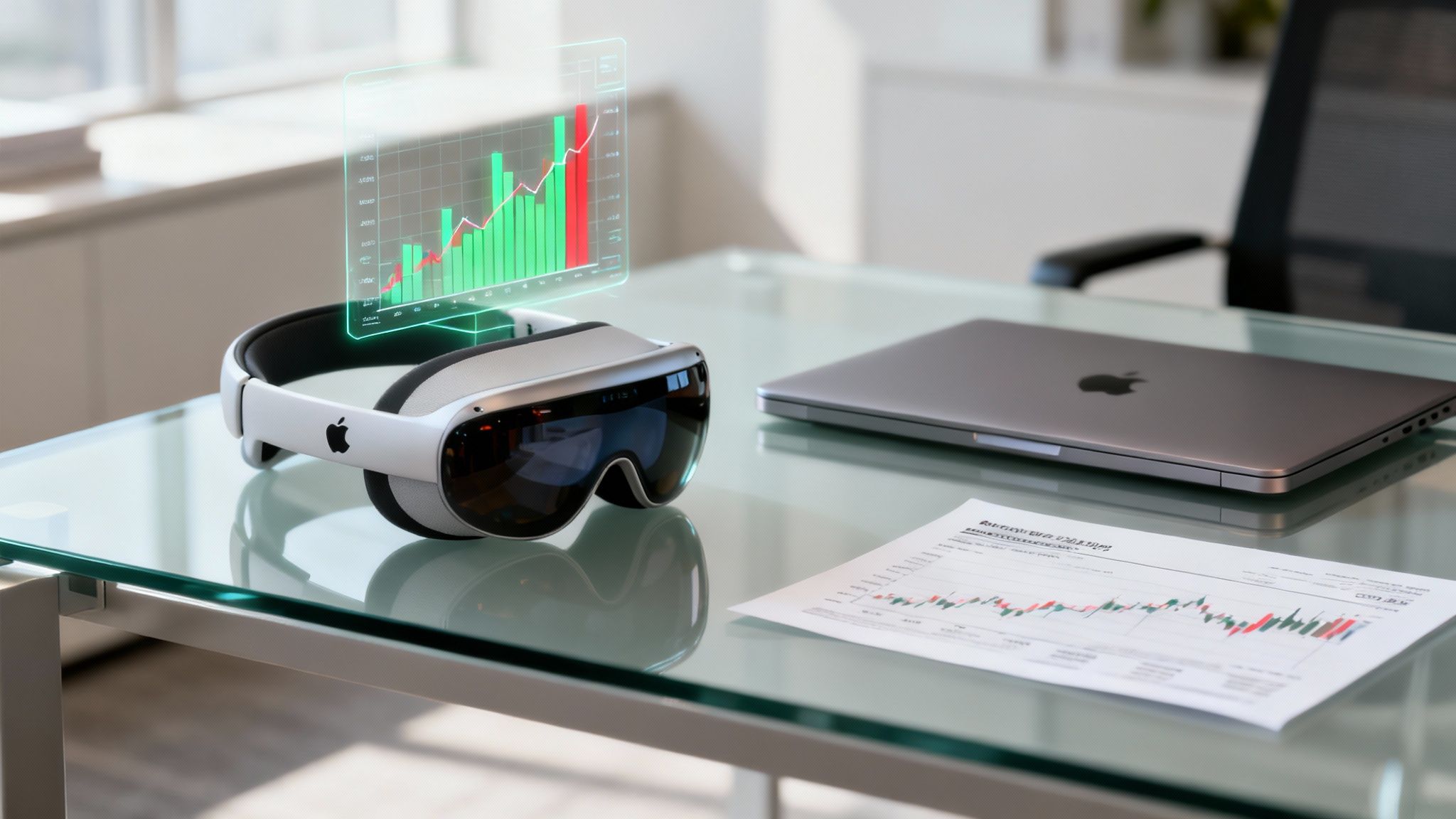
It’s easy to dismiss the Vision Pro as an expensive novelty. For fintech and engineering leaders, that would be a strategic error. This isn't just another VR headset; it's the first viable platform for mainstream spatial computing. That has the potential to fundamentally change how financial services professionals interact with complex data.
Think of it less as a headset and more as an infinite, private digital workspace. Your teams are no longer constrained by two-dimensional monitors. They can manipulate 3D risk models, visualize complex datasets in three dimensions, and manage multiple data streams in a single, cohesive view. This isn't about novelty; it's about enhancing professional workflows.
A Strategic Investment in Future-Proofing
The price point naturally raises questions about ROI. Viewing it as a simple hardware cost is the wrong frame. This is an R&D investment. Early adoption provides a critical head start in understanding how spatial computing can create a competitive advantage before it becomes a standard business tool.
This isn’t about just experimenting with new tech. Early exploration allows your organization to:
- Identify High-Value Use Cases: Pinpoint which specific processes—from quantitative analysis to client wealth management reviews—are genuinely improved by a spatial interface. You can't know from a press release; you have to test it.
- Develop In-House Expertise: Start building practical skills in designing and developing for visionOS. This prepares your engineering and product teams for the next major shift in user interfaces, ensuring you’re not playing catch-up.
- De-Risk Future Adoption: By understanding the platform's strengths and limitations now, you mitigate the risks of larger-scale rollouts later. This significantly reduces the time-to-market for future production applications.
Focusing on Practical, Professional Workflows
Early adoption trends confirm the Vision Pro’s immediate value is in professional fields. It is being deployed in specialized design, medical, and remote collaboration workflows—environments where the benefits of spatial visualization can quickly justify the hardware cost. This enterprise-first positioning is well-documented by outlets like AppleInsider. This aligns perfectly with the financial industry, where securely and efficiently managing complex information is paramount.
The real opportunity for fintech isn’t in consumer apps. It’s in augmenting professional workflows. Imagine traders with multi-asset dashboards that aren't constrained by screen space, or compliance officers running training in simulated high-stakes scenarios.
Engaging with the Apple Vision Pro now is about preparing for a future where data interaction is no longer flat. It's about building the institutional knowledge required to lead when spatial computing becomes a core component of data analysis, client engagement, and operational efficiency.
Understanding the Hardware and visionOS Platform
To evaluate the Apple Vision Pro for enterprise use, you must understand its underlying technology. This device is a tightly integrated system where specialized hardware is orchestrated by a new operating system, visionOS. Understanding this synergy is key to assessing its readiness for your business.
The system is powered by a dual-chip architecture. The M2 chip, familiar from the MacBook Air and iPad Pro, handles the primary processing—running applications, performing computations, and rendering graphics. This gives the device sufficient power to run desktop-grade financial models or complex data visualizations without being tethered to a separate computer, a direct benefit to productivity.
However, the component that enables the seamless spatial experience is the R1 chip.
The R1 Chip: The Engine of Presence
The R1 is a custom processor with a singular purpose: to process input from the device’s extensive sensor array. It streams images to the displays from 12 cameras, five sensors, and six microphones with a latency of just 12 milliseconds—eight times faster than a human blink.
This near-instant video passthrough is what makes the device viable for professional use. It eliminates the motion sickness and disorientation common in older VR systems, making it comfortable for extended periods. For a fintech firm, this means an analyst can work with a 3D risk model for hours without fatigue, improving focus and reducing the potential for error.
The R1 chip’s primary function is to make digital objects feel solidly anchored in your physical space. When you place a window in the air, it remains fixed as you move around it. This stability is what elevates the device from a novelty to a credible professional tool.
Micro-OLED Displays: The Visual Foundation
The visual fidelity of the Apple Vision Pro is delivered by two micro-OLED displays, each the size of a postage stamp, that contain a combined 23 million pixels. This pixel density is critical for rendering sharp text and detailed graphics—a non-negotiable requirement for financial applications where reading fine print or identifying subtle chart movements is essential.
The result is a visual experience that can genuinely replace a multi-monitor 4K setup. The business outcomes include reduced hardware costs and optimized physical desk space for traders or analysts.
This combination of processing power and visual clarity provides the foundation for visionOS. To understand the broader competitive landscape, it's worth exploring other spatial computing platforms like Apple Vision Pro, Android XR, and Samsung XR.
How visionOS Manages the Spatial Experience
visionOS is the first operating system designed from the ground up for spatial computing. It treats applications as objects in a 3D environment, not icons on a flat screen. This introduces new interaction models with a direct impact on productivity:
- Eye-Tracking as the Cursor: You select an element simply by looking at it. This fundamental shift reduces cognitive load and physical interaction, making navigation significantly faster once mastered.
- Hand Gestures as the Click: A simple pinch-and-release gesture serves as the primary click action. This intuitive control shortens the learning curve for new users.
- An Infinite Canvas for Applications: Apps are not confined to windows. They can be placed anywhere in the space around the user, creating expansive, personalized workspaces that can directly improve efficiency for roles requiring heavy multitasking.
The platform provides the tools to build genuinely new user experiences. The opportunity—and the challenge—is to design applications that leverage these unique capabilities to solve real business problems, rather than simply porting a 2D interface into a 3D world.
The Developer Toolkit for Enterprise Fintech Apps
We’ve covered the hardware; now let’s discuss development. For any engineering leader, understanding the tools and talent required to build for the Apple Vision Pro is where strategic planning begins.
The good news is that Apple has extended its existing development ecosystem, making the learning curve manageable. This isn’t about retraining your entire department; it’s about adapting familiar skills for a new dimension. This directly impacts your time-to-market and reduces the initial cost of exploration.
The core of visionOS development relies on three frameworks your iOS and macOS developers are already proficient in: SwiftUI, RealityKit, and ARKit. These have been adapted for spatial computing. The key is understanding how they can be applied to solve specific fintech challenges.
First, it's important to recognize how the hardware enables a stable development target.
The M2 chip runs application logic while the new R1 chip processes the high-volume sensor data. This dual-chip architecture ensures the user experience is smooth and responsive, which is critical for enterprise-grade applications.
Familiar Frameworks for a New Dimension
Your current development talent is closer to building for visionOS than you might think. Apple designed the primary tools for a smooth transition, allowing your teams to leverage existing expertise.
SwiftUI for 3D Interfaces: Previously used for 2D interfaces on iPhones and Macs, SwiftUI is now the primary tool for building the entire user interface in visionOS. It handles windows, buttons, and text, but it also creates and manages 3D objects. For example, an analyst could use an app built with SwiftUI to physically grab, resize, and compare 3D data visualizations. The business impact is the ability to rapidly prototype complex spatial applications, reducing development costs.
RealityKit for Realistic Visualization: For high-fidelity 3D content, RealityKit is the rendering engine. It is optimized for realism, handling complex lighting, shadows, and materials to make digital objects appear physically present in the user's environment. In fintech, this could be used to render a complex derivatives portfolio as a tangible 3D model that a risk team could inspect from all angles, leading to deeper insights.
ARKit for Environmental Understanding: ARKit provides the application with spatial awareness. It identifies surfaces like floors, walls, and tables, and it tracks the user’s hands with high precision. This is the crucial link between digital content and the physical environment, ensuring a virtual trading desk doesn't float through a real-world wall. This spatial awareness is essential for creating intuitive, grounded applications.
Here is a breakdown of how these core frameworks apply in a financial context.
Key visionOS Frameworks for Fintech Applications
These frameworks work in concert to create a cohesive experience where digital information and the real world blend seamlessly.
The Development Workflow: Simulating Before Buying
You don't need to purchase a headset for every developer on day one. Apple has integrated a powerful visionOS simulator directly into Xcode, its integrated development environment (IDE).
The visionOS simulator in Xcode is a critical tool for initial development. It allows engineers to build and test the core logic and UI of an application without requiring a physical Apple Vision Pro, which dramatically lowers the initial cost and risk of an exploratory project.
The simulator allows developers to navigate a virtual room, interact with app windows, and test basic gestures. While it cannot fully replicate the immersive experience or subtle hand-tracking, it is sufficient for the first 80% of the development cycle.
This means you can build out entire user flows and backend integrations before deploying to a physical device for final testing and refinement. It's a low-risk, cost-effective way to validate a concept. For an experienced iOS developer, the ramp-up time is a matter of weeks, not months.
Navigating Security, Privacy, and Compliance with Apple Vision Pro
For any new technology platform, particularly one as personal as the Apple Vision Pro, security is the foundation of enterprise adoption. In the fintech sector, where handling sensitive financial data is the core business, this scrutiny is non-negotiable.
Apple's privacy-by-design philosophy is integrated into the device's architecture, providing a strong starting point for building secure financial applications.
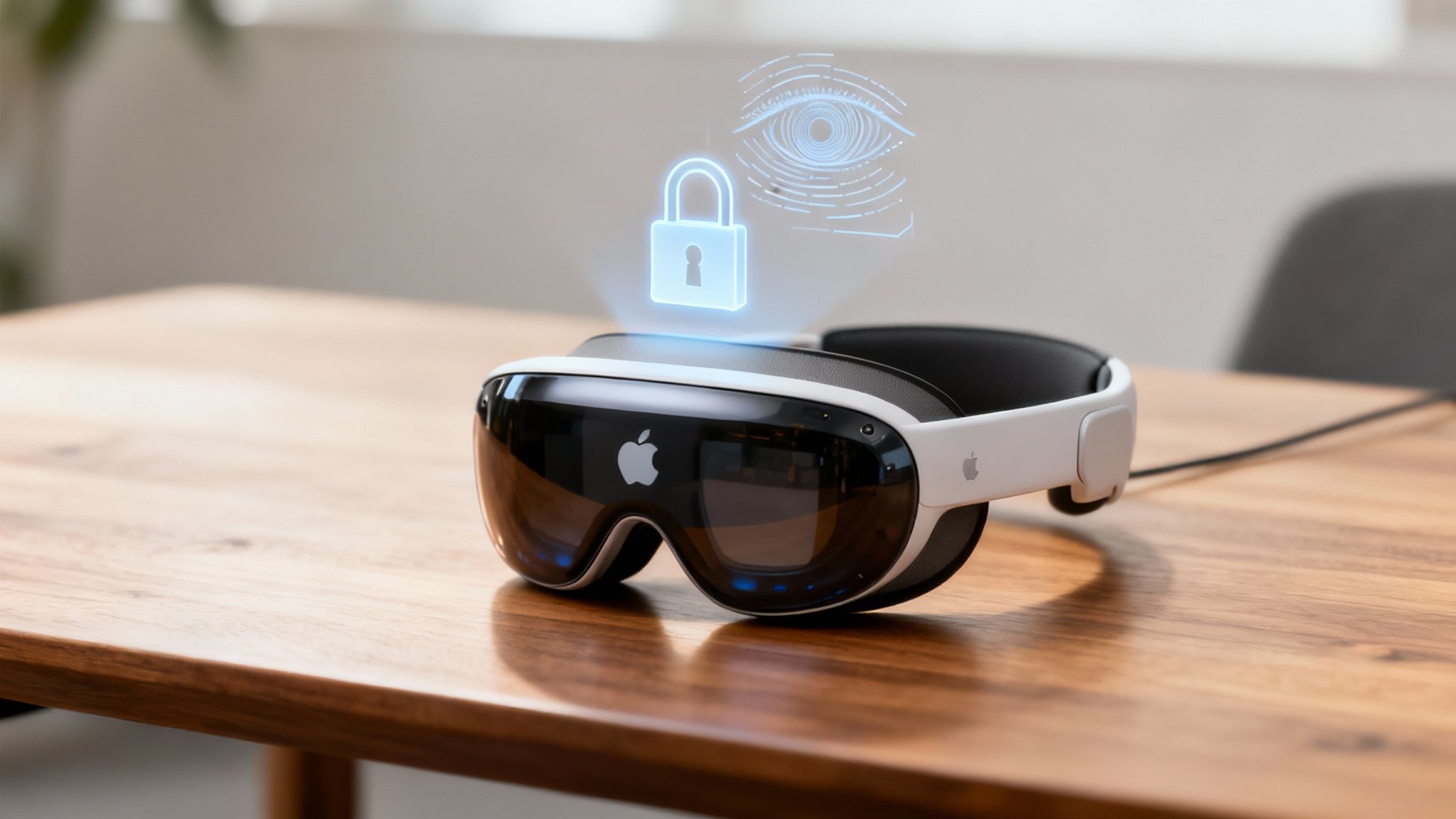
The goal is to understand how the technology choices impact your organization's risk profile, compliance costs, and ability to build trusted client experiences. The system is designed to treat user data as a liability to be protected, not an asset to be monetized.
On-Device Processing and Data Minimization
A core tenet of visionOS security is processing sensitive data on the device itself. Information from the extensive sensor array—what the user is looking at, their physical surroundings, and the objects in their room—is handled locally by the R1 and M2 chips. This data is not sent to Apple's servers for processing.
This on-device approach significantly reduces the attack surface. It also aligns with the data minimization principles required by regulations like GDPR. For a fintech application, the platform inherently helps limit the amount of sensitive environmental data you need to transmit or store, which reduces compliance overhead and the risk of data breaches. To learn more about mitigating these vulnerabilities, see this a practical guide to attack surface management.
Optic ID and the Secure Enclave
Authentication is the gateway to any financial service. The Vision Pro introduces Optic ID, a new biometric system that authenticates users by scanning their iris, which is unique to each individual. As with Face ID and Touch ID, this biometric data is encrypted and stored locally within the Secure Enclave.
The Secure Enclave is a dedicated, hardware-based key manager that is completely isolated from the main processor and visionOS.
The Secure Enclave ensures a user's biometric template never leaves the device. It is not stored on Apple servers or backed up to iCloud. This hardware-level isolation is critical for meeting Strong Customer Authentication (SCA) requirements under regulations like PSD2.
This provides two clear business outcomes:
- Reduced Risk: Hardware-based security mitigates risks associated with password theft and phishing attacks.
- Lower Friction: It enables secure, passwordless access to financial accounts, improving the user experience without compromising on security.
Connecting Platform Features to Fintech Compliance
The Vision Pro’s security architecture provides tangible assets for navigating a complex regulatory landscape. The platform's built-in privacy features are not just user benefits; they are tools that can simplify your compliance strategy and reduce the time-to-market for new, secure applications. Of course, rigorous QA and testing strategies for enterprise applications are essential to validate these integrations.
By building on a platform with privacy at its core, you can shift internal resources from developing foundational security controls to innovating at the application level. This allows your team to deliver value faster while maintaining a strong compliance posture—a clear competitive advantage.
Security and Compliance FAQ
How is eye-tracking data handled?
Eye-tracking data is processed on-device. Applications receive information about where a user is looking for interaction purposes, but they do not get the raw iris or eye imagery. This prevents apps from tracking a user's gaze without explicit intent.
Can an application see my physical environment?
Not by default. An application must explicitly request user permission to access camera data, ensuring user consent before any environmental information is shared.
Does Optic ID support financial transactions?
Yes. Optic ID is integrated with Apple Pay and can be used to authorize purchases and authenticate within third-party applications, providing a secure and seamless method for handling financial transactions.
Realistic Use Cases for the Financial Sector
While it's easy to imagine futuristic scenarios, the immediate value of the Apple Vision Pro for finance lies in solving today's problems more effectively. The focus should be on pragmatic use cases that can deliver measurable business results. The key is to identify existing workflows constrained by current technology and ask where an infinite, immersive canvas could provide a tangible benefit.
This focus on professional workflows is strategic. The device's $3,499 launch price positions it as a tool for enterprise, not a consumer gadget, a fact reflected in market analysis from sources like Vision Pro's market positioning at Statista.com. This price point necessitates a clear ROI, filtering out frivolous applications.
Secure Multi-Display Dashboards for Traders and Analysts
The most immediate and powerful use case is providing data-intensive roles with an infinite, private workspace. Traders, portfolio managers, and financial analysts currently rely on costly and cumbersome multi-monitor setups. The Apple Vision Pro can replace this entirely. A single headset can create a limitless array of virtual screens, charts, and live data feeds in the user's physical space.
- Business Outcome: This can immediately reduce hardware costs and free up physical desk space. More importantly, an immersive, customizable environment can increase focus and efficiency, potentially leading to faster analysis and better-informed decisions.
Immersive Client Advisory and Wealth Management
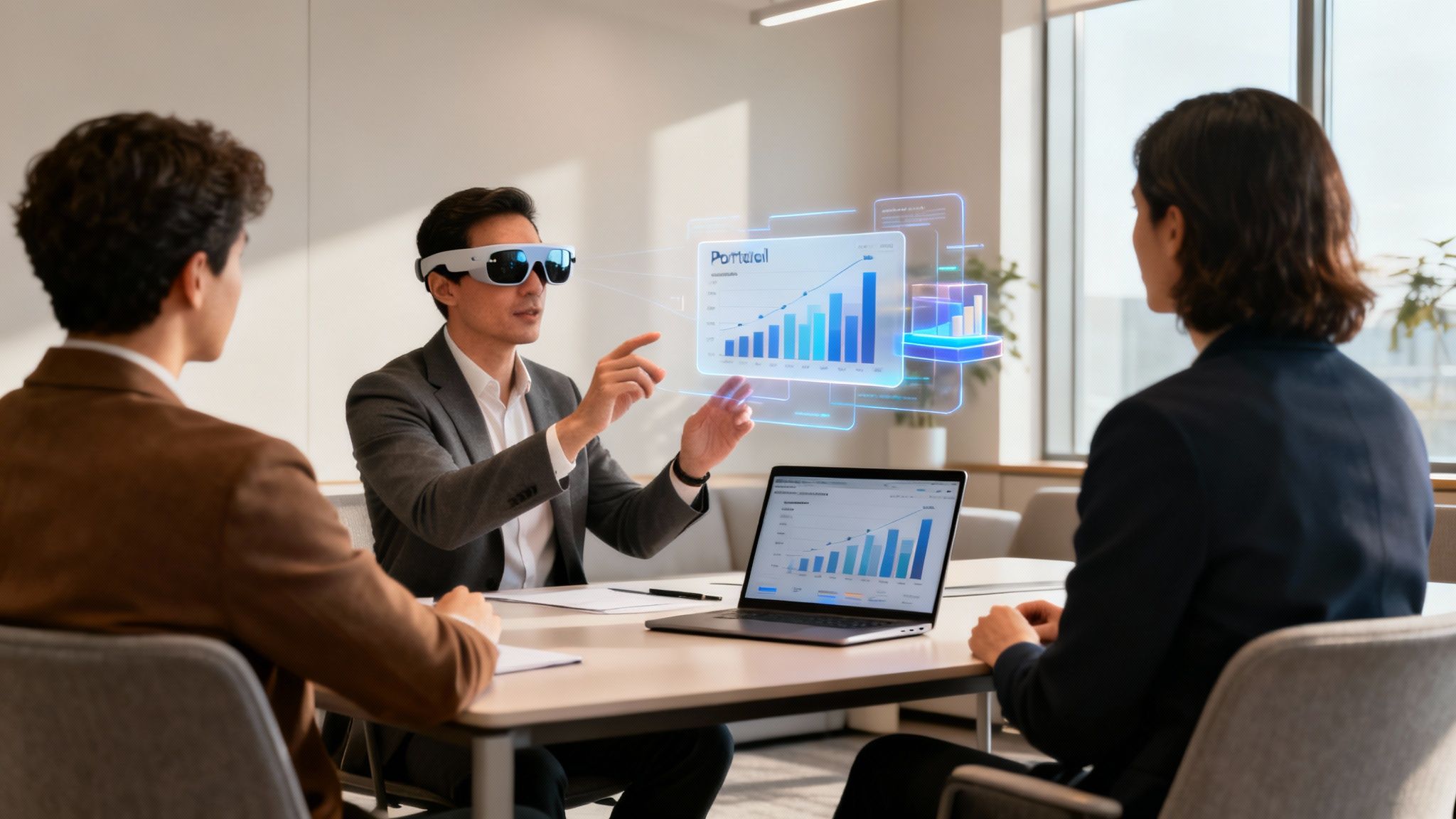
Building trust and clarifying complex financial products are central to wealth management. Spatial computing offers a new medium for client communication that surpasses the limitations of video calls and flat PDF reports. Imagine a wealth advisor and a client meeting in a shared virtual space. They could interact with a 3D visualization of the client’s portfolio, seeing asset allocation and risk exposure as a tangible model rather than abstract numbers. This transforms a dry report into a shared, interactive experience, improving understanding and strengthening the client relationship.
A key technology enabling this is shared spatial anchors, where digital objects remain in the same relative position for all participants in a shared session. This creates a stable, collaborative environment where pointing to a virtual chart feels as natural as pointing to a physical one.
This approach has significant potential. For example, our work on Open Banking integration in practice highlights the importance of clear financial communication. Immersive advisory sessions could be a game-changer.
Collaborative 3D Data Visualization for Risk Assessment
Risk management teams often work with multi-dimensional datasets that are difficult to represent on a 2D screen. Visualizing market volatility, credit risk, or portfolio stress tests in rows and columns can obscure critical patterns. With an Apple Vision Pro, a distributed risk team could load a complex financial model into a shared virtual room. Each team member could inspect the model from their own perspective, manipulate variables in real-time, and observe the impact across the system.
- Business Outcome: This enables a more dynamic and collaborative form of analysis. It reduces the risk of misinterpretation and accelerates the time to critical insights. A static report becomes an interactive workshop, leading to more robust risk strategies and potentially reducing financial losses.
Enhanced Remote Training for Compliance and Operations
Compliance training is critical but often suffers from low engagement and knowledge retention. Spatial computing can address this by creating realistic, interactive simulations for procedures like anti-money laundering (AML) protocols or trade compliance checks. Instead of reading a manual, a trainee can be placed in a simulated environment where they must identify suspicious transactions or navigate a regulatory workflow. The system can provide immediate, contextual feedback.
- Business Outcome: Immersive, hands-on training has been shown to improve knowledge retention significantly compared to traditional methods. This translates to fewer compliance errors, lower regulatory risk, and a reduced long-term cost of training.
Building Your Enterprise Adoption Strategy for Apple Vision Pro
How do you move from interesting use cases to a practical rollout? The key is a strategic, phased approach. Adopting the Apple Vision Pro is not about a company-wide hardware purchase. It is a calculated investment in innovation that requires careful planning to manage risk, prove value, and build a solid business case for wider deployment.
The journey starts with focused exploration, not a massive capital expenditure. The Vision Pro’s price point clearly defines it as an enterprise tool, a niche segment in the broader AR/VR market, as noted by industry observers at Mobile World Live. This reinforces the need for a strategy that delivers a clear, defensible return on investment.
Starting with a Focused Proof of Concept (PoC)
The most effective first step is a small, contained pilot program or proof of concept. The objective is not to build a polished, production-ready application. It is to answer a critical question: can spatial computing solve a specific, high-value problem for our organization more effectively than existing tools?
Your PoC must be laser-focused on a single, measurable outcome. For instance, you might aim to visualize one complex dataset for your analysts or prototype an immersive presentation for high-value clients. For a solid framework, see our guide on how to run an effective proof of concept.
A PoC is about generating data, not just a flashy demo. You should track hard metrics: did our analysts find insights faster? Did training error rates decrease? Did clients report a better understanding of complex financial models? This data forms the foundation of your business case for further investment.
Assembling Your Pilot Team and Upskilling Talent
You do not need to hire a team of specialized "spatial computing developers." This is a key advantage of the Apple ecosystem. Your existing iOS and macOS engineers are already 80% of the way there.
Keep the pilot team small and agile:
- One or two senior iOS/Swift developers to lead the technical implementation.
- A UX/UI designer motivated to learn the principles of spatial design.
- A product owner to maintain a tight scope and connect the work to business value.
- A couple of subject matter experts—the end-users, such as a trader or risk analyst.
This lean structure minimizes initial costs and fosters the cross-functional collaboration necessary for innovation. You are not investing in new headcount; you are investing in upskilling your existing talent for visionOS.
Planning for Integration and Total Cost of Ownership (TCO)
A successful pilot must have a clear path to integration. Your visionOS application will need to communicate securely with your existing backend systems, APIs, and data sources. Consider authentication, data synchronization, and network performance from the outset to avoid future roadblocks.
Finally, look beyond the hardware's sticker price. The total cost of ownership (TCO) includes:
- Development Costs: The time and salary of your pilot team.
- Device Management: Mobile Device Management (MDM) solutions for deploying and securing the headsets.
- Ongoing Support: Budgeting for maintenance and future software updates.
By starting small, measuring everything, and planning for the real TCO, you can transform the Apple Vision Pro from an interesting technology into a validated strategic asset.
Frequently Asked Questions (FAQ)
Here are answers to common questions from fintech leaders considering the Apple Vision Pro.
How quickly can my existing iOS team start building for visionOS?
Your iOS developers have a significant head start. They are already proficient in SwiftUI and ARKit, the foundational frameworks for visionOS development. An experienced Swift developer can build a basic proof-of-concept application in a matter of weeks. The primary learning curve is not in the code, but in mastering the new UX/UI design patterns for spatial computing. This allows you to begin prototyping immediately without a major hiring initiative, which directly reduces initial R&D costs and shortens your time-to-market.
What is a realistic budget for a pilot project?
The headset itself costs approximately $3,500 per unit. However, the primary cost is talent. A focused, three-month proof of concept with a small team (e.g., two developers, one designer) typically falls in the $50,000 to $80,000 range. This should be viewed as an investment in data. The outcome is not just a demo, but crucial information to determine the real ROI and de-risk a larger future investment.
Can a visionOS app connect securely to our existing backend systems?
Yes, absolutely. A visionOS application is fundamentally an Apple app. It utilizes the same battle-tested networking and security frameworks as your existing iOS applications. It can communicate with your backend services and APIs using standard protocols like REST and GraphQL. Integrating with your current, secure infrastructure is a fundamental requirement for any serious enterprise strategy. Your spatial applications will pull from the same secure data sources as your web and mobile platforms.
Ready to move from discussion to development? SCALER Software Solutions Ltd provides the senior engineering talent and strategic guidance you need to build secure, scalable applications for the future of finance.
< MORE RESOURCES / >
Fintech
Dictionary Comprehension Python: Efficient Data Handling for Business Impact
Fintech
The 12 Best IDE for Python: A 2025 Guide for Enterprise Teams
Fintech
A Consultant's Guide to SAP Jobs in Hungary
Fintech
A Practical Guide to Proof of Concepts in Fintech
Fintech
Django vs Flask: A CTO's Guide to Choosing the Right Framework

Fintech
Finding Jobs in Debrecen: A Consultant's Guide
Fintech
Your 2025 Guide to Finding Student Jobs in Budapest

Fintech
Kotlin vs Java: A Strategic Guide for Business & Tech Leaders

Fintech
Go vs Rust: A Strategic Comparison for Tech Leaders
Fintech